Hybrid Electric Vehicle (HEV) - Economy | UPSC Learning
Topics
0 topics • 0 completed
🔍
No topics match your search
Hybrid Electric Vehicle (HEV)
Easy⏱️ 5 min read
economy
📖 Introduction
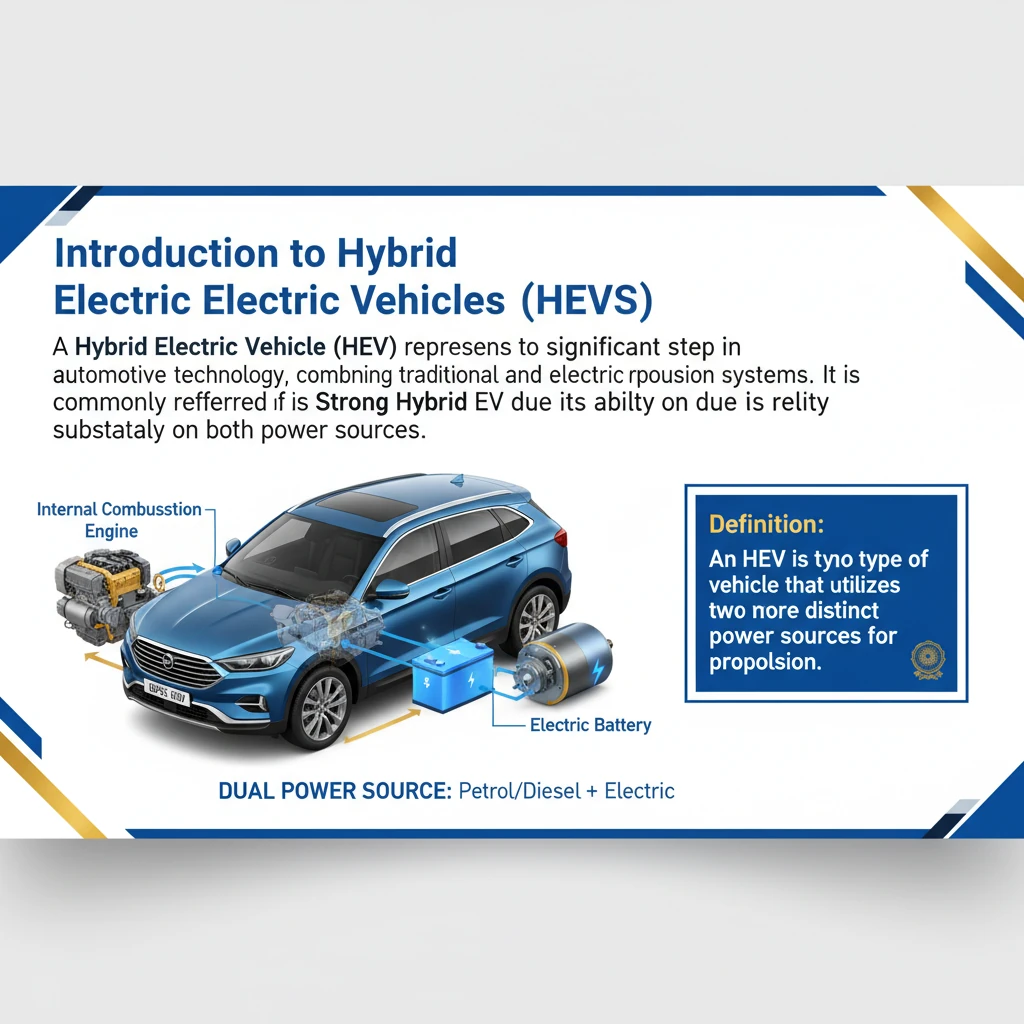
<h4>Introduction to Hybrid Electric Vehicles (HEVs)</h4><p>A <strong>Hybrid Electric Vehicle (HEV)</strong> represents a significant step in automotive technology, combining traditional and electric propulsion systems. It is commonly referred to as a <strong>Strong Hybrid EV</strong> due to its ability to rely substantially on both power sources.</p><div class='info-box'><p><strong>Definition:</strong> An <strong>HEV</strong> is a type of vehicle that utilizes <strong>two or more distinct power sources</strong> to propel the vehicle, most commonly an <strong>Internal Combustion Engine (ICE)</strong> and an <strong>electric motor</strong>.</p></div><h4>Core Components and Powertrain</h4><p>The fundamental design of an <strong>HEV</strong> integrates a conventional <strong>internal combustion (usually petrol) engine</strong> with a <strong>battery-powered electric motor powertrain</strong>. This dual-system approach allows for optimized performance and efficiency under various driving conditions.</p><div class='key-point-box'><p><strong>Key Feature:</strong> The powertrain of an <strong>HEV</strong> is characterized by its <strong>hybrid nature</strong>, seamlessly switching between or combining power from the <strong>petrol engine</strong> and the <strong>electric motor</strong>.</p></div><h4>Operational Mechanism of HEVs</h4><p>In an <strong>HEV</strong>, the <strong>petrol engine</strong> serves a dual purpose. It not only provides power to <strong>drive the vehicle</strong> directly but also acts as a generator to <strong>charge the battery</strong> when its energy levels are low. This ensures continuous operation without the need for external charging infrastructure.</p><ul><li>The <strong>electric motor</strong> can propel the vehicle at lower speeds or assist the engine during acceleration.</li><li>The <strong>petrol engine</strong> takes over at higher speeds or when more power is required, simultaneously recharging the battery.</li></ul><h4>Efficiency Considerations of HEVs</h4><p>While offering improved fuel economy compared to conventional ICE vehicles, <strong>HEVs</strong> are generally <strong>not as efficient</strong> as their fully electric counterparts or <strong>Plug-in Hybrid Electric Vehicles (PHEVs)</strong>. This is primarily due to the continued reliance on fossil fuels and the energy losses associated with converting mechanical energy to electrical energy for battery charging.</p><div class='exam-tip-box'><p><strong>UPSC Insight:</strong> When comparing vehicle technologies, remember that <strong>HEVs</strong> offer a middle ground. They provide better efficiency than traditional cars but fall short of the environmental benefits and energy efficiency of <strong>Battery Electric Vehicles (BEVs)</strong> and <strong>PHEVs</strong>, which have larger batteries and external charging capabilities. This distinction is crucial for questions on sustainable transportation.</p></div>
💡 Key Takeaways
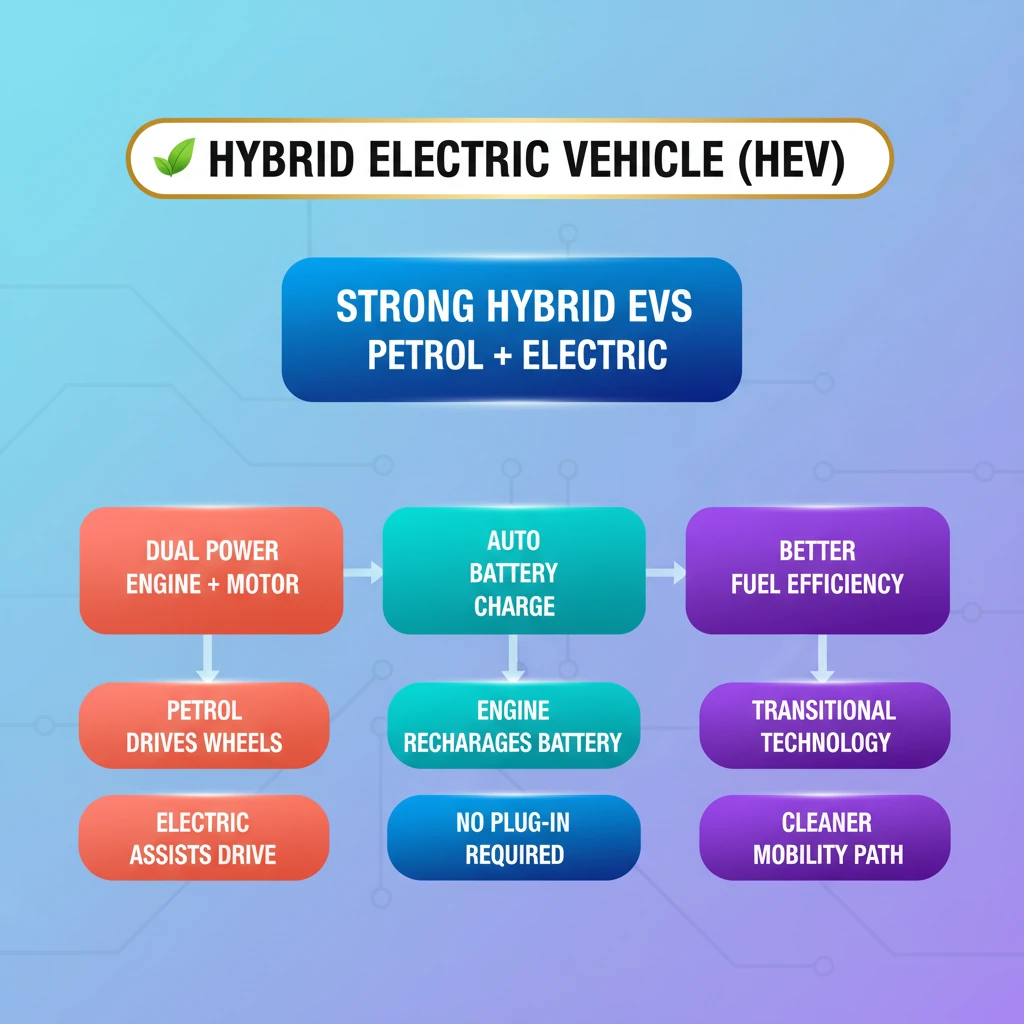
- •Hybrid Electric Vehicles (HEVs) are also known as Strong Hybrid EVs.
- •They combine an internal combustion (petrol) engine and a battery-powered electric motor.
- •The petrol engine drives the vehicle and recharges the battery when empty.
- •HEVs are more efficient than conventional cars but less efficient than fully electric or plug-in hybrid vehicles.
- •They serve as a crucial transitional technology towards cleaner mobility.
🧠 Memory Techniques

95% Verified Content
📚 Reference Sources
•General knowledge of automotive technology and environmental policies (e.g., FAME India)