30th Anniversary of World Trade Organisation (WTO) - Economy | UPSC Learning
Topics
0 topics • 0 completed
🔍
No topics match your search
30th Anniversary of World Trade Organisation (WTO)
Medium⏱️ 8 min read
economy
📖 Introduction
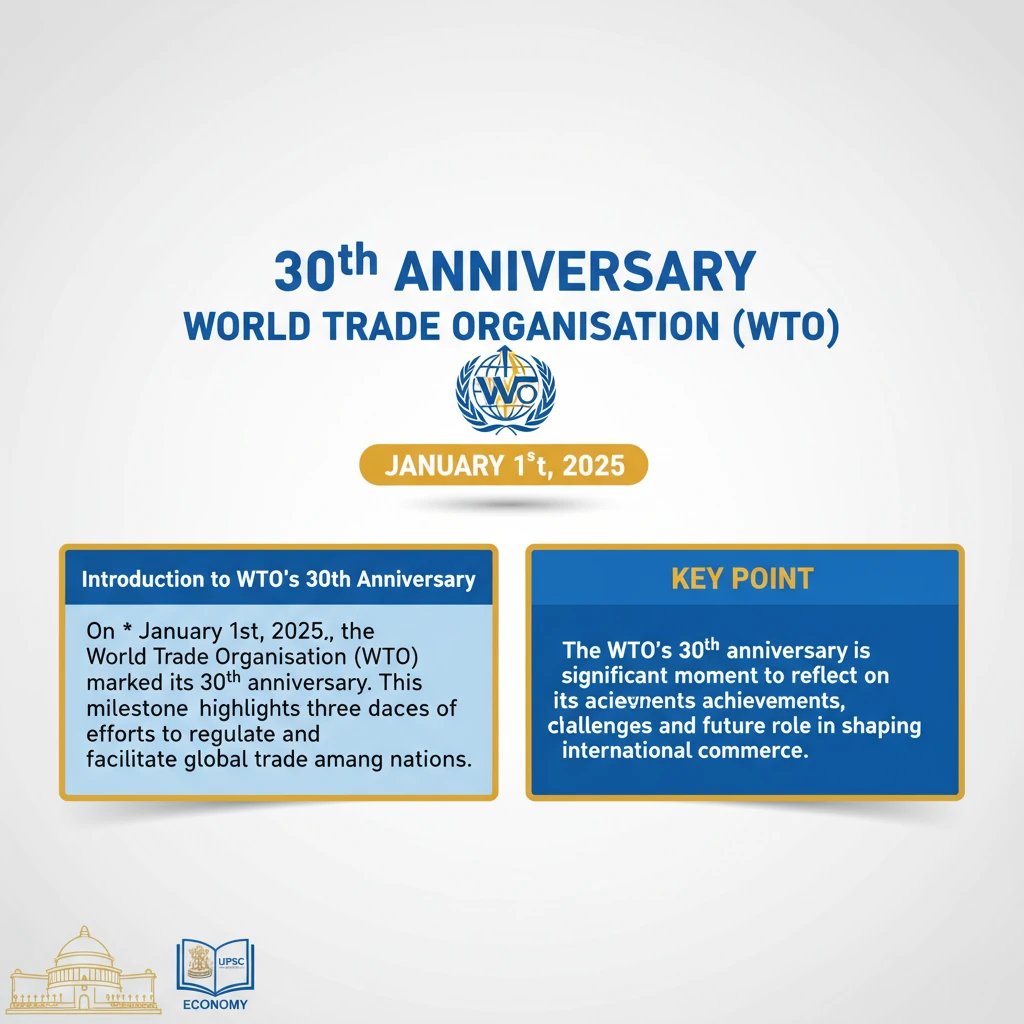
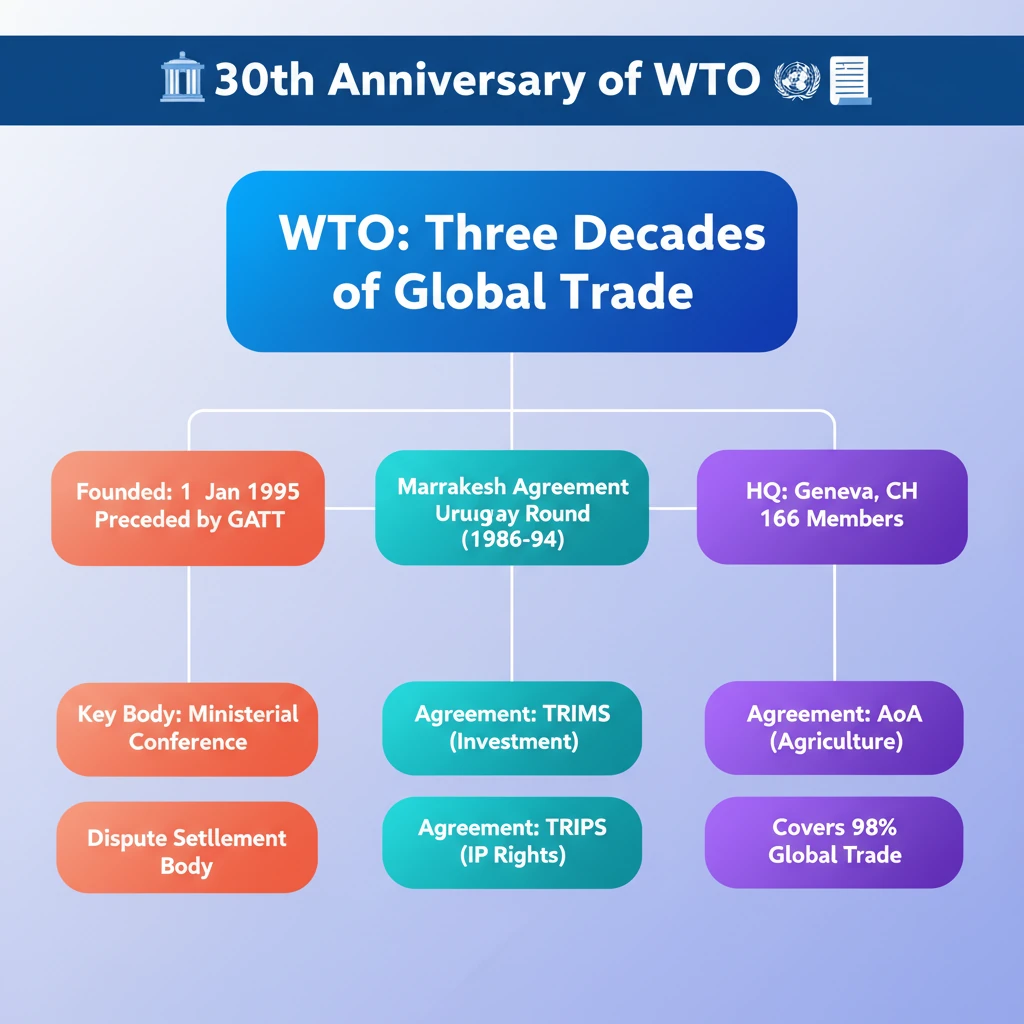
<h4>Introduction to WTO's 30th Anniversary</h4><p>On <strong>January 1st, 2025</strong>, the <strong>World Trade Organisation (WTO)</strong> marked its <strong>30th anniversary</strong>. This milestone highlights three decades of efforts to regulate and facilitate global trade among nations.</p><div class='key-point-box'><p>The <strong>WTO's 30th anniversary</strong> is a significant moment to reflect on its achievements, challenges, and future role in shaping international commerce.</p></div><h4>What is the WTO?</h4><p>The <strong>World Trade Organisation (WTO)</strong> is a pivotal <strong>international institution</strong> established to formulate and enforce rules governing global trade. Its primary objective is to ensure that trade flows as smoothly, predictably, and freely as possible.</p><div class='info-box'><p><strong>Definition:</strong> The <strong>WTO</strong> is an international body that regulates global trade rules and provides a forum for trade negotiations and dispute resolution.</p></div><h4>Evolution from GATT to WTO</h4><p>The <strong>WTO</strong> officially came into existence on <strong>January 1st, 1995</strong>. It succeeded the <strong>General Agreement on Tariffs and Trade (GATT)</strong>, which had been the primary framework for regulating world trade since <strong>1948</strong>.</p><p>The transition from <strong>GATT</strong> to <strong>WTO</strong> was the culmination of extensive multilateral trade negotiations. These discussions were known as the <strong>Uruguay Round</strong>, which spanned from <strong>1986 to 1994</strong>.</p><p>The creation of the <strong>WTO</strong> was formally established under the <strong>Marrakesh Agreement</strong>. This agreement was signed on <strong>April 15th, 1994</strong>, by <strong>123 countries</strong>, laying the legal foundation for the new organization.</p><h4>Key Features and Structure</h4><p>The <strong>WTO's headquarters</strong> are located in <strong>Geneva, Switzerland</strong>. It boasts a broad membership, comprising <strong>166 countries</strong>, which collectively account for approximately <strong>98% of global trade</strong>.</p><div class='info-box'><p><strong>WTO at a Glance:</strong><ul><li><strong>Headquarters:</strong> 📍 <strong>Geneva, Switzerland</strong></li><li><strong>Members:</strong> 166 countries</li><li><strong>Global Trade Coverage:</strong> 98%</li></ul></p></div><p>The organization operates through several key bodies that facilitate its functions of decision-making and dispute resolution.</p><ul><li><strong>Ministerial Conference (MC):</strong> This is the <strong>highest decision-making authority</strong> within the WTO. It meets at least once every two years.</li><li><strong>Dispute Settlement Body (DSB):</strong> The <strong>DSB</strong> is responsible for resolving trade disputes between member countries. It ensures adherence to WTO agreements.</li></ul><h4>Important WTO Agreements</h4><p>The <strong>WTO</strong> framework encompasses several crucial agreements that govern various aspects of international trade, aiming for a fair and equitable global trading system.</p><ul><li><strong>TRIMS (Trade-Related Investment Measures):</strong> This agreement restricts certain investment measures that are inconsistent with GATT rules, particularly those that distort or restrict trade.</li><li><strong>TRIPS (Trade-Related Aspects of Intellectual Property Rights):</strong> This agreement sets minimum standards for the protection and enforcement of intellectual property rights (IPR) among member countries.</li><li><strong>AoA (Agreement on Agriculture):</strong> The <strong>AoA</strong> aims to reform trade in agriculture and reduce trade-distorting agricultural policies, including subsidies and tariffs.</li></ul><div class='exam-tip-box'><p><strong>UPSC Insight:</strong> Understanding the evolution from <strong>GATT to WTO</strong> and the functions of its <strong>key bodies</strong> like the <strong>DSB</strong>, along with major agreements like <strong>TRIPS</strong> and <strong>AoA</strong>, is crucial for <strong>GS Paper II (International Relations)</strong> and <strong>GS Paper III (Indian Economy)</strong>. Recent Ministerial Conferences, like the <strong>13th MC</strong>, often feature prominently in current affairs questions.</p></div>
💡 Key Takeaways
- •WTO marked its 30th anniversary on Jan 1, 2025, succeeding GATT.
- •Formed under the Marrakesh Agreement (1994) after the Uruguay Round (1986-94).
- •Headquartered in Geneva, with 166 members covering 98% of global trade.
- •Key bodies: Ministerial Conference (highest authority) and Dispute Settlement Body (resolves disputes).
- •Major agreements include TRIMS, TRIPS, and AoA, governing investment, intellectual property, and agriculture respectively.
🧠 Memory Techniques

98% Verified Content
📚 Reference Sources
•WTO Official Website (general information on structure, agreements, history)