Origin and Evolution of the Environmental Ship Index (ESI) - Economy | UPSC Learning
Topics
0 topics • 0 completed
🔍
No topics match your search
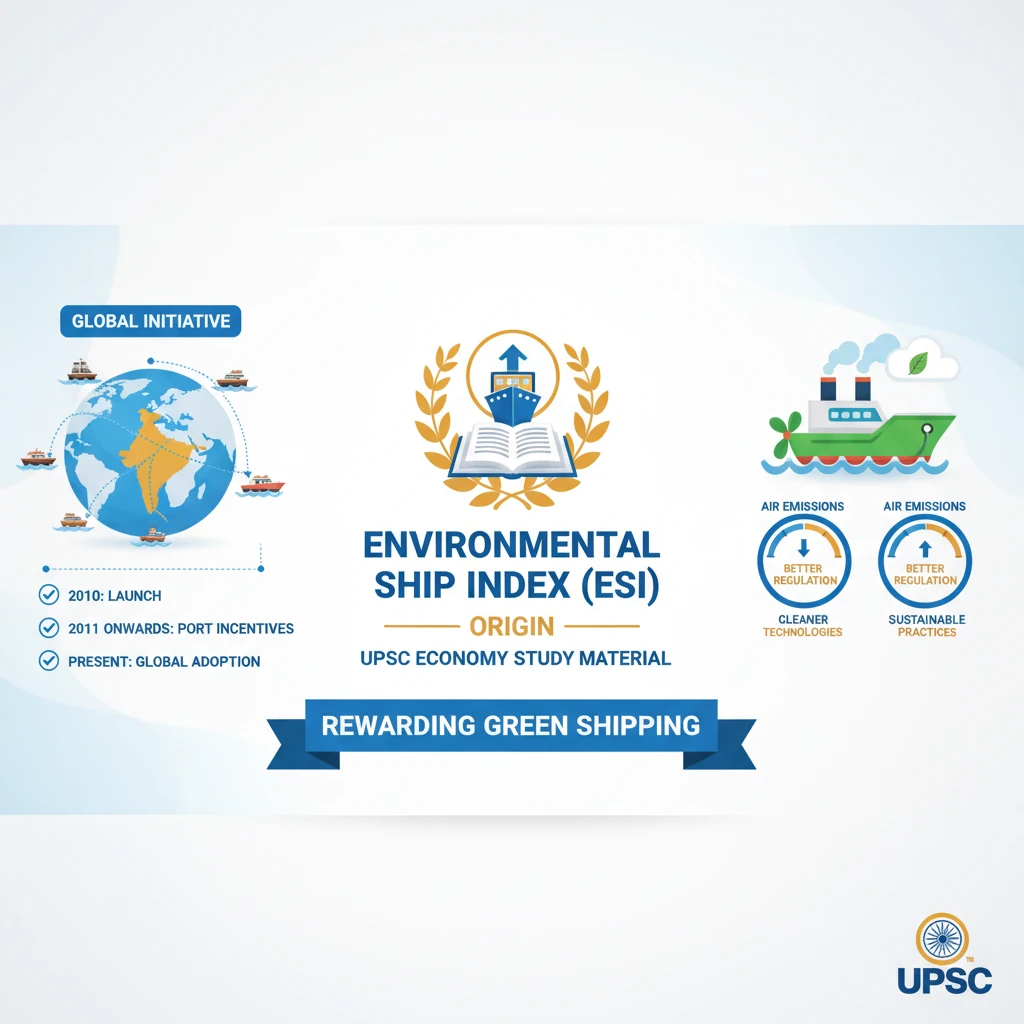
Origin and Evolution of the Environmental Ship Index (ESI)
Medium⏱️ 7 min read
economy
📖 Introduction
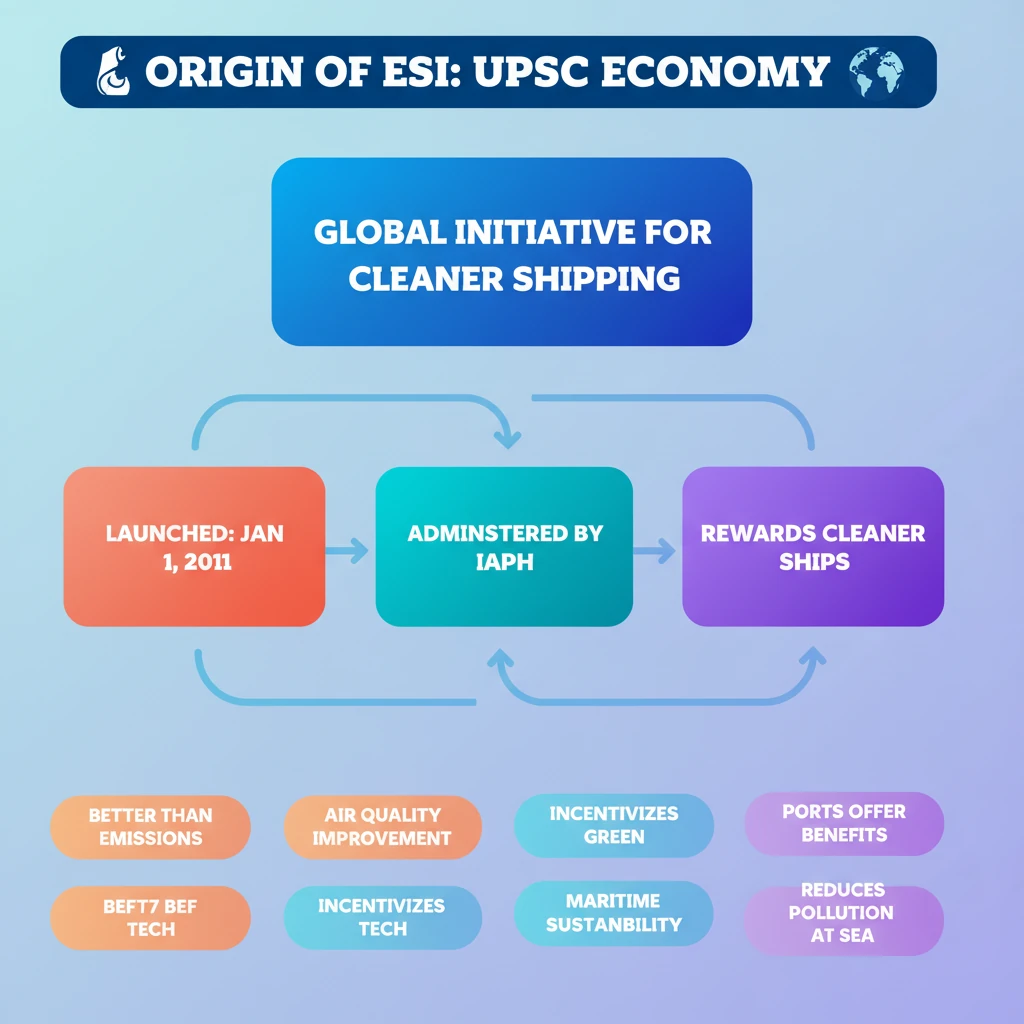
<h4>Introduction to the Environmental Ship Index (ESI)</h4><p>The <strong>Environmental Ship Index (ESI)</strong> is a crucial initiative designed to identify and reward ships that demonstrate superior environmental performance. It specifically targets vessels that perform better than regulatory standards in reducing <strong>air emissions</strong>.</p><p>This index actively encourages the adoption of cleaner shipping technologies and more sustainable operational practices across the global maritime industry.</p><div class='key-point-box'><p>The primary goal of the <strong>ESI</strong> is to foster environmental sustainability within the global maritime sector. It achieves this by providing transparency regarding the environmental performance of individual ships.</p></div><h4>Commencement and Administration of ESI</h4><p>The <strong>ESI Initiative</strong> officially commenced its operations on <strong>1st January 2011</strong>. This launch marked a significant global effort to incentivize greener shipping practices.</p><p>Since its inception, the comprehensive database for the <strong>Environmental Ship Index</strong> has been under the expert administration of the <strong>International Association of Ports and Harbours (IAPH)</strong>.</p><div class='info-box'><p>The <strong>IAPH</strong>, a leading global trade association for ports, plays a vital role in managing the <strong>ESI database</strong>. This ensures its integrity, broad adoption, and consistent application among ports and shipping lines worldwide.</p></div><h4>Purpose and Environmental Impact</h4><p>The <strong>ESI</strong> provides a quantifiable measure of a ship's environmental performance. It assesses emissions related to <strong>nitrogen oxides (NOx)</strong>, <strong>sulphur oxides (SOx)</strong>, and <strong>greenhouse gases (GHG)</strong>. Additionally, it considers the vessel's capability for shore power connection.</p><p>By highlighting and rewarding cleaner vessels, the <strong>ESI</strong> contributes significantly to reducing air pollution in port areas and mitigating the overall climate impact of maritime transport.</p><div class='exam-tip-box'><p>Understanding the <strong>ESI</strong> is crucial for UPSC aspirants, as it directly relates to environmental governance, sustainable development, and international cooperation in maritime transport. This topic often appears in <strong>GS Paper III (Environment & Economy)</strong>.</p></div>
💡 Key Takeaways
- •The Environmental Ship Index (ESI) initiative began on 1st January 2011.
- •ESI's database is administered by the International Association of Ports and Harbours (IAPH).
- •Its core purpose is to identify and reward ships with better-than-standard air emission performance.
- •It incentivizes the maritime industry to adopt cleaner technologies and operational practices.
- •Ports use ESI scores to offer incentives, promoting environmental sustainability in shipping.
🧠 Memory Techniques

95% Verified Content
📚 Reference Sources
•International Association of Ports and Harbours (IAPH) Official Website (for ESI details)