Open Market Sale Scheme (Domestic) Policy - Economy | UPSC Learning
Topics
0 topics • 0 completed
🔍
No topics match your search
Open Market Sale Scheme (Domestic) Policy
Medium⏱️ 7 min read
economy
📖 Introduction
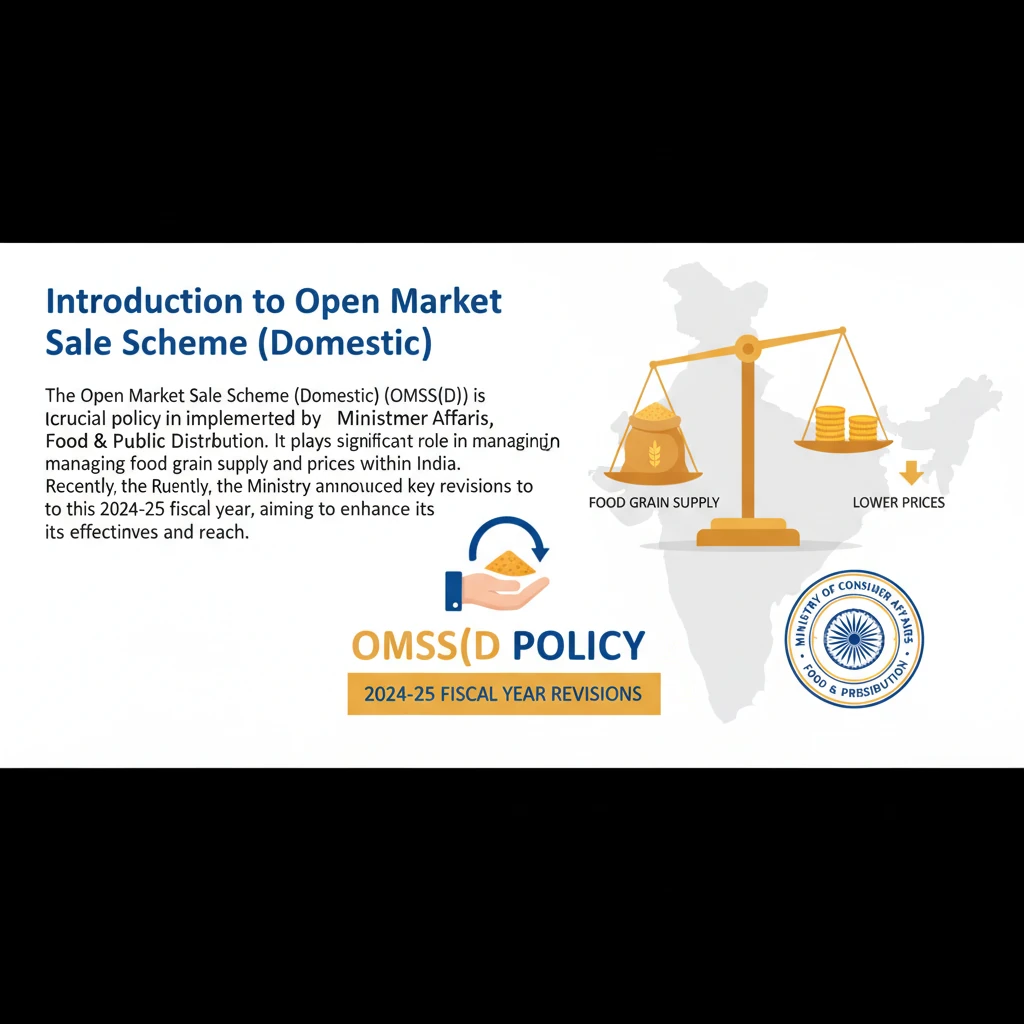
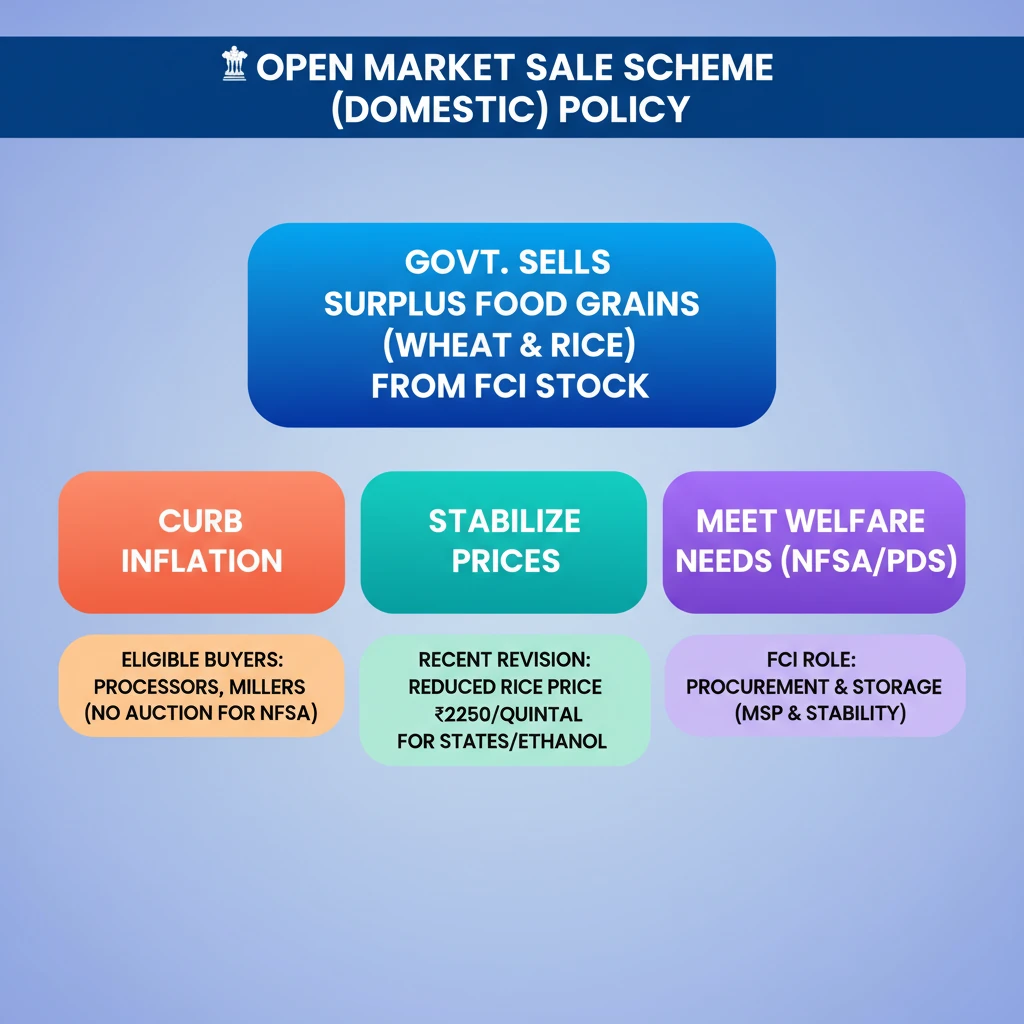
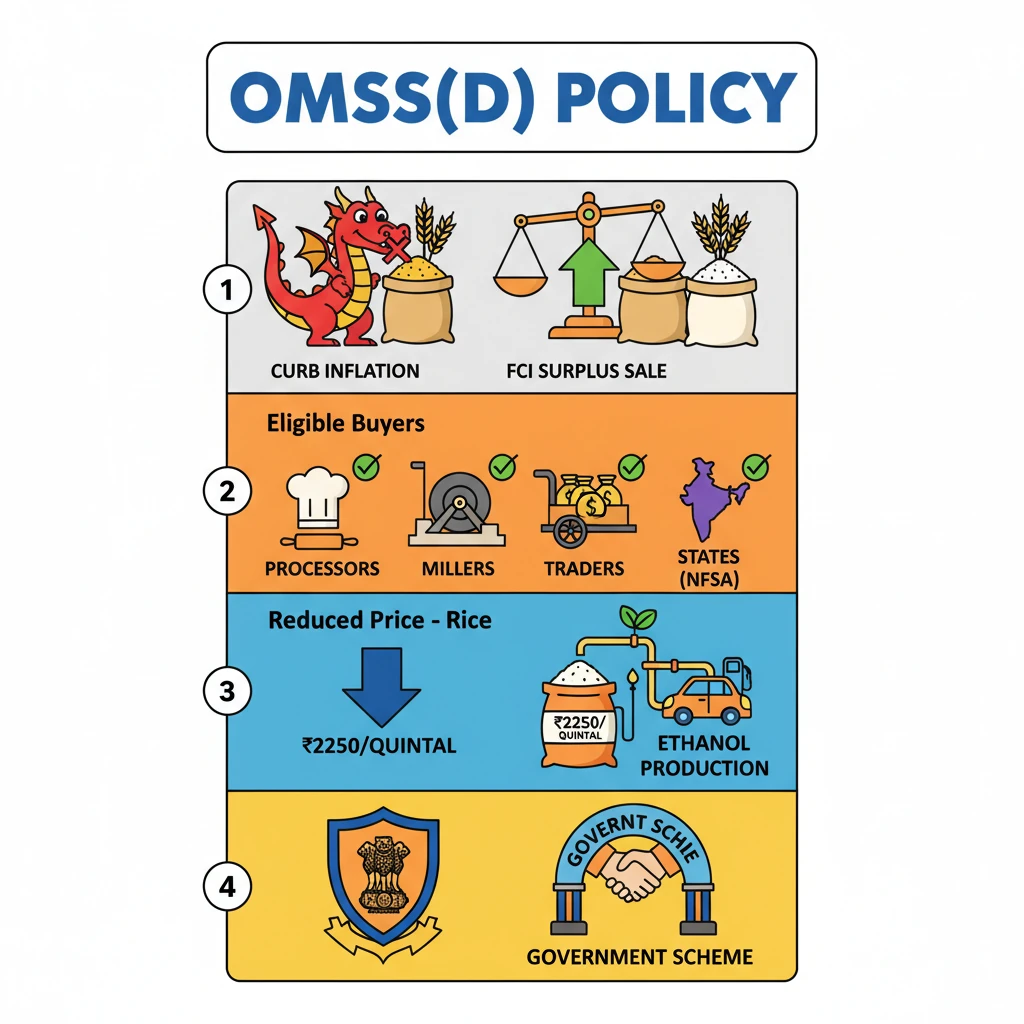
<h4>Introduction to Open Market Sale Scheme (Domestic)</h4><p>The <strong>Open Market Sale Scheme (Domestic) (OMSS(D))</strong> is a crucial policy implemented by the <strong>Ministry of Consumer Affairs, Food & Public Distribution</strong>. It plays a significant role in managing food grain supply and prices within India.</p><p>Recently, the Ministry announced key revisions to this policy for the <strong>2024-25 fiscal year</strong>, aiming to enhance its effectiveness and reach.</p><div class='info-box'><p><strong>Policy Objective:</strong> The OMSS(D) primarily aims to <strong>curb inflation</strong> and <strong>stabilize food grain prices</strong> in the domestic market. It also supports the needs of the <strong>Targeted Public Distribution System (TPDS)</strong> and various <strong>Other Welfare Schemes</strong>.</p></div><h4>What is the Open Market Sale Scheme (Domestic) Policy?</h4><p>The <strong>OMSS(D)</strong> involves the periodic sale of <strong>surplus food grains</strong>, specifically <strong>wheat</strong> and <strong>rice</strong>, from the <strong>central pool</strong>. This central pool is meticulously managed by the <strong>Food Corporation of India (FCI)</strong>.</p><div class='key-point-box'><p><strong>Core Mechanism:</strong> The scheme acts as a market intervention tool, releasing excess stock to prevent price spikes and ensure adequate availability for consumers.</p></div><h4>Eligible Buyers and State Participation</h4><p>Under the OMSS(D), specific categories of buyers are eligible to procure food grains. For <strong>wheat</strong>, the primary buyers include <strong>Processors, Atta Chalkis, and Flour Millers</strong>. In the case of <strong>rice</strong>, it is primarily sold to <strong>traders</strong>.</p><p>Significantly, <strong>States</strong> are also permitted to procure food grains through the OMSS(D). They can do so <strong>beyond their National Food Security Act (NFSA), 2013 allocation</strong>, and importantly, <strong>without participating in the e-auctions</strong>.</p><h4>The Auction Process</h4><p>For most eligible buyers, participation in the OMSS(D) is facilitated through an <strong>e-auction process</strong>. This ensures transparency and competitive bidding.</p><div class='info-box'><p><strong>Auction Specifics:</strong><ul><li>For <strong>wheat</strong>, bidders can procure a minimum of <strong>10 metric tons (MT)</strong> and a maximum of <strong>100 MT</strong>.</li><li>For <strong>rice</strong>, the minimum quantity is <strong>10 MT</strong>, while the maximum is <strong>1000 MT</strong>.</li></ul></p></div><h4>Recent Revisions to OMSS(D)</h4><p>The <strong>Centre</strong> recently implemented key revisions to the OMSS(D) policy. These changes were designed to boost sales, support specific sectors, and enhance food security.</p><div class='info-box'><p><strong>Key Revision:</strong> The <strong>reserve price of FCI rice</strong> under OMSS(D) was reduced by <strong>Rs 550</strong>, bringing it down to <strong>Rs 2,250 per quintal</strong>. This reduced price is specifically applicable for <strong>states and ethanol producers</strong>.</p></div><div class='key-point-box'><p><strong>Rationale:</strong> This reduction aims to stimulate sales, provide support to the growing <strong>ethanol production sector</strong>, and further strengthen the nation's <strong>food security initiatives</strong>.</p></div><h4>Understanding the Food Corporation of India (FCI)</h4><p>The <strong>Food Corporation of India (FCI)</strong> is the central agency pivotal to India's food security framework. It plays a multi-faceted role in managing the country's food grain economy.</p><div class='info-box'><p><strong>Establishment:</strong> The FCI is a <strong>statutory body</strong>, established under the provisions of the <strong>Food Corporations Act, 1964</strong>. This act provided the legal framework for its creation and operations.</p></div><h4>Key Roles of FCI</h4><p>The FCI's mandate extends across several critical areas, ensuring food availability and price stability.</p><ul><li><strong>National Food Security Act (NFSA):</strong> FCI is responsible for <strong>procuring grains</strong> to fulfill the requirements of the <strong>NFSA, 2013</strong>. It then distributes these grains at <strong>Central Issue Prices</strong> to economically vulnerable sections of society.</li><li><strong>Public Distribution System (PDS):</strong> It ensures the efficient delivery of food grains to <strong>State Governments and their agencies</strong> for further distribution through the network of <strong>Fair Price Shops</strong>.</li><li><strong>Nutritional Security:</strong> FCI actively promotes <strong>nutritional security</strong> by distributing <strong>fortified rice</strong>, addressing micronutrient deficiencies.</li><li><strong>Market Interventions:</strong> Through mechanisms like <strong>procurement and OMSS (Open Market Sale Scheme)</strong>, FCI plays a crucial role in <strong>stabilizing food prices</strong> and <strong>mitigating inflation</strong>.</li><li><strong>Farmer Safety Net:</strong> It provides a vital <strong>safety net for farmers</strong> by ensuring that they receive <strong>Minimum Support Prices (MSP)</strong> for their produce, thereby protecting them from market fluctuations.</li></ul>
💡 Key Takeaways
- •OMSS(D) is a government scheme to sell surplus food grains (wheat, rice) from FCI's central pool.
- •Its primary goals are to curb inflation, stabilize food grain prices, and meet welfare scheme needs.
- •Eligible buyers include processors, millers, traders, and states (without auction for NFSA surplus).
- •Recent revisions include a reduced rice reserve price (Rs 2,250/quintal) for states and ethanol producers to boost sales and support ethanol production.
- •FCI is a statutory body (Food Corporations Act, 1964) responsible for procurement, storage, and distribution of food grains under NFSA and PDS, ensuring MSP and market stability.
🧠 Memory Techniques
98% Verified Content
📚 Reference Sources
•Ministry of Consumer Affairs, Food & Public Distribution official website
•Food Corporation of India (FCI) official website
•National Food Security Act (NFSA), 2013 document
•Food Corporations Act, 1964