National Security Advisory Board (NSAB) - Defence And Security | UPSC Learning
Topics
0 topics • 0 completed
🔍
No topics match your search
National Security Advisory Board (NSAB)
Medium⏱️ 8 min read
defence and security
📖 Introduction
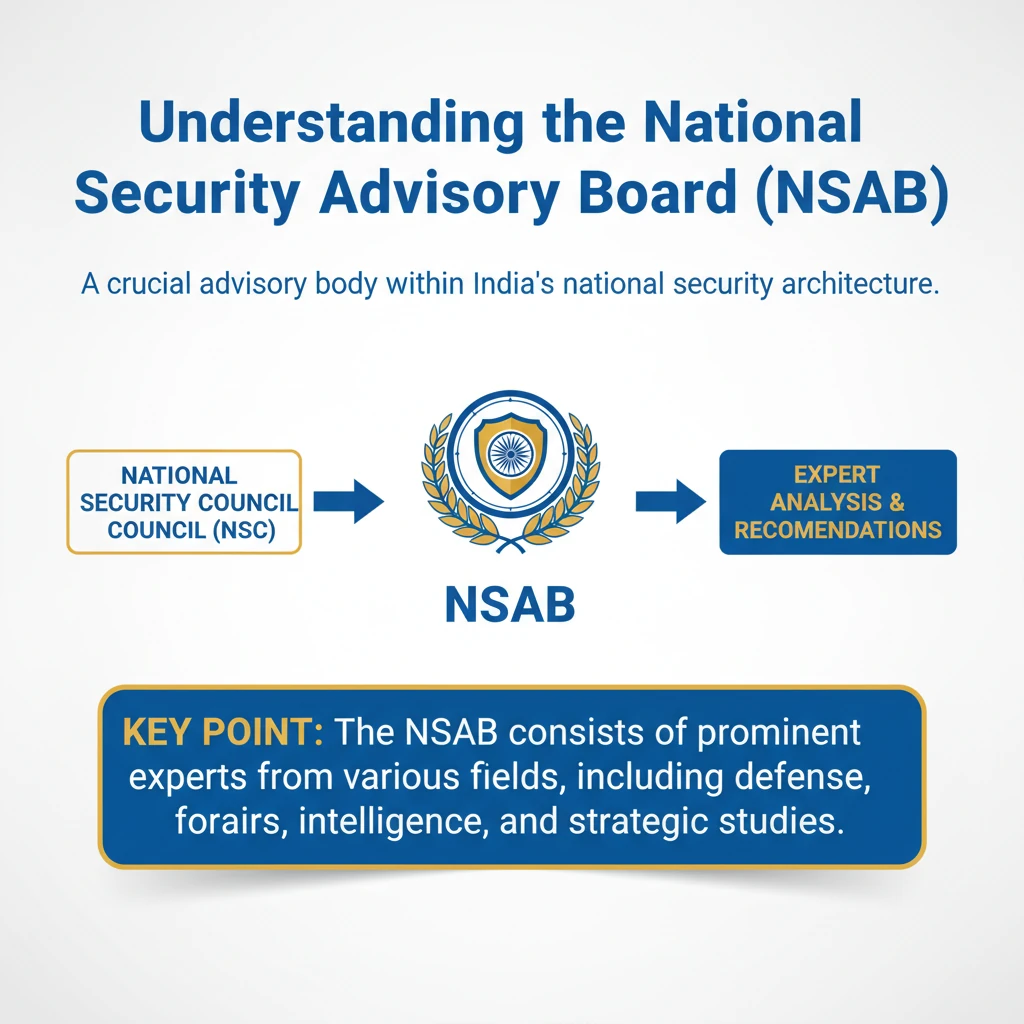
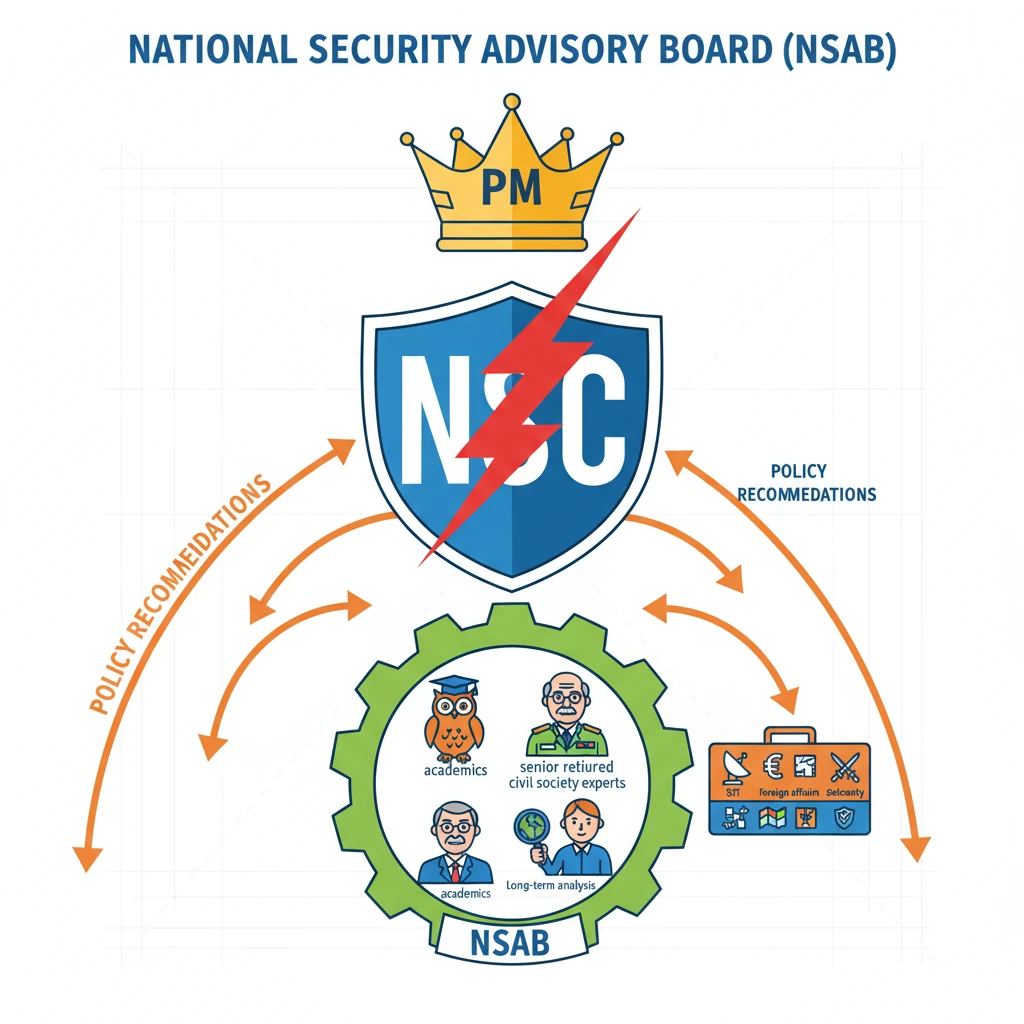
<h4>Understanding the National Security Advisory Board (NSAB)</h4><p>The <strong>National Security Advisory Board (NSAB)</strong> is a crucial advisory body within India's national security architecture. It operates under the broader framework of the <strong>National Security Council (NSC)</strong>.</p><p>Its primary role is to provide expert analysis and recommendations on various facets of national security to the <strong>National Security Council</strong>.</p><div class='key-point-box'><p>The <strong>NSAB</strong> is distinct from the <strong>National Security Council Secretariat (NSCS)</strong> and the <strong>National Security Council (NSC)</strong> itself, though all are interconnected.</p></div><h4>Composition and Role of the National Security Council (NSC)</h4><p>Before delving deeper into <strong>NSAB</strong>, it is crucial to understand its parent body, the <strong>National Security Council (NSC)</strong>. The <strong>NSC</strong> is the apex body for all matters concerning internal and external security.</p><div class='info-box'><ul><li><strong>Headed by:</strong> The <strong>Prime Minister of India</strong>.</li><li><strong>Key Members:</strong> Traditionally includes senior ministers (Defence, Home, Finance, External Affairs) and the <strong>Chiefs of the Armed Forces</strong>, the Director of the <strong>Intelligence Bureau (IB)</strong>, and the Secretary of the <strong>Research and Analysis Wing (R&AW)</strong>.</li><li><strong>Main Task:</strong> To make high-level policy recommendations on national security to the government.</li></ul></div><h4>The National Security Advisory Board (NSAB): Structure and Function</h4><p>The <strong>NSAB</strong> functions as a critical component providing intellectual depth to the <strong>National Security Council (NSC)</strong>.</p><div class='info-box'><p><strong>Composition of NSAB:</strong></p><ul><li><strong>Senior Retired Officials:</strong> Including former diplomats, military officers, and civil servants.</li><li><strong>Academics:</strong> Experts from universities and think tanks specializing in relevant fields.</li><li><strong>Experts from Civil Society:</strong> Individuals with practical experience or specialized knowledge.</li></ul></div><div class='key-point-box'><p><strong>Primary Mandate of NSAB:</strong> To provide <strong>long-term analysis</strong> and <strong>policy recommendations</strong> on a wide array of national security issues to the <strong>NSC</strong>.</p></div><p>The scope of its recommendations is comprehensive, covering vital domains essential for India's security and strategic interests.</p><div class='info-box'><p><strong>Areas of Focus for NSAB Recommendations:</strong></p><ul><li><strong>Internal Security:</strong> Addressing threats within the country's borders.</li><li><strong>External Security:</strong> Geopolitical challenges and border defense.</li><li><strong>Foreign Affairs:</strong> International relations and strategic partnerships.</li><li><strong>Defence:</strong> Military preparedness and modernization.</li><li><strong>Science & Technology:</strong> Leveraging technological advancements for security.</li><li><strong>Economic Affairs:</strong> Economic security and strategic autonomy.</li></ul></div><h4>The National Security Council Secretariat (NSCS) and National Security Advisor (NSA)</h4><p>The <strong>National Security Council Secretariat (NSCS)</strong> provides the organizational support and administrative backbone for the <strong>NSC</strong> and <strong>NSAB</strong>.</p><div class='info-box'><ul><li><strong>Oversight:</strong> The <strong>NSCS</strong> operates under the direct oversight of the <strong>Prime Minister</strong>.</li><li><strong>Head:</strong> The <strong>National Security Advisor (NSA)</strong> serves as the secretary of the <strong>NSCS</strong>.</li><li><strong>Headquarters:</strong> The <strong>NSC</strong>, and by extension its secretariat, is headquartered in <strong>New Delhi</strong>.</li></ul></div><p>The <strong>National Security Advisor (NSA)</strong> is a pivotal figure, acting as the primary advisor to the <strong>Prime Minister</strong> on national security matters.</p><div class='key-point-box'><p><strong>Key Role of NSA:</strong> The <strong>NSA</strong> acts as the <strong>secretary of the NSC</strong> and also as the <strong>primary advisor to the Prime Minister</strong>, coordinating various intelligence and security agencies.</p></div><p>India has seen distinguished individuals hold this crucial position since its inception.</p><div class='info-box'><ul><li><strong>First NSA:</strong> <strong>Brajesh Mishra</strong>.</li><li><strong>Current NSA:</strong> <strong>Ajit Doval</strong>, serving his third term.</li><li><strong>Longest-serving NSA:</strong> <strong>Ajit Doval</strong>, with a tenure exceeding <strong>10 years</strong>.</li></ul></div><h4>Appointments Committee of the Cabinet (ACC)</h4><p>The appointment of key government officials, including the <strong>National Security Advisor</strong>, is a meticulous process overseen by a high-level committee.</p><div class='info-box'><p>The <strong>Appointments Committee of the Cabinet (ACC)</strong> is responsible for processing proposals and making decisions on senior government appointments in India.</p></div><p>The composition of the <strong>ACC</strong> ensures that decisions on critical positions are made with the highest level of governmental authority and deliberation.</p><div class='info-box'><p><strong>Composition of ACC:</strong></p><ul><li><strong>Chaired by:</strong> The <strong>Prime Minister</strong>.</li><li><strong>Member:</strong> The <strong>Minister of Home Affairs</strong>.</li></ul></div><div class='exam-tip-box'><p>Understanding the structure and functions of bodies like the <strong>NSAB</strong>, <strong>NSC</strong>, and the role of the <strong>NSA</strong> is vital for <strong>UPSC Mains GS Paper II (Polity & Governance)</strong> and <strong>GS Paper III (Internal Security)</strong>. Questions can often focus on their relevance in contemporary security challenges.</p></div>
💡 Key Takeaways
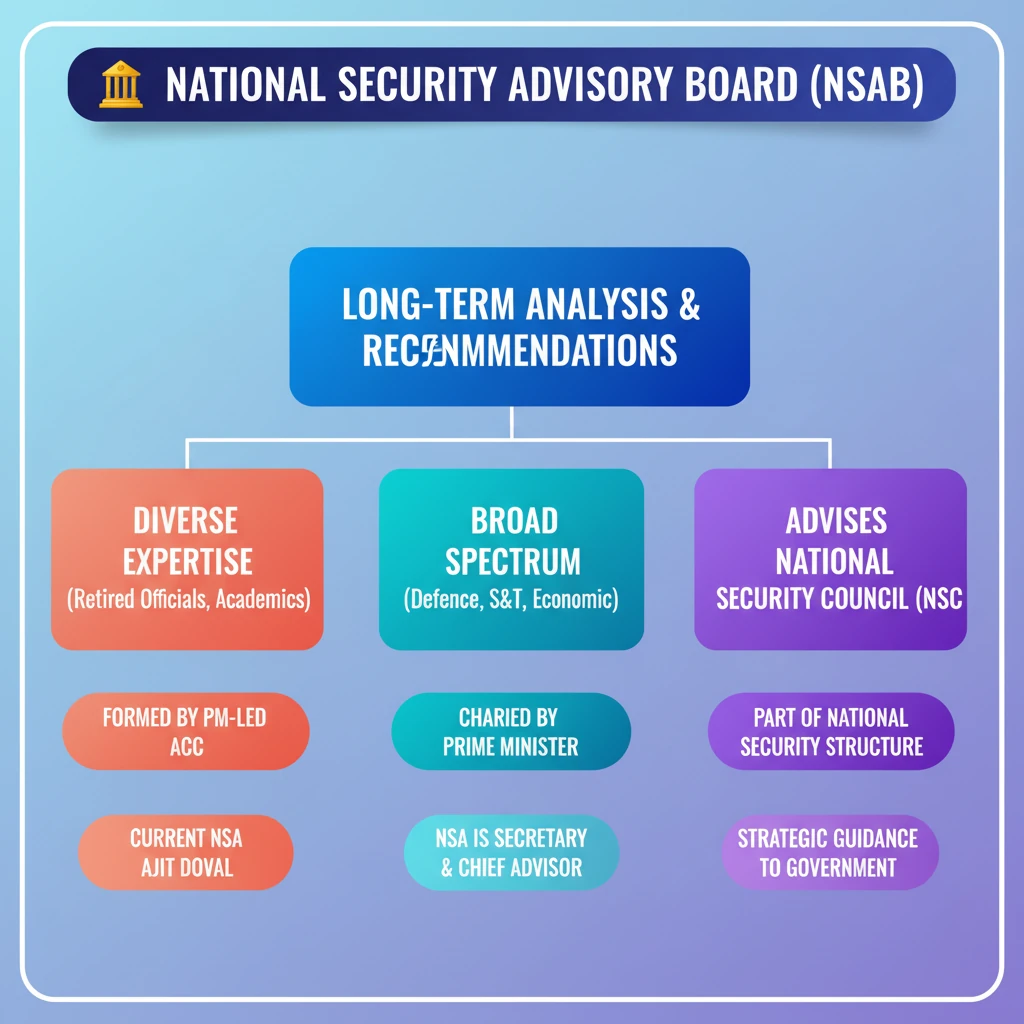
- •The <strong>National Security Advisory Board (NSAB)</strong> provides long-term analysis and policy recommendations to the <strong>National Security Council (NSC)</strong>.
- •<strong>NSAB</strong> comprises senior retired officials, academics, and civil society experts, offering diverse expertise.
- •Its recommendations cover a broad spectrum including internal, external, foreign affairs, defence, S&T, and economic security.
- •The <strong>National Security Council (NSC)</strong> is headed by the <strong>Prime Minister</strong>, with the <strong>National Security Advisor (NSA)</strong> acting as its secretary and primary advisor to the PM.
- •<strong>Ajit Doval</strong> is the current, longest-serving <strong>NSA</strong>, appointed by the <strong>Appointments Committee of the Cabinet (ACC)</strong> chaired by the <strong>PM</strong> and <strong>Home Minister</strong>.
🧠 Memory Techniques
95% Verified Content
📚 Reference Sources
•Official Government of India (Cabinet Secretariat/National Security Council) websites for structure and appointments (general knowledge)