Indian Navy: Shedding Colonial Legacy & Redefining Naval Identity - Defence And Security | UPSC Learning
Topics
0 topics • 0 completed
🔍
No topics match your search
Indian Navy: Shedding Colonial Legacy & Redefining Naval Identity
Medium⏱️ 8 min read
defence and security
📖 Introduction
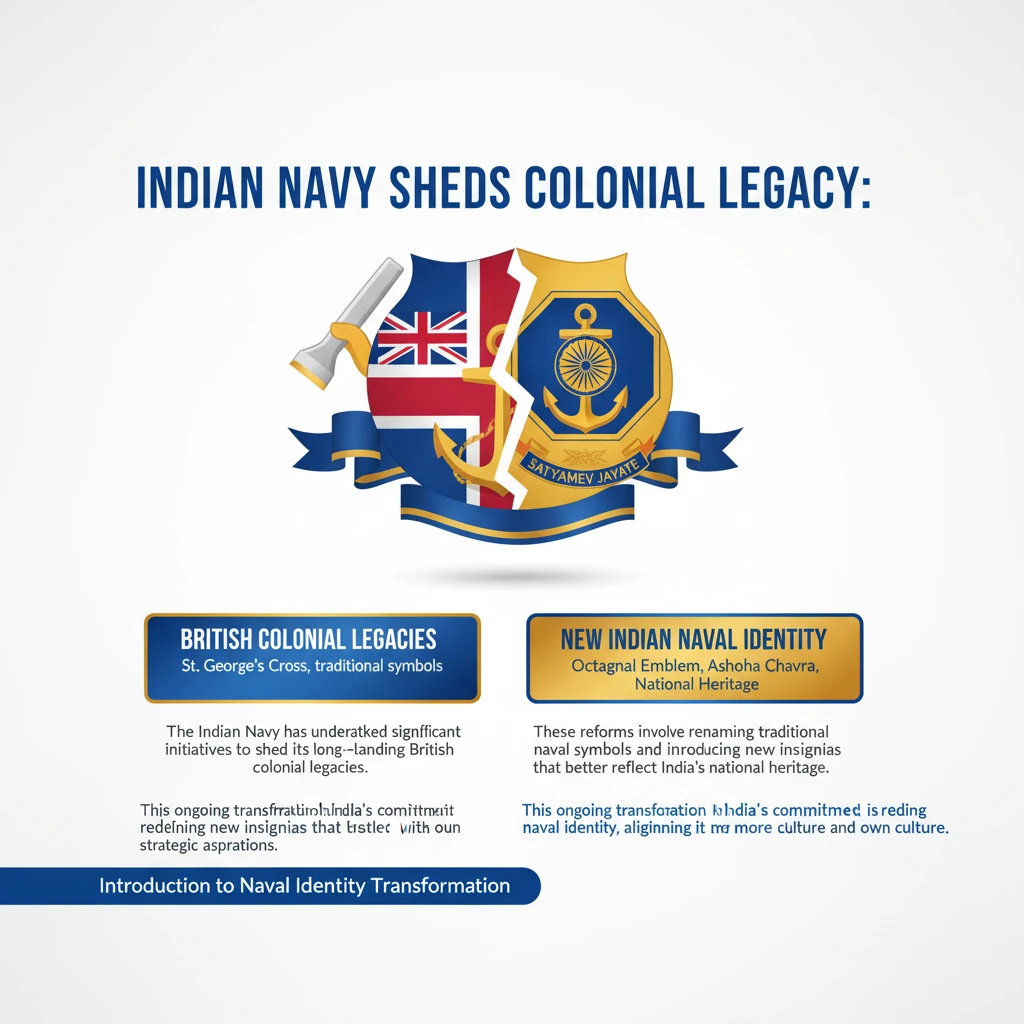
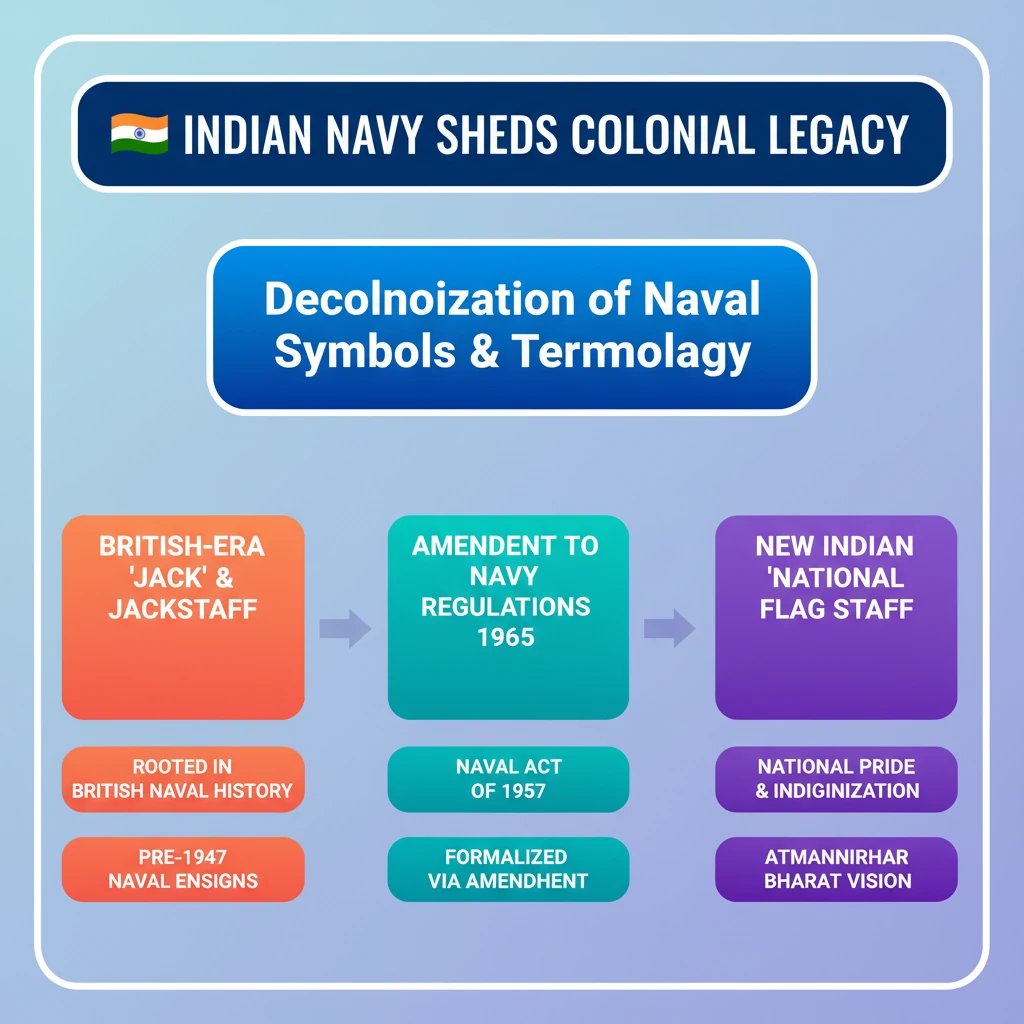
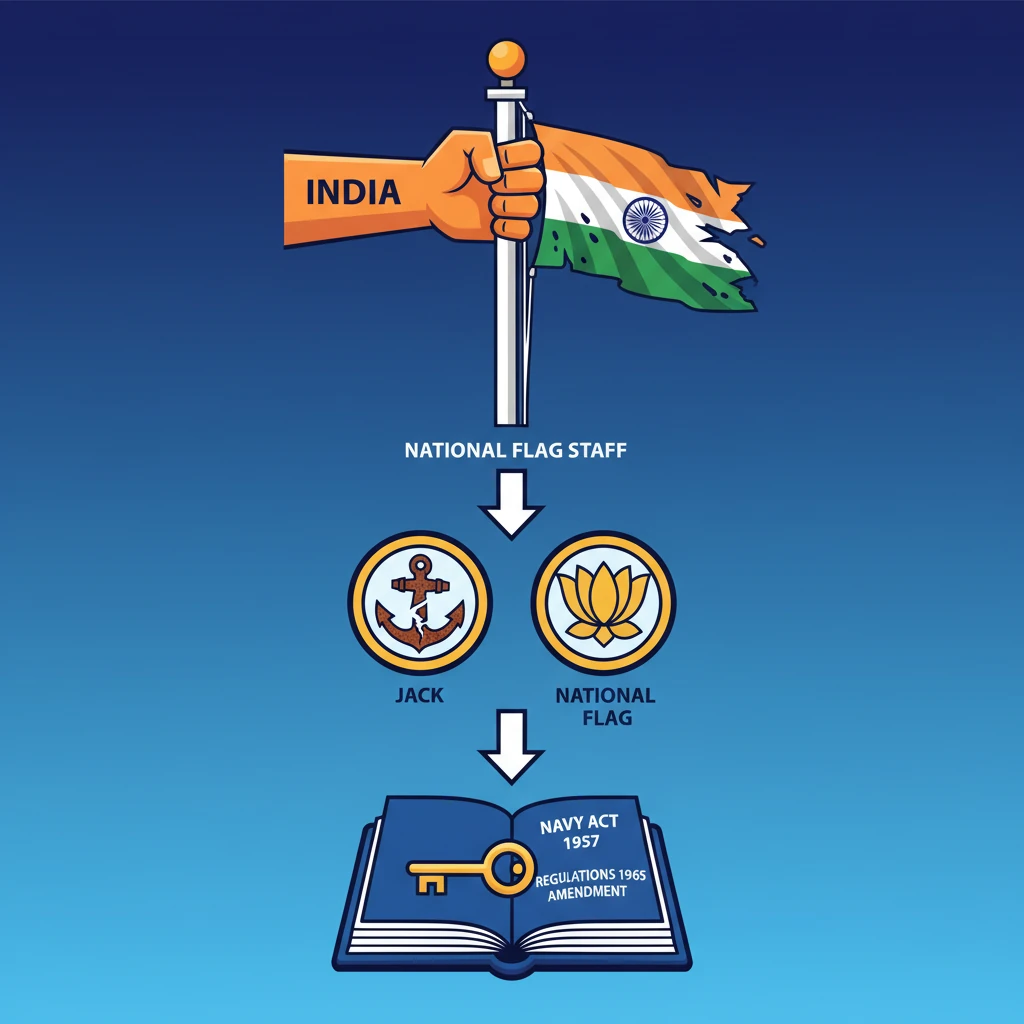
<h4>Introduction to Naval Identity Transformation</h4><p>The <strong>Indian Navy</strong> has undertaken significant initiatives to shed its long-standing <strong>British colonial legacies</strong>. These reforms involve renaming traditional naval symbols and introducing new insignias that better reflect India's national heritage.</p><p>This ongoing transformation highlights India’s commitment to redefining its naval identity, aligning it more closely with its own culture and strategic aspirations.</p><h4>Specific Nomenclature Changes</h4><p>As part of its indigenization efforts and to foster national pride, the <strong>Indian Navy</strong> has formally changed key terminologies previously inherited from the British.</p><ul><li>The term '<strong>Jack</strong>' has been renamed to '<strong>National Flag</strong>'.</li><li>The term '<strong>Jackstaff</strong>' has been renamed to '<strong>National Flag Staff</strong>'.</li></ul><div class='info-box'><p>The <strong>'Jack'</strong> traditionally refers to a flag flown at the bow of a ship. The <strong>'Jackstaff'</strong> is the short pole from which this flag is flown. Both terms are deeply rooted in British naval history.</p></div><h4>Historical Roots of Naval Terminology</h4><p>The terms '<strong>Jack</strong>' and '<strong>Jackstaff</strong>' originated from <strong>British naval practices</strong> and were subsequently adopted by many navies worldwide, including India, as a remnant of colonial influence.</p><p>These terms symbolize a historical connection to the Royal Navy, which the Indian Navy is now actively seeking to replace with indigenous representations.</p><h4>Legal Framework for Reforms</h4><p>The formalization of these nomenclature changes was achieved through a specific amendment to existing naval regulations.</p><div class='info-box'><p>The amendment was made to the <strong>“Regulations for the Navy (Ceremonial, Conditions and Service and Miscellaneous Regulation) 1965”</strong>. This was done leveraging the powers granted by the <strong>Naval Act of 1957</strong>.</p></div><h4>Enhancing Naval Capabilities</h4><p>Alongside these symbolic changes, the <strong>Indian Navy</strong> continues to enhance its operational capabilities, reinforcing its role as a formidable maritime force.</p><div class='exam-tip-box'><p><strong>UPSC Insight:</strong> The <strong>Indian Navy</strong> recently announced the successful engagement of a live target with the <strong>BrahMos missile</strong> at an enhanced range of <strong>900 km</strong>. This demonstrates India's growing self-reliance and advanced capabilities in defense, a crucial aspect for <strong>GS Paper 3 (Internal Security)</strong> and <strong>GS Paper 2 (International Relations)</strong>.</p></div>
💡 Key Takeaways
- •Indian Navy is actively shedding British colonial legacies by renaming symbols.
- •Specific changes include 'Jack' to 'National Flag' and 'Jackstaff' to 'National Flag Staff'.
- •These terms were deeply rooted in British naval history.
- •Changes were formalized via amendment to the 'Regulations for the Navy 1965' under the Naval Act of 1957.
- •This move aligns with India's national pride, indigenization efforts, and 'Atmanirbhar Bharat' vision.
- •The Indian Navy also recently demonstrated enhanced capabilities with a 900 km range BrahMos missile strike.
🧠 Memory Techniques
98% Verified Content
📚 Reference Sources
•Naval Act of 1957 (India)
•Regulations for the Navy (Ceremonial, Conditions and Service and Miscellaneous Regulation) 1965 (as amended)
•Press Information Bureau (PIB) releases regarding Indian Navy Ensign change (2022)
•Ministry of Defence statements on indigenization