NIA’s Combat Against the Terror-Gangster Nexus - Defence And Security | UPSC Learning
Topics
0 topics • 0 completed
🔍
No topics match your search
NIA’s Combat Against the Terror-Gangster Nexus
Medium⏱️ 7 min read
defence and security
📖 Introduction
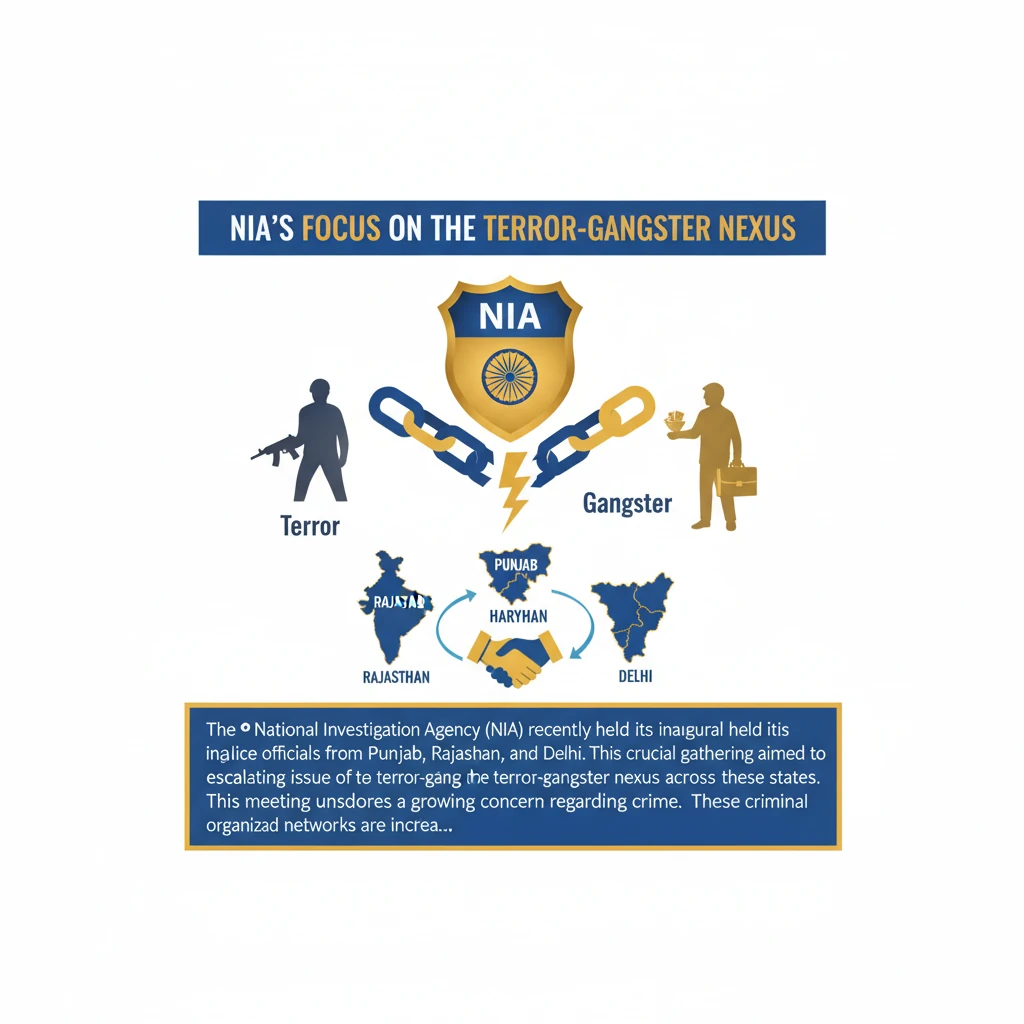
<h4>NIA's Focus on the Terror-Gangster Nexus</h4><p>The <strong>National Investigation Agency (NIA)</strong> recently held its inaugural meeting with police officials from <strong>Punjab, Rajasthan, Haryana</strong>, and <strong>Delhi</strong>. This crucial gathering aimed to address the escalating issue of the <strong>terror-gangster nexus</strong> across these states.</p><p>This meeting underscores a growing concern regarding <strong>organized crime</strong>. These criminal networks are increasingly linked to <strong>terror groups</strong>, particularly those associated with <strong>Pro-Khalistan Elements (PKEs)</strong> and having direct connections to <strong>Pakistan</strong>.</p><div class='key-point-box'><p>The convergence of <strong>terrorist organizations</strong> and <strong>organized criminal gangs</strong> poses a significant and evolving threat to India's internal security, demanding a coordinated and robust response.</p></div><h4>Establishment of the National Investigation Agency (NIA)</h4><p>The <strong>National Investigation Agency (NIA)</strong> was established by the Indian government in <strong>2008</strong>. Its primary mandate is to combat the complex and multifaceted threats of <strong>terrorism</strong>, especially those involving inter-State and international linkages.</p><div class='info-box'><p><strong>Formation Catalyst:</strong> The NIA was formed directly in response to the devastating <strong>2008 Mumbai terror attacks</strong>.</p><p><strong>Legal Basis:</strong> It was constituted under the <strong>National Investigation Agency Act, 2008</strong>.</p></div><p>The establishment of the NIA was based on recommendations from various experts and committees. Notably, the <strong>Administrative Reforms Commission</strong> played a role in advocating for such a specialized agency.</p><h4>NIA's Organisational Framework</h4><p>The <strong>National Investigation Agency (NIA)</strong> operates under the direct purview of the <strong>Union Ministry of Home Affairs</strong>, which serves as its parent ministry.</p><div class='info-box'><p><strong>Headquarters:</strong> The primary headquarters of the NIA is located in <strong>New Delhi</strong>.</p></div><h4>NIA's Investigation Procedures</h4><p>State governments possess the authority to refer specific cases to the <strong>NIA</strong>. This process is facilitated through the <strong>Central Government</strong>, specifically the <strong>Union Home Ministry</strong>.</p><p>Beyond referrals, the NIA also has the power to initiate investigations <strong>suo motu</strong>, meaning on its own accord. Alternatively, it can take up cases if explicitly directed by the <strong>Central Government</strong>.</p><div class='key-point-box'><p>A significant aspect of NIA's jurisdiction is its ability to investigate <strong>scheduled offenses</strong> committed outside India. This capability is crucial for addressing cross-border terrorism and related crimes.</p></div><h4>Mandate and Jurisdiction of NIA</h4><p>The <strong>NIA's mandate</strong> is broad, empowering it to investigate and prosecute offenses that directly affect <strong>national security, sovereignty, and international relations</strong> of India.</p><p>Its jurisdiction is unique, allowing it to operate across all Indian states <strong>without needing special permission</strong> from individual state governments. This ensures swift and unhindered investigations into complex terror cases.</p><div class='info-box'><p><strong>Expanded Scope:</strong> Under the <strong>NIA (Amendment) Act, 2019</strong>, the agency's jurisdiction was further expanded, explicitly allowing it to investigate crimes committed <strong>outside India</strong>, enhancing its capability to tackle global terror networks.</p></div><div class='exam-tip-box'><p>For <strong>UPSC Mains GS Paper III (Internal Security)</strong>, understanding the NIA's role, its legal framework (Acts and Amendments), and its operational challenges (like the terror-gangster nexus) is critical. Questions often revolve around institutional mechanisms to combat terrorism.</p></div>
💡 Key Takeaways
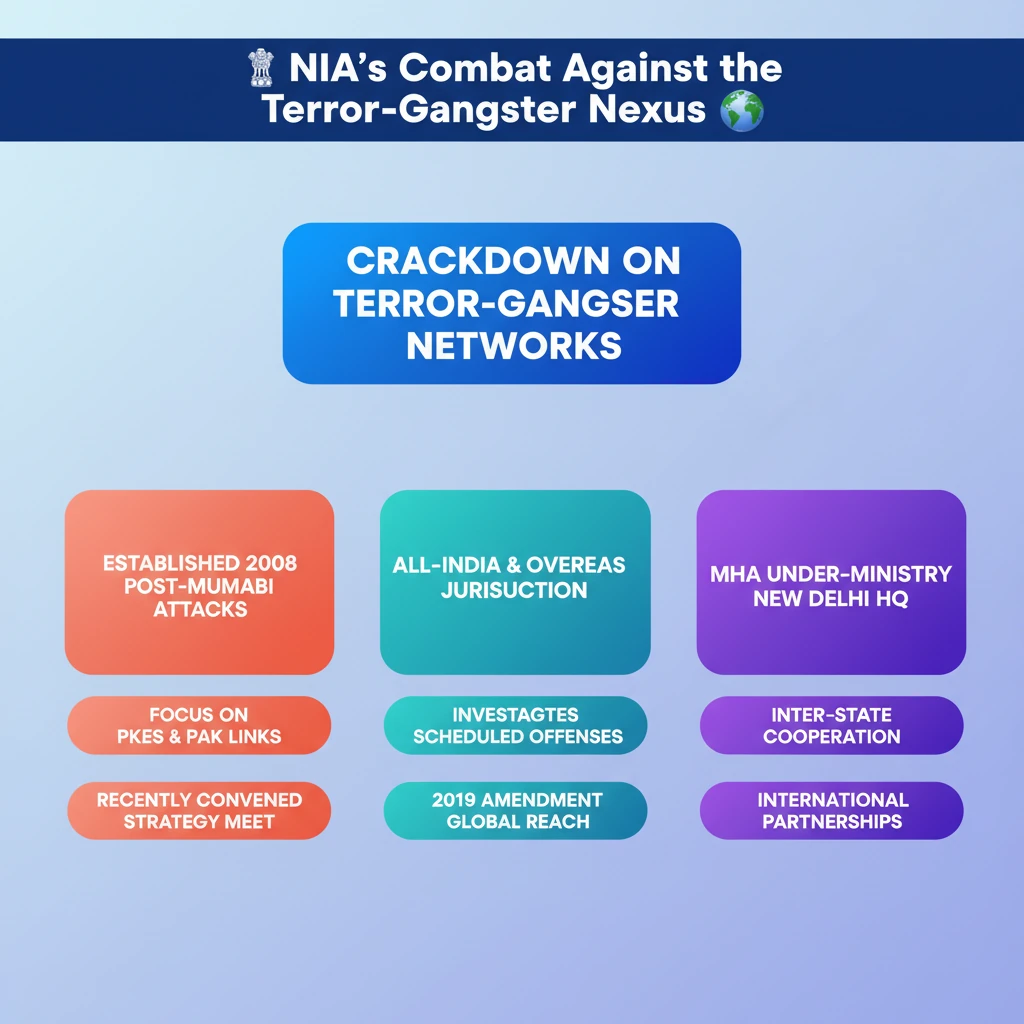
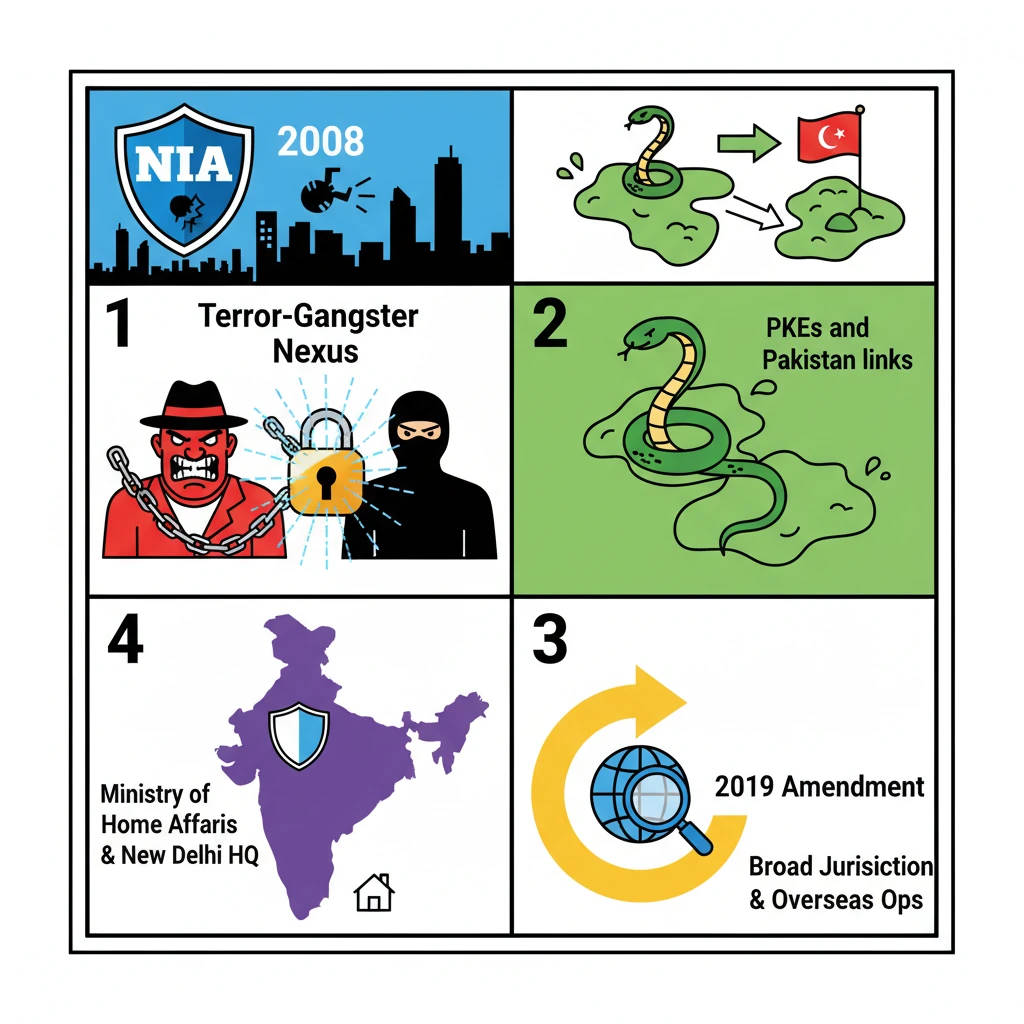
- •NIA was established in 2008 post-Mumbai attacks to combat terrorism.
- •It recently convened a meeting to address the growing terror-gangster nexus, especially with PKEs and Pakistan links.
- •NIA operates under the Ministry of Home Affairs with headquarters in New Delhi.
- •It has broad jurisdiction, including investigating scheduled offenses outside India (post-2019 Amendment).
- •The nexus poses a significant threat, requiring strong inter-state and international cooperation.
🧠 Memory Techniques
95% Verified Content