Joint Doctrine for Amphibious and Cyberspace Operations - Defence And Security | UPSC Learning
Topics
0 topics • 0 completed
🔍
No topics match your search
Joint Doctrine for Amphibious and Cyberspace Operations
Medium⏱️ 8 min read
defence and security
📖 Introduction
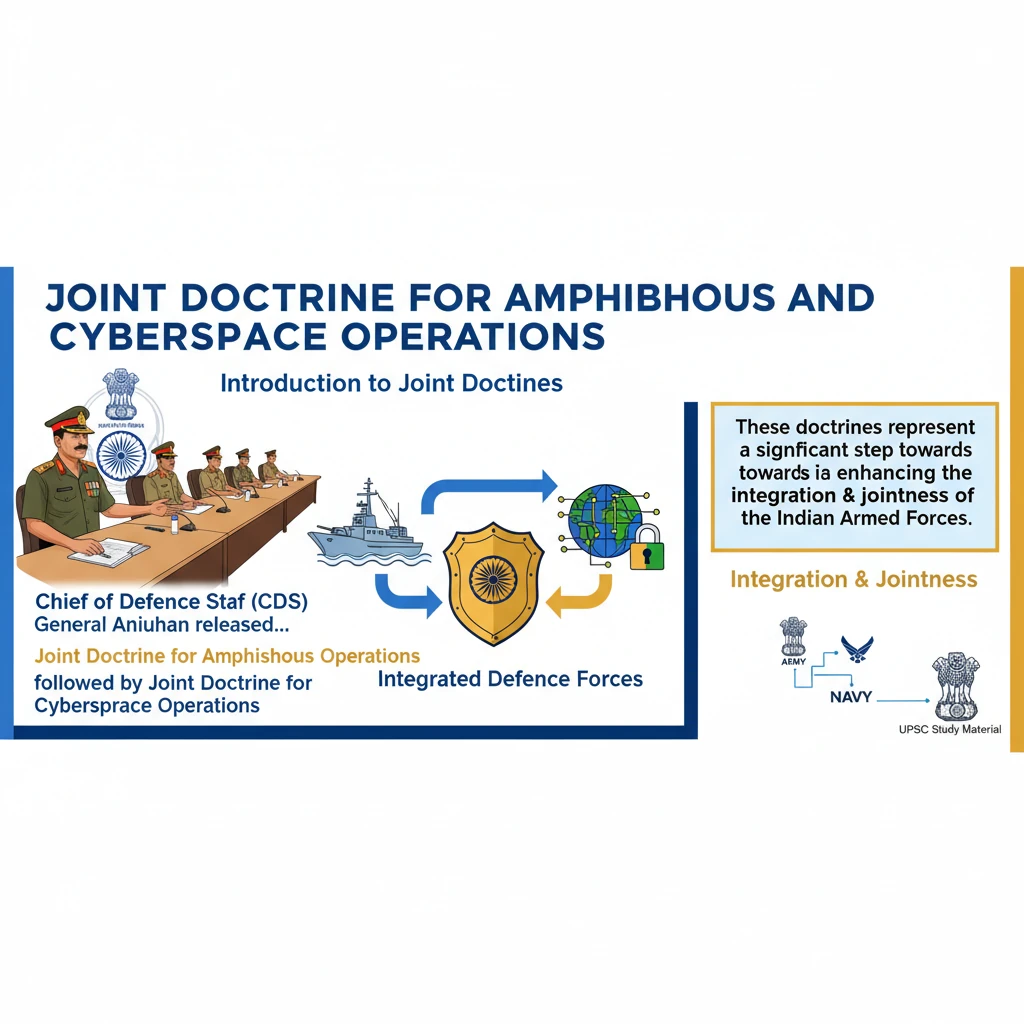
<h4>Introduction to Joint Doctrines</h4><p>The <strong>Chief of Defence Staff (CDS) General Anil Chauhan</strong> recently released the <strong>Joint Doctrine for Amphibious Operations</strong> during a <strong>Chiefs of Staff Committee (COSC)</strong> meeting. This follows the earlier release of the <strong>Joint Doctrine for Cyberspace Operations</strong> by the CDS.</p><div class='key-point-box'><p>These doctrines represent a significant step towards enhancing the <strong>integration</strong> and <strong>coordination</strong> among India's Armed Forces in modern warfare domains.</p></div><h4>Joint Doctrine for Amphibious Operations</h4><p>This doctrine serves as a foundational publication, offering crucial guidance to commanders for executing <strong>Amphibious Operations</strong> within complex maritime environments. It underscores the importance of seamless coordination across different service branches.</p><p>The capability for amphibious operations significantly boosts the <strong>Armed Forces' capacity</strong> to undertake a broad spectrum of missions. These operations are vital for both <strong>wartime</strong> and <strong>peacetime scenarios</strong> within the <strong>Indian Ocean Region (IOR)</strong>.</p><div class='info-box'><p><strong>Amphibious Operations:</strong> These are military operations launched from the sea by naval and landing forces, supported by air, to land on a hostile or potentially hostile shore.</p></div><p>They are a critical component of <strong>multi-domain military engagements</strong>, demonstrating the highest level of synergy and combined effort among the Army, Navy, and Air Force.</p><h4>Joint Doctrine for Cyberspace Operations</h4><p>The <strong>Cyberspace Doctrine</strong> addresses the military dimensions of this increasingly critical domain. It provides strategic guidance for commanders, staff, and practitioners involved in planning and executing <strong>cyberspace operations</strong>.</p><div class='info-box'><p><strong>Cyberspace:</strong> Defined as the global network of entities, including <strong>Information and Communication Technology (ICT) systems</strong>, that process, store, and transmit digital information and code, whether connected or independent.</p></div><p>Beyond traditional domains of <strong>land, sea, and air warfare</strong>, cyberspace has emerged as a complex and crucial domain. It demands dedicated strategic focus and a comprehensive approach for effective military engagement.</p><p>This doctrine also aims to raise <strong>awareness</strong> among military personnel at all levels regarding the intricacies and importance of cyberspace in modern conflict.</p><h4>Context of Contemporary Security Challenges</h4><p>The development of these doctrines is set against a backdrop of evolving security threats. These challenges necessitate a robust and integrated defence strategy, encompassing both traditional and non-traditional domains.</p><ul><li><strong>Narcotics and Trafficking:</strong> This remains a major internal security concern, significantly impacting <strong>social and economic stability</strong> within the nation.</li><li><strong>Non-Major Ports and Fishing Harbours:</strong> These areas pose substantial risks due to their vulnerability to <strong>smuggling</strong> and other <strong>illegal activities</strong>, requiring enhanced security measures.</li></ul><h4>Emerging Threats and Technological Challenges</h4><p>Recent discussions, such as those at the COSC meeting, have explored several contemporary security threats driven by technological advancements.</p><ul><li><strong>Fintech Fraud:</strong> There is a growing emphasis on how <strong>financial technologies</strong> are being exploited for various <strong>criminal activities</strong>, posing economic and security risks.</li><li><strong>Rogue Drones:</strong> Countermeasures against <strong>rogue drones</strong>, which are increasingly used for <strong>smuggling</strong> and <strong>surveillance</strong>, have become a focal point of security sessions.</li><li><strong>Exploitation of App Ecosystems:</strong> Criminal elements are increasingly leveraging <strong>mobile applications</strong> for illicit activities, necessitating vigilance and defensive strategies in the digital space.</li></ul><div class='exam-tip-box'><p><strong>UPSC Insight:</strong> Joint Doctrines reflect India's evolving defence strategy to address <strong>multi-domain warfare</strong> and <strong>hybrid threats</strong>. Questions can link these doctrines to India's geopolitical ambitions in the <strong>IOR</strong>, internal security challenges, and the role of the <strong>CDS</strong> in defence reforms. Focus on the 'why' and 'how' of such integrations.</p></div>
💡 Key Takeaways
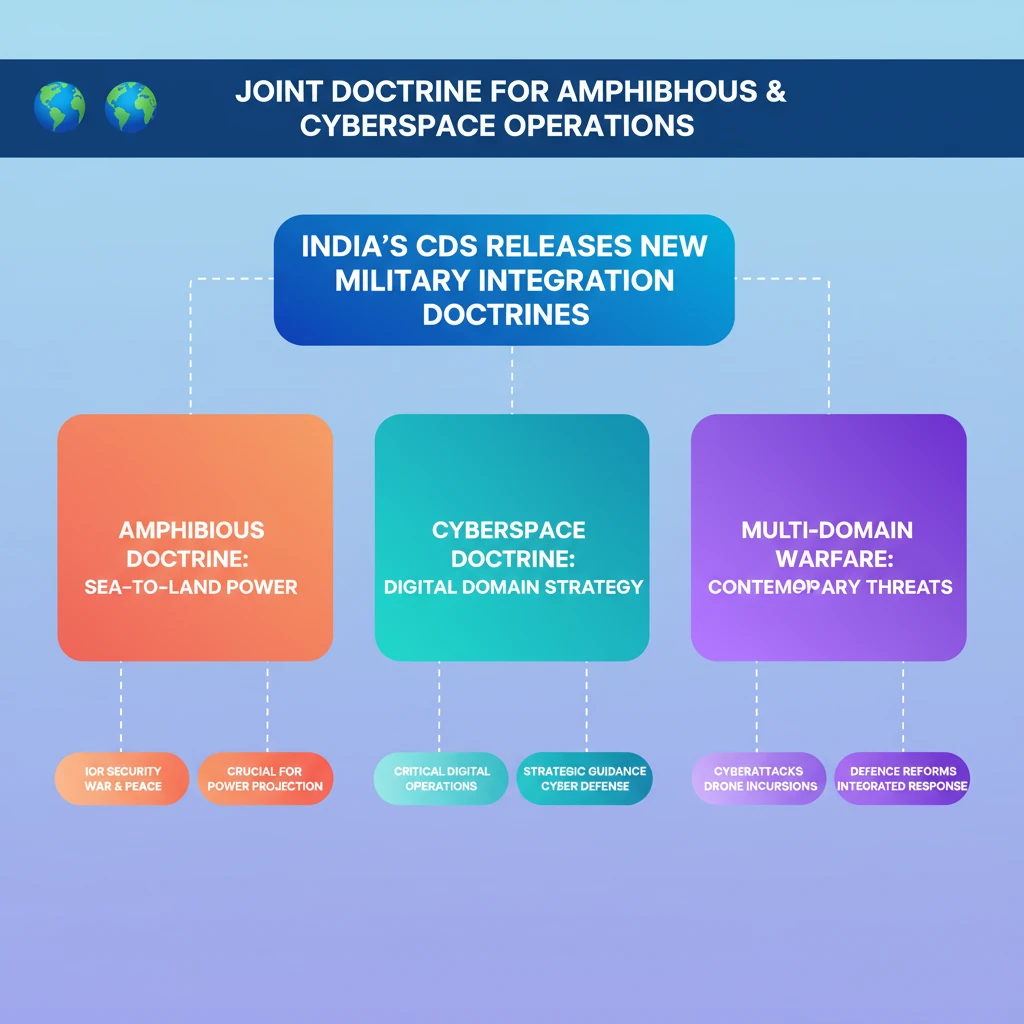
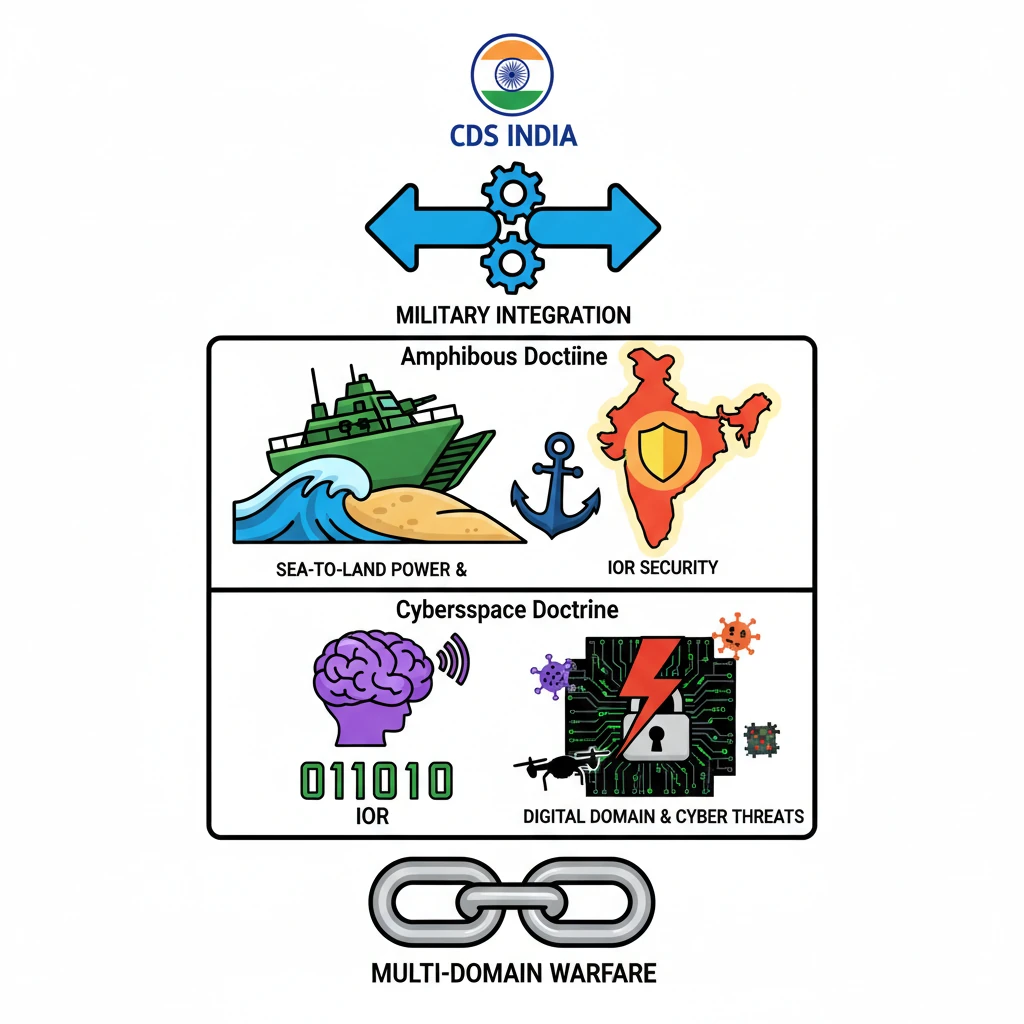
- •India's CDS released Joint Doctrines for Amphibious and Cyberspace Operations, enhancing military integration.
- •Amphibious Doctrine guides sea-to-land power projection, crucial for IOR security in war and peace.
- •Cyberspace Doctrine provides strategic guidance for military operations in the critical digital domain.
- •These doctrines are vital for addressing multi-domain warfare and contemporary threats like cyberattacks and drone incursions.
- •The initiatives underscore India's commitment to defence reforms and integrated security responses.
🧠 Memory Techniques
90% Verified Content