THAAD, UNIFIL and Dragon Drones - Defence And Security | UPSC Learning
Topics
0 topics • 0 completed
🔍
No topics match your search

THAAD, UNIFIL and Dragon Drones
Medium⏱️ 8 min read
defence and security
📖 Introduction
<h4>Introduction to Key Defence Systems and Organisations</h4><p>The recent news highlights three critical components of global security: the <strong>Terminal High Altitude Area Defense (THAAD)</strong> system, the <strong>United Nations Interim Force in Lebanon (UNIFIL)</strong>, and <strong>Dragon Drones</strong>. These elements represent different facets of modern warfare, international peacekeeping, and strategic defense capabilities.</p><div class='exam-tip-box'><p>Understanding these distinct yet interconnected topics is crucial for <strong>UPSC Mains Paper 2 (International Relations)</strong> and <strong>Paper 3 (Internal Security/Defence Technology)</strong>. Focus on their roles, implications, and recent developments.</p></div><h4>Terminal High Altitude Area Defense (THAAD)</h4><p><strong>THAAD</strong> is an American anti-ballistic missile defense system designed to intercept and destroy short, medium, and intermediate-range ballistic missiles in their terminal phase (descent or re-entry) by colliding with them. This 'hit-to-kill' technology uses kinetic energy to neutralize threats.</p><div class='info-box'><p><strong>Key Features of THAAD:</strong><ul><li><strong>Developer:</strong> Lockheed Martin.</li><li><strong>Function:</strong> Intercepts ballistic missiles at high altitudes.</li><li><strong>Technology:</strong> 'Hit-to-kill' kinetic interceptor.</li><li><strong>Mobility:</strong> Highly mobile, deployable by air.</li></ul></p></div><p>The <strong>United States</strong> recently sent a <strong>THAAD battery to Israel</strong>. This deployment underscores the strategic importance of missile defense in volatile regions and signifies strong security cooperation between the two nations, aiming to bolster Israel's defense capabilities against potential missile threats.</p><div class='key-point-box'><p><strong>Strategic Significance:</strong> THAAD deployments are often viewed as a deterrent and a significant enhancement to a nation's air defense architecture, but can also be perceived as escalatory by adversaries.</p></div><h4>United Nations Interim Force in Lebanon (UNIFIL)</h4><p><strong>UNIFIL</strong> is a United Nations peacekeeping mission established in <strong>March 1978</strong> by <strong>UN Security Council Resolutions 425 and 426</strong>. Its primary mandate is to confirm the withdrawal of Israeli forces from Lebanon, restore international peace and security, and assist the Lebanese government in restoring its effective authority in the area.</p><div class='info-box'><p><strong>UNIFIL's Mandate:</strong><ul><li>Monitoring cessation of hostilities.</li><li>Accompanying and supporting the Lebanese Armed Forces (LAF).</li><li>Ensuring humanitarian access.</li><li>Preventing illegal arms proliferation.</li></ul></p></div><p>Recently, <strong>Israeli tanks attacked UNIFIL positions in Lebanon</strong>. Such incidents highlight the precarious security situation in the region and the challenges faced by peacekeeping forces operating in active conflict zones. These events often lead to diplomatic tensions and calls for investigations into violations of international law.</p><div class='key-point-box'><p><strong>Challenges for UNIFIL:</strong> Operating amidst ongoing geopolitical tensions, maintaining impartiality, and ensuring the safety of peacekeepers while fulfilling its mandate.</p></div><h4>Dragon Drones</h4><p>The term <strong>'Dragon Drones'</strong> generally refers to a class of Unmanned Aerial Vehicles (UAVs) or drones, often associated with advanced capabilities in surveillance, reconnaissance, and sometimes combat. These drones are characterized by their agility, endurance, and ability to operate in complex environments.</p><div class='info-box'><p><strong>Characteristics of Advanced Drones:</strong><ul><li><strong>Versatility:</strong> Used for ISR (Intelligence, Surveillance, Reconnaissance) and strike missions.</li><li><strong>Autonomy:</strong> Increasing levels of autonomous operation.</li><li><strong>Swarming Capabilities:</strong> Multiple drones operating in coordination.</li><li><strong>Cost-effectiveness:</strong> Often cheaper than manned aircraft for certain tasks.</li></ul></p></div><p>In the ongoing <strong>Russia-Ukraine war</strong>, <strong>Dragon Drones are being used by both sides</strong>. This exemplifies the growing prominence of drone technology in modern warfare, transforming tactics and strategies. Drones provide critical battlefield intelligence, target acquisition, and even direct combat support, often with minimal risk to human operators.</p><div class='key-point-box'><p><strong>Impact on Warfare:</strong> Drones have revolutionized battlefield dynamics, enabling precision strikes, real-time intelligence, and reducing human exposure to danger, while also raising ethical concerns regarding autonomous weapons systems.</p></div>
💡 Key Takeaways
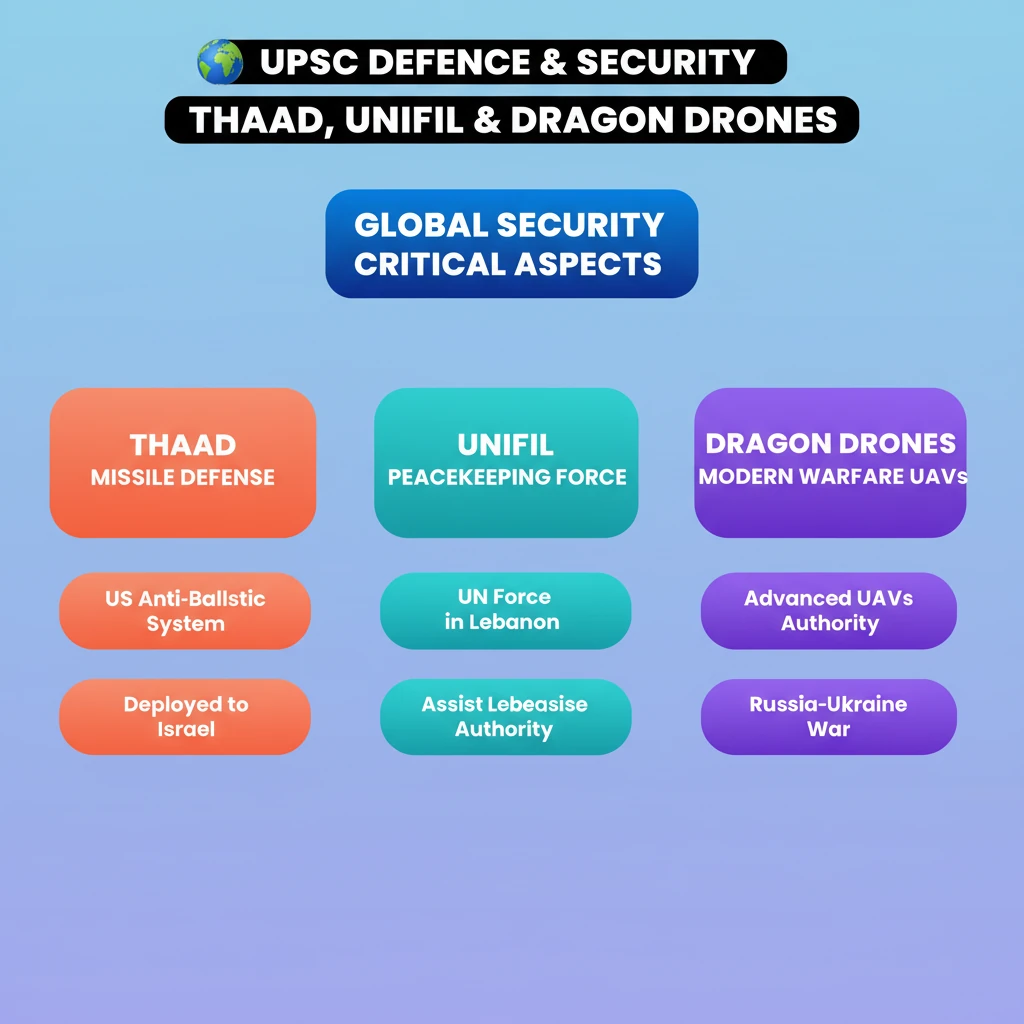
- •THAAD is a US anti-ballistic missile system, recently deployed to Israel, emphasizing missile defense in volatile regions.
- •UNIFIL is a UN peacekeeping force in Lebanon, established to ensure peace and assist Lebanese authority, facing challenges like recent Israeli tank attacks.
- •Dragon Drones represent advanced UAVs, extensively used by both sides in the Russia-Ukraine war, showcasing the evolving nature of modern combat.
- •These three elements highlight critical aspects of global security: strategic defense, international peacekeeping, and technological advancements in warfare.
- •Understanding their roles and recent developments is crucial for analyzing contemporary international relations and defense strategies.
🧠 Memory Techniques

95% Verified Content
📚 Reference Sources
•United Nations Peacekeeping Website (UNIFIL)
•Lockheed Martin Official Website (THAAD)
•Council on Foreign Relations (Drones in Warfare)