Major Military Exercises of India - Defence And Security | UPSC Learning
Topics
0 topics • 0 completed
🔍
No topics match your search
Major Military Exercises of India
Medium⏱️ 10 min read
defence and security
📖 Introduction
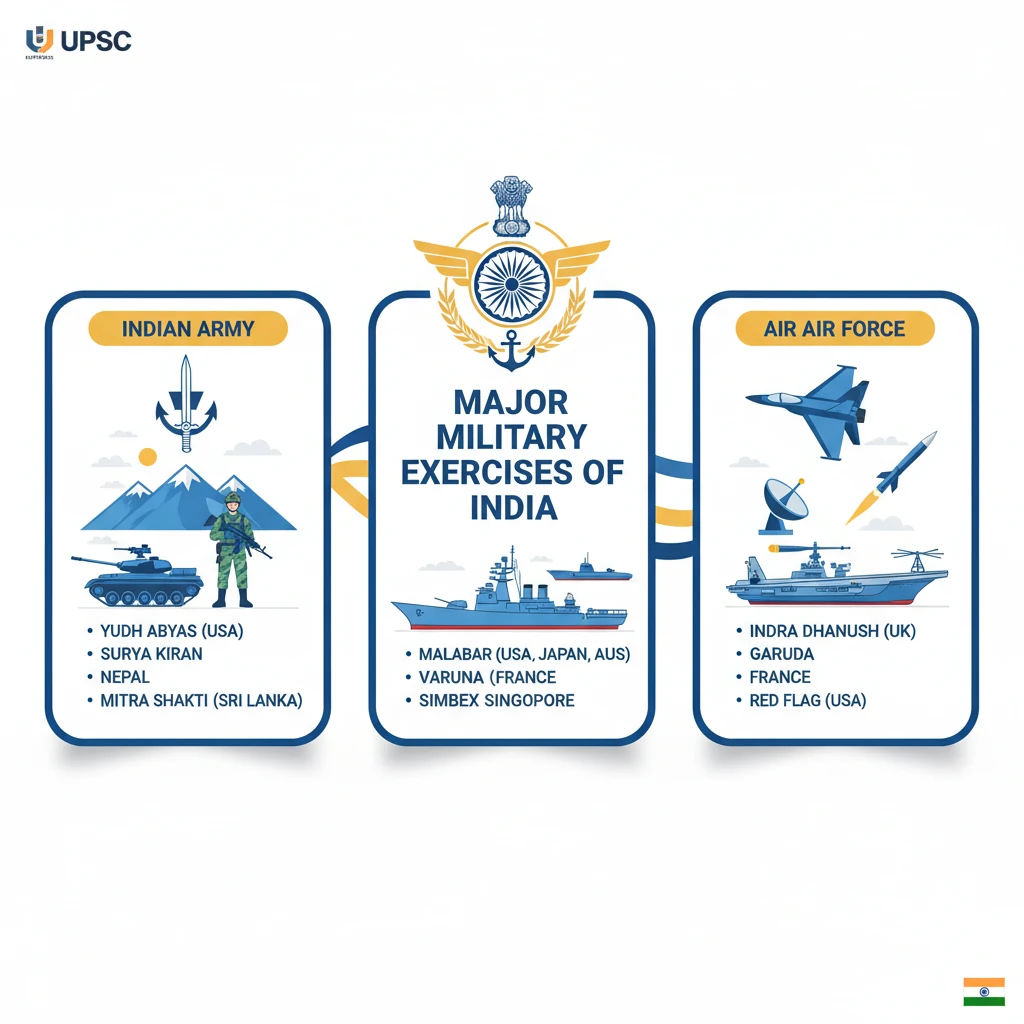
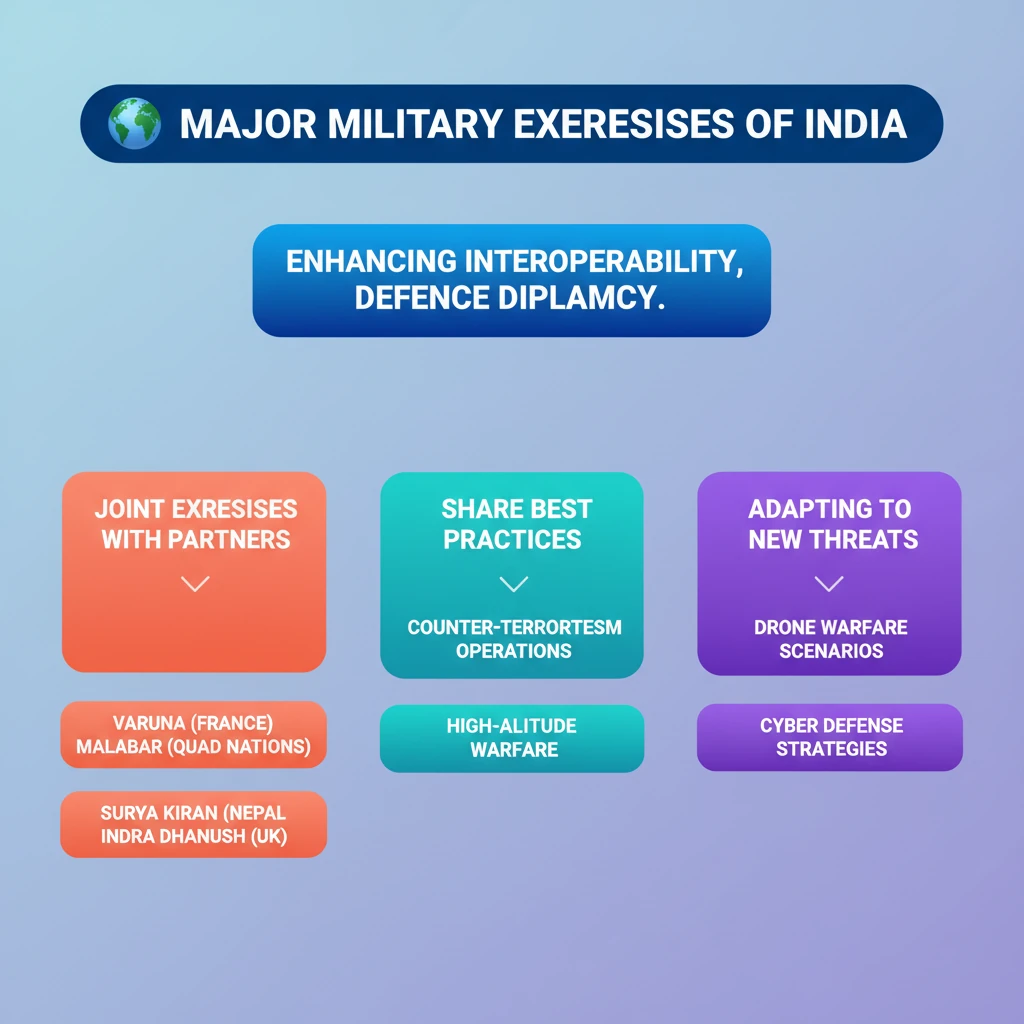
<h4>Introduction to India's Major Military Exercises</h4><p><strong>Joint Military Exercises</strong> are pivotal events in India's defence cooperation strategy. They serve as flagship platforms, showcasing the <strong>Indian Armed Forces'</strong> professional competence across diverse operational scenarios. These exercises also provide invaluable opportunities for participating nations to learn and implement best practices in modern warfare.</p><div class='key-point-box'><p><strong>Purpose of Joint Exercises:</strong></p><ul><li>Showcasing <strong>professional competence</strong>.</li><li>Facilitating <strong>learning of best practices</strong>.</li><li>Enhancing <strong>interoperability</strong> and mutual understanding.</li><li>Strengthening <strong>defence diplomacy</strong> and strategic partnerships.</li></ul></div><h4>Scope and Evolving Complexity</h4><p>The scope of these joint exercises is both realistic and highly diversified. Initially focusing on traditional warfare, it has expanded significantly to address contemporary threats and challenges. This evolution ensures that training remains relevant and effective against emerging security paradigms.</p><p>Key operational scenarios covered include:</p><ul><li><strong>Counter-Terrorist Operations</strong></li><li><strong>Humanitarian Assistance & Disaster Relief (HADR)</strong></li><li><strong>UN Peacekeeping Missions</strong></li><li><strong>High Altitude Operations</strong></li><li><strong>Desert Warfare</strong></li><li><strong>Urban Warfare</strong></li><li><strong>Jungle Warfare</strong></li></ul><p>The complexity of these exercises is continuously increased by incorporating the latest practices in warfighting. This includes adapting to new technologies and strategies such as <strong>Drone Warfare</strong> and understanding the nuances of <strong>Grey Zone Warfare</strong>, ensuring preparedness for future conflicts.</p><h4>Major Joint Exercises of the Indian Army</h4><p>The Indian Army conducts numerous bilateral and multilateral exercises with various countries, fostering strong military ties and enhancing operational readiness. These exercises are crucial for sharing tactical knowledge and improving coordination.</p><div class='info-box'><table class='info-table'><tr><th>Country</th><th>Exercise Name</th></tr><tr><td><strong>Australia</strong></td><td><strong>Ex AUSTRA HIND</strong></td></tr><tr><td><strong>Bangladesh</strong></td><td><strong>Ex SAMPRITI</strong></td></tr><tr><td><strong>China</strong></td><td><strong>Ex HAND IN HAND</strong></td></tr><tr><td><strong>France</strong></td><td><strong>Ex SHAKTI</strong></td></tr><tr><td><strong>Indonesia</strong></td><td><strong>Ex GARUDA SHAKTI</strong></td></tr><tr><td><strong>Kazakhstan</strong></td><td><strong>Ex PRABAL DOSTYYK</strong></td></tr><tr><td><strong>Kyrgyzstan</strong></td><td><strong>Ex KHANJAR</strong></td></tr><tr><td><strong>Maldives</strong></td><td><strong>Ex EKUVERIN</strong></td></tr><tr><td><strong>Mongolia</strong></td><td><strong>Ex NOMADIC ELEPHANT</strong></td></tr><tr><td><strong>Myanmar</strong></td><td><strong>IMBEX</strong></td></tr><tr><td><strong>Nepal</strong></td><td><strong>Ex SURYA KIRAN</strong></td></tr><tr><td><strong>Oman</strong></td><td><strong>AL NAGAH</strong></td></tr><tr><td><strong>Russia</strong></td><td><strong>Ex INDRA</strong></td></tr><tr><td><strong>Seychelles</strong></td><td><strong>Ex LAMITIYE</strong></td></tr><tr><td><strong>Sri Lanka</strong></td><td><strong>Ex MITRA SHAKTI</strong></td></tr><tr><td><strong>Thailand</strong></td><td><strong>Ex MAITREE</strong></td></tr><tr><td><strong>UK</strong></td><td><strong>Ex AJEYA WARRIOR</strong></td></tr><tr><td><strong>USA</strong></td><td><strong>Ex YUDHABHAYAS</strong></td></tr><tr><td><strong>USA</strong></td><td><strong>Ex VAJRA PRAHAR</strong></td></tr></table></div><p>Recently, the <strong>16th edition</strong> of the <strong>India-Mongolia Joint Military Exercise NOMADIC ELEPHANT</strong> commenced at the <strong>Foreign Training Node, Umroi (Meghalaya)</strong>. This highlights the ongoing commitment to these strategic engagements.</p><h4>Major Joint Exercises of the Indian Navy</h4><p>The Indian Navy also actively participates in joint exercises, particularly focusing on maritime security, anti-piracy operations, and enhancing interoperability in naval doctrines. These exercises are vital for projecting India's maritime power and ensuring safety of sea lanes.</p><div class='info-box'><table class='info-table'><tr><th>Exercise Name</th><th>Participating Countries</th></tr><tr><td><strong>MALABAR</strong></td><td><strong>India, USA, Japan, Australia</strong></td></tr><tr><td><strong>Varuna</strong></td><td><strong>India, France</strong></td></tr><tr><td><strong>La Perouse</strong></td><td><strong>India, Australia, United States, France, Japan, United Kingdom</strong></td></tr><tr><td><strong>Sea Dragon</strong></td><td><strong>India, USA, Japan, Canada, South Korea</strong></td></tr><tr><td><strong>Konkan</strong></td><td><strong>India, UK</strong></td></tr><tr><td><strong>AIME & INDEX</strong></td><td><strong>India, ASEAN Countries</strong></td></tr><tr><td><strong>Bright Star</strong></td><td><strong>India, 34 Countries</strong></td></tr><tr><td><strong>SALVEX</strong></td><td><strong>India, USA</strong></td></tr><tr><td><strong>SLINEX</strong></td><td><strong>India, Sri Lanka</strong></td></tr><tr><td><strong>Samudra Shakti</strong></td><td><strong>India, Indonesia</strong></td></tr><tr><td><strong>Al-Mohed Al-Hindi</strong></td><td><strong>India, Saudi Arabia</strong></td></tr><tr><td><strong>India - France - UAE trilateral exercise</strong></td><td><strong>India, France, UAE</strong></td></tr><tr><td><strong>India - France - UAE trilateral PASSEX</strong></td><td><strong>India, France, UAE</strong></td></tr><tr><td><strong>KOMODO</strong></td><td><strong>India, Multiple (36 Countries)</strong></td></tr><tr><td><strong>AUSINDEX</strong></td><td><strong>India, Australia</strong></td></tr><tr><td><strong>SIMBEX</strong></td><td><strong>India, Singapore</strong></td></tr></table></div><div class='exam-tip-box'><p><strong>UPSC Insight:</strong> For both Army and Navy exercises, remember to focus on the <strong>participating countries</strong> and the <strong>strategic significance</strong> of the exercise. Questions often test the pairing of an exercise with its partner nation(s) or the broader implications for India's foreign policy and security objectives.</p></div>
💡 Key Takeaways
- •Joint military exercises are crucial for India's defence cooperation and strategic partnerships.
- •They enhance interoperability, facilitate best practice sharing, and build trust between armed forces.
- •Exercises cover diverse operational scenarios, from counter-terrorism to HADR and advanced warfare techniques.
- •India conducts numerous bilateral and multilateral exercises with key partners like the USA, Japan, Australia, France, and neighboring countries.
- •These exercises are vital for India's role in regional stability, maritime security, and projecting its influence as a responsible global power.
🧠 Memory Techniques
98% Verified Content
📚 Reference Sources
•Indian Ministry of Defence official statements
•Official Indian Army and Indian Navy websites
•Reputable defence news and analysis portals