Nag Mark 2 Anti-Tank Guided Missile - Defence And Security | UPSC Learning
Topics
0 topics • 0 completed
🔍
No topics match your search
Nag Mark 2 Anti-Tank Guided Missile
Medium⏱️ 8 min read
defence and security
📖 Introduction
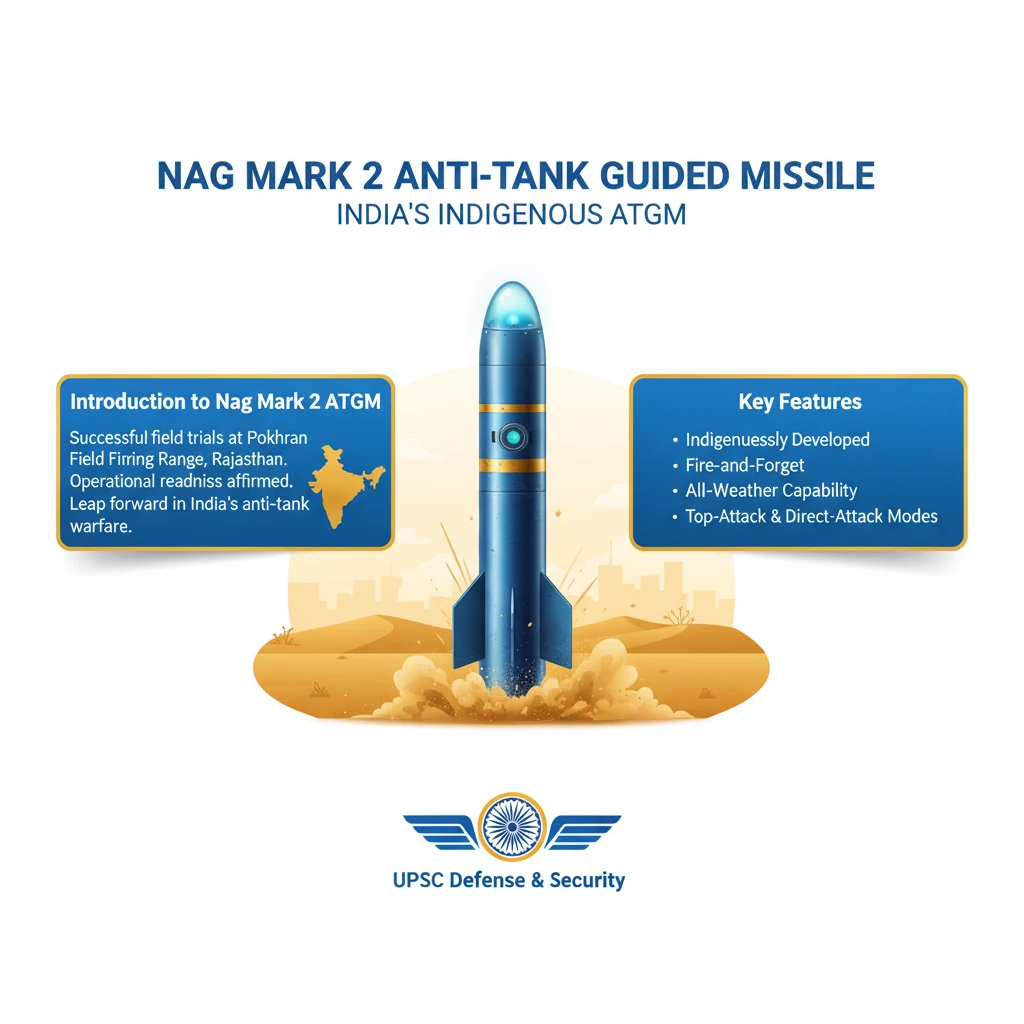
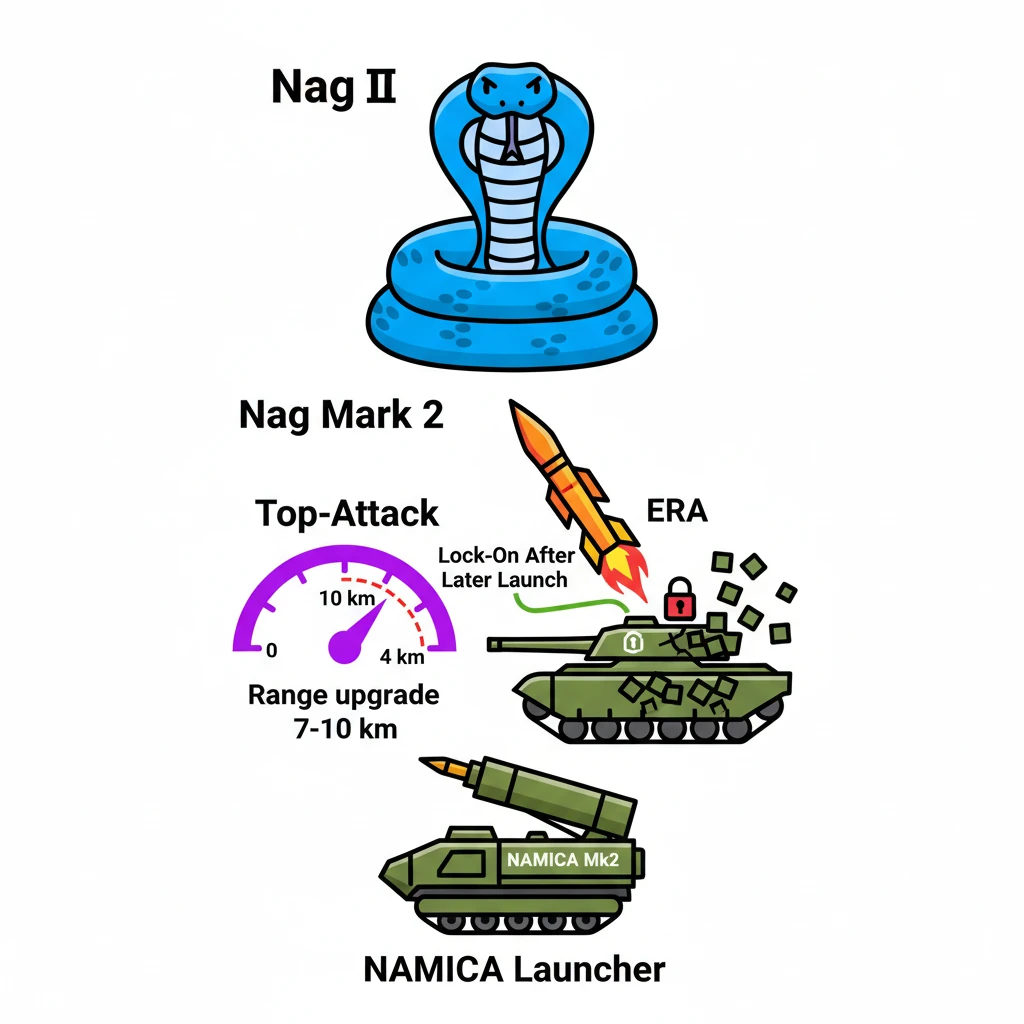
<h4>Introduction to Nag Mark 2 ATGM</h4><p>India has achieved a significant milestone with the successful field trials of the <strong>indigenously developed Nag Mk 2 Anti-Tank Guided Missile (ATGM)</strong>. These crucial tests were conducted at the <strong>Pokhran Field Firing Range</strong> in <strong>Rajasthan</strong>, affirming its operational readiness.</p><p>The <strong>Nag Mk 2</strong> represents a leap forward in India's anti-tank warfare capabilities, enhancing the nation's defense preparedness against modern armored threats.</p><div class='key-point-box'><p>The <strong>Nag Mk 2 ATGM</strong> is a testament to India's growing self-reliance in advanced defense technology, aligning with the <strong>'Atmanirbhar Bharat'</strong> initiative.</p></div><h4>Development and Core Functionality</h4><p>The <strong>Nag Mk 2 ATGM</strong> has been meticulously developed by the <strong>Defence Research and Development Organisation (DRDO)</strong>. It is classified as a <strong>third-generation</strong> missile, signifying its advanced technological features and operational autonomy.</p><p>This missile is designed for <strong>all-weather</strong> operations, ensuring its effectiveness across diverse climatic conditions and terrains. Its core functionality is based on the <strong>fire-and-forget</strong> principle, allowing the launch platform to disengage immediately after firing.</p><div class='info-box'><p><strong>Fire-and-Forget:</strong> A missile guidance system where the missile does not require further guidance after launch and autonomously tracks its target.</p></div><h4>Advanced Engagement Capabilities</h4><p>A key feature of the <strong>Nag Mk 2</strong> is its <strong>lock-on after launch</strong> capability. This allows the missile to be fired towards a general target area and then acquire and track the specific target once airborne, providing greater flexibility and stealth.</p><p>The missile is engineered to autonomously track and engage targets, significantly reducing the operator's workload and increasing the probability of a successful hit.</p><h4>Technical Specifications and Effectiveness</h4><p>The <strong>Nag Mk 2 ATGM</strong> is specifically designed to neutralize <strong>modern armoured vehicles</strong>. This includes tanks equipped with advanced protective measures like <strong>Explosive Reactive Armour (ERA)</strong>.</p><p>To overcome such defenses, it employs a sophisticated <strong>tandem high-explosive anti-tank (HEAT) warhead</strong>. This design ensures enhanced destructive power, capable of penetrating multiple layers of armor.</p><div class='info-box'><p><strong>Warhead Type:</strong> <strong>Tandem HEAT (High-Explosive Anti-Tank)</strong><br><strong>Purpose:</strong> Designed to defeat <strong>Explosive Reactive Armour (ERA)</strong> by detonating a precursor charge to trigger the ERA, followed by a main charge to penetrate the exposed primary armor.</p></div><p>The missile boasts an impressive operational <strong>range</strong> of <strong>7 to 10 km</strong>. This is a significant improvement over its predecessor, the <strong>Nag Mark 1</strong>, which had a range of approximately <strong>4 km</strong>.</p><div class='key-point-box'><p><strong>Range Comparison:</strong><br><ul><li><strong>Nag Mk 2:</strong> 7-10 km</li><li><strong>Nag Mk 1:</strong> ~4 km</li></ul></p></div><h4>Strategic Attack Modes</h4><p>One of the most effective features of the <strong>Nag Mk 2</strong> is its <strong>top-attack capability</strong>. This mode targets the most vulnerable upper surface of armoured vehicles, where the armour protection is typically thinner.</p><p>By striking from above, the missile bypasses the heavily fortified frontal and side armour, significantly increasing its lethality against even the most modern tanks.</p><h4>Launch Platform: NAMICA Version 2</h4><p>The <strong>Nag Mk 2 ATGM</strong> is launched from a specialized vehicle known as the <strong>NAMICA (Nag Missile Carrier) Version 2</strong>. This dedicated platform is crucial for the missile's operational deployment.</p><div class='info-box'><p><strong>NAMICA (Nag Missile Carrier):</strong><br><ul><li>An <strong>anti-tank armoured vehicle</strong> or <strong>tank destroyer vehicle</strong>.</li><li>Used by the <strong>Indian Army</strong> for launching anti-tank missiles.</li><li>Provides mobility, protection, and a stable launch platform for the Nag series of missiles.</li></ul></p></div><div class='exam-tip-box'><p><strong>UPSC Insight:</strong> Questions on indigenous defense systems often focus on their <strong>strategic importance</strong>, <strong>technological advancements</strong>, and contributions to <strong>national security</strong> and <strong>self-reliance</strong>. Understand the 'why' behind such developments.</p></div>
💡 Key Takeaways
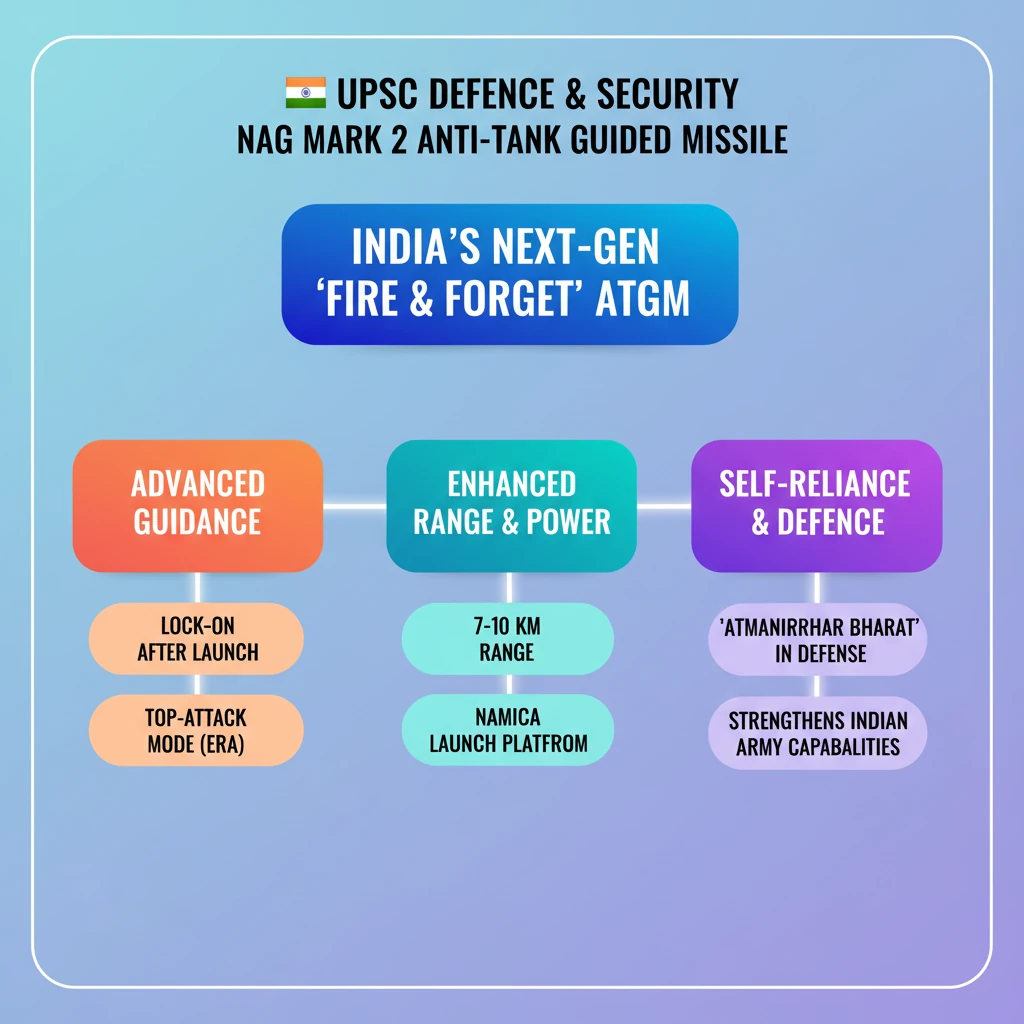
- •Nag Mk 2 is an indigenously developed, third-generation, all-weather, fire-and-forget ATGM by DRDO.
- •It features lock-on after launch capability and a top-attack mode, making it highly effective against modern tanks with ERA.
- •Its range of 7-10 km is a significant upgrade from its predecessor, Nag Mk 1 (4 km).
- •Launched from the NAMICA (Nag Missile Carrier) Version 2, an anti-tank armored vehicle.
- •Boosts India's 'Atmanirbhar Bharat' in defense and strengthens the Indian Army's anti-tank capabilities.
🧠 Memory Techniques
95% Verified Content
📚 Reference Sources
•DRDO Official Website (general information on missile development)