Opium Regulation and Uses - Defence And Security | UPSC Learning
Topics
0 topics • 0 completed
🔍
No topics match your search
Opium Regulation and Uses
Medium⏱️ 8 min read
defence and security
📖 Introduction
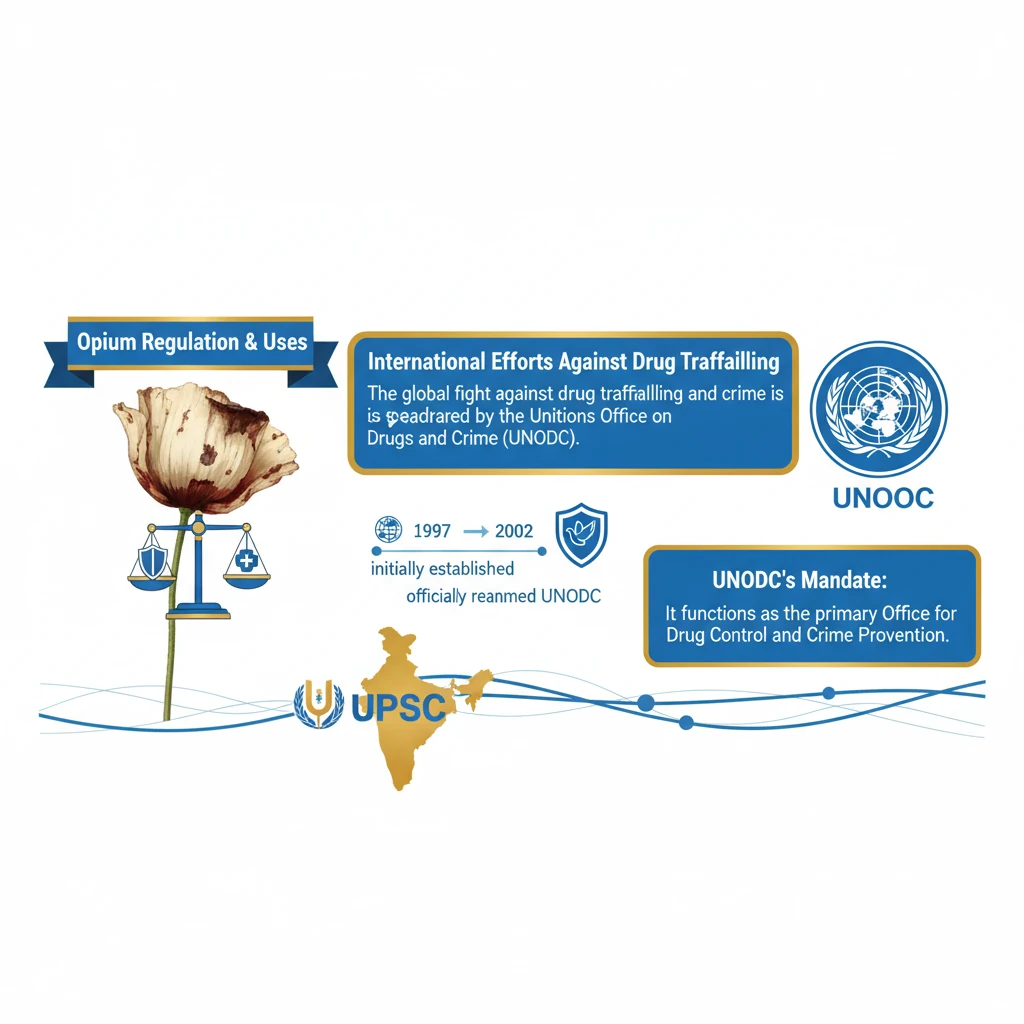
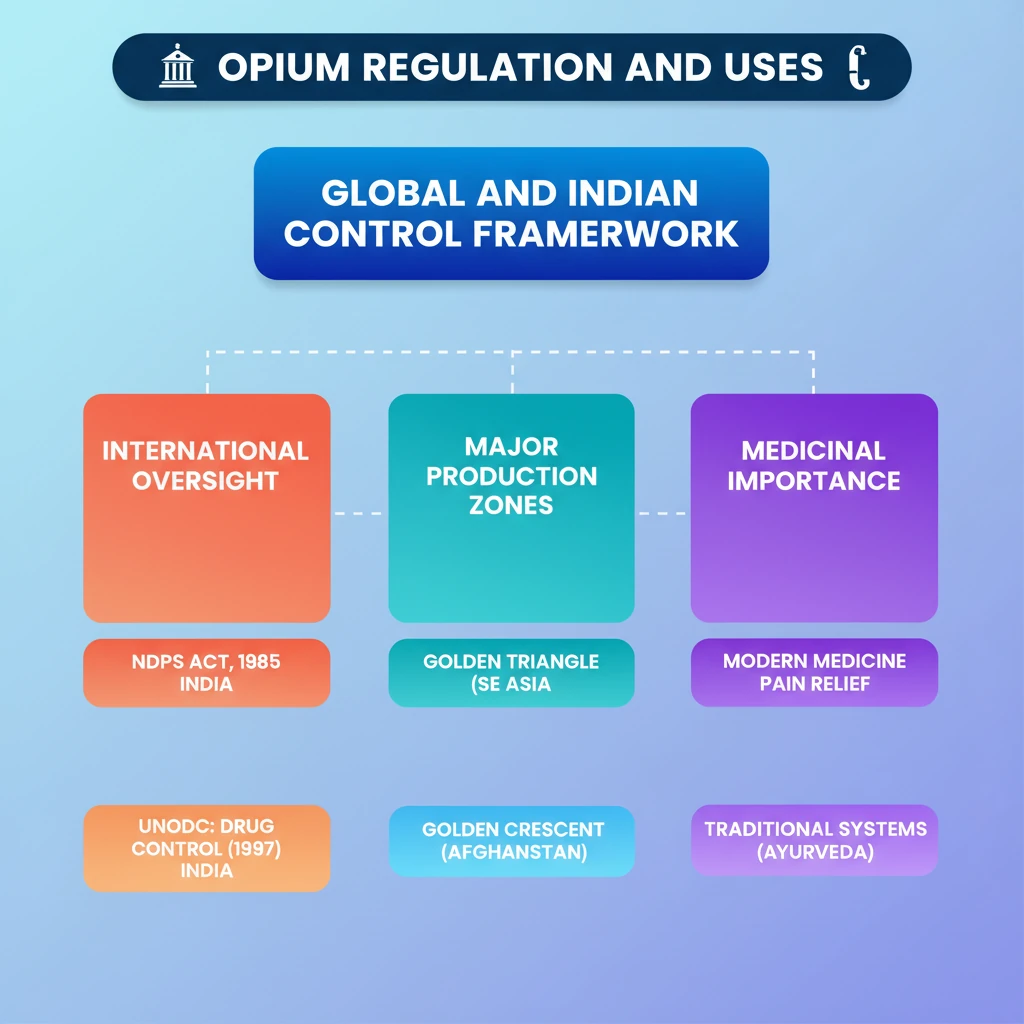
<h4>International Efforts Against Drug Trafficking</h4><p>The global fight against drug trafficking and crime is spearheaded by the <strong>United Nations Office on Drugs and Crime (UNODC)</strong>.</p><p>This crucial international body was initially established in <strong>1997</strong> and officially renamed <strong>UNODC</strong> in <strong>2002</strong>.</p><div class="info-box"><p><strong>UNODC's Mandate:</strong> It functions as the primary Office for <strong>Drug Control and Crime Prevention</strong>, merging the <strong>United Nations International Drug Control Program (UNDCP)</strong> with the <strong>Crime Prevention and Criminal Justice Division</strong> of the United Nations Office in Vienna.</p></div><h4>Global Hotspots of Illicit Drug Production</h4><p>The world's illicit drug trade is heavily influenced by specific geographical regions known for extensive cultivation and production of narcotics, particularly <strong>opium</strong>.</p><div class="info-box"><p><strong>The Golden Triangle:</strong> This notorious region in <strong>Southeast Asia</strong> is a major source of illicit drugs, predominantly <strong>Opium</strong>. It encompasses areas where the borders of three countries converge: <strong>Myanmar</strong> (formerly Burma), <strong>Laos</strong>, and <strong>Thailand</strong>.</p></div><div class="info-box"><p><strong>The Golden Crescent:</strong> Also termed the “Death Crescent,” this region is another significant hub for illicit drug production and transit. It primarily includes <strong>Afghanistan</strong> and <strong>Iran</strong>, serving as a natural smuggling route for drugs originating from <strong>Pakistan</strong>.</p></div><h4>Opium Regulation Framework in India</h4><p>In India, the cultivation of <strong>opium poppy</strong> and the production of <strong>opium</strong> are strictly regulated under comprehensive legal frameworks.</p><p>The primary legislative instruments governing these activities are the <strong>Narcotic Drugs & Psychotropic Substances Act, 1985 (NDPS Act)</strong> and the <strong>Narcotic Drugs & Psychotropic Substances Rules, 1985</strong>.</p><div class="key-point-box"><p><strong>Key Authority:</strong> The <strong>Narcotics Commissioner</strong> is the designated authority responsible for all functions related to the superintendence of <strong>opium poppy cultivation</strong> and subsequent <strong>opium production</strong> in India.</p></div><h4>Designated Opium Cultivation Tracts in India</h4><p>To ensure strict control and monitoring, the cultivation of <strong>opium poppy</strong> is permitted only in specific tracts that are officially notified by the <strong>Government of India</strong>.</p><p>Currently, these designated cultivation areas are concentrated within three Indian states.</p><ul><li><strong>Madhya Pradesh</strong></li><li><strong>Rajasthan</strong></li><li><strong>Uttar Pradesh</strong></li></ul><div class="info-box"><p><strong>Major Contributing Districts:</strong> Approximately <strong>80%</strong> of the total area cultivated for opium poppy is located in the districts of <strong>Mandsaur</strong> in Madhya Pradesh, and <strong>Chittorgarh</strong> and <strong>Jhalawar</strong> in Rajasthan.</p></div><h4>Diverse Uses of Opium</h4><p>Despite its illicit applications, <strong>opium</strong> possesses significant therapeutic value and is considered indispensable in the legitimate medical world.</p><p>Its unique properties make it a vital component in various healthcare systems.</p><ul><li><strong>Modern Medicine:</strong> Opium derivatives are crucial for pain management and other therapeutic applications.</li><li><strong>Indigenous Medicine Systems:</strong> It is also utilized in traditional Indian systems such as <strong>Homeopathy</strong>, <strong>Ayurveda</strong>, and <strong>Unani</strong> medicines.</li></ul><h4>India's Initiatives Against Drug Abuse</h4><p>The Government of India has launched several initiatives to combat drug abuse and reduce demand for illicit substances across the nation.</p><div class="exam-tip-box"><p>These initiatives are crucial for understanding India's strategy in tackling the drug menace, often asked in <strong>GS-II</strong> and <strong>GS-III</strong> papers related to social justice and internal security.</p></div><ul><li><strong>Nasha Mukt Bharat Abhiyaan (Drugs-Free India Campaign):</strong> A flagship program aimed at creating awareness and reducing substance abuse.</li><li><strong>National Action Plan for Drug Demand Reduction (NAPDR):</strong> Focuses on preventive education, awareness generation, identification, treatment, and rehabilitation of drug dependents.</li><li><strong>Narco-Coordination Centre (NCORD):</strong> Established to ensure effective coordination among various central and state agencies to combat drug trafficking.</li><li><strong>National Fund to Control Drug Abuse:</strong> Provides financial assistance for activities related to drug abuse prevention, awareness, and rehabilitation.</li></ul>
💡 Key Takeaways
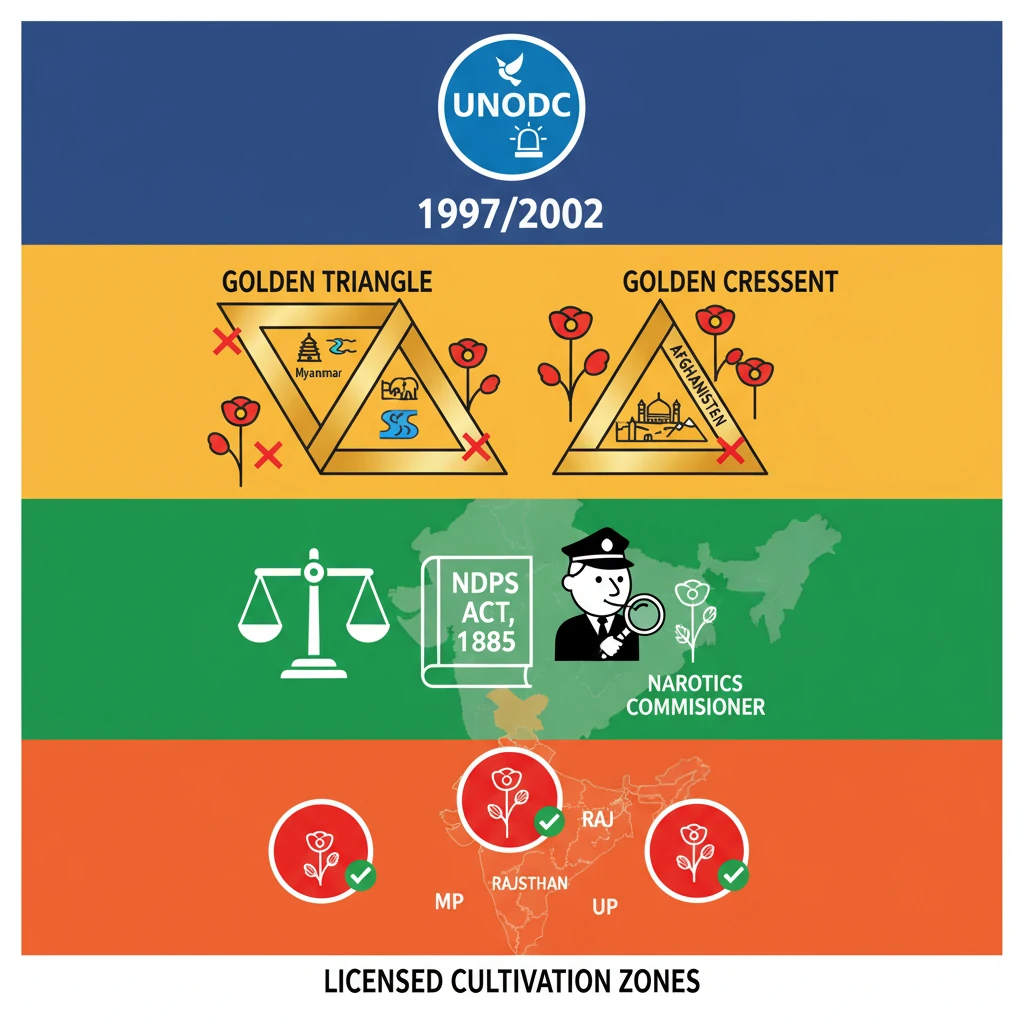
- •UNODC is the key international body for drug control and crime prevention, established in 1997/2002.
- •Golden Triangle (Myanmar, Laos, Thailand) and Golden Crescent (Afghanistan, Iran) are major illicit opium production/transit zones.
- •India regulates opium cultivation under the NDPS Act, 1985, overseen by the Narcotics Commissioner.
- •Licensed opium poppy cultivation in India is confined to Madhya Pradesh, Rajasthan, and Uttar Pradesh.
- •Opium has vital medicinal uses in modern and traditional systems (Ayurveda, Unani, Homeopathy) alongside its illicit potential.
- •India's anti-drug initiatives include Nasha Mukt Bharat Abhiyaan, National Action Plan for Drug Demand Reduction, and Narco-Coordination Centre.
🧠 Memory Techniques
95% Verified Content
📚 Reference Sources
•United Nations Office on Drugs and Crime (UNODC) official website (implied)
•Narcotic Drugs and Psychotropic Substances Act, 1985 (implied)