What is Armed Forces Special Powers Act (AFSPA), 1958? - Defence And Security | UPSC Learning
Topics
0 topics • 0 completed
🔍
No topics match your search
What is Armed Forces Special Powers Act (AFSPA), 1958?
Medium⏱️ 8 min read
defence and security
📖 Introduction
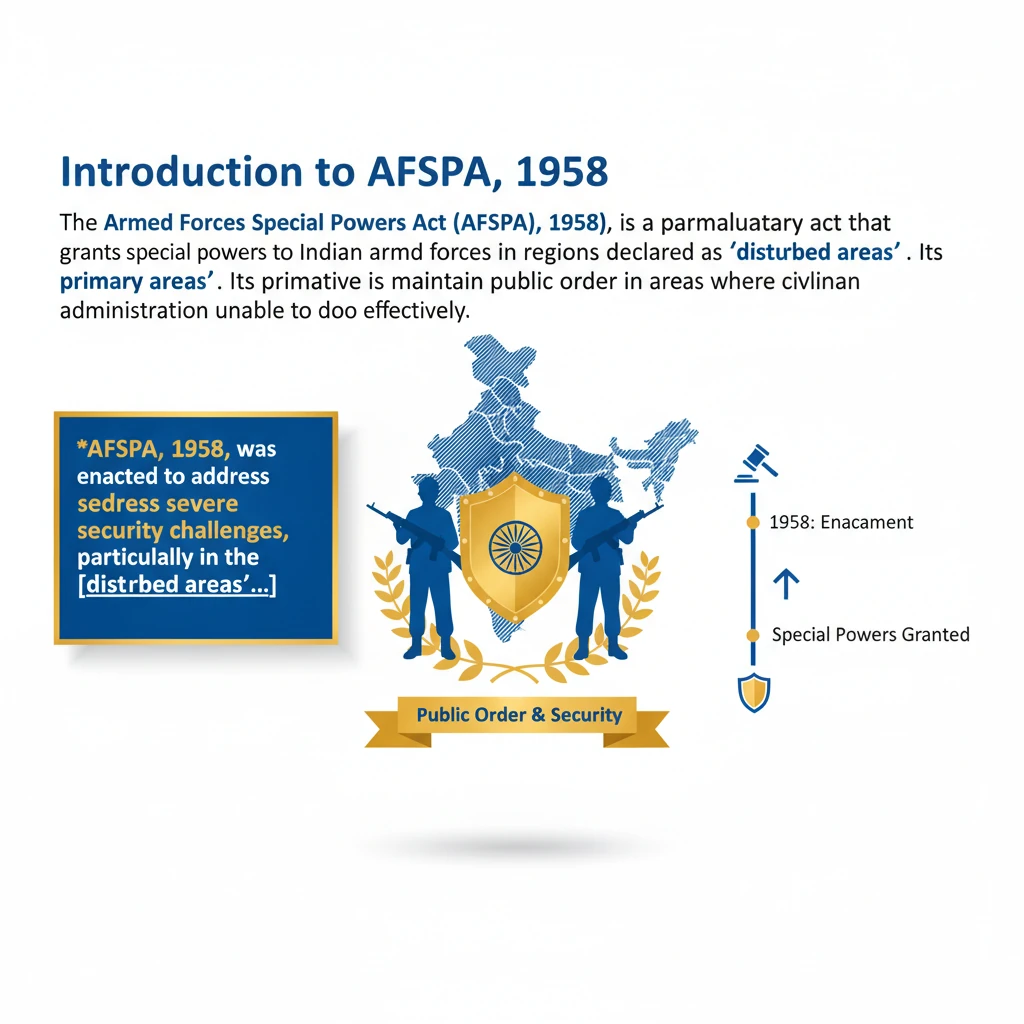
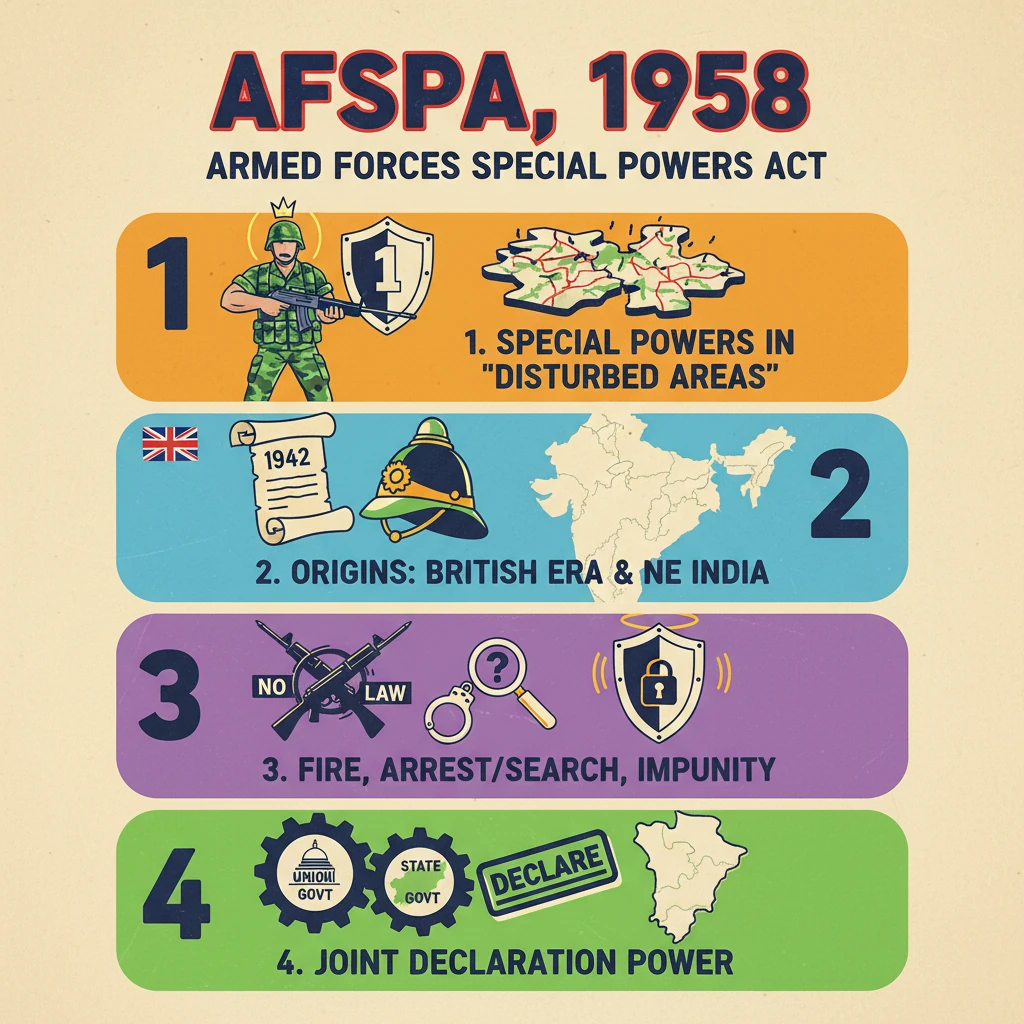
<h4>Introduction to AFSPA, 1958</h4><p>The <strong>Armed Forces Special Powers Act (AFSPA), 1958</strong>, is a parliamentary act that grants special powers to the Indian armed forces in regions declared as <strong>"disturbed areas"</strong>. Its primary objective is to maintain public order in areas where civilian administration is unable to do so effectively.</p><div class='key-point-box'><p><strong>AFSPA, 1958</strong>, was enacted to address severe security challenges, particularly in the <strong>North-eastern States</strong>, where state governments struggled to manage escalating violence. It became law on <strong>11th September 1958</strong>.</p></div><h4>Historical Genesis of AFSPA</h4><p>The origins of AFSPA can be traced back to the <strong>British colonial government</strong>. On <strong>15th August 1942</strong>, they introduced the <strong>Armed Forces Special Powers Ordinance</strong> to suppress the widespread <strong>Quit India Movement</strong>.</p><p>Following India's independence and partition in <strong>1947</strong>, the Indian government passed several ordinances, including one for <strong>"Assam disturbed areas"</strong>, to tackle emerging security challenges in the region.</p><p>The <strong>Armed Forces (Assam and Manipur) Special Powers Act, 1958</strong>, succeeded the <strong>Assam Disturbed Areas Act of 1955</strong>. This was specifically enacted to address significant unrest in the <strong>Naga hills</strong>. The current <strong>AFSPA</strong> later replaced this act for broader application.</p><h4>Key Provisions and Powers under AFSPA</h4><p>AFSPA grants <strong>extensive powers</strong> to both the <strong>armed forces</strong> and <strong>Central Armed Police Forces</strong> operating in declared disturbed areas. These powers are designed to enable them to effectively counter insurgency and maintain law and order.</p><div class='info-box'><p>Key powers granted under AFSPA include:</p><ul><li>Authority to <strong>fire upon individuals</strong> violating law or acting against public order, even causing death, if deemed necessary for maintaining peace.</li><li>Power to <strong>arrest and search premises without a warrant</strong>, based on reasonable suspicion, and to use force for such actions.</li><li><strong>Protection from prosecution and legal suits</strong> for actions taken under the Act, unless specifically sanctioned by the <strong>Central government</strong>.</li></ul></div><h4>Declaration of 'Disturbed Areas'</h4><p>An area can be declared <strong>"disturbed"</strong> by either the <strong>State government</strong> or the <strong>Union government</strong> through an official notification. This declaration is a prerequisite for the armed forces to exercise authority under AFSPA in that specific region.</p>
💡 Key Takeaways
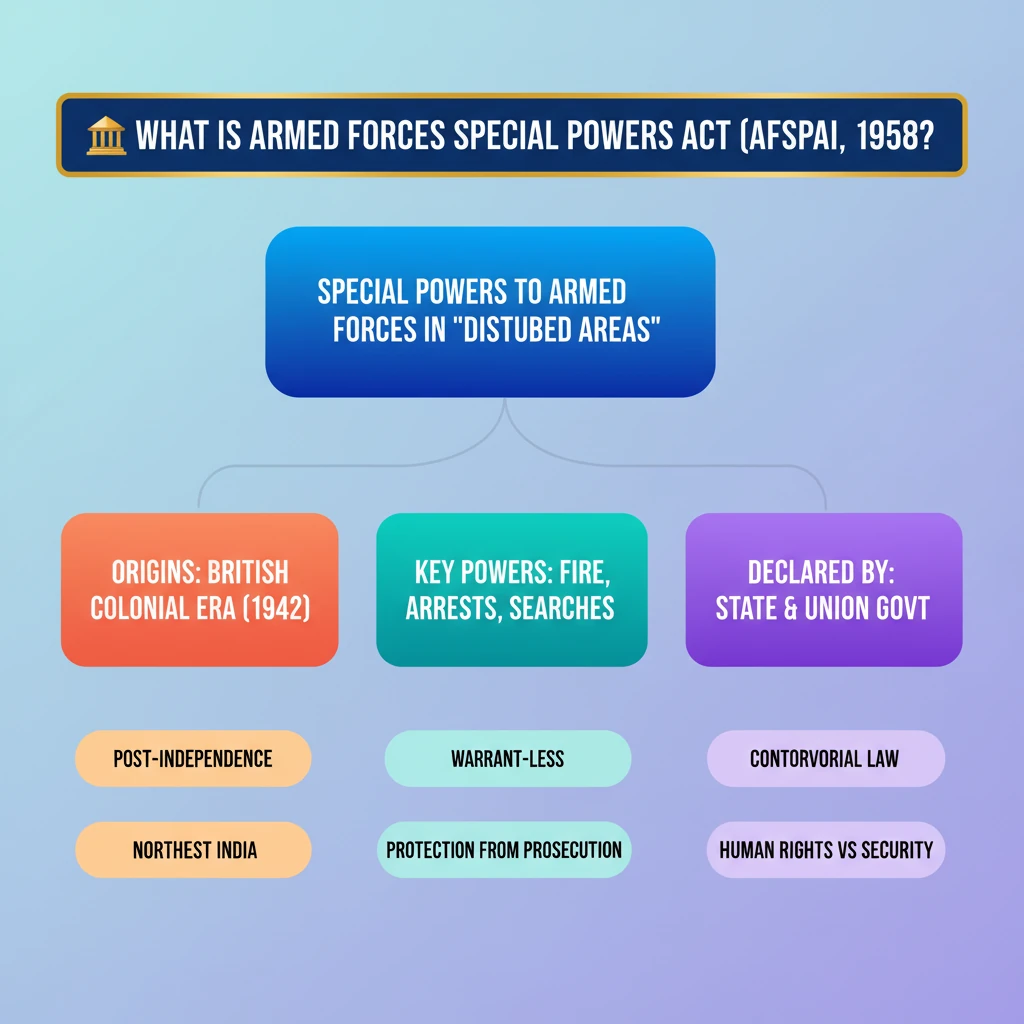
- •AFSPA, 1958, grants special powers to armed forces in 'disturbed areas' to maintain public order.
- •Its origins trace back to the British colonial era (1942 Ordinance) and post-independence challenges in the Northeast.
- •Key powers include firing on law violators, warrant-less arrests/searches, and protection from prosecution.
- •Both State and Union governments can declare an area 'disturbed' for AFSPA's application.
- •AFSPA remains controversial due to human rights concerns vs. its perceived necessity for internal security.
🧠 Memory Techniques
95% Verified Content
📚 Reference Sources
•Official parliamentary records for AFSPA enactment date
•Government of India notifications regarding 'disturbed areas' and withdrawals