Operation Meghdoot - Defence And Security | UPSC Learning
Topics
0 topics • 0 completed
🔍
No topics match your search
Operation Meghdoot
Medium⏱️ 6 min read
defence and security
📖 Introduction
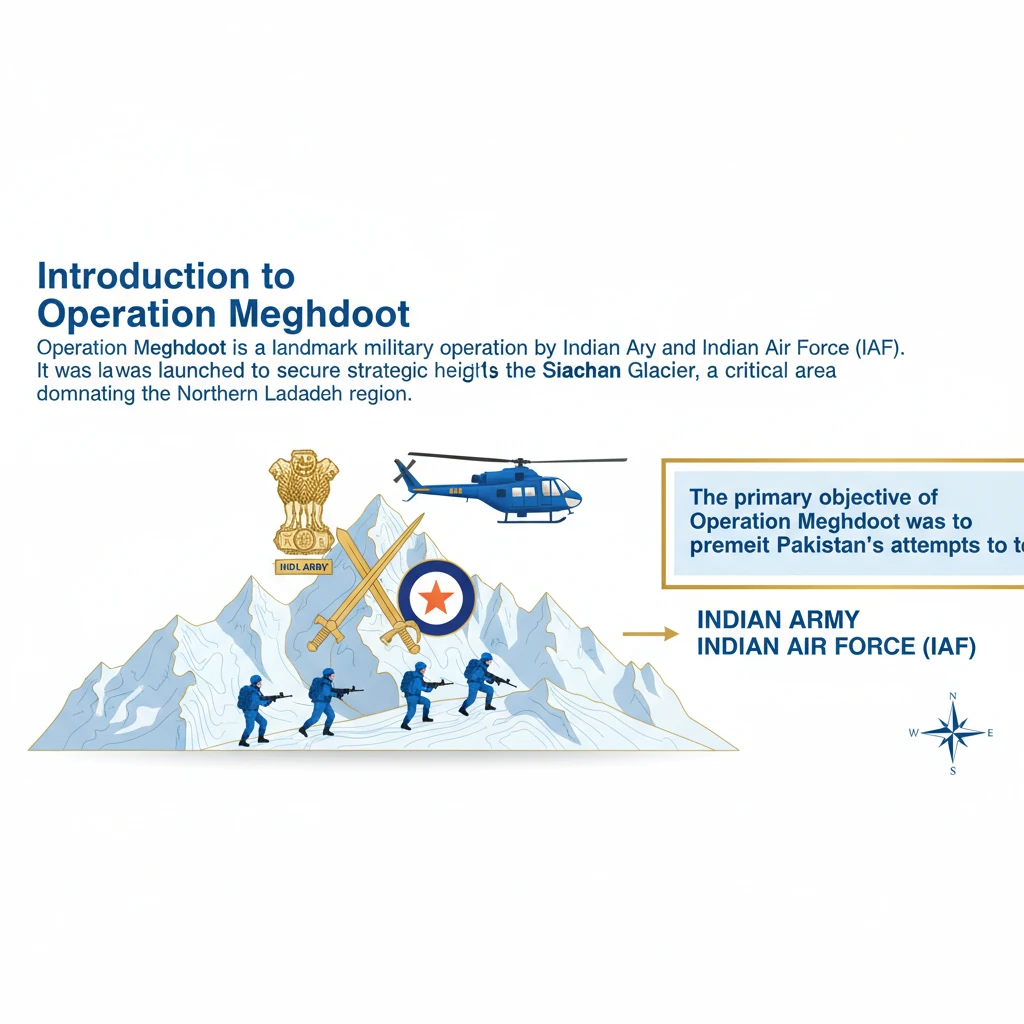
<h4>Introduction: 40 Years of Operation Meghdoot</h4><p>In <strong>April 2024</strong>, <strong>Operation Meghdoot</strong> marked its <strong>40th anniversary</strong>. This milestone commemorates the significant achievements of the <strong>Indian Army</strong> and the <strong>Indian Air Force (IAF)</strong> in securing the strategically vital heights of the <strong>Siachen Glacier</strong>, which dominate the <strong>Northern Ladakh region</strong>.</p><div class='key-point-box'><p><strong>Operation Meghdoot</strong> stands as a testament to India's resolve and capability in conducting complex military operations in extreme high-altitude environments.</p></div><h4>Understanding the Operation's Execution</h4><p>The core of <strong>Operation Meghdoot</strong> involved a meticulously planned airlifting strategy. The <strong>IAF</strong> played a crucial role by transporting <strong>Indian Army soldiers</strong> and essential supplies.</p><p>These personnel and provisions were strategically dropped onto the formidable <strong>Siachen Glacier</strong>, enabling the Indian forces to establish control over key positions.</p><h4>Genesis of the Siachen Dispute</h4><p>The <strong>Siachen Glacier</strong> has been a persistent point of contention between India and Pakistan. Its disputed status dates back to the <strong>Karachi Agreement</strong> signed in <strong>July 1949</strong>, which left the demarcation line ambiguous in this extreme northern sector.</p><p>During the <strong>1980s</strong>, <strong>Pakistan</strong> intensified its efforts to legitimize its claim over the <strong>Siachen Glacier</strong>. These aggressive attempts prompted India to take decisive action to secure its territorial integrity.</p><h4>Launch and Objectives of Operation Meghdoot</h4><p><strong>Operation Meghdoot</strong> was officially launched on <strong>13th April 1984</strong>. This critical military initiative saw the rapid advancement of both the <strong>Indian Army</strong> and the <strong>Indian Air Force (IAF)</strong> towards the <strong>Siachen Glacier</strong>.</p><p>The primary objective was to pre-empt Pakistani occupation and secure the dominating heights in the <strong>Northern Ladakh region</strong>, ensuring India's strategic advantage.</p><h4>Strategic Outcomes and Gains</h4><p>The successful execution of <strong>Operation Meghdoot</strong> led to significant territorial gains for India. The operation secured the entire <strong>70 kilometres long Siachen Glacier</strong>, along with all its tributary glaciers.</p><p>Crucially, India also gained control over three main passes of the vital <strong>Saltoro Ridge</strong>. These strategic passes are <strong>Sia La</strong>, <strong>Bilafond La</strong>, and <strong>Gyong La</strong>, which are critical for military control of the region.</p><div class='exam-tip-box'><p>For UPSC exams, remember the <strong>dates</strong> (<strong>13th April 1984</strong>, <strong>April 2024</strong>), the <strong>forces involved</strong> (<strong>Indian Army</strong>, <strong>IAF</strong>), and the <strong>strategic gains</strong> (<strong>Siachen Glacier</strong>, <strong>Saltoro Ridge passes</strong>) as these are frequently tested factual points.</p></div>
💡 Key Takeaways
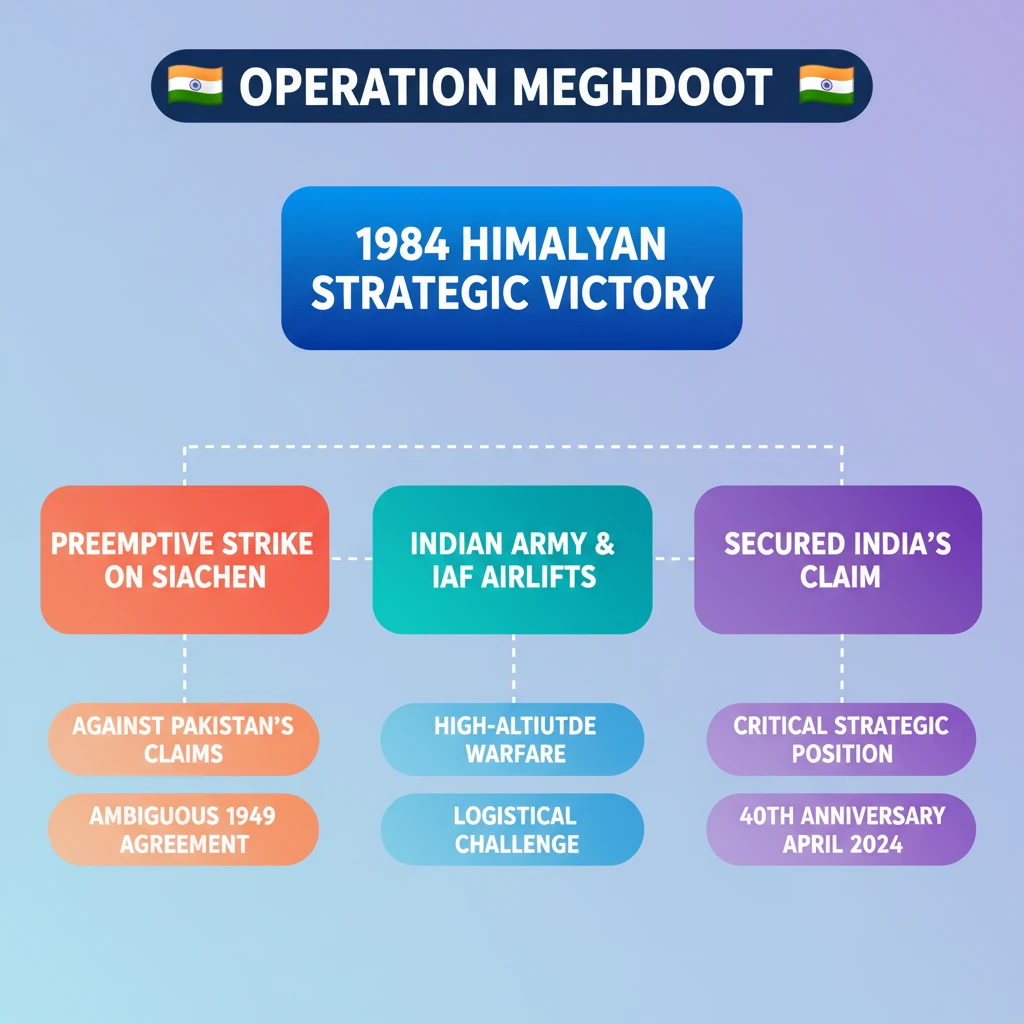
- •Operation Meghdoot was launched on 13th April 1984 by the Indian Army and IAF.
- •Its objective was to secure the Siachen Glacier and Saltoro Ridge passes (Sia La, Bilafond La, Gyong La) in Northern Ladakh.
- •The operation was a pre-emptive response to Pakistan's attempts to claim Siachen, a dispute stemming from the 1949 Karachi Agreement.
- •India successfully gained control of the 70 km long Siachen Glacier and its tributary glaciers.
- •April 2024 marked the 40th anniversary of Operation Meghdoot, reaffirming its enduring strategic significance for India's defense.
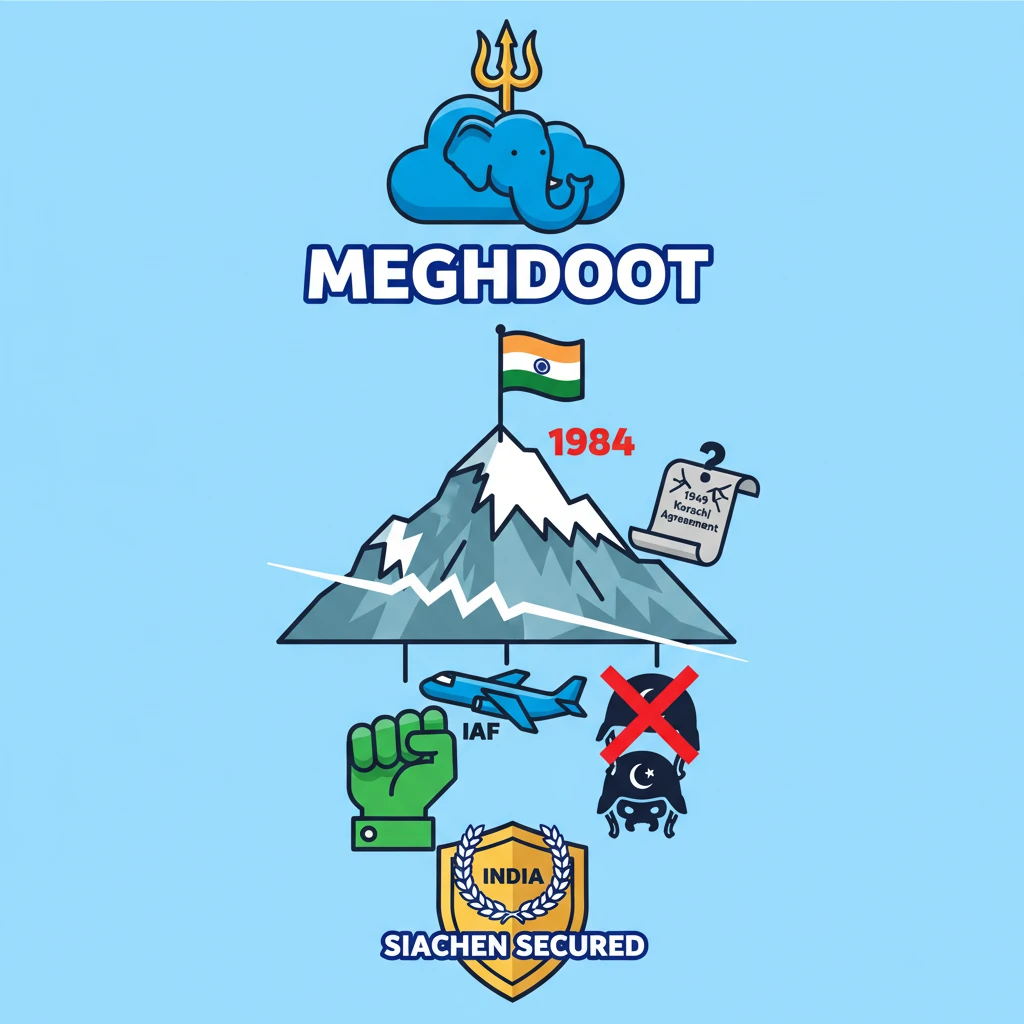
🧠 Memory Techniques
98% Verified Content