Rise of Minilateralism - Defence And Security | UPSC Learning
Topics
0 topics • 0 completed
🔍
No topics match your search
Rise of Minilateralism
Medium⏱️ 7 min read
defence and security
📖 Introduction
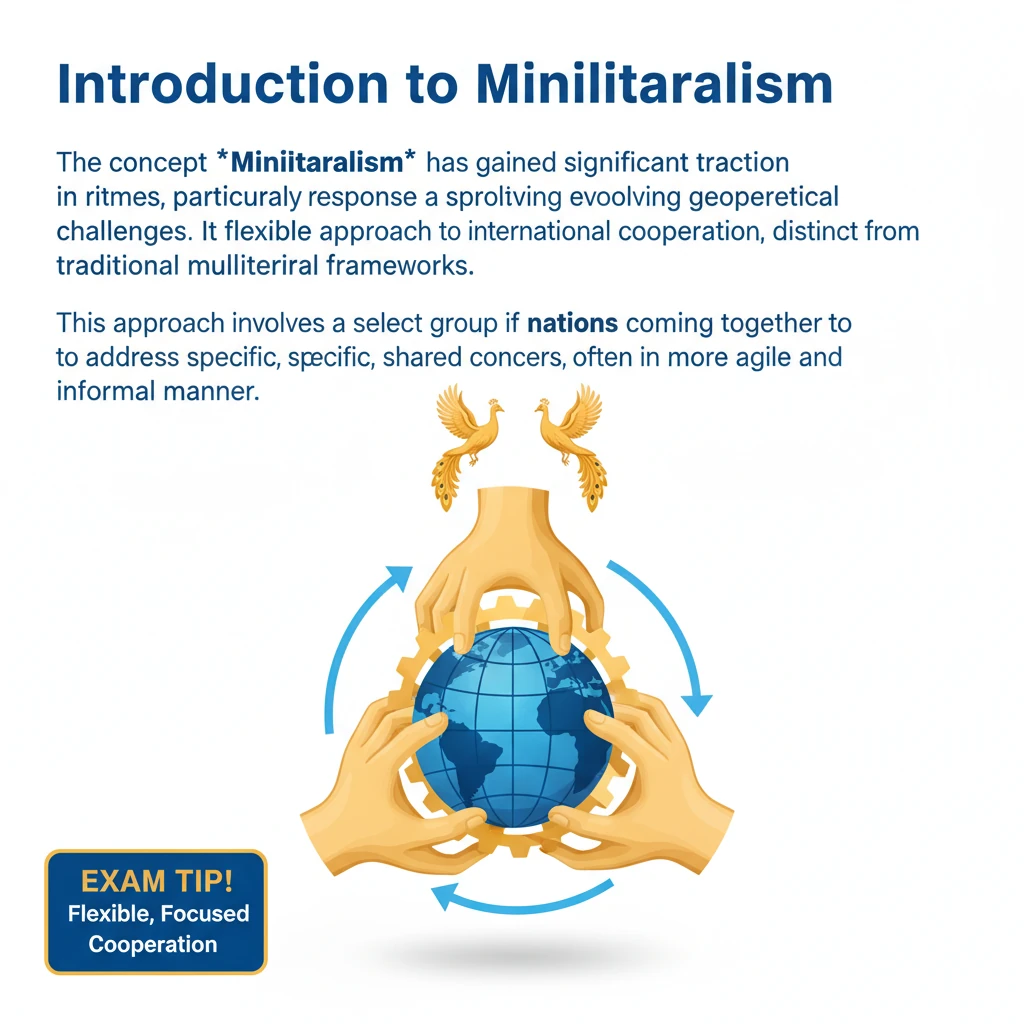
<h4>Introduction to Minilateralism</h4><p>The concept of <strong>Minilateralism</strong> has gained significant traction in recent times, particularly in response to evolving geopolitical challenges. It represents a flexible approach to international cooperation, distinct from traditional multilateral frameworks.</p><p>This approach involves a select group of nations coming together to address specific, shared concerns, often in a more agile and informal manner.</p><div class='exam-tip-box'><p>For <strong>UPSC Mains GS Paper 2</strong> (International Relations), understanding <strong>Minilateralism</strong> is crucial for analyzing contemporary global governance and security architectures. It's often contrasted with <strong>Multilateralism</strong> and <strong>Bilateralism</strong>.</p></div><h4>Why Minilateralism is in the News</h4><p>Recently, the increasing <strong>Chinese aggression</strong> in the <strong>Indo-Pacific region</strong> has been a primary driver for the emergence and emphasis on minilateral groupings. This assertive posture by China has necessitated new forms of cooperation among concerned nations.</p><p>A notable example highlighting this trend is the formation of "the <strong>Squad</strong>". This grouping underscores the growing importance of <strong>minilateralism</strong> as a strategic response to regional security dynamics.</p><div class='info-box'><p>The <strong>Squad</strong> is an informal multilateral group comprising the <strong>United States</strong>, <strong>Japan</strong>, <strong>Australia</strong>, and the <strong>Philippines</strong>. Its formation directly reflects the need for focused cooperation in the Indo-Pacific.</p></div><h4>Defining Minilateralism</h4><p><strong>Minilateralism</strong> refers to international cooperation initiatives that are both <strong>informal</strong> and highly <strong>targeted</strong>. These arrangements are designed to address particular challenges or security issues effectively.</p><div class='key-point-box'><p>Key characteristics include a <strong>small number of states</strong> (typically three or four) involved, all sharing a common interest in resolving a specific issue within a <strong>finite period</strong>.</p></div><p>Unlike broader multilateral organizations, minilateral arrangements prioritize a <strong>specific purpose</strong> over extensive inclusivity. They are characterized by their lack of a <strong>permanent</strong> or <strong>formal institutional structure</strong>.</p>
💡 Key Takeaways
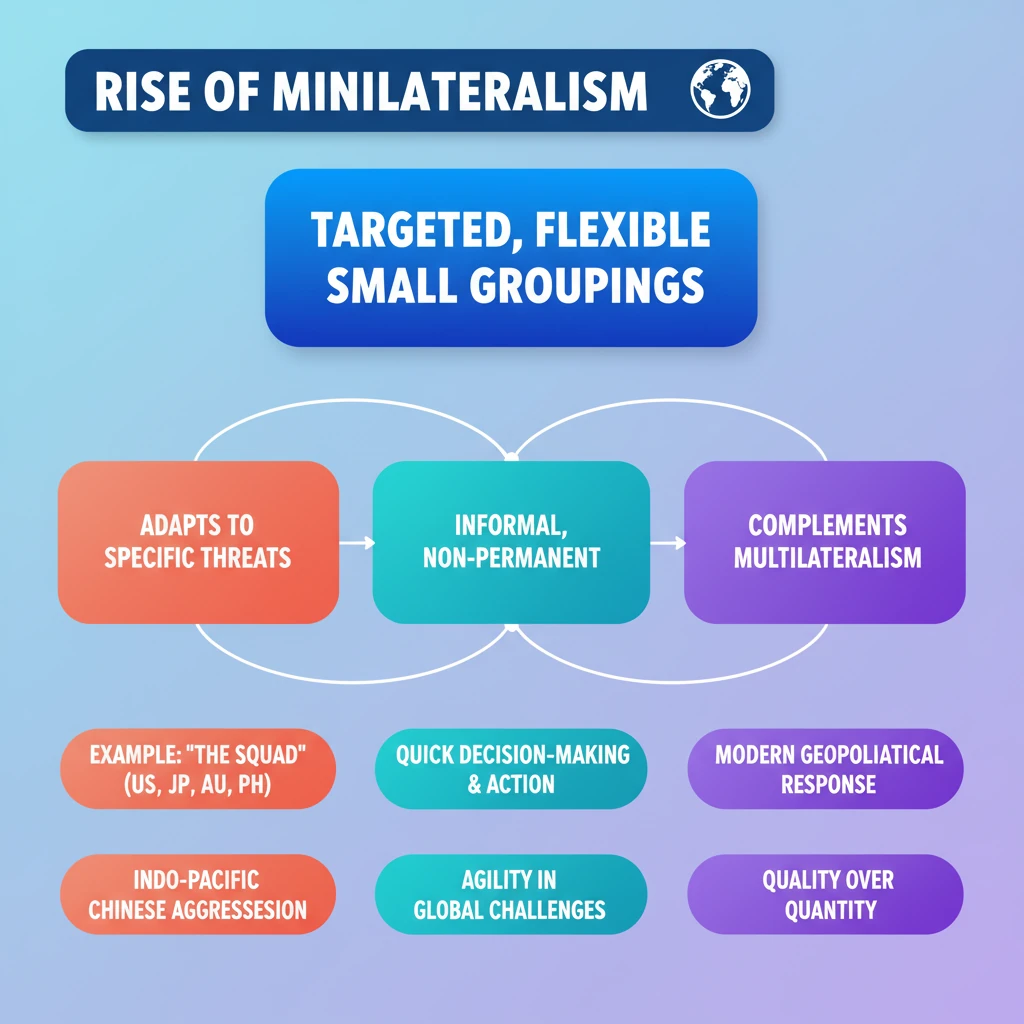
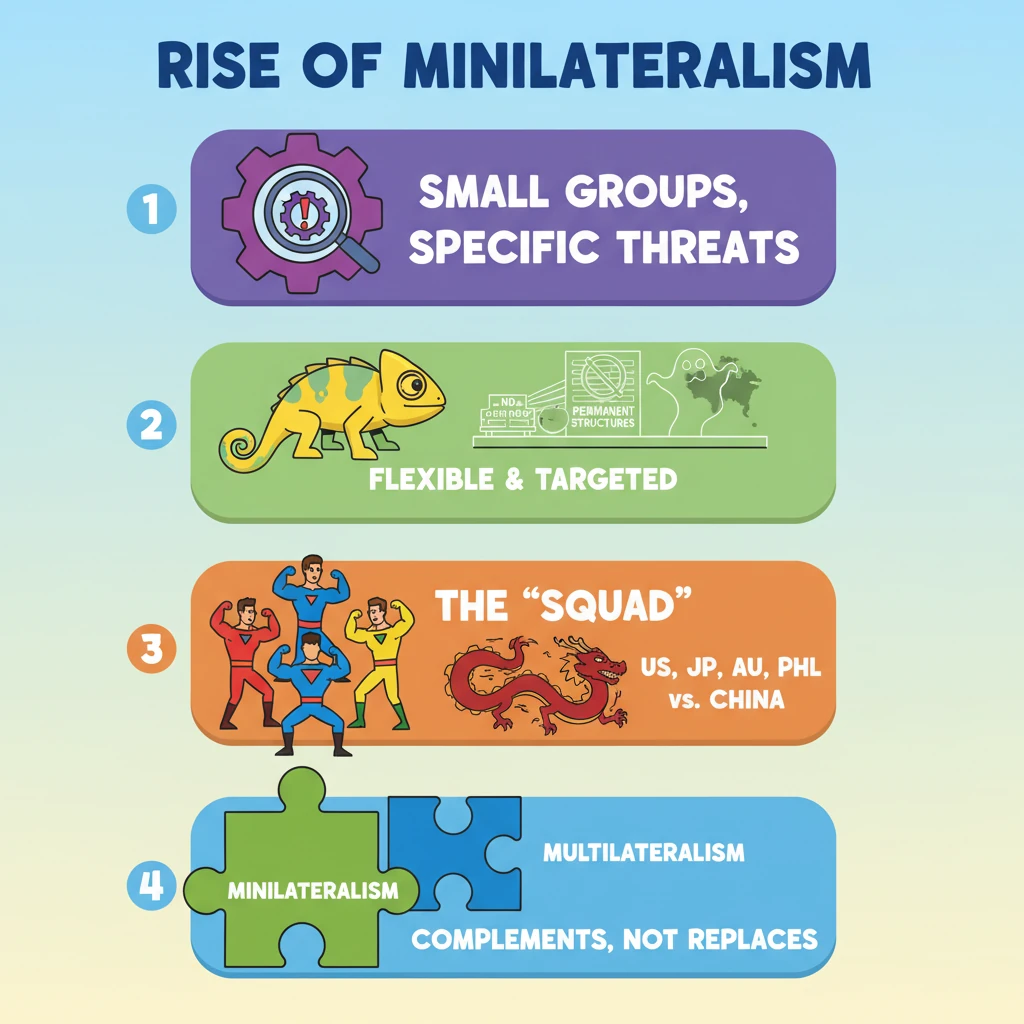
- •Minilateralism involves small, informal groups addressing specific threats or issues.
- •It is a targeted, flexible approach, often without permanent institutional structures.
- •The "Squad" (US, Japan, Australia, Philippines) is a key example, formed due to Chinese aggression in the Indo-Pacific.
- •It complements, rather than replaces, traditional multilateralism by offering agility.
- •It is a contemporary response to complex global challenges and geopolitical shifts.
🧠 Memory Techniques
95% Verified Content