Minilateral Groupings: QUAD, AUKUS & Other Partnerships for UPSC - Defence And Security | UPSC Learning
Topics
0 topics • 0 completed
🔍
No topics match your search
Minilateral Groupings: QUAD, AUKUS & Other Partnerships for UPSC
Medium⏱️ 7 min read
defence and security
📖 Introduction
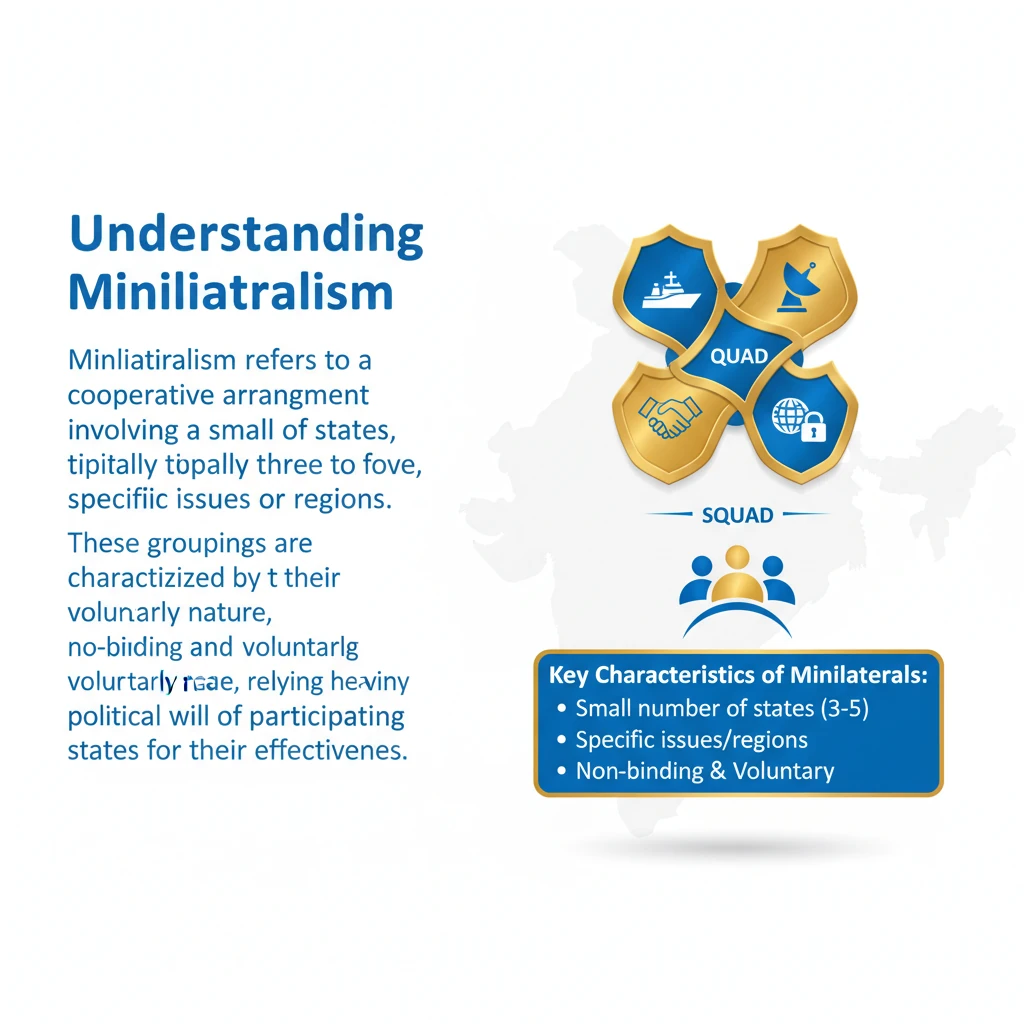
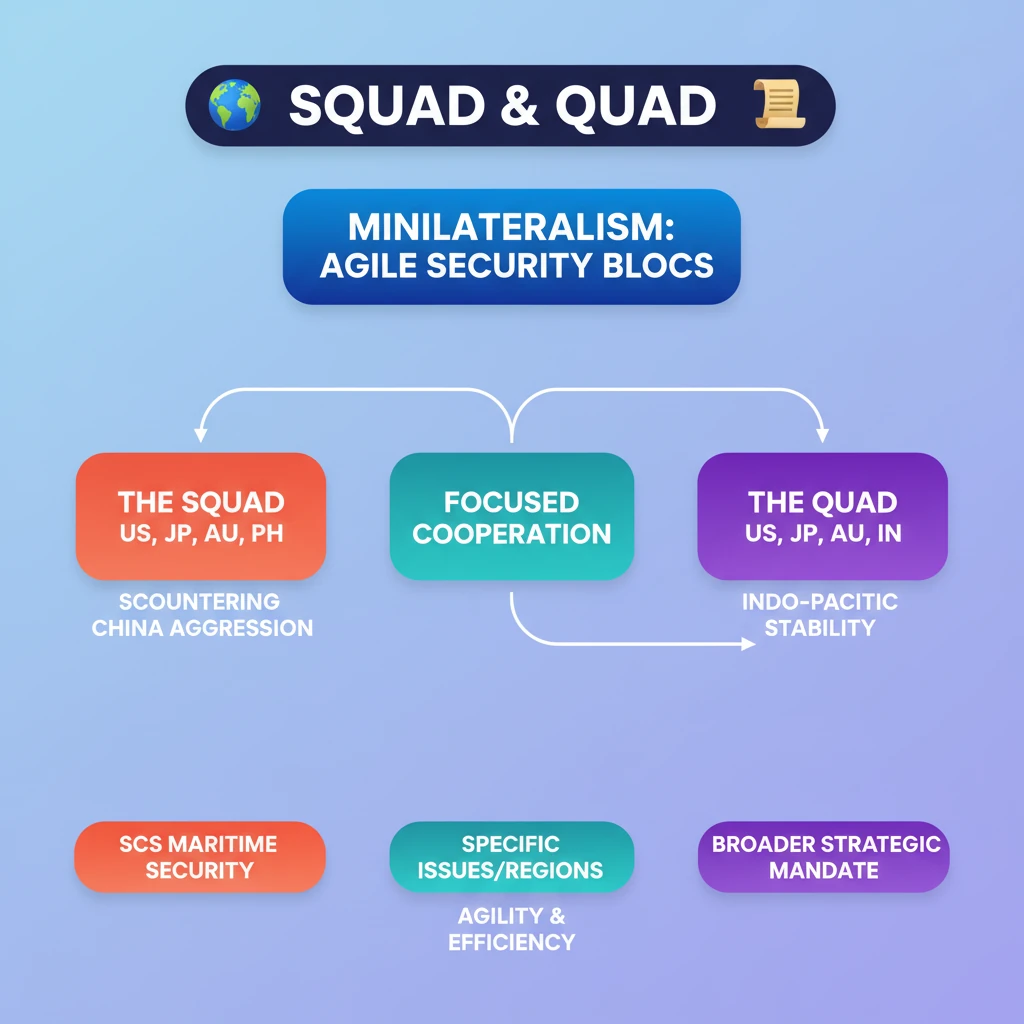
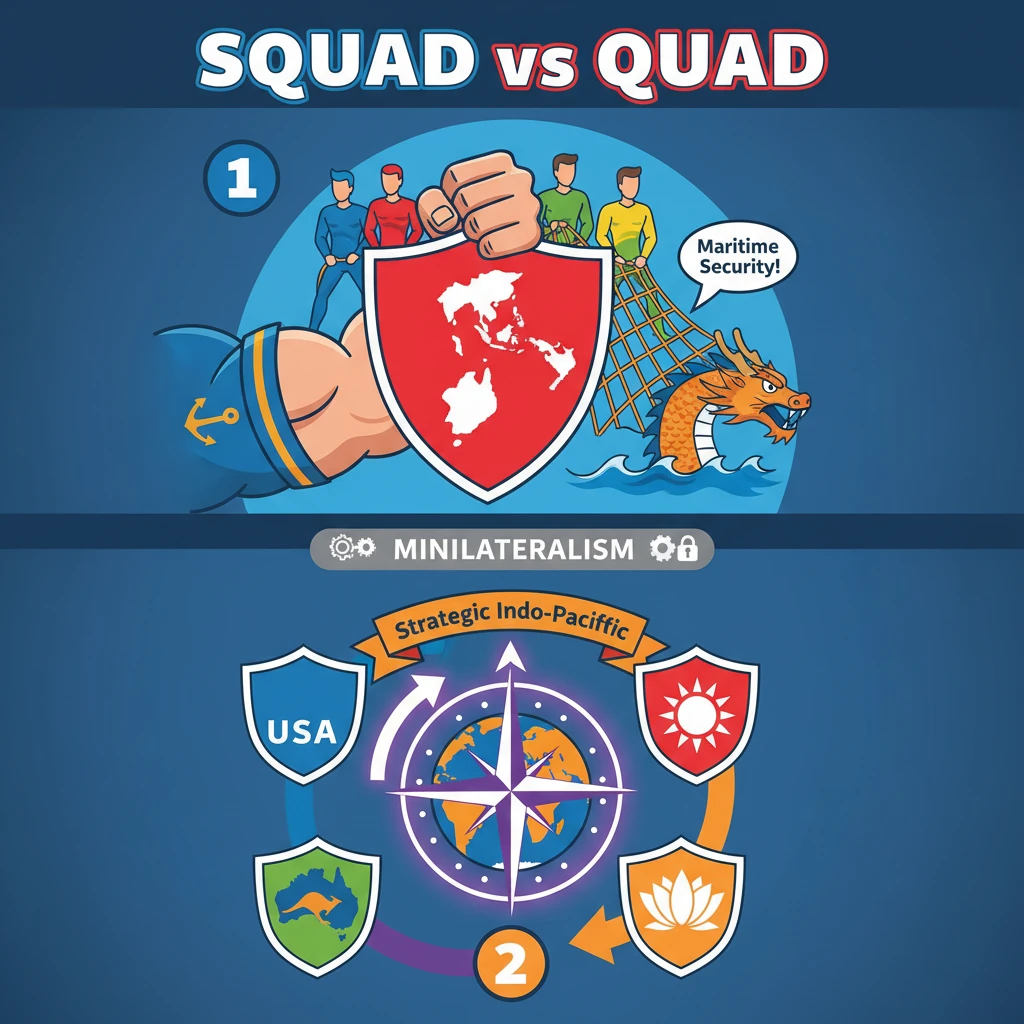
<h4>Understanding Minilateralism</h4><p><strong>Minilateralism</strong> refers to a cooperative arrangement involving a small number of states, typically three to five, focused on specific issues or regions.</p><p>These groupings are characterized by their <strong>non-binding</strong> and <strong>voluntary</strong> nature, relying heavily on the political will of participating states for their effectiveness.</p><div class='info-box'><p><strong>Key Characteristics of Minilaterals:</strong><ul><li><strong>Non-binding:</strong> Commitments are not legally enforceable.</li><li><strong>Voluntary:</strong> Participation is based on mutual interest and willingness.</li><li><strong>Focused:</strong> Often address specific issues or regional challenges.</li><li><strong>Flexible:</strong> Can adapt quickly to evolving geopolitical landscapes.</li></ul></p></div><h4>Types of Minilateral Groupings</h4><p>Minilaterals can be categorized based on their scope and leadership structure, reflecting diverse strategic objectives.</p><ul><li><strong>Partnership Minilaterals:</strong> Focus on broader cooperation among multiple states. Examples include <strong>Quad</strong>; <strong>Australia-UK-US trilateral security mechanism (AUKUS)</strong>; <strong>Comprehensive and Progressive Agreement for Trans-Pacific Partnership (CPTPP)</strong>; <strong>India-Japan-Australia trilateral</strong>; and <strong>India-Israel-UAE-US mechanism (I2U2)</strong>.</li><li><strong>Single-Power Led Minilaterals:</strong> Initiated and often driven by a single dominant power. Examples include <strong>Belt and Road Initiative (BRI)</strong>; <strong>Lancang-Mekong Cooperation (LMC)</strong>; and <strong>Mekong-US Partnership (MUSP)</strong>.</li><li><strong>Sectoral Minilaterals:</strong> Concentrate on specific sectors like digital economy or regional development. Examples include <strong>Digital Economy Partnership Agreement (DEPA)</strong>; and <strong>Brunei-Indonesia-Malaysia-Philippines East ASEAN Growth Area (BIMP-EAGA)</strong>.</li><li><strong>Issue-Based Minilaterals:</strong> Formed to address particular challenges such as climate change or maritime security. Examples include <strong>Just Energy Transition Partnerships (JETPs)</strong>; <strong>Malacca Straits Patrols (MSP)</strong>; and <strong>Japan-UK-Italy Global Combat Air Program (GCAP)</strong>.</li></ul><h4>Formation and Role of the 'Squad'</h4><p>The <strong>'Squad'</strong> is an informal grouping formed to enhance the <strong>Philippines' maritime security</strong> in the face of escalating regional tensions.</p><p>It comprises defense ministers from the <strong>United States</strong>, <strong>Japan</strong>, <strong>Australia</strong>, and the <strong>Philippines</strong>, who convened in <strong>Hawaii</strong> to discuss advancing maritime cooperation.</p><div class='key-point-box'><p>The primary objective of the 'Squad' is to strengthen collaborative efforts aimed at countering <strong>Chinese aggression</strong> specifically in the <strong>South China Sea (SCS)</strong>.</p></div><p>This formation gains significant importance due to recent <strong>physical confrontations</strong> between Chinese and Philippine forces, leading to heightened tensions and calls for proportional countermeasures by the <strong>Philippines</strong>.</p><h4>Understanding the Quad</h4><p>The <strong>Quad</strong>, formally known as the <strong>Quadrilateral Security Dialogue</strong>, is a strategic forum involving four countries: the <strong>United States</strong>, <strong>Japan</strong>, <strong>Australia</strong>, and <strong>India</strong>.</p><p>Its overarching aim is to ensure a <strong>secure and stable Indo-Pacific region</strong>, promoting a free, open, and prosperous environment broadly.</p><h4>Squad vs. Quad: A Comparative Analysis</h4><p>While both the 'Squad' and the 'Quad' involve key democratic powers in the Indo-Pacific, they differ significantly in their geographic focus and scope of objectives.</p><div class='info-box'><table class='info-table'><tr><th>Feature</th><th>'Squad'</th><th>'Quad'</th></tr><tr><td><strong>Members</strong></td><td>US, Japan, Australia, Philippines</td><td>US, Japan, Australia, India</td></tr><tr><td><strong>Primary Focus</strong></td><td>Specific security dynamics in the <strong>South China Sea (SCS)</strong>, countering Chinese aggression against the Philippines.</td><td>Broader goal of a secure and stable <strong>Indo-Pacific</strong>, encompassing various security, economic, and humanitarian aspects.</td></tr></table></div><div class='exam-tip-box'><p>UPSC aspirants should note the distinction: the <strong>'Squad'</strong> is geographically concentrated on the <strong>SCS</strong> and <strong>Philippines' security</strong>, whereas the <strong>'Quad'</strong> has a wider, more strategic <strong>Indo-Pacific</strong> mandate. This distinction is crucial for Mains answers on regional security architectures.</p></div>
💡 Key Takeaways
- •Minilateralism involves small, voluntary, and non-binding state groupings focused on specific issues or regions.
- •The 'Squad' (US, Japan, Australia, Philippines) is an informal grouping aimed at enhancing Philippines' maritime security and countering Chinese aggression in the South China Sea.
- •The Quad (US, Japan, Australia, India) is a strategic forum focused on ensuring a secure and stable Indo-Pacific broadly.
- •The 'Squad' has a specific geographic and issue-based focus (SCS security), while the Quad has a wider, more strategic Indo-Pacific mandate.
- •Minilaterals offer agility, efficiency, and targeted responses to complex global challenges, complementing larger multilateral efforts.
🧠 Memory Techniques
95% Verified Content
📚 Reference Sources
•Official statements from the US Department of Defense, Japanese Ministry of Defense, Australian Department of Defence, and Philippine Department of National Defense regarding maritime cooperation.
•Reputable international relations think tanks and journals covering Indo-Pacific security and minilateralism.