Terrorism and Counter-Terrorism - Defence And Security | UPSC Learning
Topics
0 topics • 0 completed
🔍
No topics match your search
Terrorism and Counter-Terrorism
Medium⏱️ 7 min read
defence and security
📖 Introduction
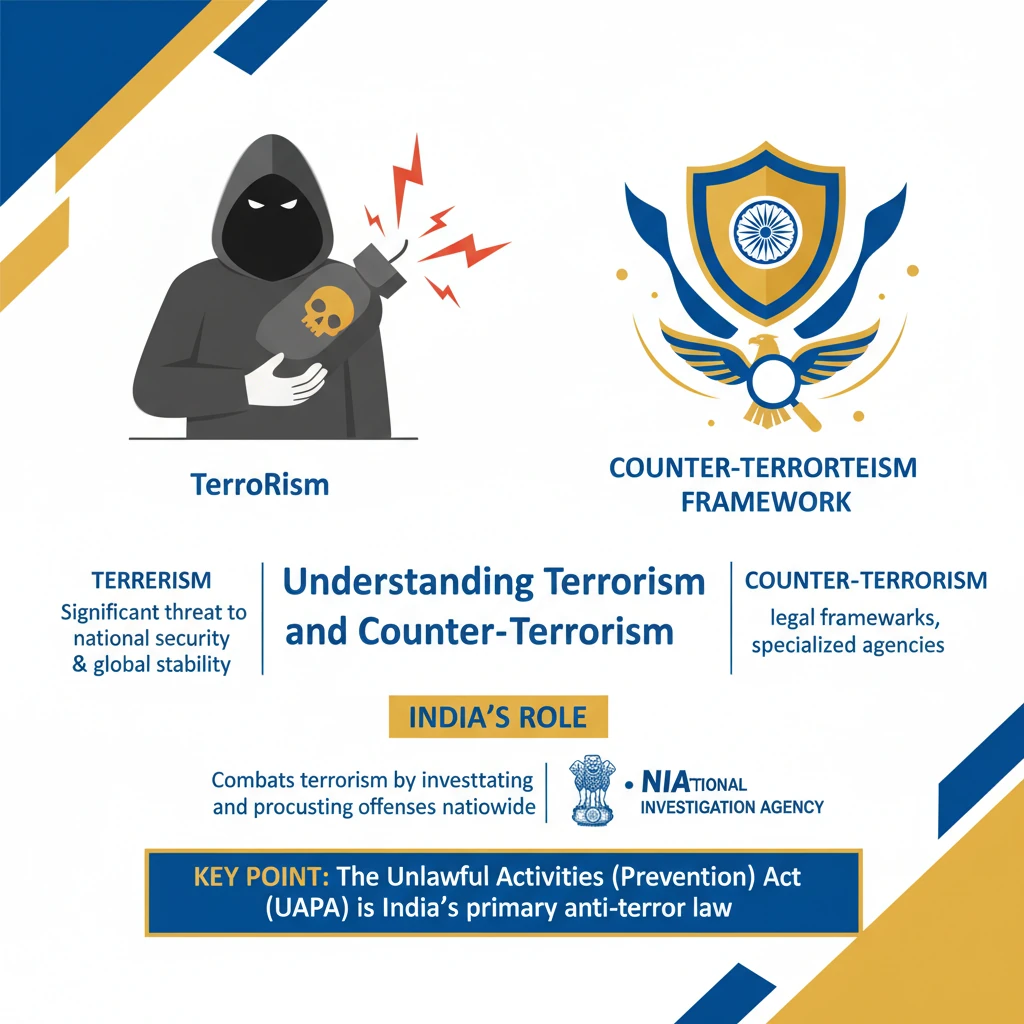
<h4>Understanding Terrorism and Counter-Terrorism Framework</h4><p><strong>Terrorism</strong> poses a significant threat to national security and global stability. Counter-terrorism efforts involve a multi-faceted approach, including legal frameworks and specialized agencies.</p><p>In India, the <strong>National Investigation Agency (NIA)</strong> plays a crucial role in combating terrorism by investigating and prosecuting related offenses across the country.</p><div class='key-point-box'><p>The <strong>NIA</strong> was established in <strong>2009</strong> in the wake of the <strong>2008 Mumbai terror attacks</strong>, specifically to deal with terror-related crimes and strengthen India's counter-terrorism capabilities.</p></div><h4>Scheduled Offences Investigated by NIA</h4><p>The <strong>NIA</strong> is empowered to investigate a specific list of offenses, known as <strong>Scheduled Offences</strong>, which are defined under the <strong>National Investigation Agency Act, 2008</strong>.</p><p>These offenses cover a wide range of activities that pose a threat to India's sovereignty, security, and integrity.</p><div class='info-box'><p>Key Acts under which <strong>NIA</strong> investigates <strong>Scheduled Offences</strong> include:</p><ul><li><strong>Explosive Substances Act, 1908</strong></li><li><strong>Atomic Energy Act, 1962</strong></li><li><strong>Unlawful Activities (Prevention) Act, 1967 (UAPA)</strong></li><li><strong>Anti-Hijacking Act, 2016</strong></li><li><strong>Suppression of Unlawful Acts Against Safety of Civil Aviation Act, 1982</strong></li><li><strong>SAARC Convention (Suppression of Terrorism) Act, 1993</strong></li><li><strong>Weapons of Mass Destruction and their Delivery Systems (Prohibition of Unlawful Activities) Act, 2005</strong></li></ul></div><h4>Expansion of NIA's Mandate</h4><p>The scope of the <strong>NIA's</strong> investigative powers has been progressively expanded to address emerging threats and interconnected criminal activities.</p><p>This expansion reflects the evolving nature of terrorism, which often relies on various illicit means for funding and logistics.</p><div class='info-box'><p>In <strong>September 2020</strong>, the <strong>NIA's mandate</strong> was significantly expanded.</p><ul><li>It now includes offenses under the <strong>Narcotic Drugs and Psychotropic Substances (NDPS) Act, 1985</strong>.</li><li>This inclusion is specifically for cases where drug trafficking is directly connected to <strong>terrorism</strong>.</li></ul></div><div class='exam-tip-box'><p>The expansion to include <strong>NDPS Act</strong> offenses highlights the growing nexus between <strong>narcotics trade</strong> and <strong>terror financing</strong>, a critical aspect for <strong>UPSC Mains GS-III Internal Security</strong>.</p></div><h4>Special Courts for Terror Trials</h4><p>To ensure expeditious and effective prosecution of terror-related cases, specific judicial mechanisms are put in place.</p><p>These mechanisms are designed to handle the sensitive and complex nature of terrorism trials.</p><div class='info-box'><p>Trials for <strong>NIA</strong> cases are conducted in <strong>Special Courts</strong>.</p><ul><li>These courts are <strong>designated by the Central Government</strong>.</li><li>The designation is made in consultation with the <strong>Chief Justice of the High Court</strong> of the respective State.</li></ul></div><div class='key-point-box'><p>The establishment of <strong>Special Courts</strong> aims to streamline the judicial process, ensuring faster trials and better conviction rates in terror-related cases.</p></div><h4>Operation Dhvast: Countering Terror-Gangster Nexus</h4><p>Law enforcement agencies often conduct targeted operations to dismantle criminal networks that support or engage in terrorist activities.</p><p>One such operation specifically targeted the dangerous convergence of organized crime and terrorism.</p><div class='info-box'><p><strong>Operation Dhvast</strong> is a significant initiative by the <strong>NIA</strong>.</p><ul><li>It focuses on disrupting the intricate nexus between <strong>terrorist groups</strong> and <strong>gangsters</strong>.</li><li>This operation aims to dismantle infrastructure, funding channels, and recruitment networks that bridge organized crime with terrorism.</li></ul></div><div class='exam-tip-box'><p>Mentioning specific operations like <strong>Operation Dhvast</strong> can add value to answers in <strong>GS-III Internal Security</strong>, demonstrating knowledge of practical counter-terrorism measures.</p></div>
💡 Key Takeaways
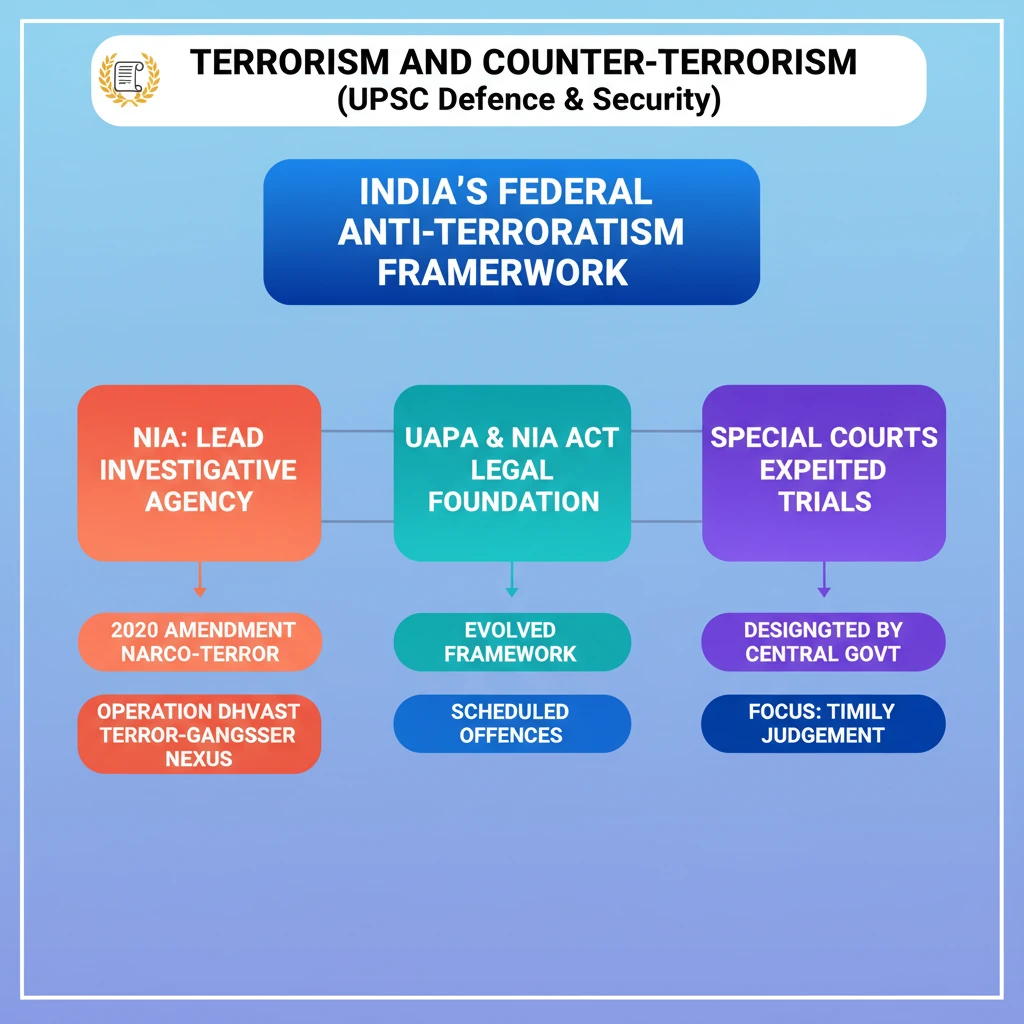
- •The NIA is India's primary federal agency for investigating Scheduled Offences related to terrorism.
- •NIA's mandate expanded in 2020 to include NDPS Act offenses connected to terrorism, addressing the terror-narcotics nexus.
- •Special Courts are designated by the Central Government to ensure expeditious trials for NIA cases.
- •Operation Dhvast is a key NIA initiative targeting the terror-gangster nexus.
- •India's counter-terrorism framework has evolved significantly, with UAPA and NIA Act being central pillars.
🧠 Memory Techniques

95% Verified Content
📚 Reference Sources
•National Investigation Agency Act, 2008
•Unlawful Activities (Prevention) Act, 1967
•Narcotic Drugs and Psychotropic Substances Act, 1985