UNODC Report on Illicit Drugs - Defence And Security | UPSC Learning
Topics
0 topics • 0 completed
🔍
No topics match your search
UNODC Report on Illicit Drugs
Medium⏱️ 8 min read
defence and security
📖 Introduction
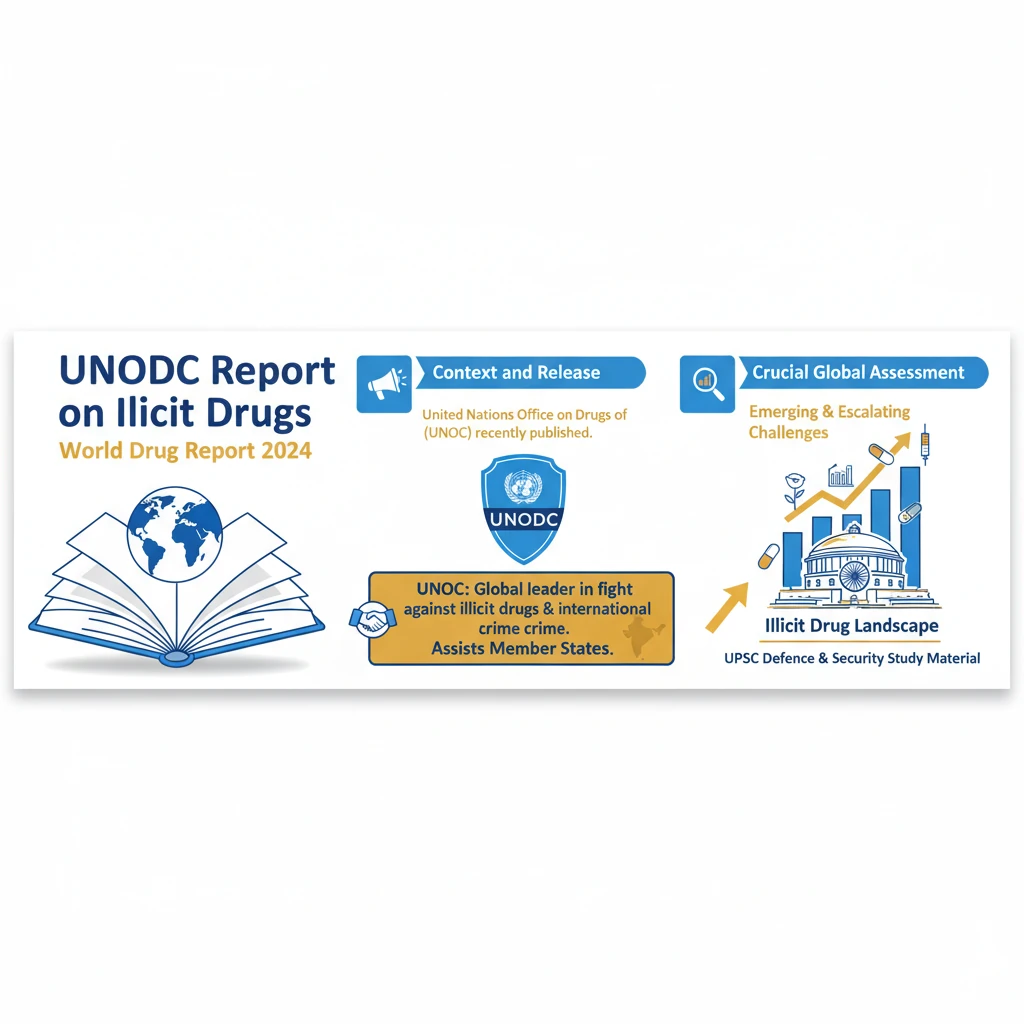
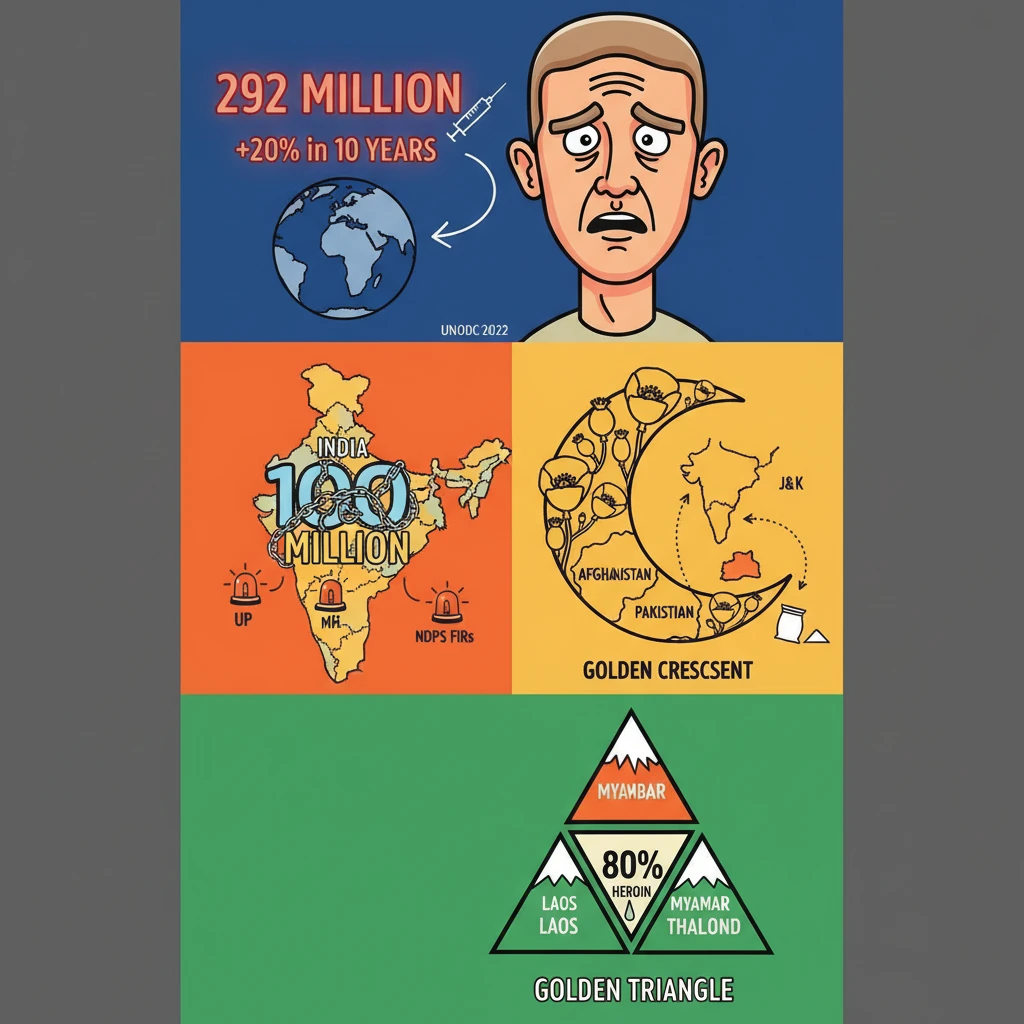
<h4>Context and Release of the UNODC Report</h4><p>The <strong>United Nations Office on Drugs and Crime (UNODC)</strong> recently published its <strong>World Drug Report 2024</strong>. This report serves as a crucial global assessment, highlighting emerging and escalating challenges within the international drug landscape.</p><div class='info-box'><p><strong>UNODC</strong> is a global leader in the fight against illicit drugs and international crime. It provides assistance to Member States in their struggle against illicit drugs, crime, and terrorism.</p></div><h4>Global Drug Use Trends</h4><p>The report indicates a significant rise in drug use worldwide. In <strong>2022</strong>, the total number of drug users globally reached an estimated <strong>292 million</strong> individuals.</p><p>This figure represents a substantial <strong>20% increase</strong> over the past decade, underscoring a growing global public health and security concern.</p><h4>Drug Use Situation in India</h4><p>India is also experiencing a sharp increase in drug addiction. Data from the <strong>Narcotics Control Bureau (NCB)</strong> reveals that approximately <strong>100 million</strong> people in the country are currently addicted to various narcotic substances.</p><p>The <strong>Ministry of Home Affairs</strong> has identified specific states with high rates of drug-related offenses. Between <strong>2019 and 2021</strong>, <strong>Uttar Pradesh</strong>, <strong>Maharashtra</strong>, and <strong>Punjab</strong> registered the highest number of <strong>FIRs</strong> under the <strong>Narcotic Drugs and Psychotropic Substances Act (NDPS Act)</strong>.</p><div class='exam-tip-box'><p>Understanding India's drug situation, including affected states and relevant laws like the <strong>NDPS Act</strong>, is vital for questions in <strong>GS Paper 3 (Internal Security)</strong> and <strong>GS Paper 1 (Social Issues)</strong>.</p></div><h4>Major Global Drug-Producing Regions</h4><p>Two primary regions are globally recognized for their significant role in illicit drug production and trafficking. These are the <strong>Golden Crescent</strong> and the <strong>Golden Triangle</strong>.</p><div class='key-point-box'><p>These regions are critical to understanding global drug supply chains and their impact on international and national security.</p></div><h4>The Golden Crescent</h4><p>The <strong>Golden Crescent</strong> is a major hub for <strong>opium production</strong> and distribution. It is geographically located at the crossroads of Central, South, and West Asia.</p><div class='info-box'><p>The region comprises three key countries: <ul><li><strong>Afghanistan</strong></li><li><strong>Iran</strong></li><li><strong>Pakistan</strong></li></ul></p></div><p>This region significantly impacts India, with trafficking routes affecting several Indian states. These include <strong>Jammu and Kashmir</strong>, <strong>Punjab</strong>, <strong>Himachal Pradesh</strong>, <strong>Rajasthan</strong>, and <strong>Gujarat</strong>.</p><h4>The Golden Triangle</h4><p>The <strong>Golden Triangle</strong> is another crucial region for illicit drug production, primarily known for <strong>heroin manufacturing</strong>. It is situated in Southeast Asia.</p><div class='info-box'><p>This area is formed by the intersection of territories from: <ul><li><strong>Laos</strong></li><li><strong>Myanmar</strong></li><li><strong>Thailand</strong></li></ul></p></div><p><strong>Myanmar</strong> is a particularly dominant producer within this region, accounting for approximately <strong>80% of global heroin production</strong>. Trafficking routes from the Golden Triangle often pass through <strong>Laos</strong>, <strong>Vietnam</strong>, <strong>Thailand</strong>, and notably, <strong>India</strong>.</p>
💡 Key Takeaways
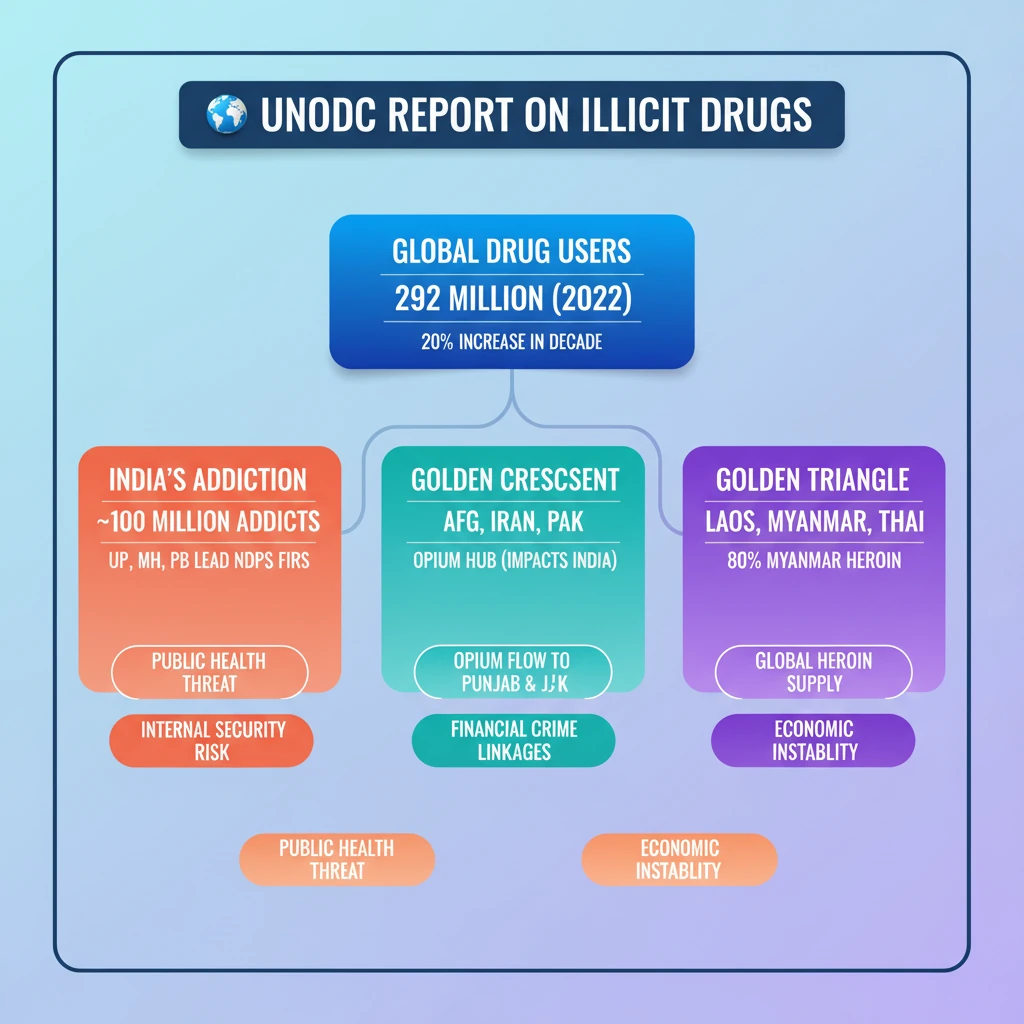
- •Global drug users reached 292 million in 2022, a 20% increase in a decade, as per UNODC.
- •India has approximately 100 million drug addicts; UP, Maharashtra, Punjab lead in NDPS Act FIRs (2019-2021).
- •The Golden Crescent (Afghanistan, Iran, Pakistan) is a major opium hub, impacting Indian states like Punjab and J&K.
- •The Golden Triangle (Laos, Myanmar, Thailand) is a primary heroin producer, with Myanmar contributing 80% of regional heroin.
- •Drug trafficking poses significant threats to public health, internal security, and economic stability, requiring robust national and international responses.
🧠 Memory Techniques
95% Verified Content
📚 Reference Sources
•Narcotics Control Bureau (NCB) official data (as cited in Drishti IAS)
•Ministry of Home Affairs (MHA) data on NDPS Act FIRs (as cited in Drishti IAS)