RudraM-II: India's New Air-Launched Anti-Radiation Missile - Defence And Security | UPSC Learning
Topics
0 topics • 0 completed
🔍
No topics match your search
RudraM-II: India's New Air-Launched Anti-Radiation Missile
Medium⏱️ 6 min read
defence and security
📖 Introduction
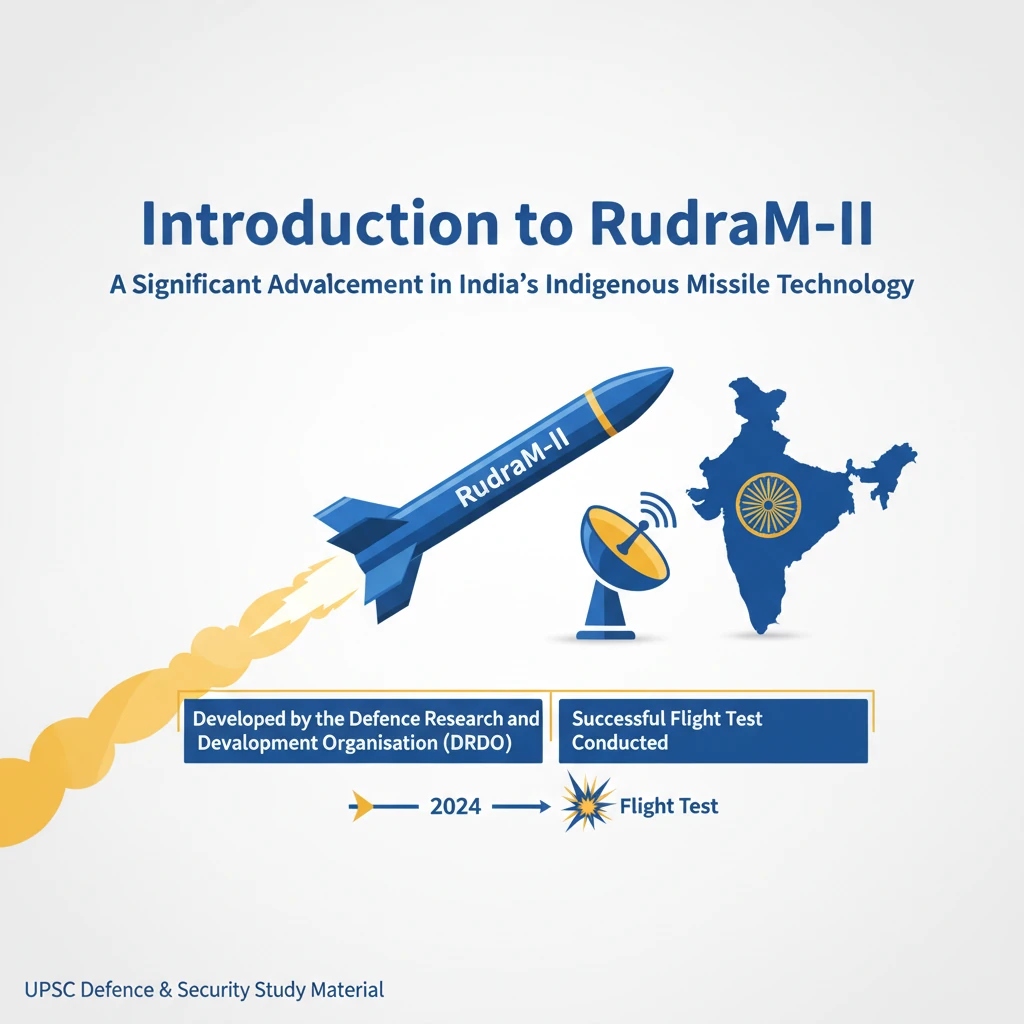
<h4>Introduction to RudraM-II</h4><p>The <strong>RudraM-II</strong> is a significant advancement in India's indigenous missile technology. It represents a crucial component in strengthening the nation's air defence capabilities.</p><p>Developed by the <strong>Defence Research and Development Organisation (DRDO)</strong>, this missile system recently underwent a successful flight test.</p><h4>Successful Flight Test</h4><p>The <strong>DRDO</strong> successfully conducted the flight test of the <strong>RudraM-II Missile</strong>. This critical evaluation took place from a <strong>Sukhoi-30 MKI fighter jet</strong>.</p><div class="info-box"><p><strong>Test Platform:</strong> <strong>Sukhoi-30 MKI</strong> fighter jet</p><p><strong>Developer:</strong> <strong>Defence Research and Development Organisation (DRDO)</strong></p></div><h4>Key Characteristics and Operational Role</h4><p>The <strong>RudraM-II</strong> is a <strong>solid-propelled air-launched missile system</strong>. It is designed specifically for <strong>Air-to-surface operations</strong>.</p><p>Its primary objective is to <strong>neutralise various types of enemy assets</strong>, providing a strategic advantage in combat scenarios.</p><div class="key-point-box"><p>The missile is expected to play a <strong>vital role in strengthening India’s air security and defence preparedness</strong>. It acts as a significant <strong>‘force multiplier’</strong> for the Indian Air Force.</p></div><h4>Performance Evaluation</h4><p>The performance of the <strong>RudraM-II</strong> during its flight test was meticulously evaluated. This involved the use of advanced range tracking instruments.</p><ul><li><strong>Electro-optical systems</strong></li><li><strong>Radar</strong></li><li><strong>Telemetry stations</strong></li></ul><h4>Technical Specifications</h4><div class="info-box"><table class="info-table"><tr><th>Specification</th><th>Detail</th></tr><tr><td><strong>Range</strong></td><td><strong>300 kilometres</strong></td></tr><tr><td><strong>Speed</strong></td><td>Up to <strong>Mach 5.5</strong></td></tr><tr><td><strong>Payload</strong></td><td><strong>200 kilograms</strong></td></tr><tr><td><strong>Detection Capability</strong></td><td>Can detect enemy <strong>radio frequencies</strong> and <strong>signals from radars</strong> from over <strong>100 km</strong></td></tr></table></div><h4>Strategic Replacement</h4><p>The <strong>RudraM-II</strong> is envisioned as a potential replacement for <strong>Russia’s Kh-31 missile</strong>. The <strong>Kh-31</strong> is currently in service with India’s <strong>Sukhoi fighter jets</strong>.</p><div class="exam-tip-box"><p>Understanding indigenous replacements like <strong>RudraM-II</strong> for foreign systems is crucial for questions on <strong>defence indigenisation</strong> and <strong>strategic autonomy</strong> in UPSC Mains <strong>GS-III</strong>.</p></div>
💡 Key Takeaways
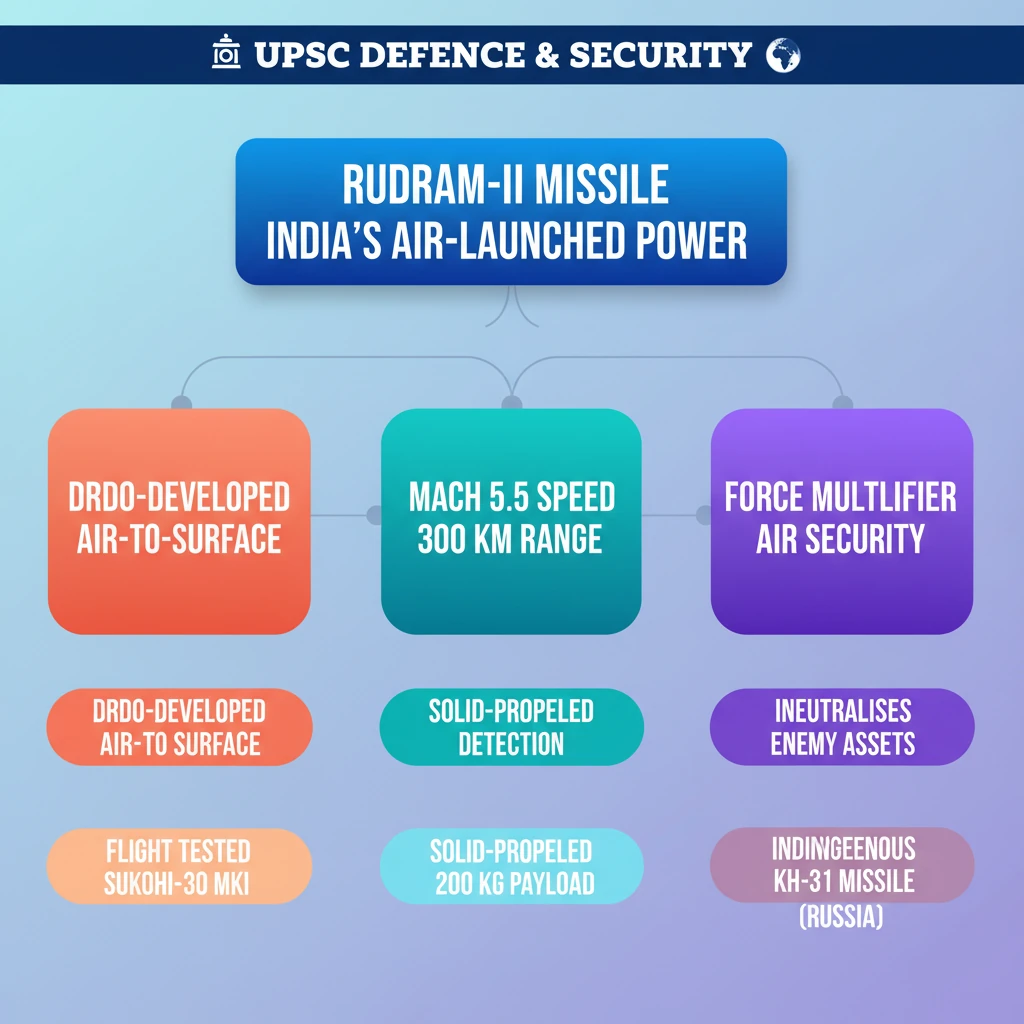
- •RudraM-II is a DRDO-developed, solid-propelled, air-launched, air-to-surface missile.
- •Successfully flight-tested from a Sukhoi-30 MKI fighter jet.
- •Key specifications: 300 km range, Mach 5.5 speed, 200 kg payload, 100+ km radar/RF detection.
- •Aims to neutralise enemy assets and acts as a 'force multiplier' for India's air security.
- •Potential indigenous replacement for Russia's Kh-31 missile on Sukhoi jets.
- •Signifies India's progress in defence indigenisation and strategic autonomy.
🧠 Memory Techniques

95% Verified Content
📚 Reference Sources
•DRDO Official Releases (implied by content)