Launch of Samudra Pratap - defence-and-security | UPSC Learning
Topics
0 topics • 0 completed
🔍
No topics match your search
Launch of Samudra Pratap
Medium⏱️ 6 min read
defence and security
📖 Introduction
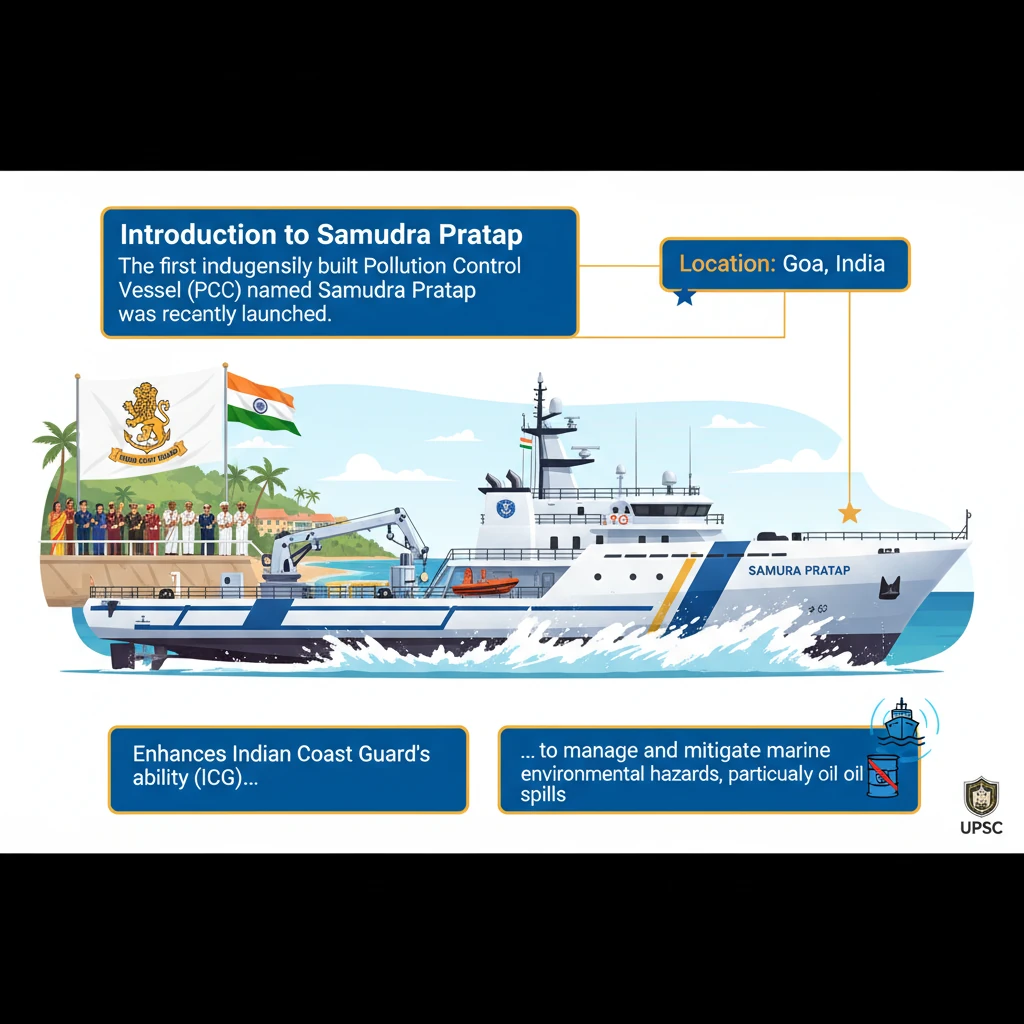
<h4>Introduction to Samudra Pratap</h4><p>The <strong>first indigenously built Pollution Control Vessel (PCV)</strong> named <strong>Samudra Pratap</strong> was recently launched. This significant event took place in <strong>Goa</strong>, marking a crucial step in India's maritime capabilities.</p><p>The vessel is designed to enhance the <strong>Indian Coast Guard's (ICG)</strong> ability to manage and mitigate marine environmental hazards, particularly <strong>oil spills</strong>.</p><div class='info-box'><p><strong>Key Details of Samudra Pratap:</strong></p><ul><li><strong>Type:</strong> Pollution Control Vessel (PCV)</li><li><strong>Builder:</strong> <strong>Goa Shipyard Limited (GSL)</strong></li><li><strong>Operator:</strong> <strong>Indian Coast Guard (ICG)</strong></li><li><strong>Location of Launch:</strong> Goa</li></ul></div><h4>Significance of Indigenous Design and Construction</h4><p>The construction of <strong>Samudra Pratap</strong> represents a landmark achievement for India. It is the <strong>first time</strong> that such specialized pollution control vessels are being entirely <strong>designed and constructed indigenously</strong> within the country.</p><div class='key-point-box'><p>This indigenous development aligns with the government's <strong>'Make in India'</strong> and <strong>'Atmanirbhar Bharat'</strong> initiatives, bolstering India's self-reliance in defence and maritime technology.</p></div><p>The vessel's primary role will be to effectively check and control <strong>oil spillage</strong> incidents along India's vast coastline and in its Exclusive Economic Zone (EEZ).</p><h4>Understanding Oil Spills</h4><p>An <strong>oil spill</strong> is broadly defined as the release of a <strong>liquid petroleum hydrocarbon</strong> into the environment. This typically occurs in <strong>marine areas</strong> and is a direct consequence of human activity.</p><div class='info-box'><p><strong>Causes of Oil Spills:</strong></p><ul><li>Releases of <strong>crude oil</strong> from <strong>tankers</strong></li><li>Accidents involving <strong>offshore platforms</strong></li><li>Malfunctions in <strong>drilling rigs</strong> or <strong>wells</strong></li><li>Other industrial activities impacting marine ecosystems</li></ul></div><p><strong>Oil on ocean surfaces</strong> poses severe threats to <strong>aquatic life</strong>. It creates a barrier that blocks essential <strong>sunlight</strong> from penetrating the water, which is vital for photosynthetic organisms.</p><p>Furthermore, oil spills significantly <strong>reduce dissolved oxygen levels</strong> in the water, leading to suffocation and death for marine flora and fauna.</p><h4>Notable Oil Spill Incidents</h4><p>History has witnessed several catastrophic oil spills that highlight the devastating environmental and economic impacts of such disasters. These events underscore the critical need for effective pollution control measures.</p><div class='info-box'><p>The <strong>Deepwater Horizon oil spill</strong> in <strong>2010</strong>, occurring in the <strong>Gulf of Mexico</strong>, is widely recognized as the <strong>largest and most famous oil spill in history</strong>. It caused extensive damage to marine life and coastal economies.</p></div><h4>Innovative Oil Spill Mitigation Techniques</h4><p>To combat the challenges posed by oil spills, new technologies and methods are continuously being developed. These innovations aim to provide more efficient and environmentally friendly solutions for cleanup.</p><div class='key-point-box'><p>One such emerging technique is <strong>oilsheening</strong>. This method involves using specialized <strong>bacteria</strong> that are capable of consuming and breaking down petroleum hydrocarbons, effectively helping to rid the environment of oil spills.</p></div><div class='exam-tip-box'><p><strong>UPSC Relevance:</strong> The launch of <strong>Samudra Pratap</strong> is significant for <strong>GS Paper III</strong> (Security, Environment). Questions can relate to <strong>maritime security</strong>, <strong>environmental protection</strong>, <strong>disaster management</strong>, and <strong>indigenisation of defence technology</strong>. Understanding both the vessel's role and the broader context of oil spills is crucial.</p></div>
💡 Key Takeaways
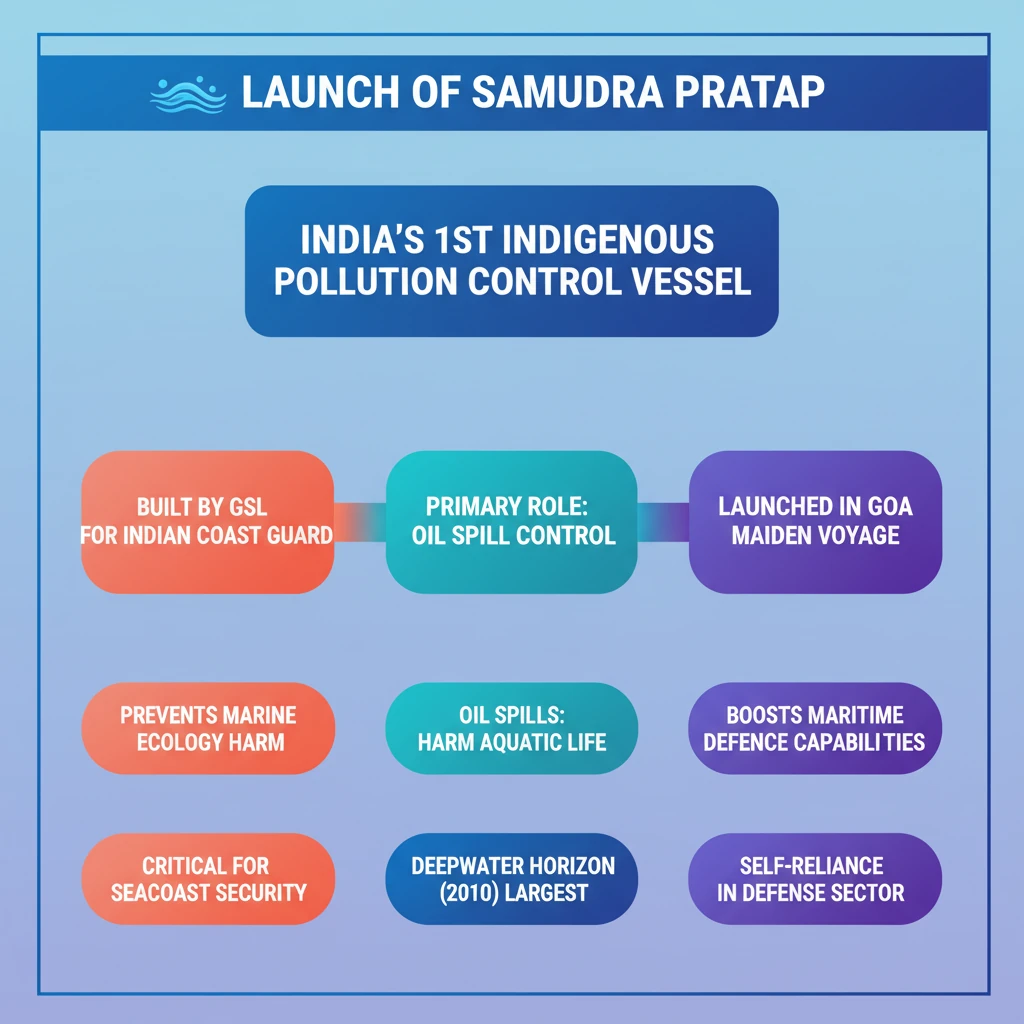
- •Samudra Pratap is India's first indigenously built Pollution Control Vessel (PCV).
- •It was launched in Goa and built by Goa Shipyard Limited (GSL) for the Indian Coast Guard (ICG).
- •Its primary purpose is to check and control oil spillage in India's sea coast.
- •Oil spills are releases of liquid petroleum hydrocarbons into marine environments, harming aquatic life.
- •The Deepwater Horizon (2010) was the largest oil spill in history.
- •Oilsheening is a new technique using bacteria to mitigate oil spills.
🧠 Memory Techniques
95% Verified Content
📚 Reference Sources
•Official statements from the Ministry of Defence, Government of India (implied)
•Reports from Goa Shipyard Limited (GSL) and Indian Coast Guard (ICG) (implied)