Disturbed Area AFSPA - defence-and-security | UPSC Learning
Topics
0 topics • 0 completed
🔍
No topics match your search
Disturbed Area AFSPA
Medium⏱️ 6 min read
defence and security
📖 Introduction
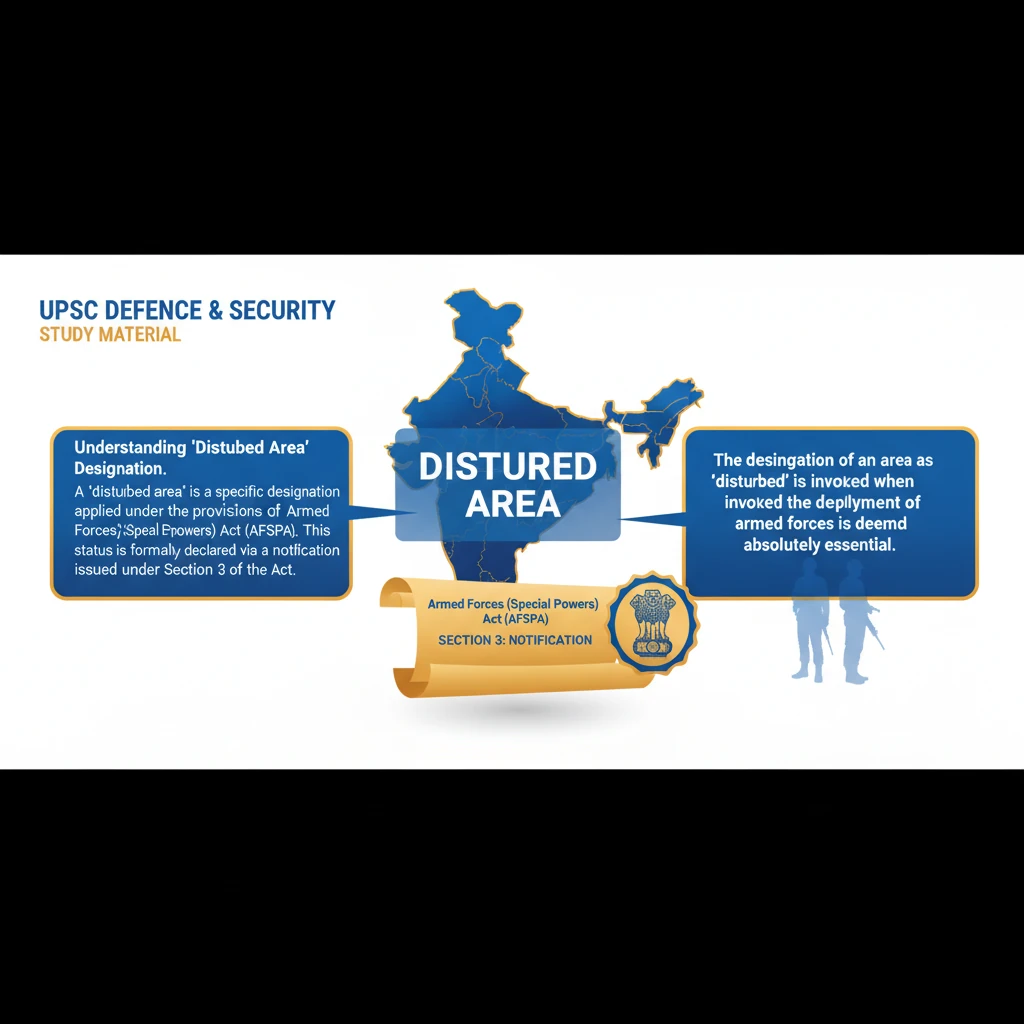
<h4>Understanding 'Disturbed Area' Designation</h4><p>A <strong>“disturbed area”</strong> is a specific designation applied under the provisions of the <strong>Armed Forces (Special Powers) Act (AFSPA)</strong>. This status is formally declared via a <strong>notification</strong> issued under <strong>Section 3</strong> of the Act.</p><div class='info-box'><p>The designation of an area as <strong>'disturbed'</strong> is invoked when the <strong>deployment of armed forces</strong> is deemed absolutely necessary to assist the <strong>civil power</strong> in maintaining law and order. This signifies a breakdown of normal administrative control.</p></div><h4>Evolution of Declaring Authority</h4><p>Initially, the authority to declare an area as <strong>'disturbed'</strong> was more restricted. However, a significant change occurred with the <strong>1972 amendment</strong> to the AFSPA.</p><div class='key-point-box'><p>The <strong>1972 amendment</strong> expanded the authority, allowing <strong>both the Central government and State governments</strong> to independently declare an area as 'disturbed'. This change introduced a dual power structure in the declaration process.</p></div><h4>Criteria for Designation</h4><p>The decision to designate an area as <strong>'disturbed'</strong> is not arbitrary. It is based on specific grounds related to severe public disorder and conflict.</p><div class='info-box'><p>Such a designation can arise from conflicts or disputes between various communities, specifically those based on <strong>religious, racial, linguistic, regional, or caste</strong> identities. These conflicts must be significant enough to necessitate military aid to civil administration.</p></div><h4>Authorities Empowered to Declare</h4><p>Multiple authorities are empowered to issue the notification for a <strong>'disturbed area'</strong> status, reflecting the federal structure of India.</p><div class='info-box'><p>The declaration can be made by the <strong>Central Government</strong>. Additionally, the <strong>Governor of a State</strong> or the <strong>Administrator of a Union Territory</strong> holds the power to declare any part, or the entirety, of their respective State or Union Territory as 'disturbed'.</p></div><h4>Duration of 'Disturbed Area' Status</h4><p>Once an area is declared <strong>'disturbed'</strong>, this status is not indefinite. There is a specified minimum duration for which the declaration remains in effect.</p><div class='info-box'><p>As per the provisions of the <strong>Disturbed Areas (Special Courts) Act, 1976</strong>, an area, once declared 'disturbed', maintains this status for a <strong>continuous period of 3 months</strong>. This ensures a review mechanism, albeit after a fixed term.</p></div><h4>Role of State Government in Continuation</h4><p>While the initial declaration can be made by various authorities, the <strong>State government</strong> plays a crucial role in the ongoing assessment of the situation.</p><p>The <strong>State government</strong> has the power to recommend whether the <strong>AFSPA</strong>, and thus the 'disturbed area' status, should continue in the region beyond the initial period. This recommendation is vital for democratic oversight and local input.</p><div class='exam-tip-box'><p><strong>UPSC Insight:</strong> Understanding the role of the <strong>State government</strong> in recommending continuation highlights the importance of <strong>Centre-State relations</strong> and the balance of power in internal security matters. This is a frequently debated aspect in <strong>GS Paper II (Polity)</strong> and <strong>GS Paper III (Internal Security)</strong>.</p></div>
💡 Key Takeaways
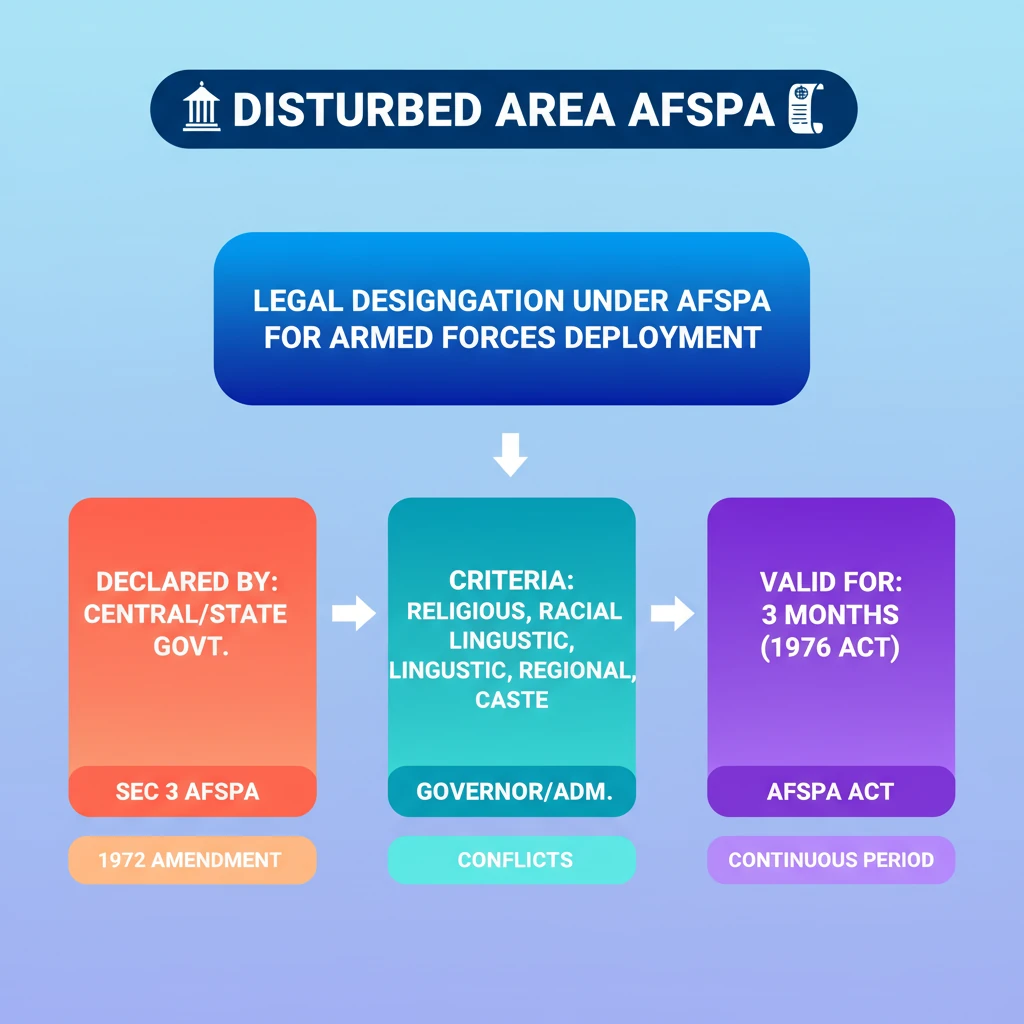
- •A 'disturbed area' is a legal designation under AFSPA (Section 3) for deploying armed forces.
- •The 1972 amendment empowered both Central and State governments to declare such areas.
- •Designation criteria include conflicts based on religious, racial, linguistic, regional, or caste communities.
- •The Central Government, Governor of a State, or Administrator of a UT can make the declaration.
- •Once declared, the status remains for a continuous period of 3 months, as per the 1976 Act.
- •State governments can recommend the continuation or withdrawal of the 'disturbed area' status.
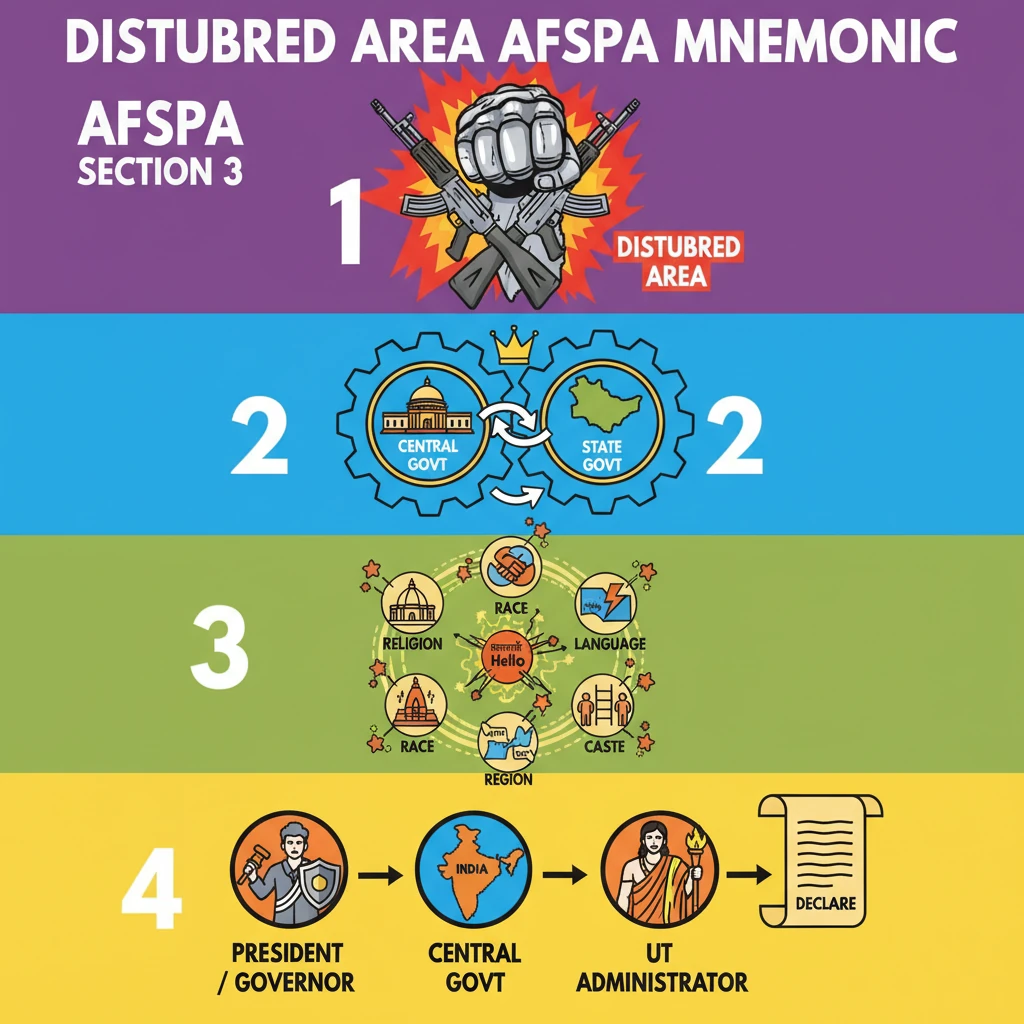
🧠 Memory Techniques
95% Verified Content