What is the Status of Linguistic Diversity in India? - Art And Culture | UPSC Learning
Topics
0 topics • 0 completed
🔍
No topics match your search
What is the Status of Linguistic Diversity in India?
Medium⏱️ 7 min read
art and culture
📖 Introduction
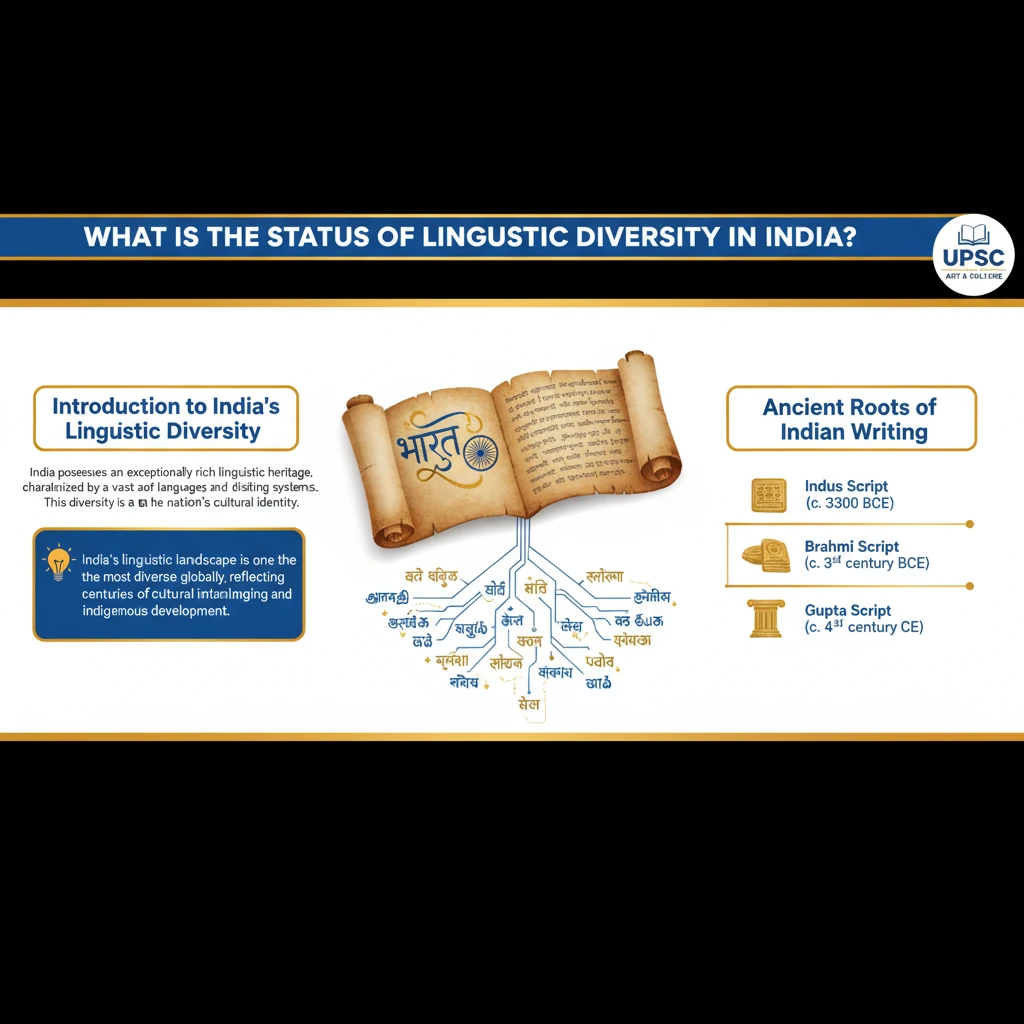
<h4>Introduction to India's Linguistic Diversity</h4><p><strong>India</strong> possesses an exceptionally rich <strong>linguistic heritage</strong>, characterized by a vast array of languages and distinct writing systems. This diversity is a cornerstone of the nation's cultural identity.</p><div class="key-point-box">India's linguistic landscape is one of the most diverse globally, reflecting centuries of cultural intermingling and indigenous development.</div><h4>Ancient Roots of Indian Writing</h4><p>The origins of writing in <strong>India</strong> can be traced back approximately <strong>four thousand years ago</strong>. This ancient lineage is evidenced by the scripts found during the period of the <strong>Indus Valley Civilisation</strong>.</p><h4>Early Linguistic Surveys: Colonial Era</h4><p>The first significant <strong>linguistic survey</strong> in India was undertaken during the <strong>colonial rule</strong>. This monumental effort aimed to document the vast linguistic landscape of the subcontinent.</p><div class="info-box"><strong>First Linguistic Survey:</strong><br><strong>Period:</strong> 1894 to 1928<br><strong>Identified:</strong> 179 languages and 544 dialects</div><h4>Post-Independence Linguistic Enumeration: Census of India 1991</h4><p>Following independence, the <strong>Census of India</strong> continued the task of documenting the nation's linguistic diversity. The <strong>1991 Census</strong> provided a detailed snapshot of the languages spoken.</p><div class="info-box"><strong>1991 Census of India Findings:</strong><br><strong>Mother Tongues:</strong> 1576 (with separate grammatical structures)<br><strong>Speech Varieties:</strong> 1796 (classified as other mother tongues)</div><h4>Defining Endangered Languages: UNESCO Criterion</h4><p>The global body <strong>UNESCO</strong> has established a clear criterion to identify languages that are at risk of extinction. This helps in prioritizing conservation efforts worldwide.</p><div class="info-box"><strong>UNESCO's Criterion for Potentially Endangered Languages:</strong><br>Any language spoken by <strong>less than 10,000 persons</strong> is considered <strong>“potentially endangered.”</strong></div><h4>Major Language Families of India</h4><p>India's languages are broadly categorized into several major <strong>language families</strong>. These classifications help understand their historical development and geographical distribution.</p><ul><li><strong>Indo-Aryan</strong></li><li><strong>Dravidian</strong></li><li><strong>Austric</strong></li><li><strong>Tibeto-Burman</strong></li><li>And others</li></ul><h4>Contemporary Threats: People's Linguistic Survey of India (PLSI)</h4><p>Despite the rich heritage, many languages in India face an imminent threat of extinction. The <strong>People’s Linguistic Survey of India (PLSI)</strong> has highlighted this critical issue.</p><div class="key-point-box">The <strong>PLSI</strong> is a linguistic survey conducted by the <strong>NGO Bhasha Research and Publication Centre</strong>. It provides crucial insights into the current status of Indian languages.</div><div class="info-box"><strong>PLSI Findings on Endangered Languages:</strong><br>Approximately <strong>400 languages</strong> are at risk of extinction within the next <strong>50 years</strong>.</div><div class="exam-tip-box">Understanding the findings of both official surveys (Census) and independent surveys (PLSI) is crucial for UPSC. Questions often compare or contrast these data points.</div>
💡 Key Takeaways
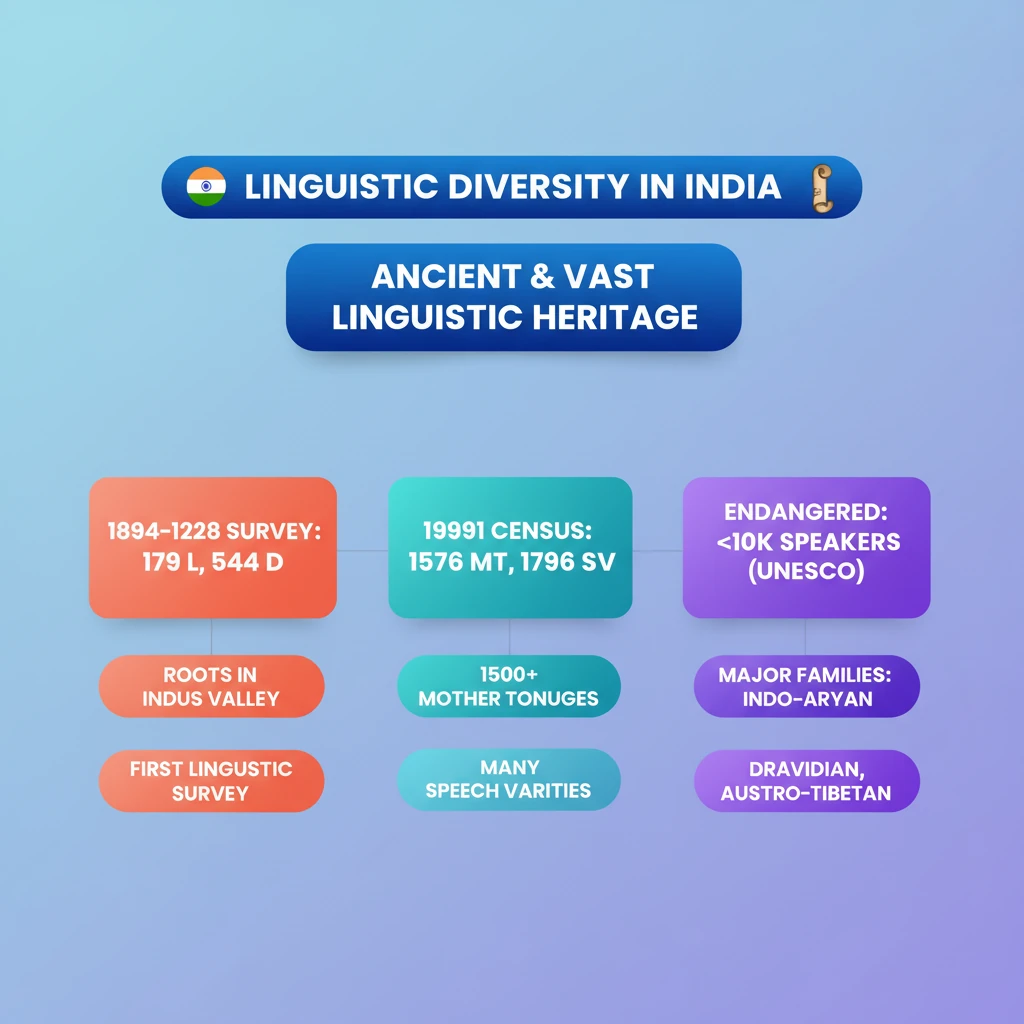
- •India possesses a vast and ancient linguistic heritage, with roots in the Indus Valley Civilisation.
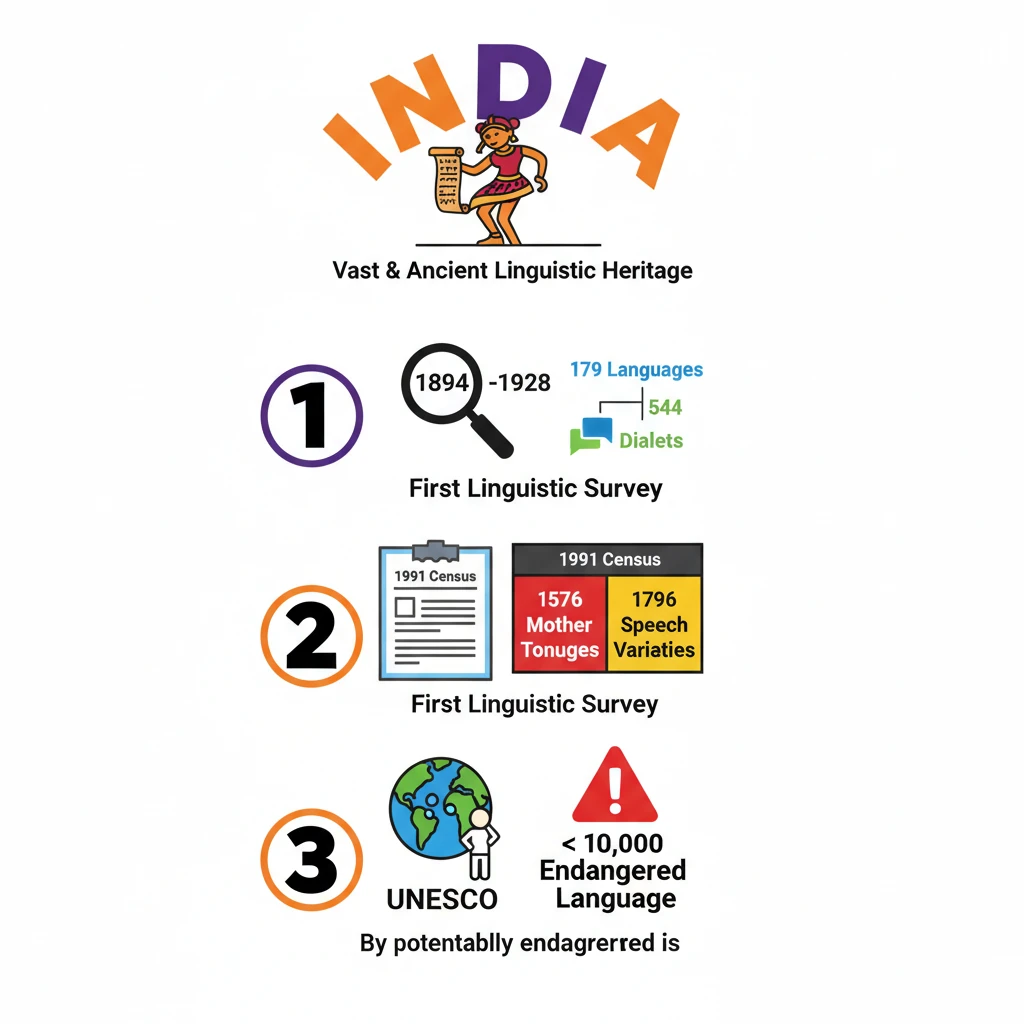
- •The first linguistic survey (1894-1928) identified 179 languages and 544 dialects.
- •The 1991 Census listed 1576 mother tongues and 1796 speech varieties.
- •UNESCO defines a potentially endangered language as one spoken by less than 10,000 persons.
- •India's major language families include Indo-Aryan, Dravidian, Austric, and Tibeto-Burman.
- •The People's Linguistic Survey of India (PLSI) estimates around 400 languages are at risk of extinction in the next 50 years.
🧠 Memory Techniques
95% Verified Content
📚 Reference Sources
•Census of India 1991 data (general knowledge)
•UNESCO criteria for endangered languages (general knowledge)
•People's Linguistic Survey of India (PLSI) findings (general knowledge)