Archaeological Survey of India (ASI) - Art And Culture | UPSC Learning
Topics
0 topics • 0 completed
🔍
No topics match your search
Archaeological Survey of India (ASI)
Medium⏱️ 8 min read
art and culture
📖 Introduction
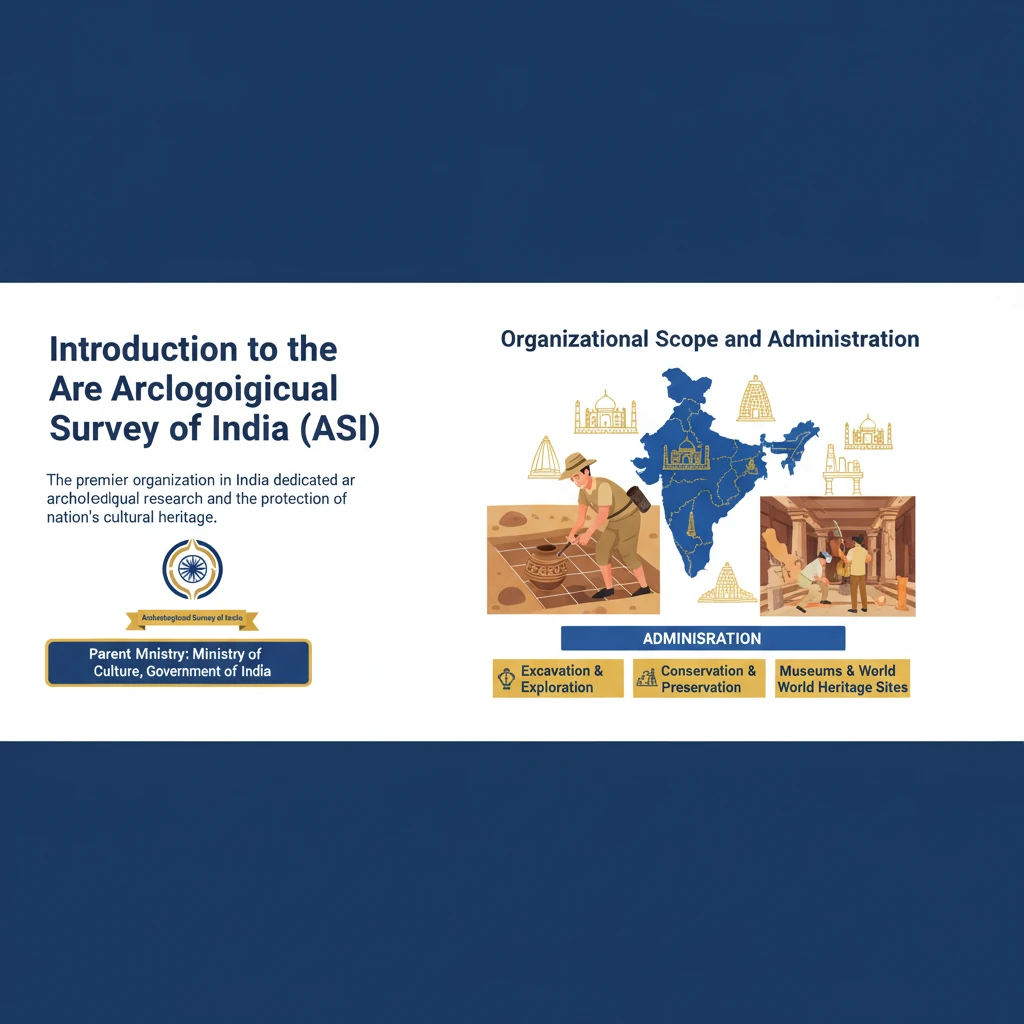
<h4>Introduction to the Archaeological Survey of India (ASI)</h4><p>The <strong>Archaeological Survey of India (ASI)</strong> stands as the premier organization in India dedicated to <strong>archaeological research</strong> and the <strong>protection of the nation's cultural heritage</strong>.</p><div class="info-box"><strong>Parent Ministry:</strong> Ministry of Culture, Government of India</div><h4>Organizational Scope and Administration</h4><p>The ASI is responsible for the administration of a vast network of historical sites. It oversees more than <strong>3650 ancient monuments</strong>, various <strong>archaeological sites</strong>, and numerous <strong>remains of national importance</strong> across the country.</p><div class="key-point-box">The sheer number of sites under ASI's purview highlights its critical role in safeguarding India's diverse historical landscape.</div><h4>Core Functions of the ASI</h4><p>The activities of the ASI are multi-faceted, encompassing a wide range of responsibilities essential for heritage management:</p><ul><li><strong>Surveys of Antiquarian Remains:</strong> Identifying and documenting historical artifacts and structures.</li><li><strong>Exploration and Excavation:</strong> Unearthing and studying archaeological sites to understand past civilizations.</li><li><strong>Conservation and Maintenance:</strong> Preserving and restoring protected monuments and sites to ensure their longevity.</li><li><strong>Epigraphical Research:</strong> Studying inscriptions to decipher historical records.</li><li><strong>Museum Management:</strong> Overseeing site museums to display excavated artifacts.</li></ul><h4>Establishment and Founding Figure</h4><p>The <strong>Archaeological Survey of India</strong> was formally established in <strong>1861</strong>. Its foundation marked a pivotal moment in the systematic study and preservation of India's ancient past.</p><div class="info-box"><strong>Founder and First Director-General:</strong> Alexander Cunningham<br><strong>Title:</strong> "Father of Indian Archaeology"</div><p><strong>Alexander Cunningham</strong>, a British army engineer, played an instrumental role in shaping India's archaeological landscape. His pioneering efforts led to him being posthumously recognized as the <strong>"Father of Indian Archaeology"</strong>.</p><div class="exam-tip-box">Remember <strong>Alexander Cunningham</strong> and the year <strong>1861</strong> as crucial facts for preliminary exams. His title, <strong>"Father of Indian Archaeology"</strong>, is also a frequently tested piece of information.</div>
💡 Key Takeaways
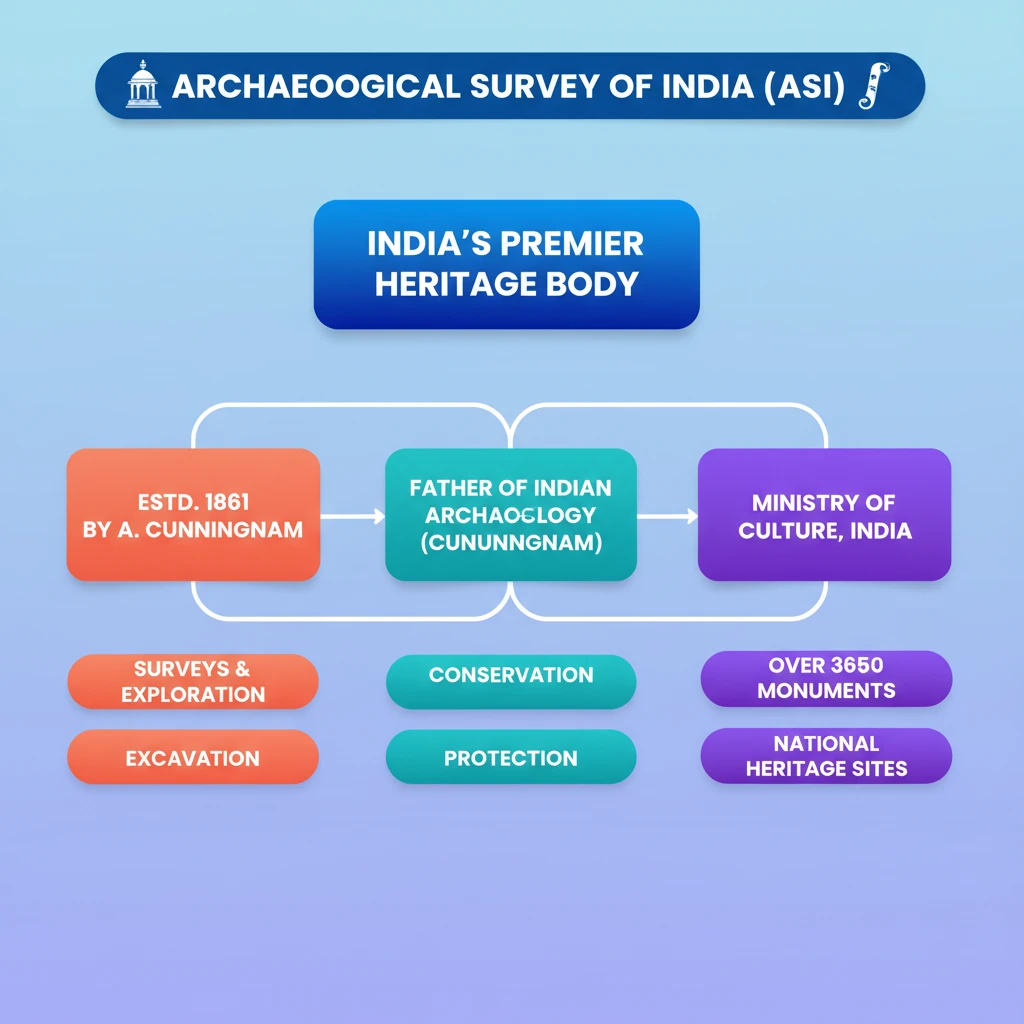
- •The Archaeological Survey of India (ASI) is India's premier organization for archaeological research and cultural heritage protection.
- •It operates under the Ministry of Culture and administers over 3650 national monuments and sites.
- •ASI's core functions include surveys, exploration, excavation, and conservation of historical sites.
- •It was founded in 1861 by Alexander Cunningham, who became its first Director-General.
- •Alexander Cunningham is widely recognized as the "Father of Indian Archaeology."
- •ASI plays a vital role in preserving national identity, promoting heritage tourism, and educating the public about India's past.
🧠 Memory Techniques

98% Verified Content
📚 Reference Sources
•Official website of Archaeological Survey of India (ASI)
•Ministry of Culture, Government of India reports
•General knowledge on Indian History and Archaeology