Humayun's Era: Coins, Architecture, Cultural Figures & Conservation - Art And Culture | UPSC Learning
Topics
0 topics • 0 completed
🔍
No topics match your search
Humayun's Era: Coins, Architecture, Cultural Figures & Conservation
Medium⏱️ 7 min read
art and culture
📖 Introduction
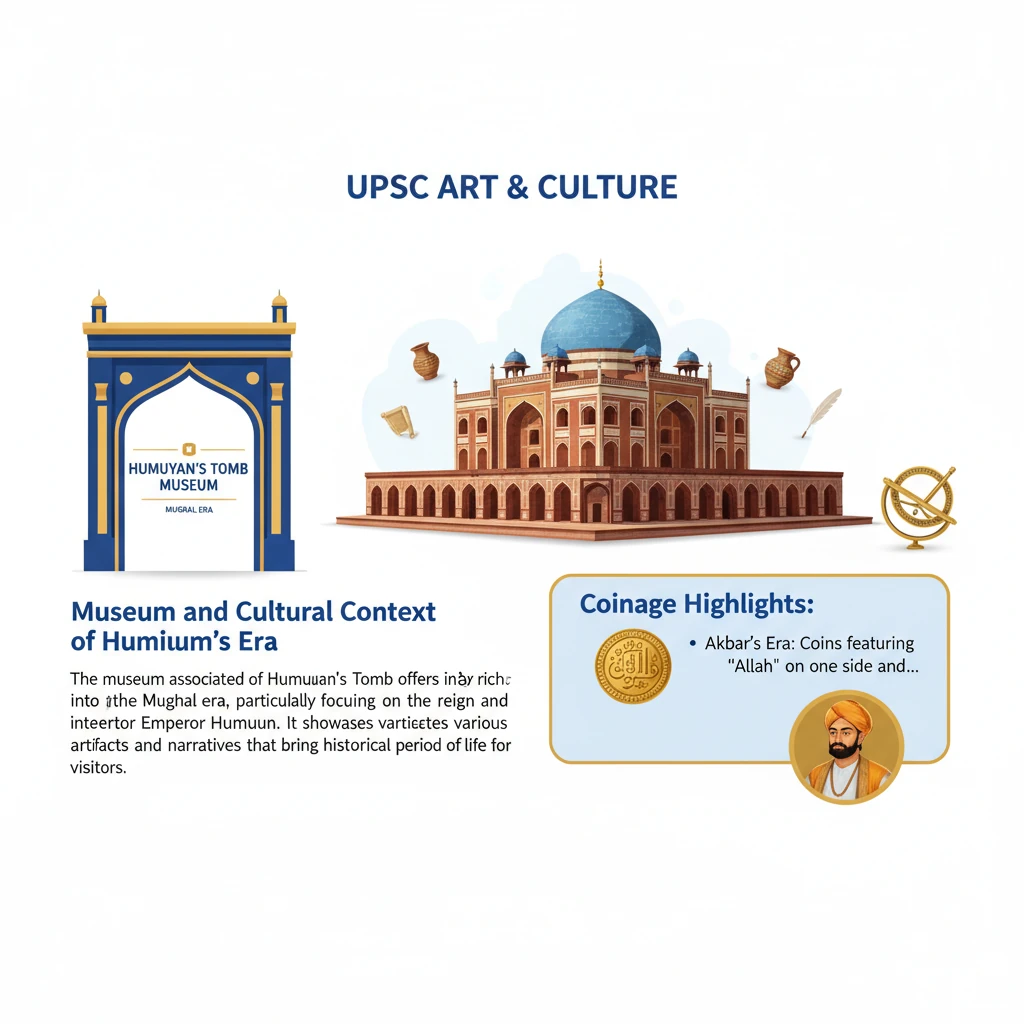
<h4>Museum and Cultural Context of Humayun's Era</h4><p>The museum associated with <strong>Humayun's Tomb</strong> offers a rich glimpse into the <strong>Mughal era</strong>, particularly focusing on the reign and interests of <strong>Emperor Humayun</strong>. It showcases various artifacts and narratives that bring the historical period to life for visitors.</p><div class="info-box"><strong>Coinage Highlights:</strong><ul><li><strong>Akbar's Era:</strong> Coins featuring 'Allah' on one side and 'Ram' on the other, reflecting religious syncretism.</li><li><strong>Jahangir's Era:</strong> Examples of expensive and intricately designed coins.</li><li><strong>Bahadur Shah Zafar:</strong> Rare coins minted by the last Mughal emperor, offering a link to later Mughal history.</li></ul></div><p>Exhibits within the museum delve into the <strong>architecture of Humayun's Mausoleum</strong> itself, alongside insights into the emperor's multifaceted <strong>personality</strong>. These displays convey stories of <strong>Humayun's extensive travels</strong>, his administrative acumen, and his intellectual pursuits.</p><p>The museum highlights <strong>Humayun's keen interest</strong> in various fields, including <strong>reading</strong>, the science of <strong>astrology</strong>, and a profound appreciation for the <strong>arts</strong>. His significant <strong>patronage of architecture</strong> is also a central theme, showcasing his contributions to Mughal building traditions.</p><h4>Key Cultural Figures of Nizamuddin</h4><p>The <strong>Nizamuddin area</strong>, where Humayun's Tomb is located, has been a vibrant cultural hub for centuries. The museum and surrounding complex acknowledge its association with several influential figures from the <strong>14th century</strong> onwards.</p><div class="info-box"><strong>Associated Cultural Personalities:</strong><ul><li><strong>Sufi Saint Hazrat Nizamuddin Auliya:</strong> A revered Sufi mystic whose shrine is central to the area.</li><li><strong>Poet Amir Khusrau Dehalvi:</strong> A legendary poet, musician, and scholar, a disciple of Nizamuddin Auliya.</li><li><strong>Rahim:</strong> A commander-in-chief of <strong>Akbar's army</strong> and a celebrated poet, known for his Hindi couplets.</li><li><strong>Dara Shikoh:</strong> The eldest son of <strong>Shah Jahan</strong>, renowned for his scholarly pursuits, including translating the <strong>Upanishads into Persian</strong>.</li></ul></div><h4>Conservation Efforts for the Cultural Complex</h4><p>The preservation of this significant historical and cultural landscape is a collaborative effort. The museum and the broader complex are actively managed by the <strong>Archaeological Survey of India (ASI)</strong>, a primary governmental body for heritage conservation.</p><div class="info-box"><strong>Integrated Conservation Area:</strong>The museum is an integral part of a larger, comprehensive conservation initiative. This effort spans a vast <strong>300-acre area</strong>, encompassing the iconic <strong>Humayun’s Tomb</strong>, the revitalized <strong>Sunder Nursery</strong>, and the historic <strong>Nizamuddin Basti</strong>, aiming for holistic preservation.</div><h4>Humayun's Tomb: Architectural Grandeur</h4><p>Constructed in <strong>1570</strong>, <strong>Humayun’s Tomb</strong> holds immense historical and architectural significance as the <strong>first major garden tomb</strong> in the <strong>Indian subcontinent</strong>. This monumental structure set a crucial precedent for the distinctive style of <strong>Mughal architecture</strong> that followed.</p><div class="key-point-box"><strong>Architectural Legacy:</strong>Humayun's Tomb is widely recognized as a pivotal precursor, laying the foundational design principles that would later culminate in the unparalleled splendor of the <strong>Taj Mahal</strong>. Its innovative design influenced subsequent Mughal funerary architecture.</div><p>The tomb was commissioned by <strong>Humayun's first wife, Empress Bega Begum</strong>, between <strong>1569-70</strong>. The architectural design was meticulously crafted by skilled <strong>Persian architects</strong>, reflecting the strong Persian influence on early Mughal art and construction.</p><p>The complex also houses other notable <strong>16th-century Mughal tombs</strong>, enriching its historical tapestry. These include the distinctive <strong>Nila Gumbad</strong> and the tomb of <strong>Isa Khan Niyazi</strong>, an influential <strong>Afghan noble</strong> from the Sur dynasty period.</p><h4>Distinctive Architectural Features</h4><ul><li><strong>Charbagh Garden:</strong> The mausoleum is set within a meticulously planned <strong>charbagh (four-part garden)</strong>, a Persian-inspired layout symbolizing paradise.</li><li><strong>High-Terraced Platform:</strong> The main tomb stands majestically on a substantial <strong>high-terraced platform</strong>, elevating its presence and offering panoramic views.</li><li><strong>Marble Clad Dome:</strong> A prominent feature is its grand <strong>marble clad dome</strong>, which became a hallmark of later Mughal imperial architecture.</li></ul><p>The mausoleum is affectionately known as the <strong>‘dormitory of the Mughals’</strong> due to the sheer number of burials it contains. It serves as the final resting place for over <strong>150 Mughal family members</strong>, making it a significant dynastic burial ground.</p><p>A unique aspect of its location is its proximity to the <strong>Shrine of the 14th-century Sufi Saint, Hazrat Nizamuddin Auliya</strong>. This placement was deliberate, driven by the widespread belief that being buried near a revered saint’s grave brings good fortune and spiritual blessings.</p><h4>Heritage Status and Preservation</h4><div class="info-box"><strong>UNESCO World Heritage Site:</strong>Humayun's Tomb was officially declared a <strong>UNESCO World Heritage Site</strong> in <strong>1993</strong>, recognizing its outstanding universal value and cultural significance.</div><p>Following its designation, the site has undergone extensive and meticulous <strong>restoration work</strong>. These efforts have aimed to preserve its structural integrity, aesthetic beauty, and historical authenticity for future generations.</p><p>The ongoing management and protection of this invaluable heritage site are jointly overseen by the <strong>Archaeological Survey of India (ASI)</strong> and the <strong>Aga Khan Trust for Culture</strong>. These organizations work in concert to ensure its preservation under various national and international legislations.</p>
💡 Key Takeaways
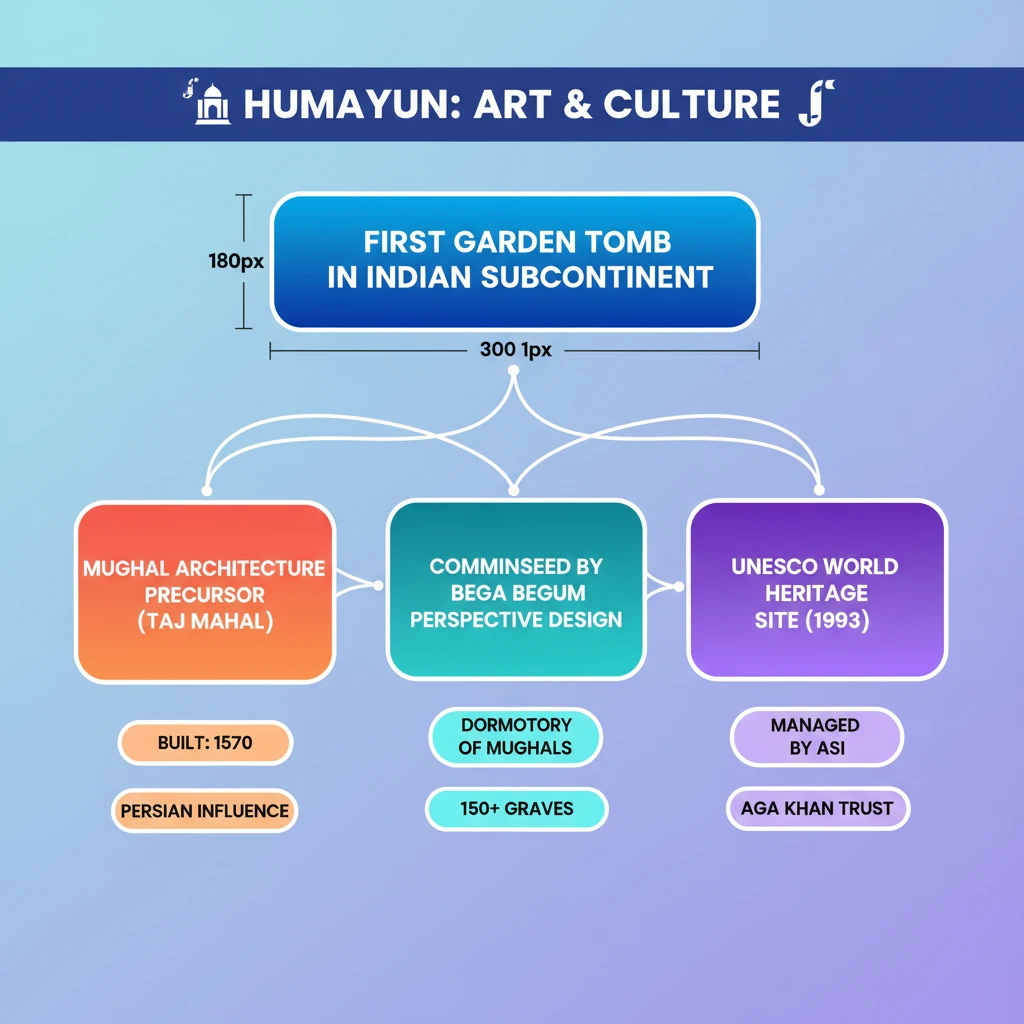
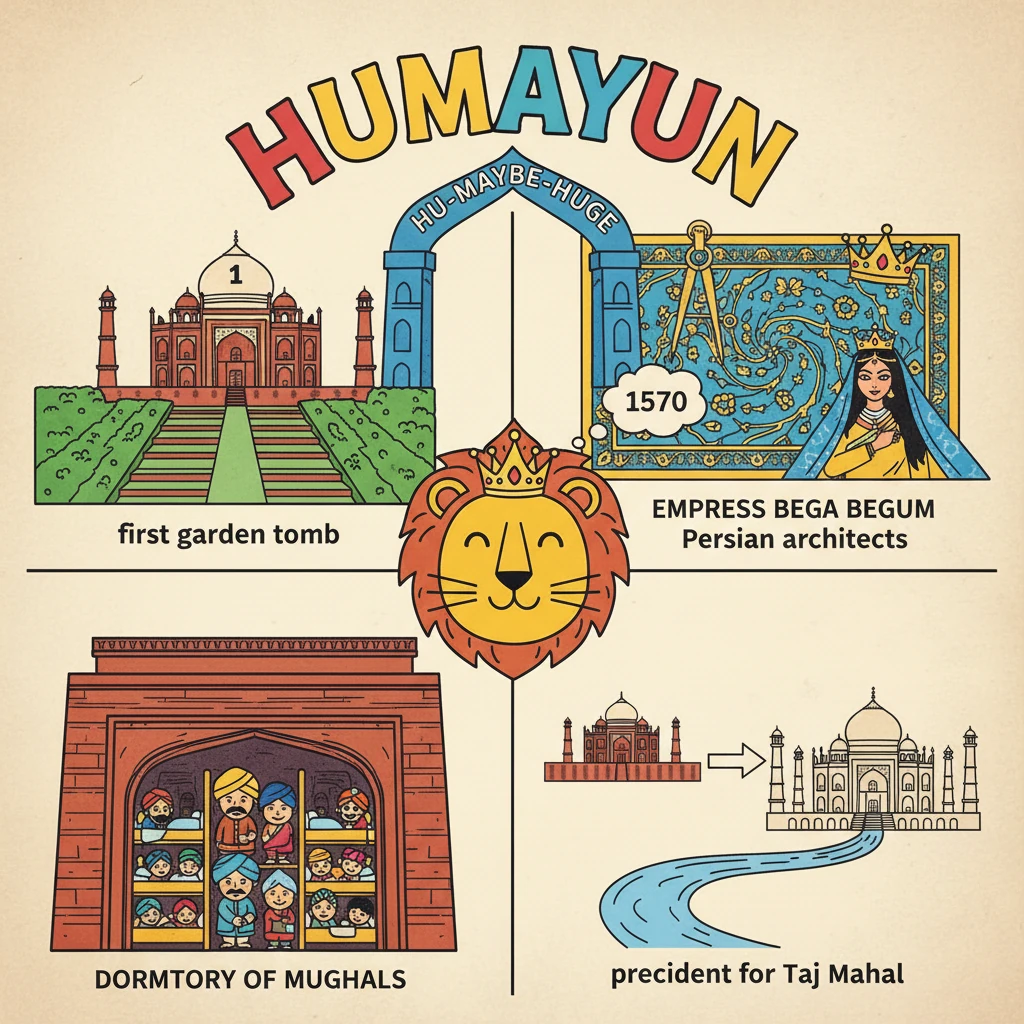
- •Humayun's Tomb, built in 1570, is the first major garden tomb in the Indian subcontinent.
- •It set a precedent for later Mughal architecture, including the Taj Mahal.
- •Commissioned by Empress Bega Begum and designed by Persian architects, it shows strong Persian influence.
- •The complex is known as the 'dormitory of the Mughals,' housing over 150 Mughal family members.
- •It is a UNESCO World Heritage Site since 1993, managed by ASI and Aga Khan Trust for Culture.
- •The surrounding Nizamuddin area is culturally rich, associated with Sufi saint Hazrat Nizamuddin Auliya and poet Amir Khusrau.
- •A museum at the site showcases Humayun's interests, administration, and coins from various Mughal emperors.
🧠 Memory Techniques
95% Verified Content