Religious Significance - Art And Culture | UPSC Learning
Topics
0 topics • 0 completed
🔍
No topics match your search
Religious Significance
Medium⏱️ 7 min read
art and culture
📖 Introduction
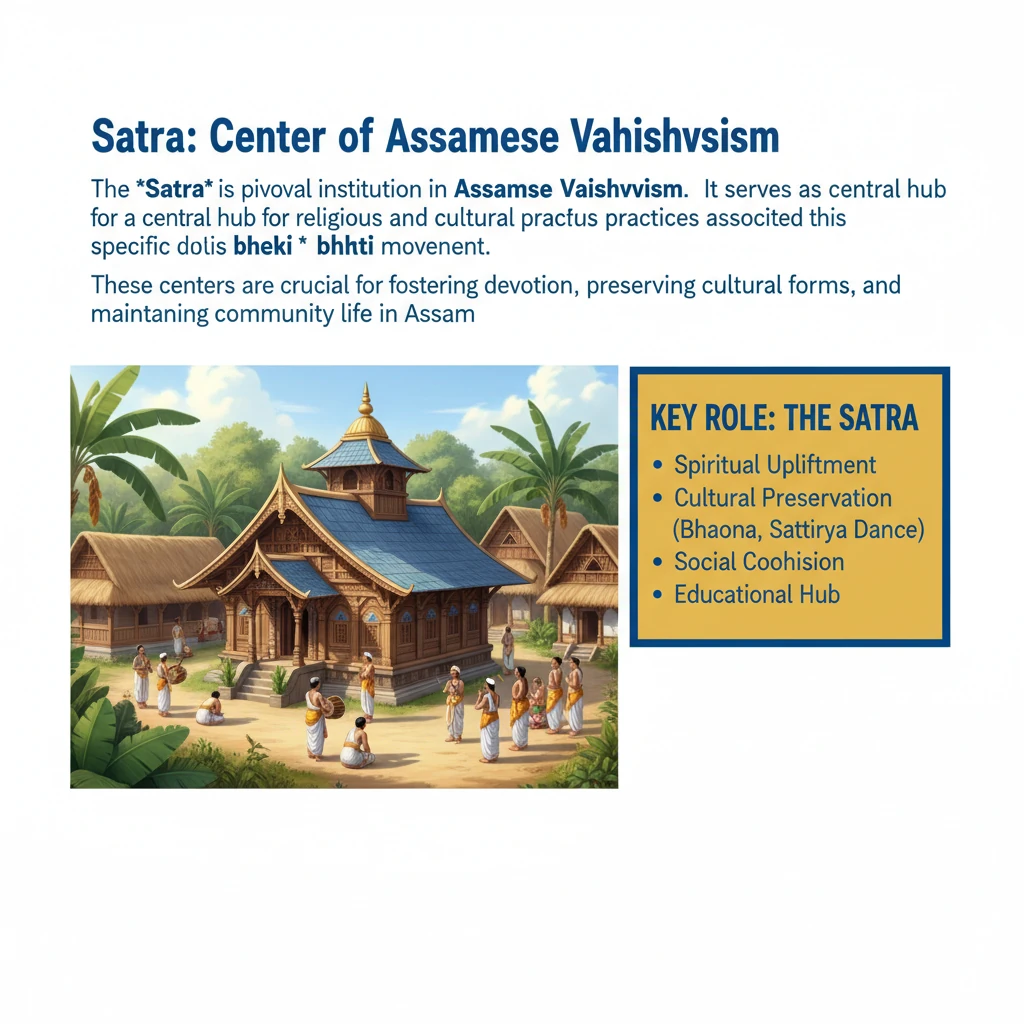
<h4>Satra: Center of Assamese Vaishnavism</h4><p>The <strong>Satra</strong> is a pivotal institution in <strong>Assamese Vaishnavism</strong>. It serves as a central hub for the religious and cultural practices associated with this specific <strong>bhakti movement</strong>.</p><p>These centers are crucial for fostering devotion, preserving cultural forms, and maintaining community life in <strong>Assam</strong>.</p><div class="key-point-box"><strong>Key Role:</strong> The <strong>Satra</strong> functions as a monastic, religious, and cultural complex, integral to the spiritual and social fabric of <strong>Assamese society</strong>.</div><h4>Assamese Vaishnavism: A Bhakti Tradition</h4><p><strong>Assamese Vaishnavism</strong>, also known as <strong>Ekasarana Dharma</strong>, is a distinct branch of the pan-Indian <strong>bhakti movement</strong>. Its core tenet revolves around the ardent worship of <strong>Lord Krishna</strong>.</p><p>This tradition, founded by <strong>Sankardeva</strong>, emphasizes devotion, communal prayer (<strong>naam kirtan</strong>), and artistic expression as pathways to spiritual realization.</p><h4>Origin of the Govinda Idol</h4><p>A significant aspect of this tradition is the origin of its principal deity. The original idol of <strong>Lord Krishna</strong>, specifically revered in the form of <strong>Govinda</strong>, holds immense spiritual value.</p><p>This revered idol is traditionally believed to have been brought from the renowned <strong>Lord Jagannath Temple</strong> at <strong>Puri</strong>, establishing a historical and spiritual link to a major pan-Indian Vaishnavite center.</p><div class="info-box"><strong>Deity:</strong> <strong>Lord Krishna</strong> (as <strong>Govinda</strong>)<br><strong>Source:</strong> <strong>Lord Jagannath Temple</strong>, <strong>Puri</strong>, <strong>Odisha</strong><br><strong>Significance:</strong> Connects <strong>Assamese Vaishnavism</strong> to broader Indian Vaishnavite traditions.</div>
💡 Key Takeaways
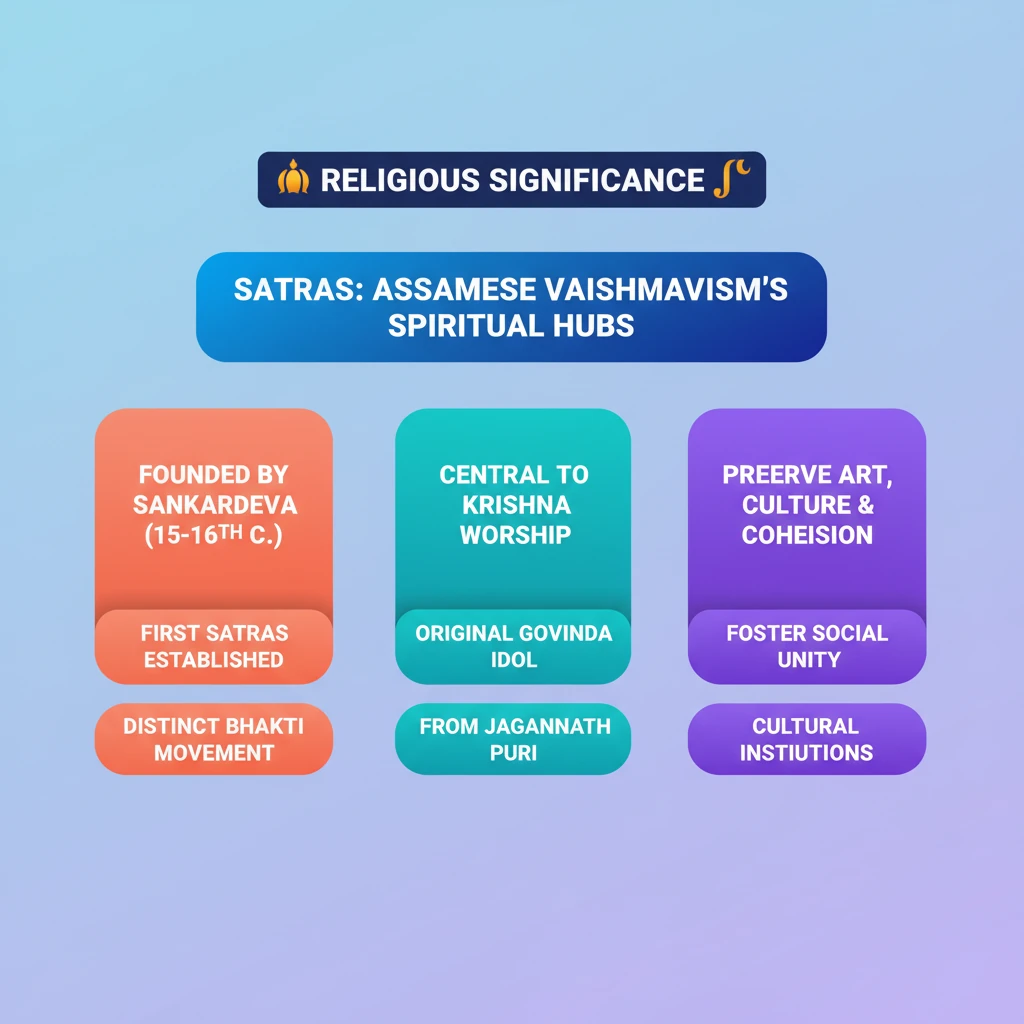
- •Satras are central institutions of Assamese Vaishnavism, a distinct bhakti movement.
- •Assamese Vaishnavism primarily revolves around the worship of Lord Krishna.
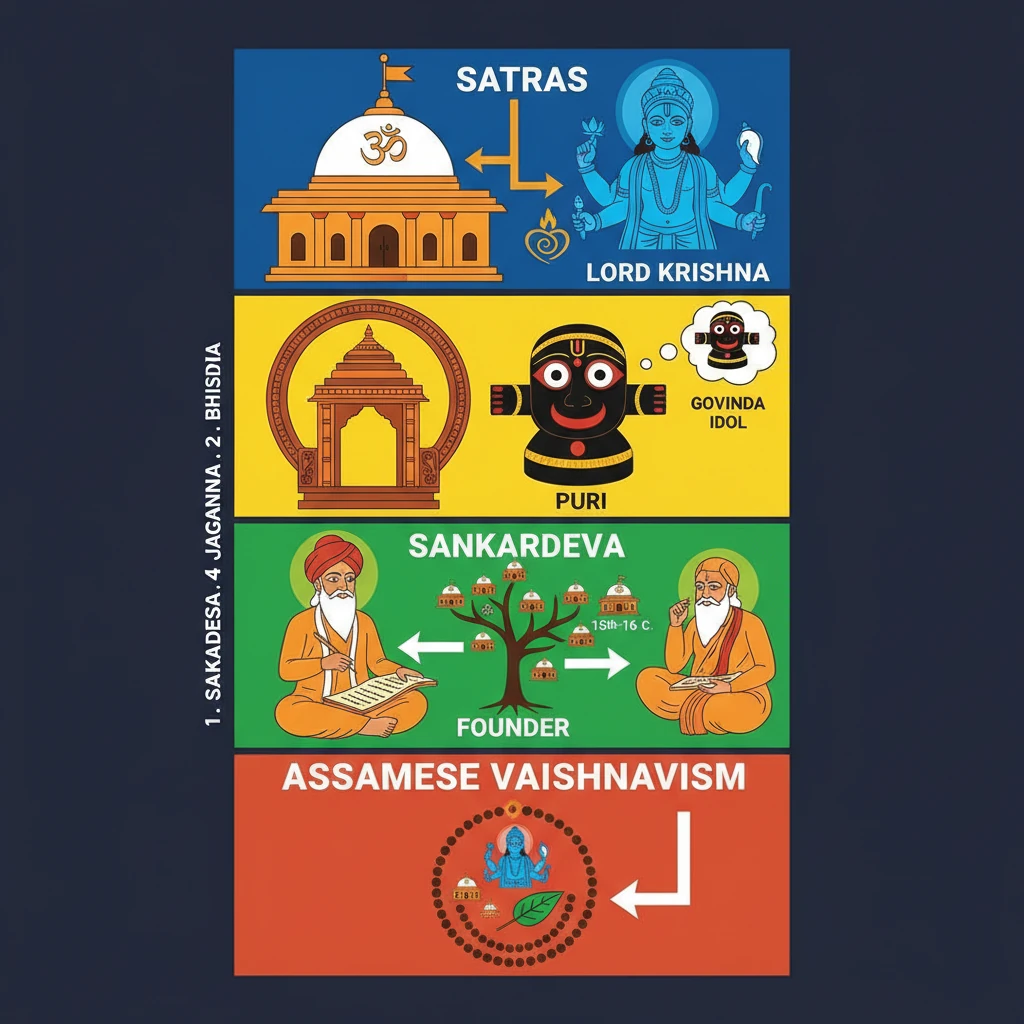
- •The original Govinda idol is traditionally believed to have come from the Lord Jagannath Temple, Puri.
- •Sankardeva founded Assamese Vaishnavism and established the first Satras in the 15th-16th centuries.
- •Satras play a vital role in preserving Assamese art, culture, and fostering social cohesion.
- •Sattriya dance, originating from Satras, is a recognized Indian classical dance form.
🧠 Memory Techniques
95% Verified Content
📚 Reference Sources
•NCERT Class XI - An Introduction to Indian Art
•Cultural History of Assam by P.C. Choudhury
•Sangeet Natak Akademi resources on Sattriya Dance