Manuscripts: Definition, Characteristics, and Significance for UPSC - Art And Culture | UPSC Learning
Topics
0 topics • 0 completed
🔍
No topics match your search

Manuscripts: Definition, Characteristics, and Significance for UPSC
Easy⏱️ 8 min read
art and culture
📖 Introduction
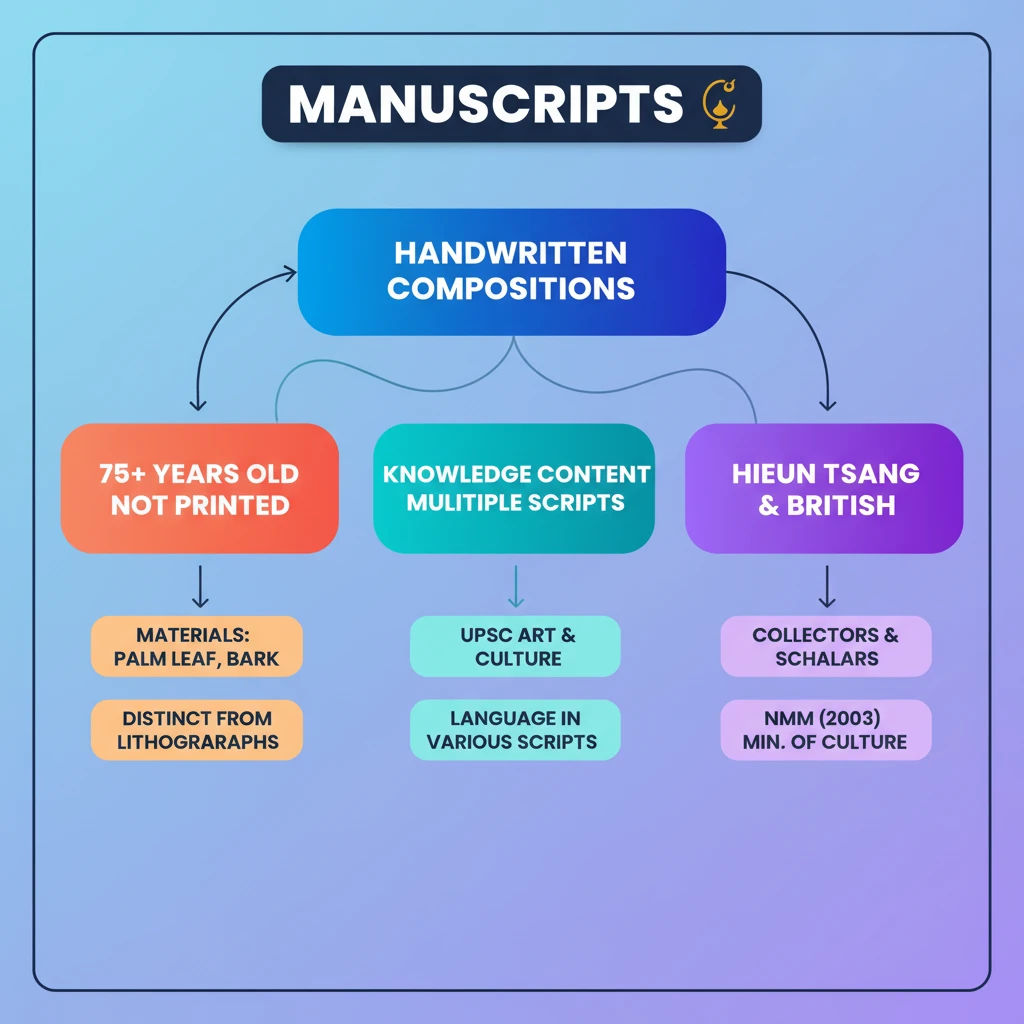
<h4>What is a Manuscript?</h4><p>A <strong>manuscript</strong> is fundamentally a <strong>handwritten composition</strong>. These invaluable texts are created on a variety of materials, reflecting the diverse cultural practices and available resources of different eras.</p><div class="info-box"><strong>Definition:</strong> A <strong>manuscript</strong> is a handwritten composition created on materials such as <strong>paper, bark, cloth, metal, or palm leaf</strong>. It must be at least <strong>75 years old</strong> to qualify as a manuscript.</div><h4>Key Characteristics of Manuscripts</h4><p>Manuscripts possess several distinct characteristics that differentiate them from other forms of historical documentation and printed materials. Understanding these helps in their study and preservation.</p><ul><li><strong>Material Diversity:</strong> They were inscribed on various surfaces including <strong>palm leaves, birch bark, cloth, metal plates</strong>, and eventually <strong>paper</strong>.</li><li><strong>Age Criterion:</strong> A crucial characteristic is their age; a composition must be at least <strong>75 years old</strong> to be classified as a manuscript.</li><li><strong>Exclusions: Lithographs</strong> and <strong>printed volumes</strong> are explicitly <strong>not considered manuscripts</strong>, as they are not handwritten.</li><li><strong>Script Variability:</strong> Often, a single language might be represented in <strong>multiple scripts</strong>. For example, <strong>Sanskrit</strong> has been written in scripts like <strong>Oriya, Grantha</strong>, and <strong>Devanagari</strong>.</li><li><strong>Distinction from Historical Records:</strong> Unlike historical records such as <strong>epigraphs, firmans</strong>, or <strong>revenue records</strong>, which primarily document historical events, manuscripts primarily contain <strong>knowledge content</strong>.</li></ul><div class="key-point-box">Manuscripts are vital repositories of knowledge, offering insights into <strong>philosophy, science, literature</strong>, and <strong>art</strong> across various periods.</div><h4>Early Historical Engagement with Manuscripts</h4><p>Interest in manuscripts dates back centuries, with various rulers and scholars recognizing their immense value. These early interactions highlight their cultural and intellectual significance.</p><p>In the <strong>18th century</strong>, the <strong>Nawab of Awadh</strong> presented an illuminated manuscript of the <strong>Padshahnama</strong> to <strong>King George III of England</strong>, showcasing their diplomatic and artistic value.</p><p>The <strong>7th-century Chinese traveller Hieun Tsang</strong> is renowned for taking numerous <strong>Indian manuscripts</strong> back to China, contributing significantly to the spread of knowledge and Buddhism.</p><h4>British Contributions to Manuscript Study</h4><p>During the British colonial period, several scholars played pivotal roles in the study, collection, and preservation of Indian manuscripts, laying the groundwork for modern Indology.</p><p>Notable figures like <strong>William Jones, C.P. Brown, John Leyden, Colin Mackenzie, Charles Wilkins, H.H. Wilson</strong>, and <strong>HT Colebrooke</strong> were instrumental in these efforts. Their work brought many hidden texts to light.</p><div class="info-box"><strong>Key British Scholars:</strong><ul><li><strong>William Jones:</strong> Founder of the Asiatic Society of Bengal.</li><li><strong>HT Colebrooke:</strong> Pioneer in cataloging Indian manuscripts.</li><li><strong>Charles Wilkins:</strong> Translated the Bhagavad Gita into English.</li></ul></div><p>Early efforts to <strong>catalogue Indian manuscripts</strong> began as early as <strong>1803</strong>, spearheaded by <strong>HT Colebrooke</strong>, who served as the fourth president of the <strong>Asiatic Society of Bengal</strong>.</p><h4>Introduction to National Mission for Manuscripts (NMM)</h4><p>Recognizing the vast and invaluable heritage contained in manuscripts, the Indian government launched a dedicated initiative for their preservation and documentation.</p><div class="info-box"><strong>About NMM:</strong> The <strong>National Mission for Manuscripts (NMM)</strong> is an initiative of the <strong>Ministry of Culture</strong>. It was launched in <strong>2003</strong> with the primary goal of preserving and documenting India’s extensive collection of manuscripts.</div><h4>Objectives and Implementation of NMM</h4><p>The NMM operates with clear objectives and a defined structure to ensure the comprehensive management of India's manuscript heritage.</p><p>The mission aims to <strong>uncover, document, conserve</strong>, and make India’s vast manuscript heritage <strong>accessible</strong> to scholars and the public.</p><ul><li><strong>Conservation:</strong> Dedicated to physically preserving manuscripts from decay and damage.</li><li><strong>Documentation:</strong> Creating a comprehensive national database of all Indian manuscripts.</li><li><strong>Dissemination:</strong> Making the knowledge contained within these manuscripts available for study and research.</li><li><strong>Accessibility:</strong> Ensuring these cultural treasures are accessible for future generations.</li></ul><div class="info-box"><strong>Implementing Bodies:</strong><ul><li>The <strong>Department of Culture</strong> is responsible for implementing the mission.</li><li>The <strong>Indira Gandhi National Centre for the Arts (IGNCA)</strong> serves as the nodal agency for the NMM.</li></ul></div><div class="key-point-box">The NMM's guiding principle and motto is: <strong>“conserving the past for the future.”</strong> This encapsulates its commitment to both preservation and knowledge dissemination.</div>
💡 Key Takeaways
- •Manuscripts are handwritten compositions on various materials, at least 75 years old.
- •They are distinct from lithographs and printed volumes, primarily containing knowledge content.
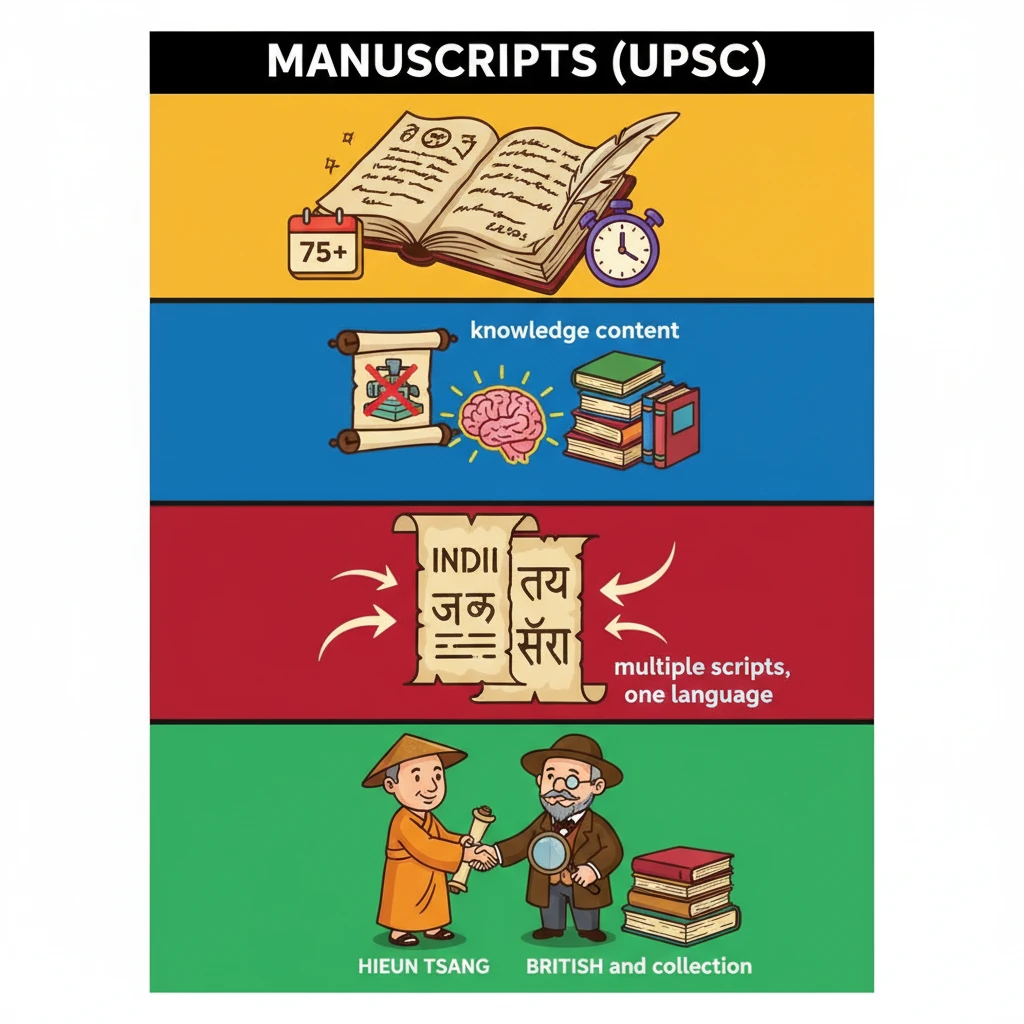
- •One language can be represented in multiple scripts in Indian manuscripts.
- •Historical figures like Hieun Tsang and British scholars played roles in studying and collecting manuscripts.
- •The National Mission for Manuscripts (NMM) was launched in 2003 by the Ministry of Culture.
- •NMM's objectives include uncovering, documenting, conserving, and making manuscripts accessible.
- •IGNCA serves as the nodal agency for the National Mission for Manuscripts.
🧠 Memory Techniques
95% Verified Content