Heritage & Other Important Sites and Cultural Institutions - Art And Culture | UPSC Learning
Topics
0 topics • 0 completed
🔍
No topics match your search
Heritage & Other Important Sites and Cultural Institutions
Medium⏱️ 8 min read
art and culture
📖 Introduction
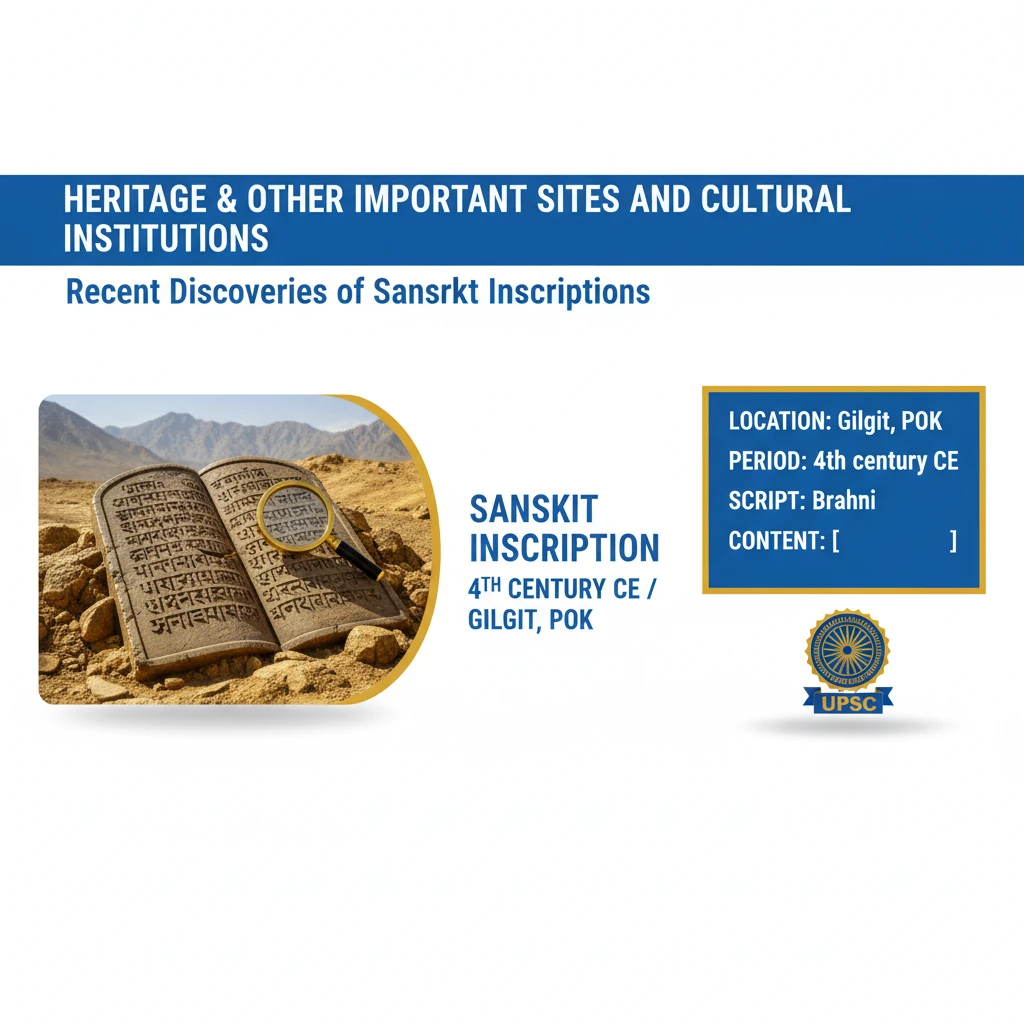
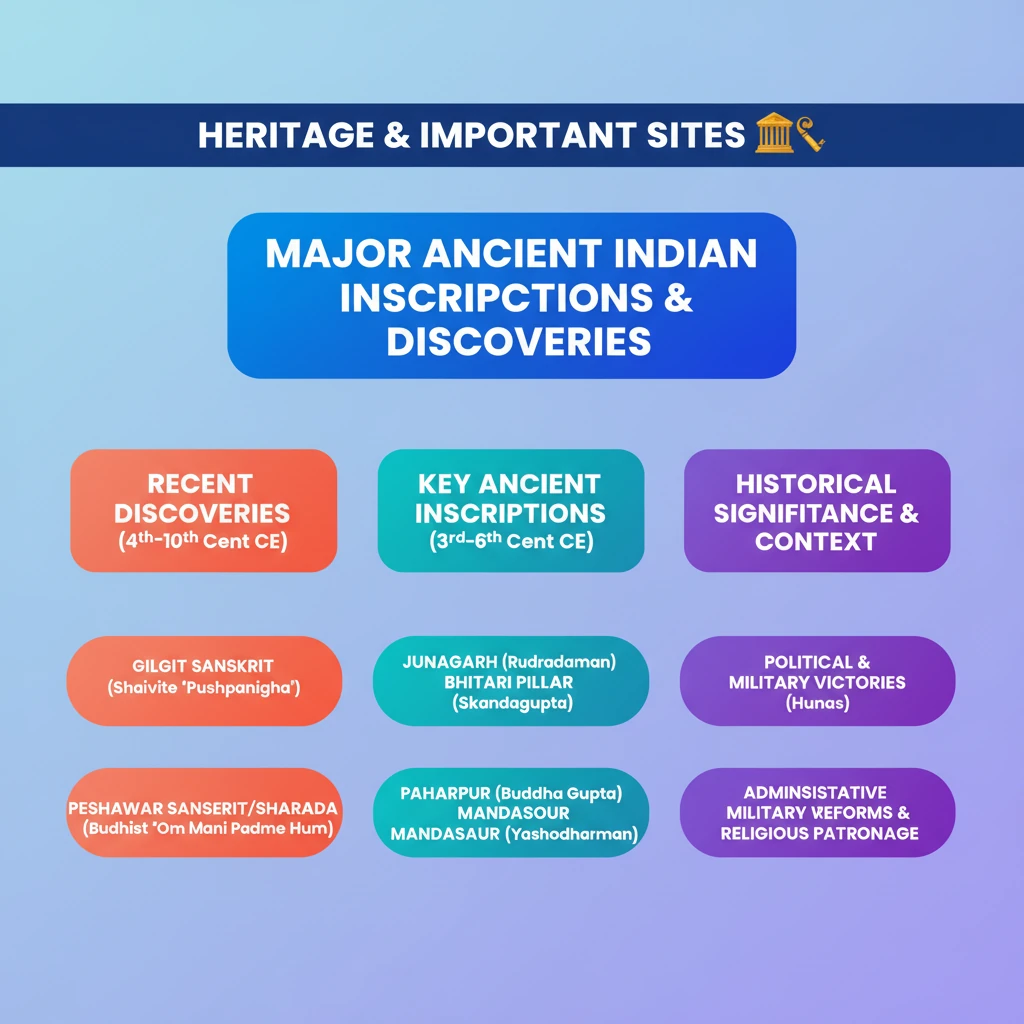
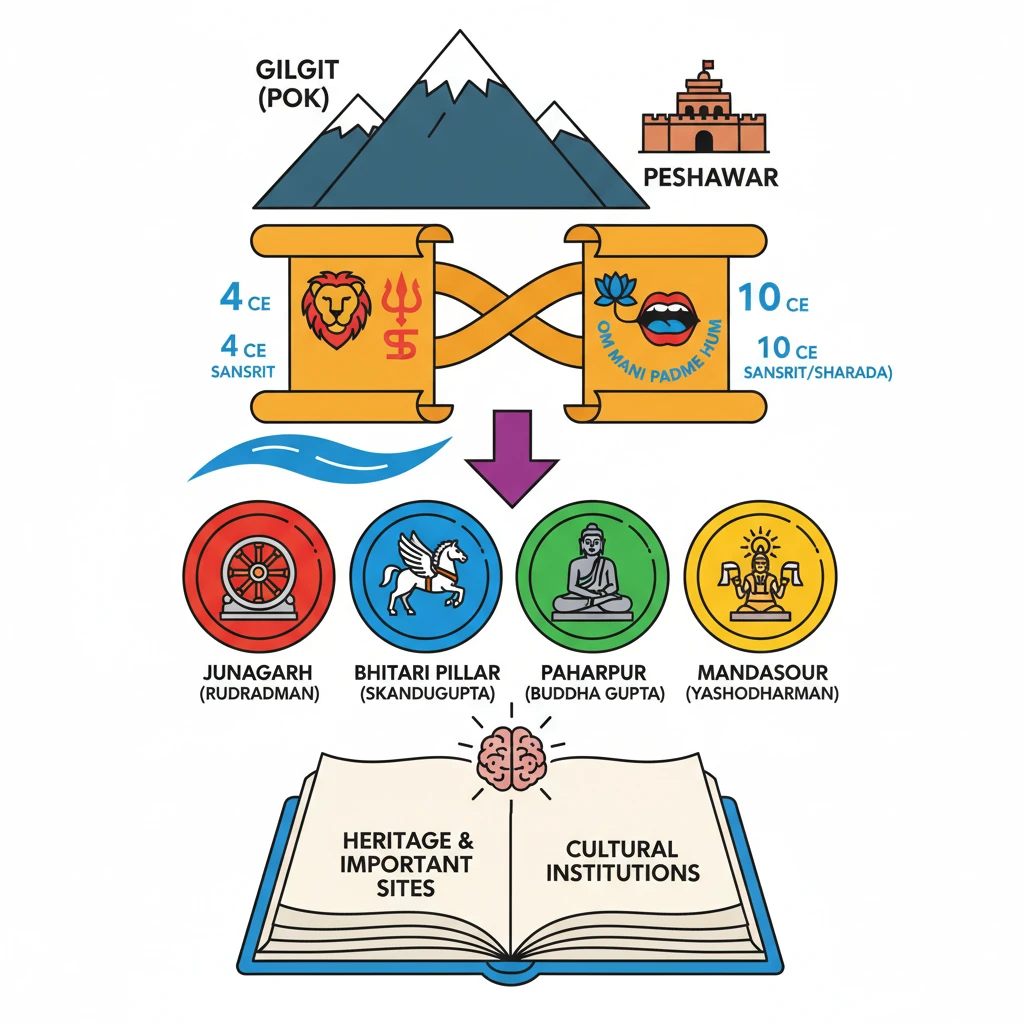
<h4>Recent Discoveries of Sanskrit Inscriptions</h4><p>A significant <strong>Sanskrit inscription</strong> dating back to the <strong>4th century CE</strong> was recently discovered near <strong>Gilgit</strong> in <strong>Pakistan-Occupied Kashmir (POK)</strong>. This inscription is written in the ancient <strong>Brahmi script</strong>.</p><div class="info-box"><strong>Location:</strong> Gilgit, POK<br><strong>Period:</strong> 4th century CE<br><strong>Script:</strong> Brahmi<br><strong>Content:</strong> Mentions <strong>“Pushpasingha”</strong> installing a <strong>Mahaesvaralinga</strong> for the merit of his guru (name partially lost).</div><p>Earlier in <strong>2024</strong>, another important discovery was made near <strong>Peshawar</strong>. This was a <strong>10th-century CE Sanskrit and Sharada script inscription</strong>.</p><div class="info-box"><strong>Location:</strong> Near Peshawar<br><strong>Period:</strong> 10th century CE<br><strong>Scripts:</strong> Sanskrit and Sharada<br><strong>Content:</strong> References <strong>Buddhist Dharani chants</strong>, specifically mentioning <strong>“Om Mani Padme Hum”</strong> in its six lines.</div><div class="key-point-box"><strong>Buddhist Dharani:</strong> These are <strong>sacred mantras or chants</strong> used in Buddhism. They are believed to possess spiritual power, offering protection, purification, and invoking blessings. Dharanis often contain sacred syllables or phrases recited in rituals for well-being.</div><h4>Important Inscriptions of Ancient India</h4><p>Ancient Indian inscriptions serve as invaluable primary sources for reconstructing history, culture, and societal structures. They are broadly categorized based on their content and purpose.</p><h5>Political Inscriptions</h5><ul><li><strong>Junagarh (Girnar) Inscription (Rudradaman):</strong> This <strong>2nd-century CE Sanskrit inscription</strong> provides detailed accounts of <strong>Rudradaman’s achievements</strong>. It notably mentions the construction of the <strong>Sudarshana lake</strong>, initiated by <strong>Chandragupta Maurya’s governor, Pushyagupta</strong>.</li><li><strong>Bhitari Pillar Inscription:</strong> This inscription is crucial for understanding the <strong>Gupta period</strong>. It chronicles <strong>Skandagupta’s military success</strong>, particularly his victories against the invading <strong>Hunas</strong>, and highlights his administrative reforms.</li></ul><h5>Administrative and Land Grant Inscriptions</h5><ul><li><strong>Paharpur Inscription (Buddha Gupta):</strong> Discovered in <strong>Bangladesh</strong>, this inscription from the <strong>Gupta period</strong> sheds light on land grants. It illustrates the prevalent practice of religious patronage during that era.</li><li><strong>Mandasaur Inscription:</strong> This inscription details the significant victory of <strong>Yashodharman</strong> over the <strong>Huns</strong>. It emphasizes his pivotal role in restoring stability and order in the region during a turbulent period.</li></ul>
💡 Key Takeaways
- •Recent discoveries include a 4th-century CE Sanskrit inscription in Gilgit (POK) and a 10th-century CE Sanskrit/Sharada inscription near Peshawar.
- •The Gilgit inscription mentions 'Pushpasingha' installing a Mahaesvaralinga, indicating Shaivite presence.
- •The Peshawar inscription references Buddhist Dharani chants, including 'Om Mani Padme Hum'.
- •Important ancient inscriptions include Junagarh (Rudradaman), Bhitari Pillar (Skandagupta), Paharpur (Buddha Gupta), and Mandasaur (Yashodharman).
- •These inscriptions provide crucial details on political achievements, military victories (e.g., against Hunas), administrative reforms, and religious patronage.
- •Inscriptions are primary sources for understanding ancient Indian history, scripts, languages, religions, and socio-political structures.
🧠 Memory Techniques
98% Verified Content
📚 Reference Sources
•General knowledge of ancient Indian epigraphy and history