What are the Key Facts About the Madhava Perumal Temple? - Art And Culture | UPSC Learning
Topics
0 topics • 0 completed
🔍
No topics match your search
What are the Key Facts About the Madhava Perumal Temple?
Medium⏱️ 6 min read
art and culture
📖 Introduction
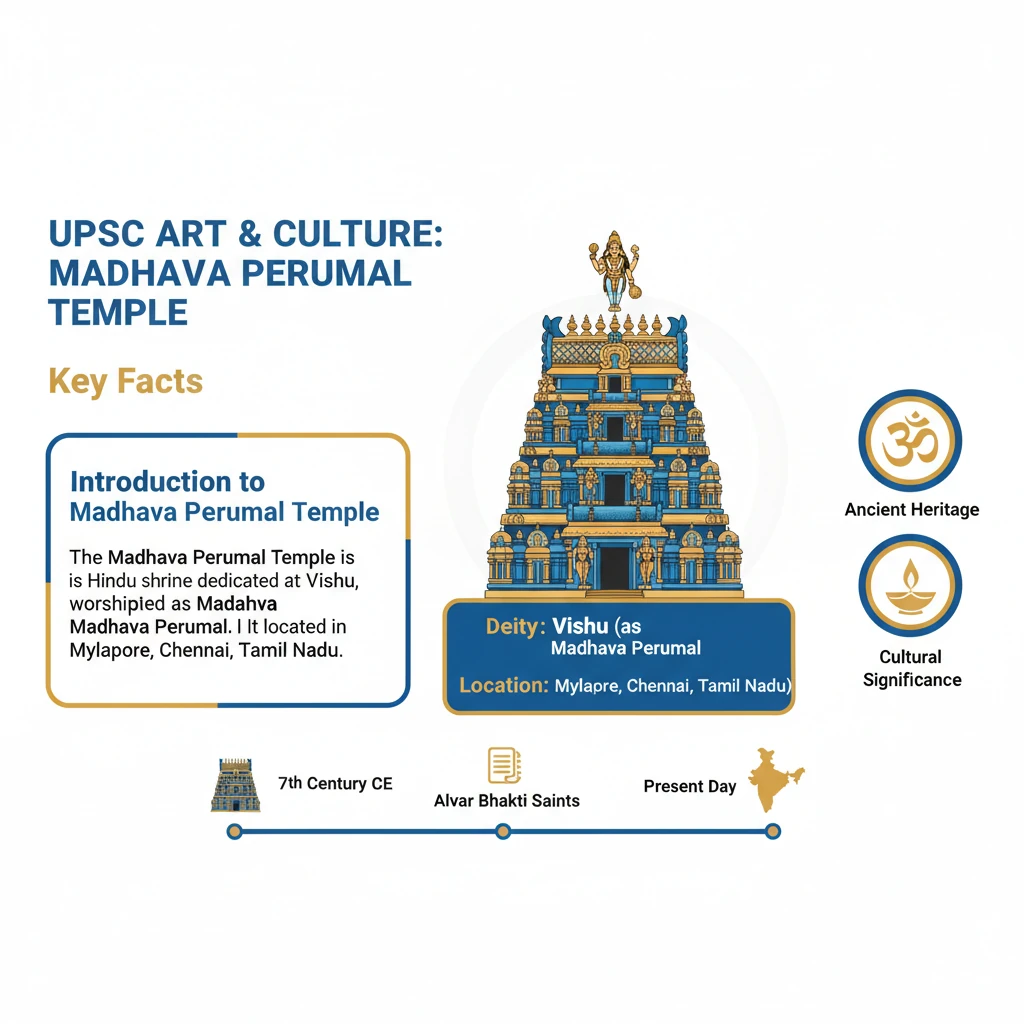
<h4>Introduction to Madhava Perumal Temple</h4><p>The <strong>Madhava Perumal Temple</strong> is a significant Hindu shrine dedicated to the deity <strong>Vishnu</strong>, worshipped in his form as <strong>Madhava Perumal</strong>. It is prominently located in <strong>Mylapore, Chennai, Tamil Nadu</strong>, a region steeped in rich cultural and historical heritage.</p><div class="info-box"><strong>Deity:</strong> Vishnu (as Madhava Perumal)<br><strong>Location:</strong> Mylapore, Chennai, Tamil Nadu</div><h4>Historical Rule and Architectural Style</h4><p>The <strong>Mylapore</strong> region, where the temple stands, once came under the dominion of the powerful <strong>Hoysala dynasty</strong>. Specifically, <strong>King Veera Ballala III</strong> played a role in the region's history.</p><p>Approximately <strong>680 years ago</strong>, a general of the Hoysala army undertook the construction of the <strong>Dhandayudapani Fort</strong>. The <strong>Madhava Perumal Temple</strong>, characterized by its distinctive <strong>Dravidian style of architecture</strong>, was subsequently built within the confines of this fort.</p><div class="key-point-box">The temple exemplifies <strong>Dravidian architecture</strong>, a hallmark of South Indian temple construction.</div><h4>Subsequent Rulers and Conflicts</h4><p>Following the Hoysala period, the area experienced further shifts in power, coming under the rule of the illustrious <strong>Vijayanagara Empire</strong>. Later, it was controlled by <strong>Tipu Sultan</strong>, a prominent figure in South Indian history.</p><p>The region near the fort was also a site of historical conflict, notably the <strong>Battle of Sathamangalam</strong> in <strong>1790</strong>. This battle was a significant event during the <strong>Third Anglo-Mysore War (1790–1792)</strong>, highlighting the strategic importance of the area.</p><h4>Spiritual Significance: Birthplace of Peyalvar</h4><p>The <strong>Madhava Perumal Temple</strong> holds profound spiritual significance as it is traditionally believed to be the birthplace of <strong>Peyalvar</strong>. Peyalvar is revered as one of the <strong>first three</strong> among the <strong>twelve Alwar saints</strong>.</p><p>These <strong>Alwar saints</strong> were influential Vaishnavite poet-saints who lived between the <strong>8th and 9th century CE</strong>, contributing immensely to the Bhakti movement in South India.</p><div class="key-point-box"><strong>Peyalvar</strong>, one of the <strong>first three Alwars</strong>, is believed to have been born here, underscoring the temple's spiritual importance.</div><h4>Rediscovery and Impact of Bhavanisagar Dam</h4><p>A unique aspect of the temple's modern history is its recent rediscovery. The temple was largely submerged within the water-spread area of the <strong>Bhavanisagar dam</strong>, located in <strong>Erode district</strong>.</p><p>It became visible again only when the water level in the dam significantly dipped, revealing its ancient structure to the modern world.</p><h4>Insights from Temple Inscriptions</h4><p>The inscriptions found within the temple premises have provided valuable historical and geographical information. They revealed the past existence of a village known as <strong>Thuruvalur</strong> in the vicinity.</p><p>Furthermore, these inscriptions indicate that the area served as a vital <strong>trunk road</strong>. Traders frequently traversed this route, crossing the <strong>River Bhavani</strong> and the <strong>River Moyar</strong>, to reach important trade centers like <strong>Wayanad in Kerala</strong> and various destinations in <strong>Karnataka</strong>.</p><h4>Consequences of Bhavanisagar Dam Construction</h4><p>The construction of the <strong>Bhavanisagar dam</strong> in <strong>1948</strong> had a significant impact on the surrounding communities and the temple itself. The project necessitated the <strong>relocation of nearby residents</strong>.</p><p>As a direct consequence of the dam's construction and the subsequent submergence, the <strong>idols</strong> from the <strong>Madhava Perumal Temple</strong> were carefully shifted to new locations in <strong>1953</strong> to ensure their preservation.</p>
💡 Key Takeaways
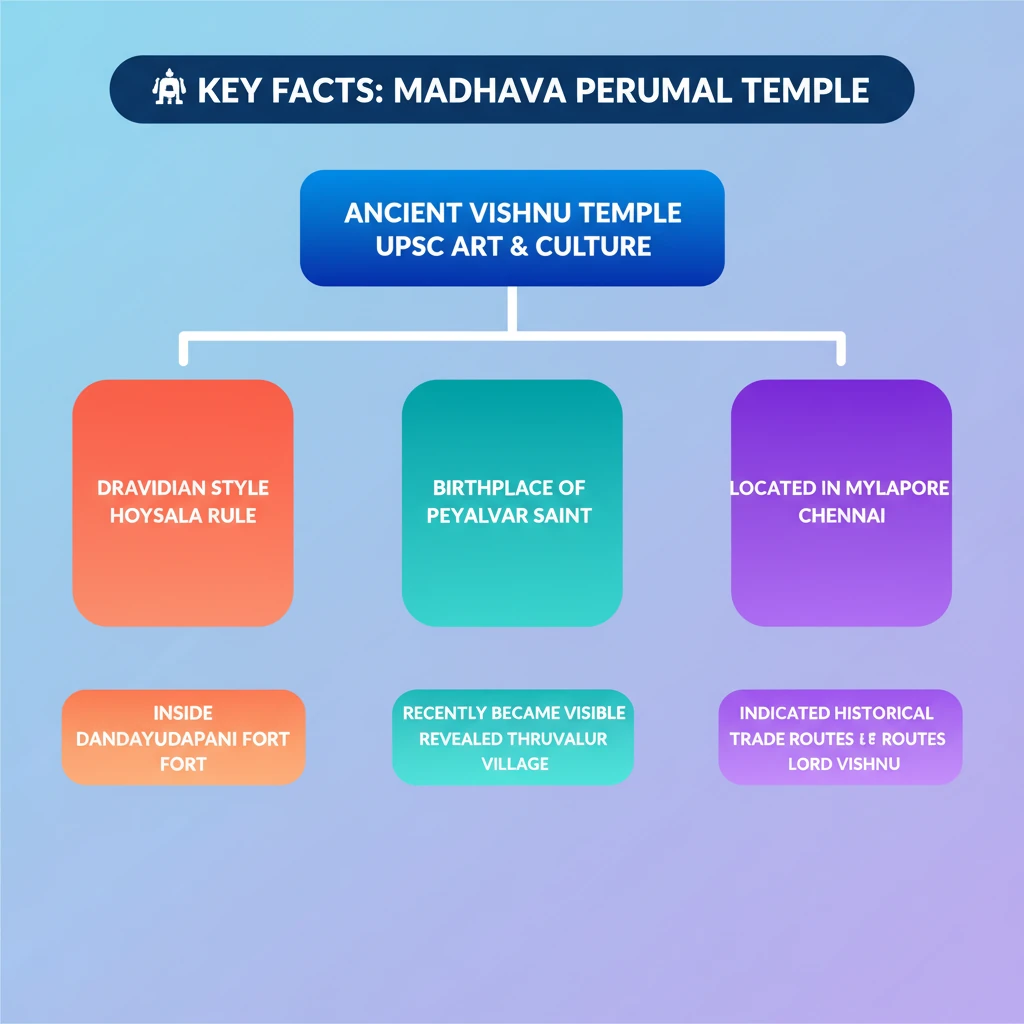
- •The Madhava Perumal Temple is dedicated to Vishnu, located in Mylapore, Chennai.
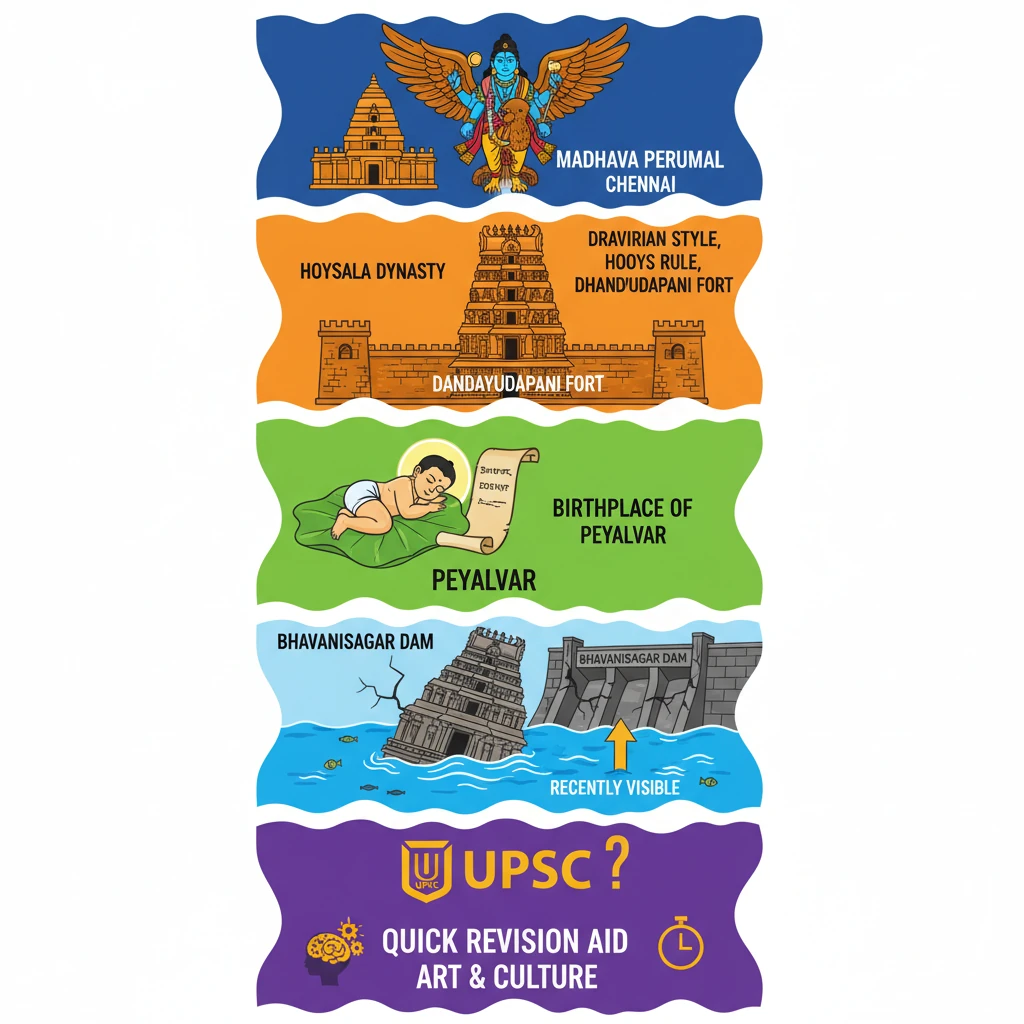
- •It was constructed in the Dravidian style during the Hoysala rule, inside Dhandayudapani Fort.
- •The temple is believed to be the birthplace of Peyalvar, one of the first three Alwar saints.
- •It was submerged by the Bhavanisagar dam in Erode district and recently became visible.
- •Inscriptions revealed the ancient village of Thuruvalur and historical trade routes.
- •The construction of Bhavanisagar dam in 1948 led to relocation of residents and temple idols in 1953.
🧠 Memory Techniques
98% Verified Content
📚 Reference Sources
•General knowledge of South Indian history and architecture (Hoysala, Vijayanagara, Dravidian style)
•Information on Bhavanisagar Dam (publicly available data)