Swami Vivekananda - Art And Culture | UPSC Learning
Topics
0 topics • 0 completed
🔍
No topics match your search
Swami Vivekananda
Medium⏱️ 7 min read
art and culture
📖 Introduction
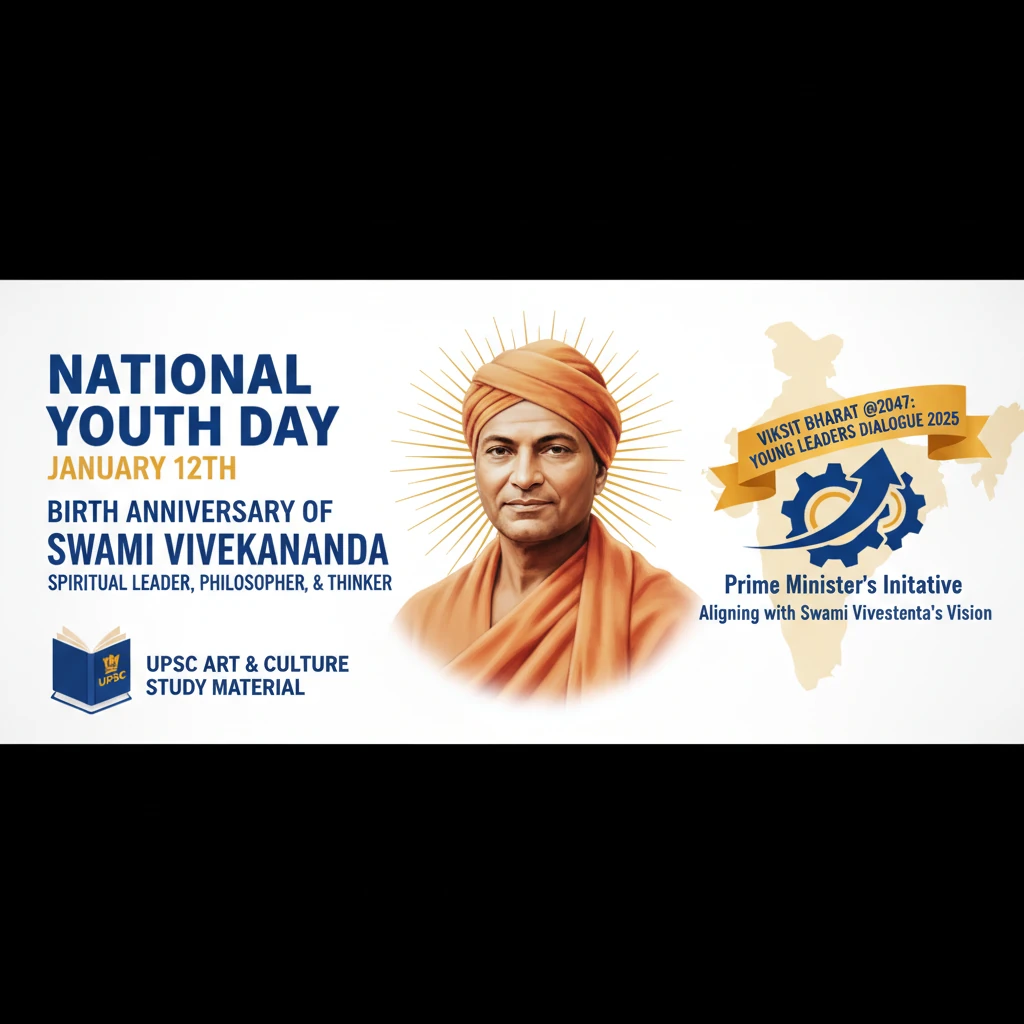
<h4>National Youth Day and Swami Vivekananda's Significance</h4><p><strong>National Youth Day</strong> is celebrated annually on <strong>January 12th</strong> to commemorate the birth anniversary of <strong>Swami Vivekananda</strong>. This day honors his legacy as a spiritual leader, philosopher, and thinker.</p><p>Recently, the Prime Minister participated in the <strong>Viksit Bharat @2047: Young Leaders Dialogue 2025</strong>, aligning with the spirit of youth empowerment championed by Swami Vivekananda.</p><div class="info-box"><strong>National Youth Day:</strong> Celebrated on <strong>January 12th</strong> (Swami Vivekananda's 162nd birth anniversary).<br><strong>National Youth Policy 2014:</strong> Defines <strong>youth</strong> as persons in the age group of <strong>15-29 years</strong>, constituting nearly <strong>40%</strong> of India’s total population.</div><h4>Early Life and Enlightenment</h4><p><strong>Swami Vivekananda</strong> was born as <strong>Narendra Nath Datta</strong> on <strong>January 12th, 1863</strong>. He became a monk and was the chief disciple of <strong>Ramakrishna Paramhansa</strong>.</p><p>In <strong>1893</strong>, at the request of <strong>Maharaja Ajit Singh of Khetri State</strong>, he adopted the name <strong>‘Vivekananda’</strong>, replacing his previous name <strong>‘Sachidananda’</strong>.</p><div class="key-point-box"><strong>The Enlightenment:</strong> In <strong>1892</strong>, Swami Vivekananda meditated for three days and nights on a rock in the <strong>Indian Ocean</strong> off <strong>Kanyakumari</strong>, which led to his spiritual enlightenment. This site is now known as the <strong>Vivekananda Rock Memorial</strong>.</div><h4>Philosophical Contributions</h4><p>Swami Vivekananda played a pivotal role in introducing the world to the profound Indian philosophies of <strong>Vedanta</strong> and <strong>Yoga</strong>. He interpreted Hinduism for a global audience.</p><p>He propagated <strong>‘Neo-Vedanta’</strong>, which presented an understanding of Hinduism through a Western perspective. He believed in harmonizing spiritual growth with material progress.</p><h4>Spiritual Contributions</h4><p>Vivekananda's message on <strong>human values</strong> drew inspiration from ancient texts like the <strong>Upanishads</strong> and the <strong>Gita</strong>, as well as the teachings of figures like <strong>Buddha</strong> and <strong>Jesus</strong>.</p><p>He emphasized concepts such as <strong>self-realization</strong>, <strong>compassion</strong>, and <strong>selfless service</strong>. He famously advocated the doctrine of service, stating that serving <strong>Jiva</strong> (living beings) is equivalent to worshipping <strong>Shiva</strong>.</p><p>He outlined <strong>four pathways</strong> to attain <strong>moksha</strong> (liberation from worldly pleasure and attachment) in his seminal works:</p><ul><li><strong>Raja-yoga</strong></li><li><strong>Karma-yoga</strong></li><li><strong>Jnana-yoga</strong></li><li><strong>Bhakti-yoga</strong></li></ul><h4>Revivalism and Education</h4><p>Vivekananda strongly emphasized the critical role of <strong>education</strong> for the regeneration and upliftment of India. He believed in a transformative approach to learning.</p><p>He advocated for a <strong>'man-making, character-building education'</strong>, focusing on holistic development rather than mere academic knowledge.</p><h4>Core Values: Youth and Ethics</h4><p><strong>Youth:</strong> He inspired young people to be dedicated to their goals, emphasizing the importance of unwavering commitment to overcome challenges. He urged them to develop both mental and physical strength, advocating for <strong>‘muscles of iron’</strong> and <strong>‘nerves of steel’</strong>.</p><p><strong>Ethics:</strong> Vivekananda viewed ethics as a fundamental code of conduct guiding individuals towards responsible citizenship. He stressed that <strong>purity</strong>, reflecting our true living <strong>Self</strong> or <strong>Atman</strong>, is our real nature.</p><h4>Core Values: Religion and Education</h4><p><strong>Religion:</strong> His vision of religion was universal, seeing it as an experience of transcendent reality. He sought to free religion from <strong>superstition</strong>, <strong>dogma</strong>, <strong>priestcraft</strong>, and <strong>intolerance</strong>.</p><p><strong>Education:</strong> Vivekananda believed education should reveal students’ inherent knowledge and power. Its primary aim was <strong>character-building</strong> and making individuals <strong>self-reliant</strong> to navigate life’s complexities.</p><h4>Core Values: Rationality and Nationalism</h4><p><strong>Rationality:</strong> He fully supported the methodologies and findings of <strong>modern science</strong>. He did not advocate for faith over reason, instead embracing scientific inquiry.</p><p><strong>Nationalism:</strong> His concept of nationalism was rooted in <strong>Humanism</strong> and <strong>Universalism</strong>, which are core tenets of Indian spiritual culture. It was characterized by concern for the <strong>masses</strong>, pursuit of <strong>freedom</strong> and <strong>equality</strong>, and the practice of <strong>Karma Yoga</strong> as a path to both political and spiritual liberation through selfless service.</p><h4>Associated Organizations and International Recognition</h4><p>In <strong>1897</strong>, he founded the <strong>Ramakrishna Mission</strong> to propagate his ideals of service, education, and spiritual upliftment, continuing the legacy of his guru.</p><p>He established the <strong>Belur Math</strong> in <strong>1899</strong>, which became his permanent residence and the headquarters of the Ramakrishna Math and Mission.</p><div class="info-box"><strong>International Address:</strong> Swami Vivekananda famously represented <strong>Hinduism</strong> at the <strong>Parliament of Religions</strong> held in <strong>Chicago</strong> in <strong>1893</strong>, where his address garnered widespread acclaim.</div>
💡 Key Takeaways
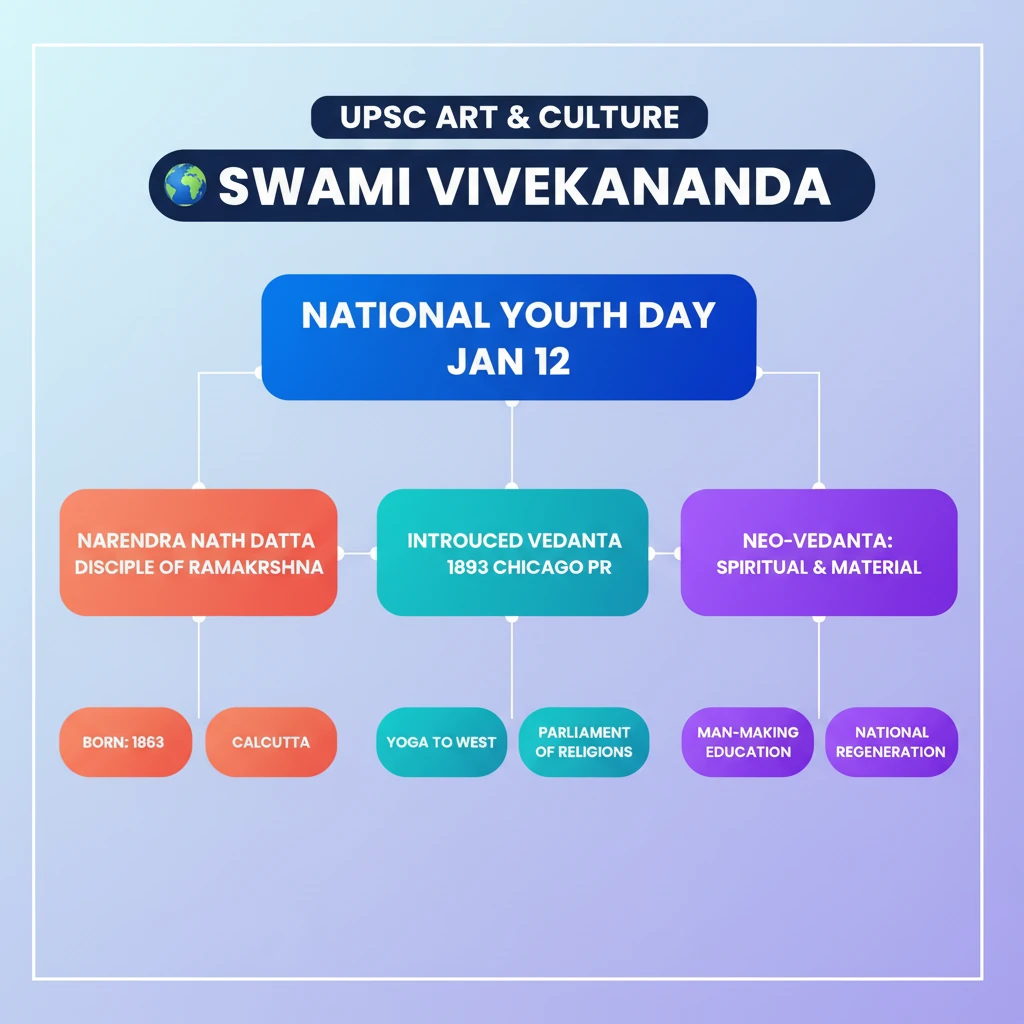
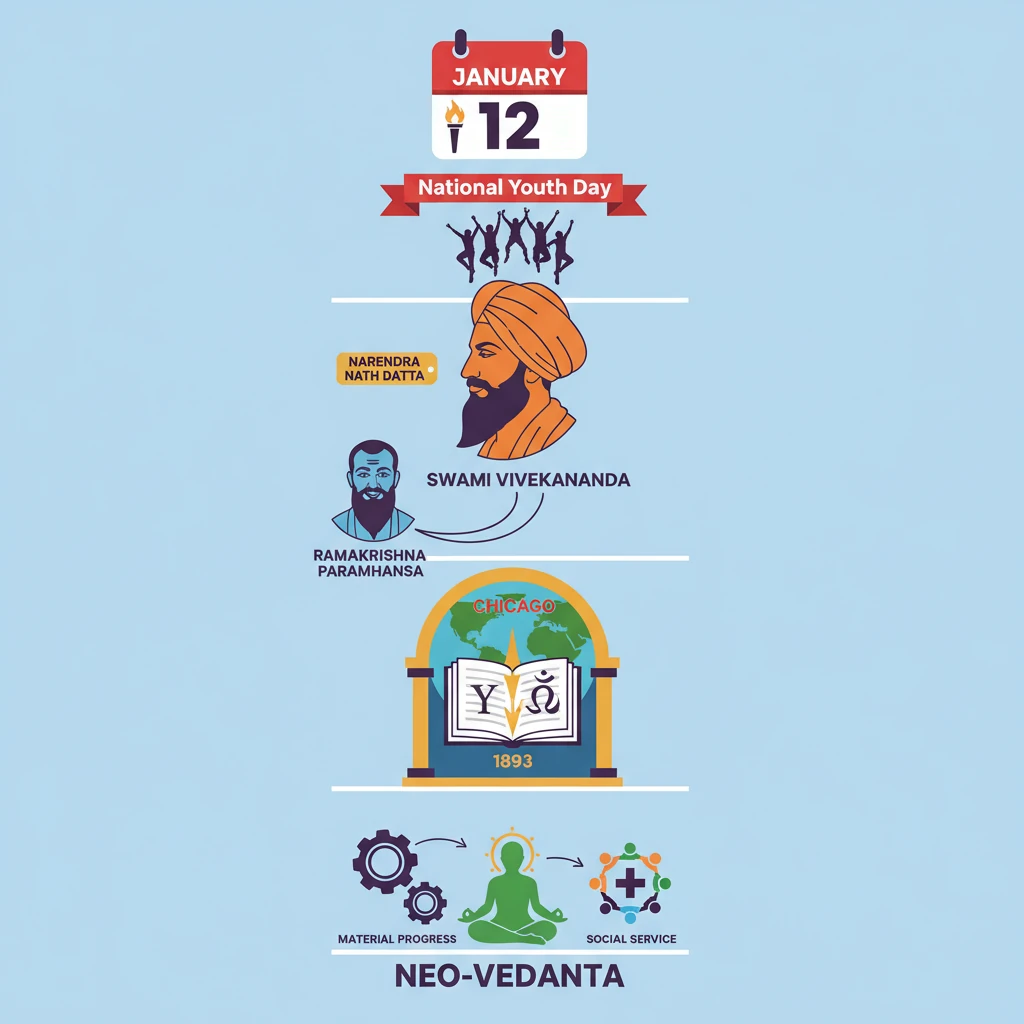
- •Swami Vivekananda's birth anniversary on January 12th is celebrated as National Youth Day.
- •He was born Narendra Nath Datta and was the chief disciple of Ramakrishna Paramhansa.
- •He introduced Vedanta and Yoga to the Western world at the 1893 Chicago Parliament of Religions.
- •His 'Neo-Vedanta' combined spirituality with material progress and social service.
- •He advocated for 'man-making, character-building education' for national regeneration.
- •He founded the Ramakrishna Mission and Belur Math to propagate his ideals.
- •His core values included strength, ethics, universal religion, rationality, and humanistic nationalism.
🧠 Memory Techniques
95% Verified Content