What are the Key Features of Amravati School of Art? - Art And Culture | UPSC Learning
Topics
0 topics • 0 completed
🔍
No topics match your search
What are the Key Features of Amravati School of Art?
Medium⏱️ 6 min read
art and culture
📖 Introduction
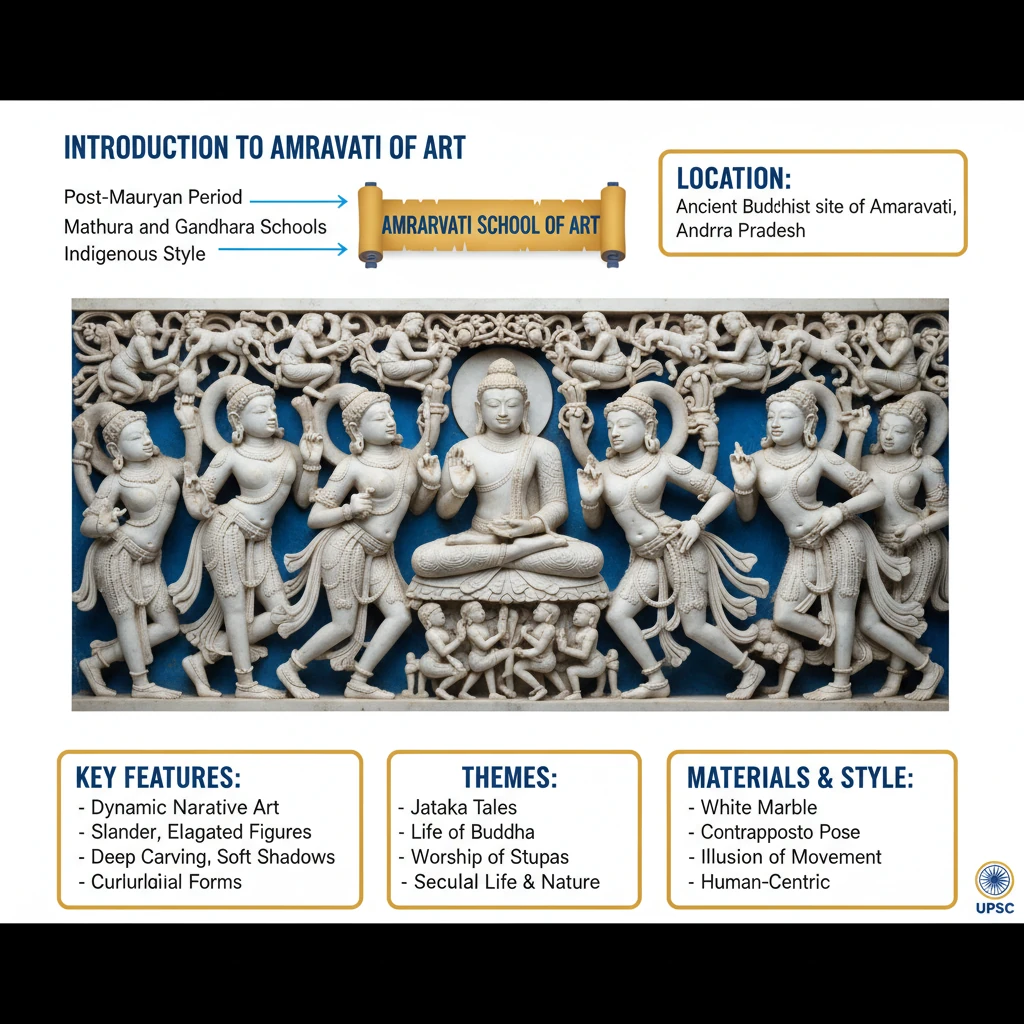
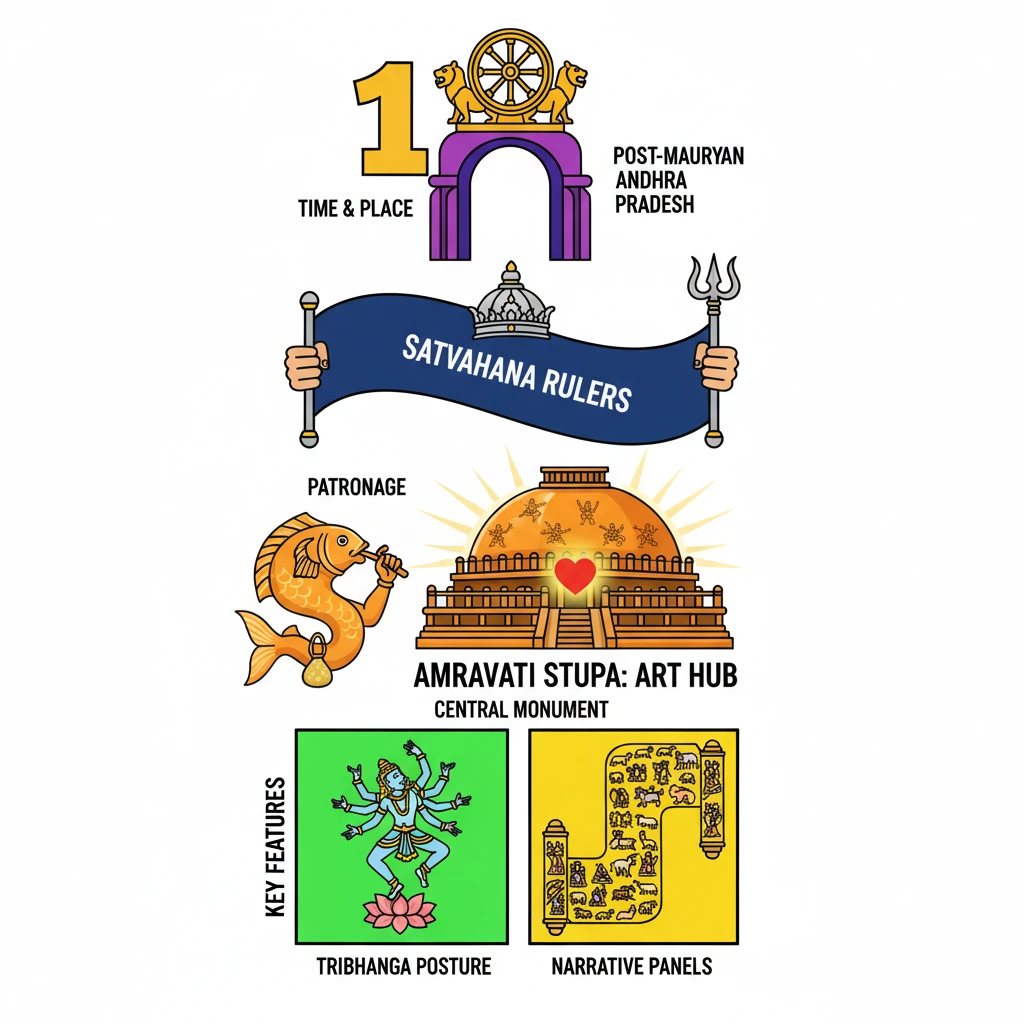
<h4>Introduction to Amravati School of Art</h4><p>The <strong>Amravati School of Art</strong> emerged during the <strong>post-Mauryan period</strong>, establishing itself as one of the three most significant styles of ancient Indian art. It flourished alongside the <strong>Mathura</strong> and <strong>Gandhara schools</strong>, distinguishing itself with a unique indigenous style.</p><div class="info-box"><strong>Location:</strong> Ancient Buddhist site of <strong>Amaravati</strong>, Andhra Pradesh<br><strong>Period:</strong> Post-Mauryan era</div><h4>The Amravati Stupa: A Central Hub</h4><p>The magnificent <strong>Amravati Stupa</strong> served as the focal point and primary inspiration for the Amravati School of Art. This grand Buddhist monument became a vibrant center for artistic and architectural endeavors, significantly influencing the development of <strong>Buddhist art</strong> across India.</p><h4>Historical Neglect and Excavations</h4><p>Unfortunately, the <strong>Amravati Stupa</strong> suffered significant degradation due to a lack of conservation efforts in the <strong>early 19th century</strong>. Local inhabitants and British officials often repurposed stupa materials for construction, leading to its decline.</p><div class="info-box"><strong>Key Events:</strong><ul><li><strong>Early 19th century:</strong> Government indifference led to material reuse.</li><li><strong>1845:</strong> Excavations by <strong>Walter Elliot</strong>.</li><li><strong>Sculpture dispersal:</strong> Pieces shipped to <strong>Calcutta, London, and Madras</strong>.</li></ul></div><h4>Key Characteristics of Amravati Art</h4><p>The sculptures of the Amravati School are renowned for their exceptional aesthetic quality and intricate detailing. They primarily utilized <strong>Palnad marble</strong>, a distinctive type of limestone that allowed for very fine and elaborate carvings.</p><div class="key-point-box"><strong>Major Centres:</strong> <strong>Amaravati</strong> and <strong>Nagarjunakonda</strong><br><strong>Patronage:</strong> <strong>Satvahana rulers</strong></div><h4>Distinctive Artistic Features</h4><ul><li><strong>Tribhanga Posture:</strong> The <strong>Tribhanga posture</strong>, characterized by the body having three distinct bends, was extensively employed in Amravati sculptures. This dynamic pose adds fluidity and grace to the figures.</li><li><strong>Narrative Panels:</strong> The art frequently features elaborate <strong>narrative panels</strong>. These panels vividly depict scenes from the <strong>life of the Buddha</strong>, various <strong>Jataka tales</strong>, and a range of Buddhist rituals and practices.</li><li><strong>Iconic Buddha Depiction:</strong> A particular representation of the <strong>Buddha</strong>, showing the robe draped over the <strong>left shoulder</strong> and the other hand in the <strong>abhaya mudra</strong> (gesture of fearlessness), became iconic. This style was widely replicated across South and Southeast Asia.</li><li><strong>Indigenous Style:</strong> Unlike the <strong>Mathura</strong> and <strong>Gandhara schools</strong>, which exhibited significant <strong>Graeco-Roman influences</strong>, the Amravati school developed a largely indigenous style with minimal external impact. It emphasized local artistic traditions.</li></ul><h4>Global Dispersal of Amravati Sculptures</h4><p>Today, numerous sculptures from the <strong>Amravati Stupa</strong> are housed in museums worldwide, reflecting a broad dispersal of this ancient Indian art. Significant collections can be found in various international institutions.</p><div class="info-box"><strong>International Collections:</strong><ul><li><strong>British Museum</strong> (London)</li><li><strong>Art Institute of Chicago</strong> (USA)</li><li><strong>Musée Guimet</strong> (Paris)</li><li><strong>Metropolitan Museum of Art</strong> (New York)</li></ul><strong>Indian Collections:</strong><ul><li><strong>Government Museum</strong> (Chennai)</li><li><strong>National Museum</strong> (New Delhi)</li></ul></div><h4>Repatriation Efforts</h4><p>Notably, <strong>Australia</strong> stands as the sole country to have returned a stolen <strong>Amravati-style sculpture</strong> to India. This act highlights growing awareness and efforts regarding the repatriation of cultural heritage.</p><div class="exam-tip-box"><strong>UPSC Insight:</strong> Understanding the unique characteristics of the <strong>Amravati School</strong>, especially its indigenous nature and the <strong>Tribhanga posture</strong>, is crucial for distinguishing it from other art schools like <strong>Gandhara</strong> and <strong>Mathura</strong> in <strong>Art and Culture</strong> (<strong>GS Paper 1</strong>).</div>

💡 Key Takeaways
- •The Amravati School of Art flourished in the post-Mauryan period, primarily in Andhra Pradesh.
- •It was patronized by the Satvahana rulers.
- •The Amravati Stupa was its central monument and a hub of artistic activity.
- •Key features include the extensive use of the Tribhanga posture and narrative panels.
- •Sculptures were predominantly crafted from Palnad marble, allowing for intricate detailing.
- •Unlike Mathura and Gandhara, it developed a unique indigenous style with minimal external influence.
- •Many Amravati sculptures are now dispersed globally, with Australia being the only country to return one.
🧠 Memory Techniques
98% Verified Content