Gingee Fort: Architectural Features, Temples, and Water Systems - Art And Culture | UPSC Learning
Topics
0 topics • 0 completed
🔍
No topics match your search
Gingee Fort: Architectural Features, Temples, and Water Systems
Medium⏱️ 8 min read
art and culture
📖 Introduction
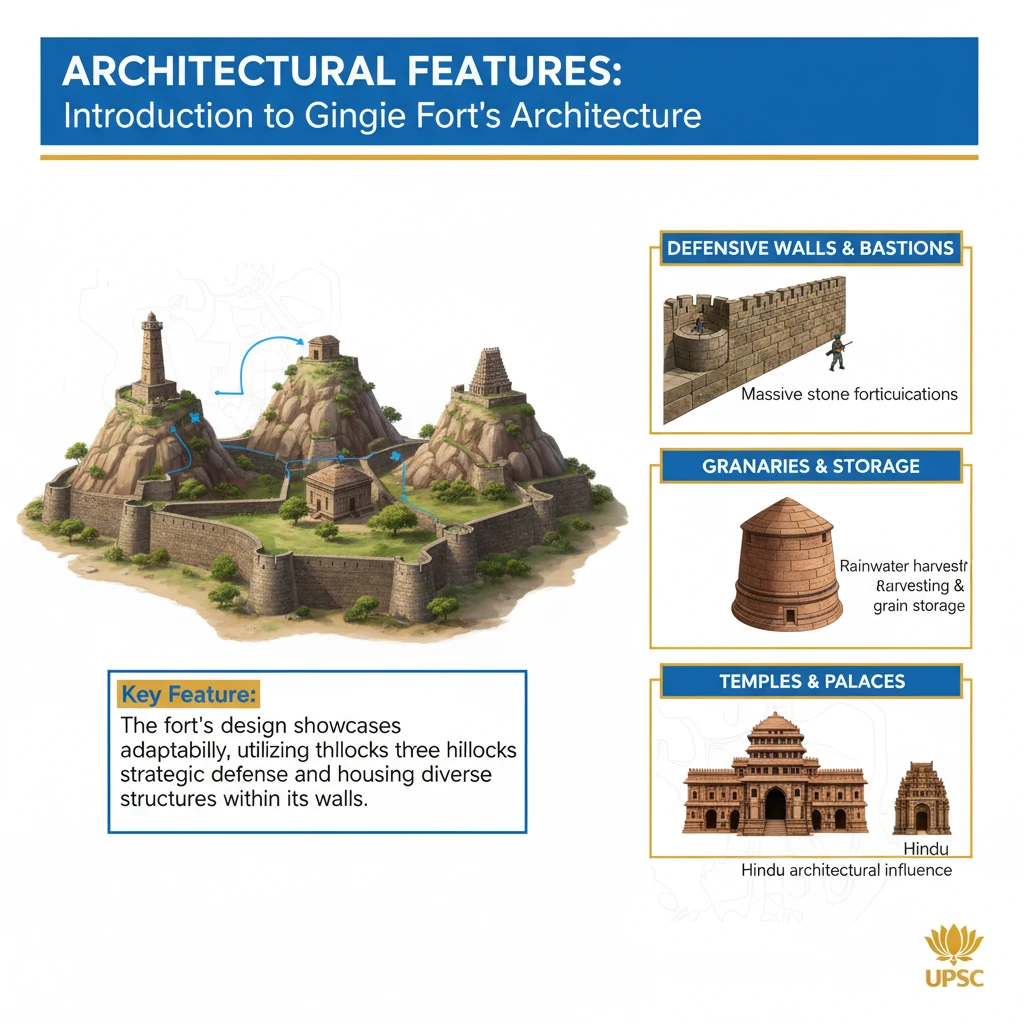
<h4>Introduction to Gingee Fort's Architecture</h4><p>The <strong>Gingee Fort complex</strong> is a remarkable example of Indian military architecture, integrating natural topography with sophisticated design. It encompasses a variety of structures that served both defensive and administrative purposes.</p><div class="key-point-box"><strong>Key Feature:</strong> The fort's design showcases adaptability, utilizing three hillocks for strategic defense and housing diverse structures within its walls.</div><h4>General Structures and Amenities</h4><p>The fort complex is extensive, housing numerous facilities essential for a self-sustaining stronghold. It includes several <strong>temples and shrines</strong>, reflecting the spiritual life within the fort.</p><ul><li><strong>Essential Infrastructure:</strong> A <strong>stepped well</strong> for water, a <strong>granary</strong> for food storage, and a <strong>stable</strong> for animals were crucial.</li><li><strong>Administrative & Military:</strong> A <strong>durbar hall</strong> for assemblies, an <strong>armory</strong>, and <strong>cannons</strong> highlight its military and governance functions.</li><li><strong>Daily Life & Culture:</strong> Features like a <strong>clock tower</strong>, <strong>elephant tank</strong>, and <strong>gymnasium</strong> indicate a well-developed urban environment.</li><li><strong>Religious Diversity:</strong> The presence of both the <strong>Venkataramana temple</strong> and the <strong>Sadathulla Mosque</strong> points to the fort's diverse cultural and religious patronage.</li></ul><h4>Sophisticated Water Supply Systems</h4><p>One of the most impressive architectural feats at <strong>Gingee Fort</strong> is its advanced <strong>water supply system</strong>. This engineering marvel ensured water availability even at the highest elevations.</p><div class="info-box"><strong>System Details:</strong> Gingee Fort features <strong>two sophisticated water supply systems</strong>. These were designed to provide a continuous water supply, crucial for sustaining the population during sieges.</div><h4>Rajagiri Hill: The Primary Citadel</h4><p><strong>Rajagiri Hill</strong> stands as the tallest and most strategically important part of the fort complex. Its elevation provided an excellent vantage point for defense.</p><div class="info-box"><strong>Elevation:</strong> Rajagiri Hill is approximately <strong>800 meters</strong> tall. It houses a primary <strong>citadel</strong> and the revered <strong>temple of Ranganatha</strong>, indicating its dual role as a defensive and religious center.</div><h4>Krishnagiri Citadel: Indo-Islamic Influence</h4><p>The <strong>Krishnagiri Citadel</strong> presents a distinct architectural style, reflecting the diverse cultural influences on the fort's builders over time. It is known for its unique structural elements.</p><div class="info-box"><strong>Architectural Style:</strong> Krishnagiri Citadel is notable for its prominent <strong>Indo-Islamic architecture</strong>. A key feature is its <strong>audience hall with a domed roof</strong>, a characteristic element of Islamic design.</div><h4>Venkataramana Swamy Temple</h4><p>Located within the lower fort complex, the <strong>Venkataramana Swamy Temple</strong> is a significant religious structure known for its artistic embellishments. It showcases intricate craftsmanship.</p><div class="info-box"><strong>Location:</strong> Situated in the <strong>Lower Fort complex</strong>. The temple is adorned with <strong>intricate carvings</strong> depicting scenes and narratives from various <strong>Hindu epics</strong>, reflecting rich cultural heritage.</div><h4>Kalyana Mahal: Royal Ladies' Quarters</h4><p>The <strong>Kalyana Mahal</strong> is a striking example of residential architecture within the fort, designed for the royal women. It is considered an architectural jewel due to its unique design and purpose.</p><div class="info-box"><strong>Structure:</strong> The Kalyana Mahal is an impressive <strong>eight-storeyed building</strong>. It served as the <strong>royal ladies' quarters</strong>, combining privacy with architectural elegance.</div><div class="exam-tip-box"><strong>UPSC Insight:</strong> When studying forts like Gingee, focus on how architectural features reflect the <strong>strategic needs</strong>, <strong>cultural influences</strong>, and <strong>daily life</strong> of the period. Questions often link architecture to socio-economic conditions.</div>
💡 Key Takeaways
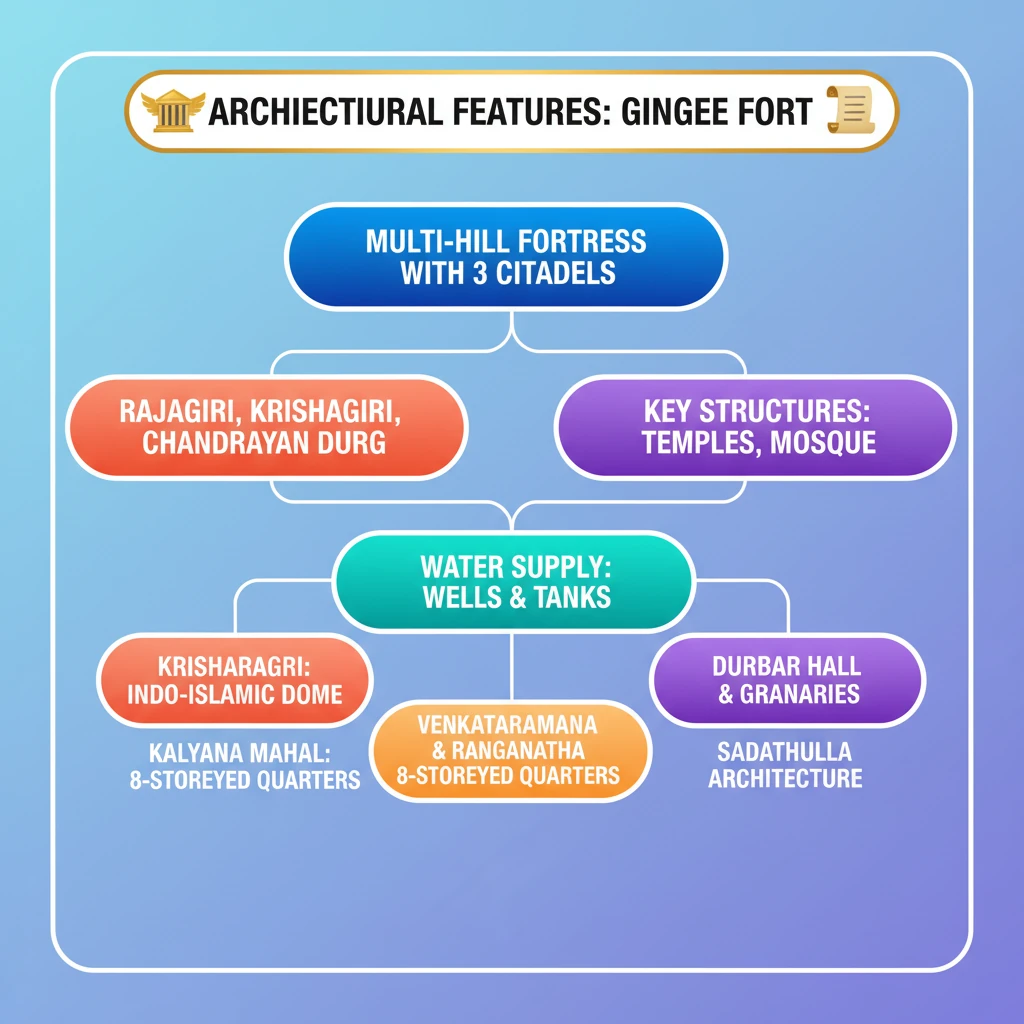
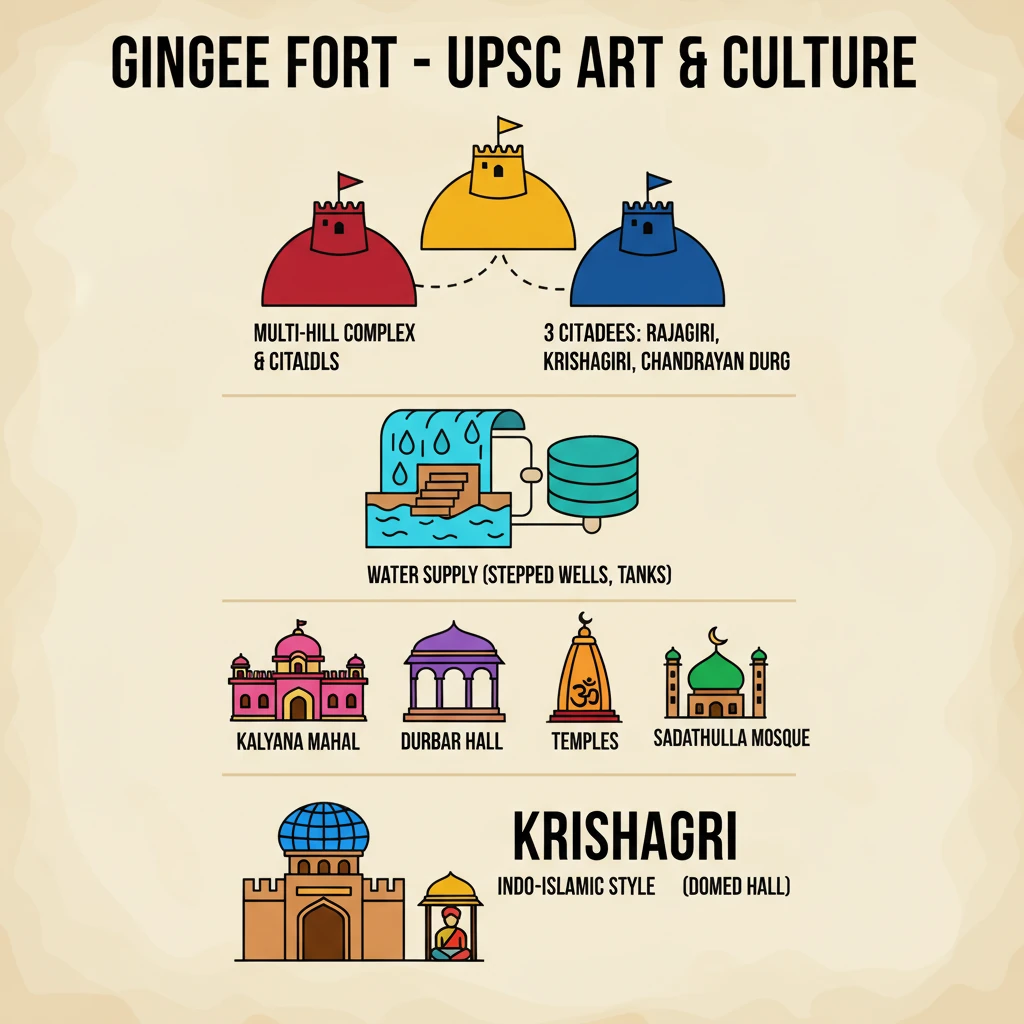
- •Gingee Fort is a multi-hill complex with three citadels: Rajagiri, Krishnagiri, and Chandrayan Durg.
- •It features sophisticated water supply systems, including stepped wells and tanks, ensuring continuous supply.
- •Key structures include Kalyana Mahal, durbar hall, temples (Venkataramana, Ranganatha), and Sadathulla Mosque.
- •Krishnagiri Citadel showcases distinct Indo-Islamic architectural elements like a domed audience hall.
- •Kalyana Mahal is an eight-storeyed royal ladies' quarters, highlighting residential architecture.
- •The fort's history spans Chola, Vijayanagara, Nayak, Maratha, Mughal, and European periods.
- •Its architectural features reflect strategic defense, diverse cultural influences, and advanced engineering.
🧠 Memory Techniques
98% Verified Content
📚 Reference Sources
•Archaeological Survey of India (ASI) publications on Gingee Fort
•NCERT Textbooks (relevant sections on Indian architecture)
•Reputable historical journals and academic articles on South Indian forts