Mughal Emperor Akbar - Art And Culture | UPSC Learning
Topics
0 topics • 0 completed
🔍
No topics match your search
Mughal Emperor Akbar
Medium⏱️ 7 min read
art and culture
📖 Introduction
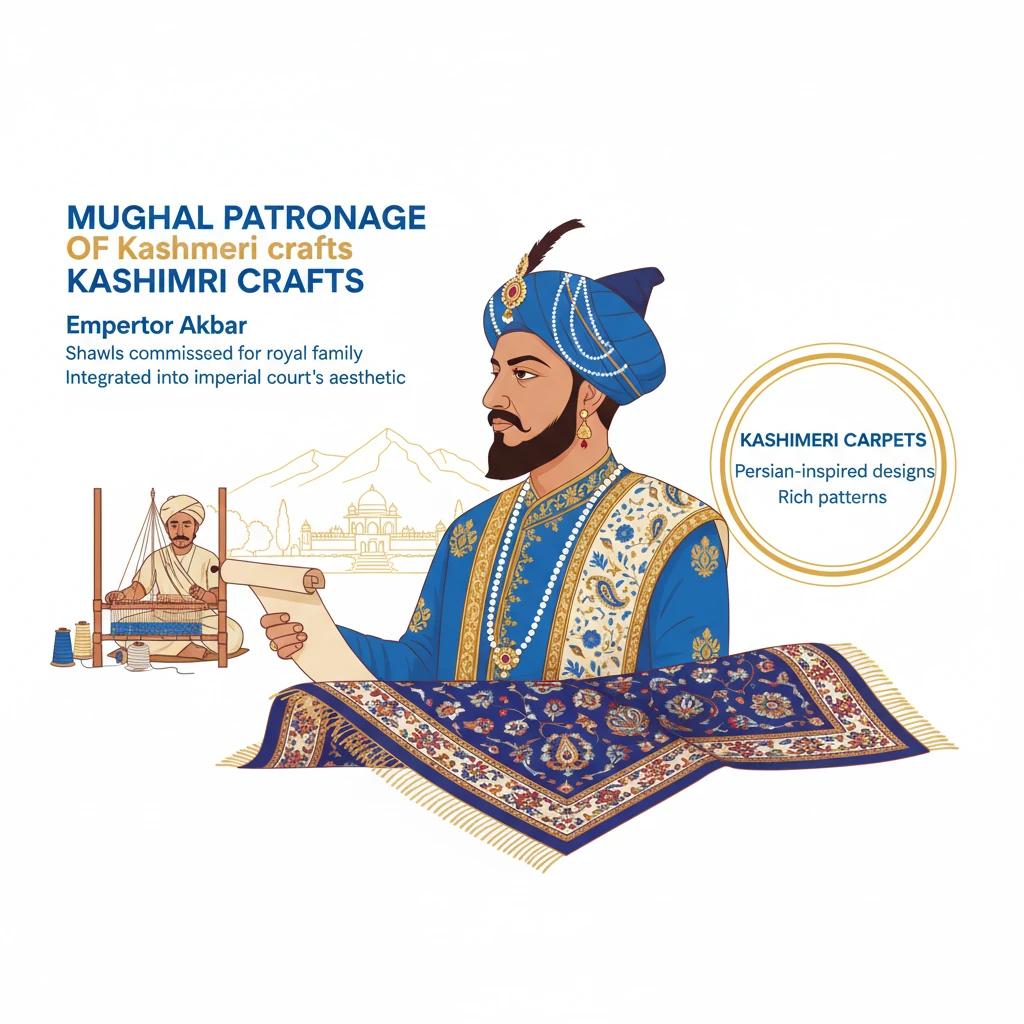
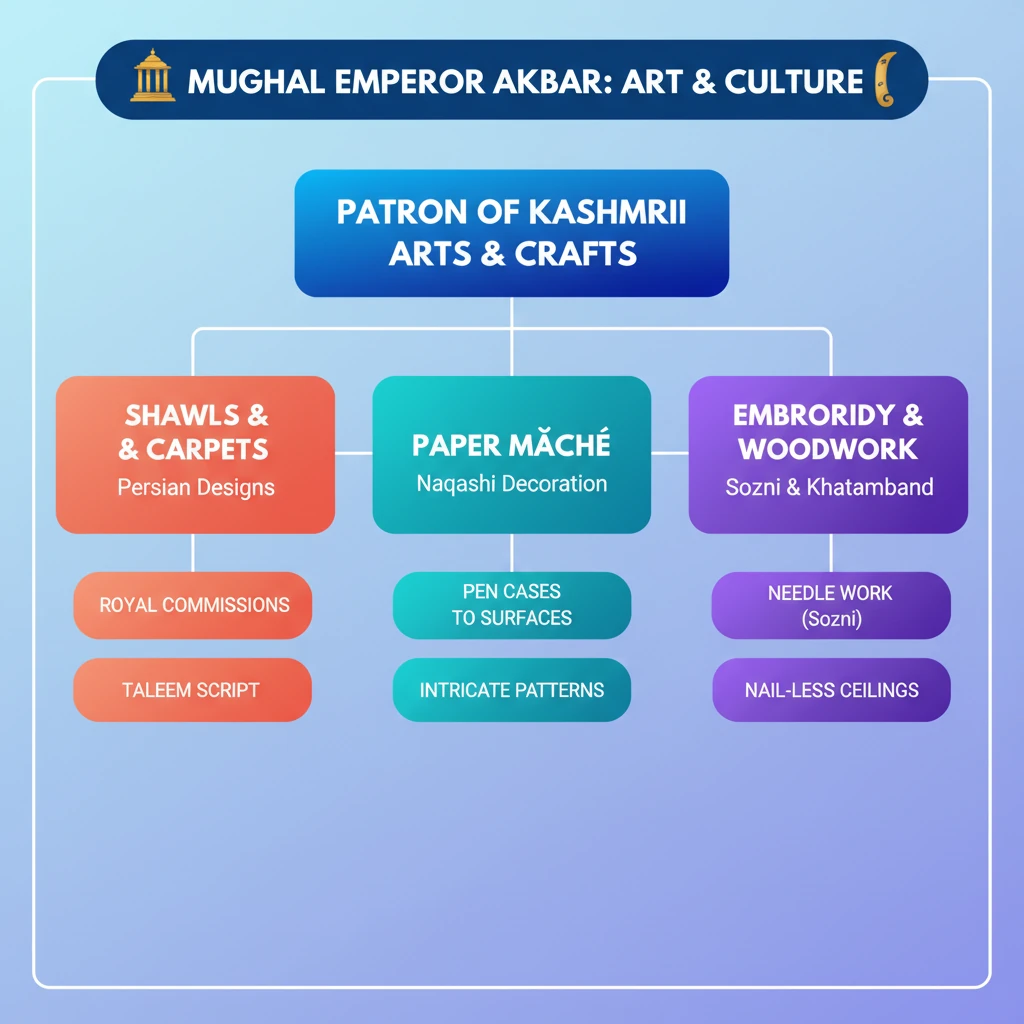
<h4>Mughal Patronage of Kashmiri Crafts</h4><p>The Mughal era saw significant promotion of <strong>Kashmiri crafts</strong>, particularly under <strong>Emperor Akbar</strong>. He actively commissioned <strong>shawls</strong> for the royal family, thereby boosting the craft sector and integrating Kashmiri artistry into the imperial court's aesthetic.</p><h4>Kashmiri Carpets</h4><p><strong>Kashmiri carpets</strong> are renowned for their rich designs, often featuring traditional <strong>Persian-style motifs</strong>. These are unique <strong>hand-knotted carpets</strong>, distinguished by their intricate craftsmanship and vibrant patterns.</p><div class="info-box"><strong>Design Instructions:</strong> A coded script called <strong>Taleem</strong> is uniquely used for design instructions.<br><strong>Motifs:</strong> Traditional oriental and floral designs are common.<br><strong>Materials:</strong> Primarily made from luxurious materials like <strong>silk</strong> and <strong>wool</strong>.</div><h4>Paper Mâché</h4><p><strong>Paper Mâché</strong> is an intricate art form where objects are created from <strong>molded paper pulp</strong>. Traditionally, these items are then meticulously painted and lacquered to achieve a glossy finish.</p><div class="info-box"><strong>Origin in Kashmir:</strong> The craft began with practical items such as <strong>pen cases</strong>.<br><strong>Evolution:</strong> It evolved into a distinct art of elaborate <strong>surface decoration</strong>, famously known as <strong>naqashi</strong>.</div><h4>Embroidered Textiles</h4><p>Kashmir is celebrated for its fine embroidery techniques used extensively in garments and accessories. Key techniques include <strong>Sozni</strong> and <strong>Aari work</strong>, known for their delicate and detailed patterns.</p><div class="info-box"><strong>Sozni Shawls:</strong> These exquisite shawls originate specifically from <strong>Kashmir</strong>.<br><strong>Meaning of Sozni:</strong> The term "Sozni" itself means <strong>needle</strong> in Persian, highlighting the intricate needlework involved.</div><h4>Wood Carving</h4><p>This craft involves creating intricate designs carved into high-quality <strong>walnut wood</strong>. It results in the production of beautiful furniture and various sophisticated home decor items, showcasing skilled artistry.</p><h4>Copperware</h4><p><strong>Copperware</strong> represents traditional <strong>Kashmiri metal crafts</strong>, where artisans demonstrate exceptional skill in metallurgy. They produce distinctive and functional items.</p><div class="info-box"><strong>Notable Items:</strong> Includes iconic <strong>copper samovars</strong> (traditional tea urns) and intricate <strong>tea sets</strong>.<br><strong>Heritage:</strong> This craft forms a significant part of Kashmir's ancient cultural heritage.</div><h4>Khatamband</h4><p><strong>Khatamband</strong> is a unique handcrafted art focused on making elaborate ceilings. It involves fitting small, precisely cut pieces of wood into complex geometric patterns.</p><div class="info-box"><strong>Materials:</strong> Primarily uses fine <strong>walnut</strong> or <strong>deodar wood</strong>.<br><strong>Technique:</strong> Notably, this intricate work is done entirely <strong>without using nails</strong>, relying on interlocking pieces.</div>
💡 Key Takeaways
- •Emperor Akbar significantly promoted Kashmiri crafts, particularly commissioning shawls for the royal family.
- •Kashmiri carpets are renowned for Persian designs and utilize the unique Taleem coded script for instructions.
- •Paper Mâché in Kashmir evolved from pen cases to intricate Naqashi surface decoration.
- •Sozni and Aari work are key embroidery techniques originating from Kashmir, with Sozni meaning 'needle' in Persian.
- •Khatamband is a unique Kashmiri art of making nail-less geometric ceilings from walnut or deodar wood.
- •Srinagar was designated a UNESCO Creative City for Crafts and Folk Arts in 2021.
- •India has multiple cities in the UCCN, including Jaipur, Varanasi, Chennai, Mumbai, Hyderabad, Kozhikode, and Gwalior, across various creative fields.
🧠 Memory Techniques
95% Verified Content
📚 Reference Sources
•UNESCO Creative Cities Network official website
•NCERT Fine Arts: An Introduction to Indian Art (Class XI)