What are Key Facts about the Sanchi Stupa? - Art And Culture | UPSC Learning
Topics
0 topics • 0 completed
🔍
No topics match your search

What are Key Facts about the Sanchi Stupa?
Medium⏱️ 7 min read
art and culture
📖 Introduction
<h4>Construction and Early Development of Sanchi Stupa</h4><p>The original <strong>Sanchi Stupa</strong> was constructed by <strong>Emperor Ashoka</strong> in the <strong>third century BC</strong>. This foundational work was notably overseen by <strong>Ashoka’s wife, Devi</strong>, who originated from the nearby significant trading town of <strong>Vidisha</strong>.</p><p>The continued development and growth of the entire <strong>Sanchi complex</strong> received substantial financial and logistical support from the thriving <strong>mercantile community of Vidisha</strong>, highlighting local patronage.</p><h4>Expansion During the Shunga Period</h4><p>During the <strong>2nd century BC</strong>, coinciding with the <strong>Shunga period</strong>, the stupa underwent significant expansion. It was enlarged using durable <strong>sandstone slabs</strong>, enhancing its structural integrity and aesthetic appeal.</p><div class="info-box"><strong>Key Additions (Shunga Period):</strong><ul><li><strong>Circumambulatory walkway:</strong> A path for ritualistic circumambulation.</li><li><strong>Harmika with a Chatra:</strong> A square railing atop the dome, crowned by an umbrella structure.</li></ul></div><h4>Addition of Toranas and Detailed Carvings</h4><p>Between the <strong>1st century BC and the 2nd century AD</strong>, four magnificent <strong>stone gateways</strong>, known as <strong>Toranas</strong>, were added to the stupa. These gateways are renowned for their intricate and detailed carvings.</p><p>The carvings on the <strong>Toranas</strong> vividly depict various aspects of <strong>Buddhist iconography</strong> and narrate important <strong>Jataka stories</strong>, offering insights into early Buddhist art and philosophy.</p><h4>Rediscovery and Initial Surveys</h4><p>The <strong>Sanchi Stupa</strong> was found in a state of considerable disrepair and ruins when it was rediscovered by <strong>British officer Henry Taylor</strong> in <strong>1818</strong>. This marked the beginning of its modern recognition.</p><p>The first formal survey and subsequent excavations at the <strong>Sanchi</strong> site were meticulously led by <strong>Alexander Cunningham</strong> in <strong>1851</strong>, laying the groundwork for its eventual restoration.</p><h4>Preservation Efforts and Bhopal Begums' Role</h4><p>In <strong>1853</strong>, <strong>Sikander Begum of Bhopal</strong> made an offer to send the valuable <strong>gateways of Sanchi</strong> to <strong>Queen Victoria</strong> in England. However, these plans faced delays due to the <strong>1857 revolt</strong> and significant transportation challenges.</p><p>The offer was renewed by the <strong>Begum</strong> in <strong>1868</strong>, but colonial authorities wisely declined it, opting instead for <strong>in-situ preservation</strong>. A <strong>plaster cast of the eastern gateway</strong> was created as an alternative.</p><h4>John Marshall's Restoration and Museum Establishment</h4><p>The site was meticulously restored to its current magnificent condition by <strong>Archaeological Survey of India (ASI) director-general John Marshall</strong> during the <strong>1910s</strong>. This extensive restoration was funded by the enlightened <strong>begums of nearby Bhopal</strong>.</p><p>Marshall's dedicated efforts culminated in the establishment of a <strong>museum at the Sanchi site in 1919</strong>. This museum was crucial for preserving unearthed artefacts and managing ongoing conservation activities.</p><h4>UNESCO World Heritage Recognition</h4><p>The <strong>Sanchi Stupa</strong> received prestigious recognition as a <strong>UNESCO World Heritage site in 1989</strong>. This status acknowledges its outstanding universal value and cultural significance.</p>
💡 Key Takeaways
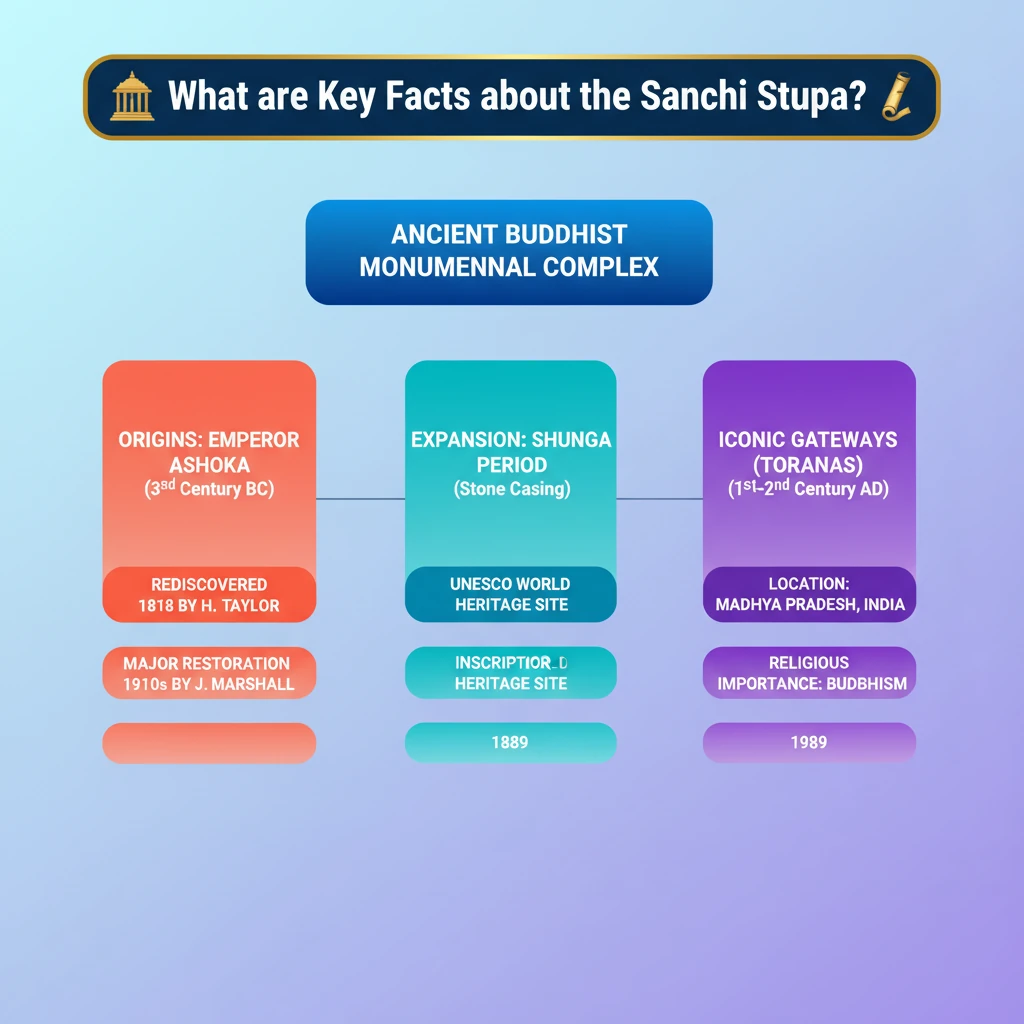
- •Sanchi Stupa was originally built by Emperor Ashoka in the 3rd century BC.
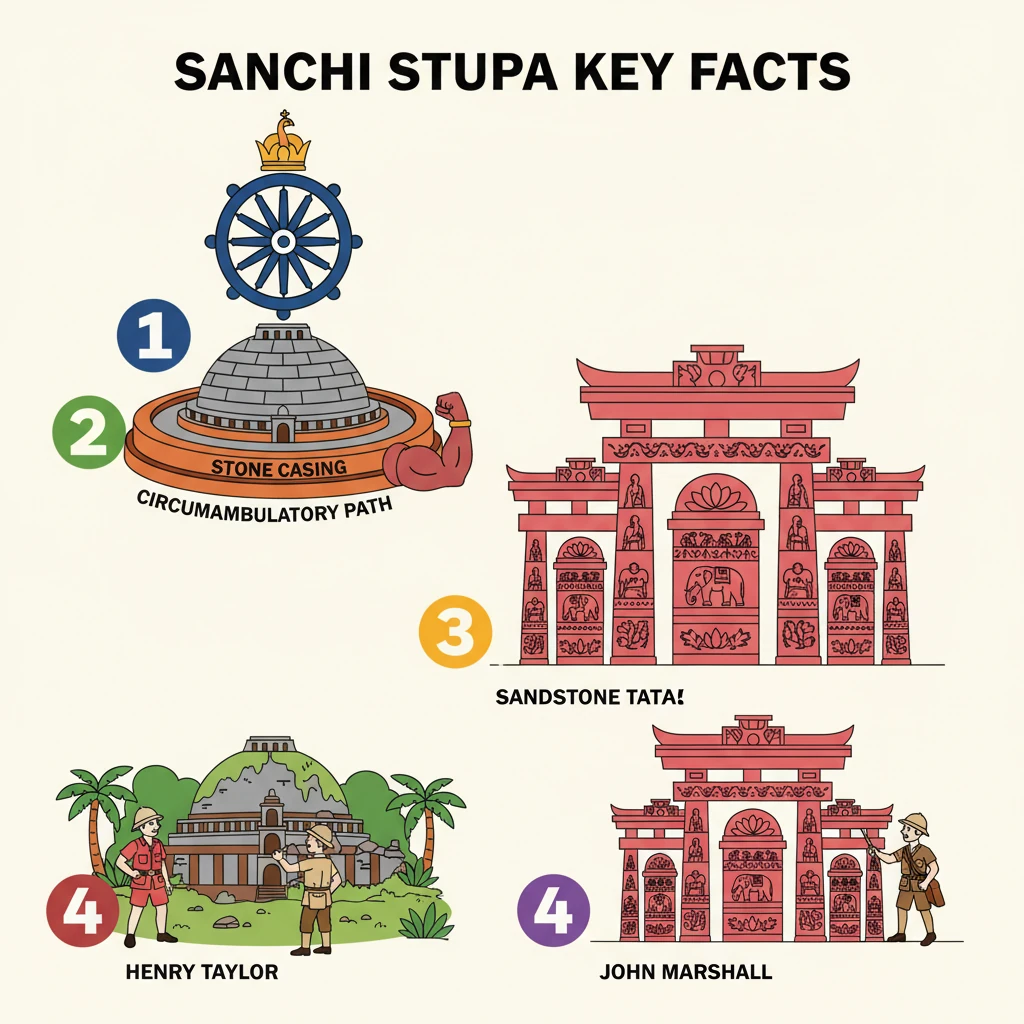
- •Its significant expansion, including stone casing and a circumambulatory path, occurred during the Shunga period.
- •The iconic carved gateways (Toranas) were added between the 1st century BC and 2nd century AD.
- •British officer Henry Taylor rediscovered the stupa in 1818, and John Marshall led its major restoration in the 1910s.
- •Sanchi Stupa is a UNESCO World Heritage site, inscribed in 1989.
- •Its architecture features distinct elements like Anda, Harmika, Chatra, Pradakshina Patha, and Toranas.
- •The site showcases early Buddhist art, often using aniconic symbols to represent the Buddha.
🧠 Memory Techniques
98% Verified Content