Great Indian Hornbill: Distribution, Habitat, and Significance - Art And Culture | UPSC Learning
Topics
0 topics • 0 completed
🔍
No topics match your search
Great Indian Hornbill: Distribution, Habitat, and Significance
Easy⏱️ 6 min read
art and culture
📖 Introduction
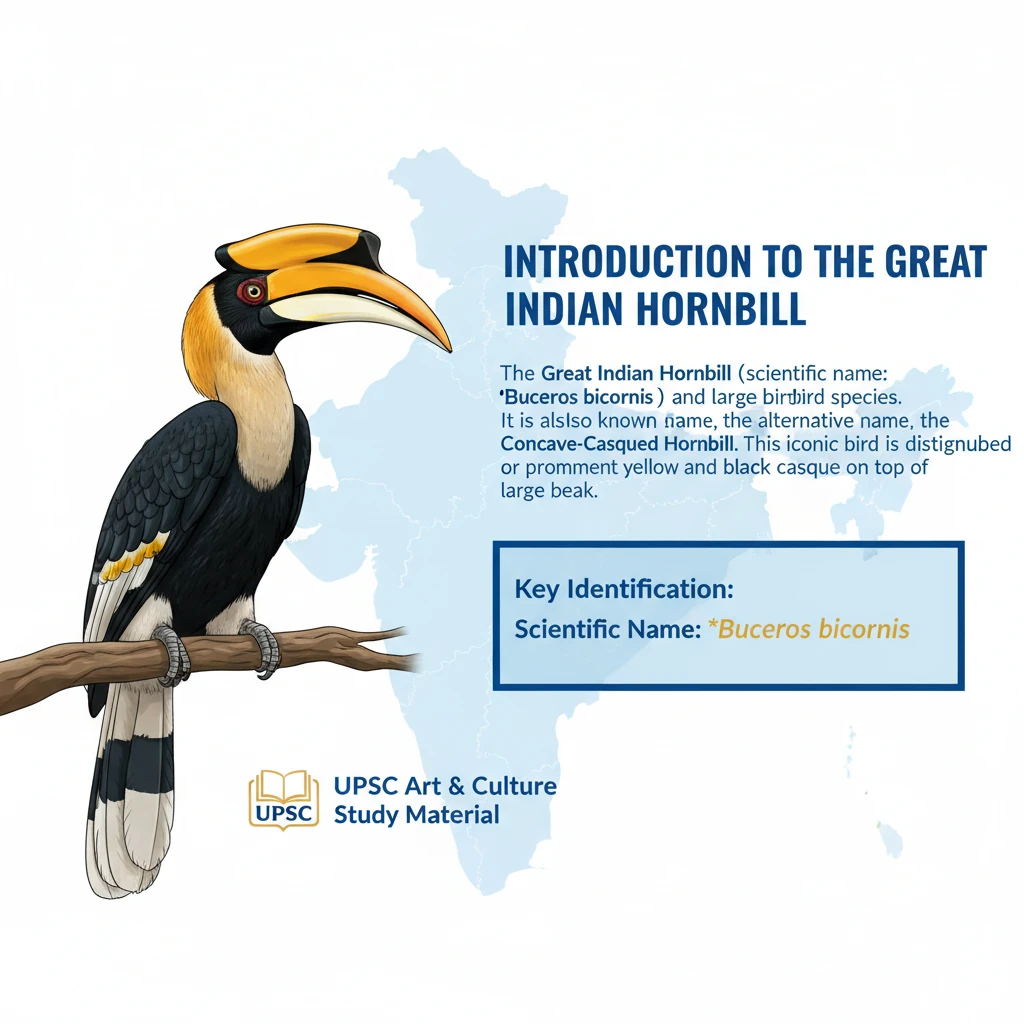
<h4>Introduction to the Great Indian Hornbill</h4><p>The <strong>Great Indian Hornbill</strong> (scientific name: <strong>Buceros bicornis</strong>) is a magnificent and large bird species. It is also known by the alternative name, the <strong>Concave-Casqued Hornbill</strong>. This iconic bird is distinguished by its prominent yellow and black casque on top of its large beak.</p><div class="info-box"><strong>Key Identification:</strong><br><strong>Scientific Name:</strong> <em>Buceros bicornis</em><br><strong>Common Name:</strong> Great Indian Hornbill<br><strong>Alternate Name:</strong> Concave-Casqued Hornbill<br><strong>Size:</strong> Large bird</div><h4>Habitat and Distribution</h4><p>The <strong>Great Indian Hornbill</strong> primarily inhabits dense <strong>evergreen and moist deciduous forests</strong>. It thrives within the canopy of tall trees, which provide both shelter and foraging grounds.</p><p>Geographically, its range extends across the <strong>Indian subcontinent</strong> and into <strong>Southeast Asia</strong>. Within India, significant populations are found in the <strong>Western Ghats</strong>, the various <strong>northeastern states</strong>, and the lower reaches of the <strong>Himalayas</strong>.</p><div class="info-box"><strong>Preferred Habitat:</strong> Canopy of tall trees in evergreen and moist deciduous forests<br><strong>Geographic Range:</strong> Indian subcontinent, Southeast Asia<br><strong>Indian Distribution:</strong> Western Ghats, Northeastern states, Himalayas</div><h4>State Bird and Species Diversity in India</h4><p>The <strong>Great Indian Hornbill</strong> holds the prestigious status of being the <strong>state bird of Arunachal Pradesh</strong>. This highlights its cultural and ecological importance in the region.</p><p>India is home to a remarkable diversity of hornbill species, hosting a total of <strong>nine hornbill species</strong>. The <strong>northeastern region of India</strong> is particularly rich in hornbill diversity, boasting the highest number of species.</p><div class="key-point-box"><strong>State Bird:</strong> Arunachal Pradesh<br><strong>Indian Hornbill Species:</strong> 9<br><strong>Highest Diversity:</strong> Northeastern states of India</div>
💡 Key Takeaways
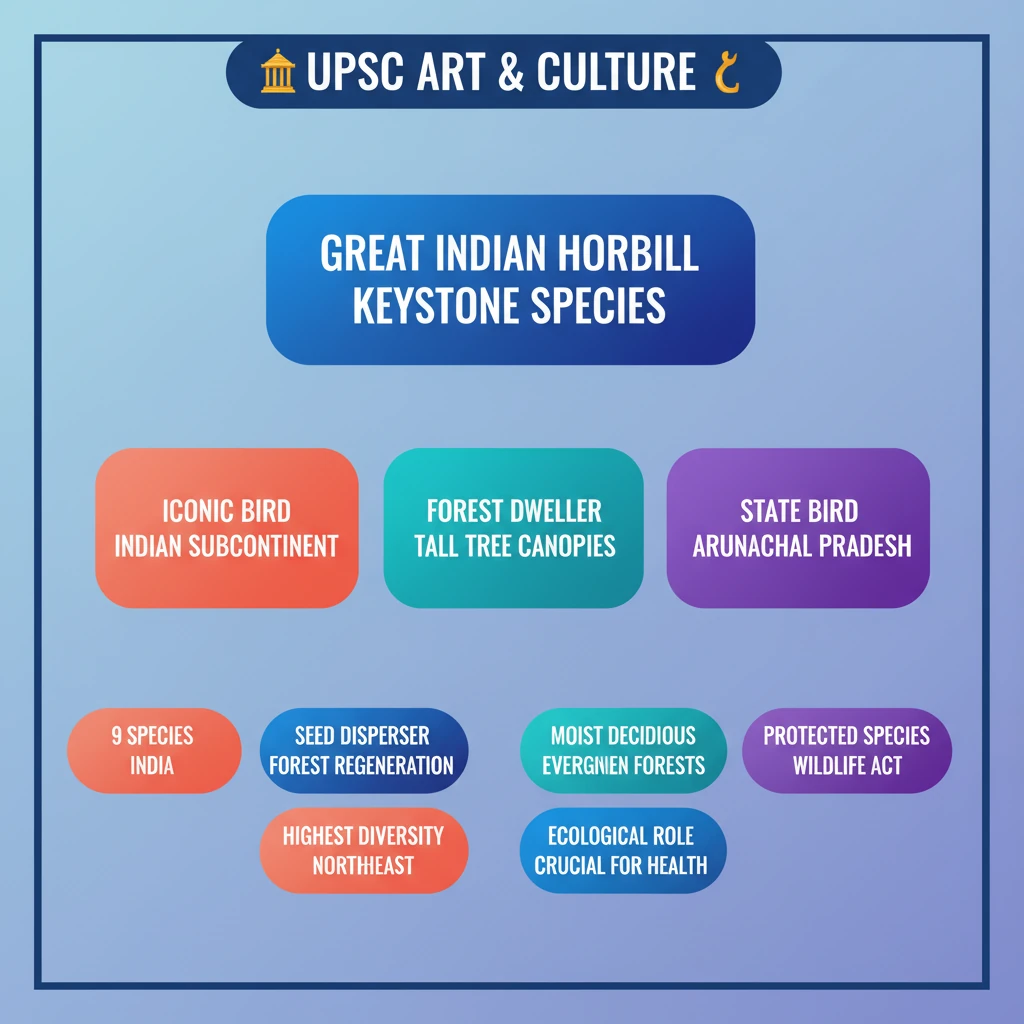
- •The Great Indian Hornbill is a large, iconic bird found in the Indian subcontinent and Southeast Asia.
- •It primarily inhabits evergreen and moist deciduous forests, thriving in tall tree canopies.
- •It is the state bird of Arunachal Pradesh.
- •India is home to nine hornbill species, with the highest diversity in the Northeast.
- •Hornbills are crucial seed dispersers, making them a keystone species for forest regeneration.
- •Habitat loss and poaching are major threats to its survival.
- •The species is protected under Schedule I of the Wildlife Protection Act, 1972.
🧠 Memory Techniques
95% Verified Content
📚 Reference Sources
•Wildlife Protection Act, 1972 (Schedule I)
•Various online wildlife conservation resources (e.g., WWF, IUCN, eBird)