Asian Buddhist Conference for Peace - Art And Culture | UPSC Learning
Topics
0 topics • 0 completed
🔍
No topics match your search
Asian Buddhist Conference for Peace
Medium⏱️ 7 min read
art and culture
📖 Introduction
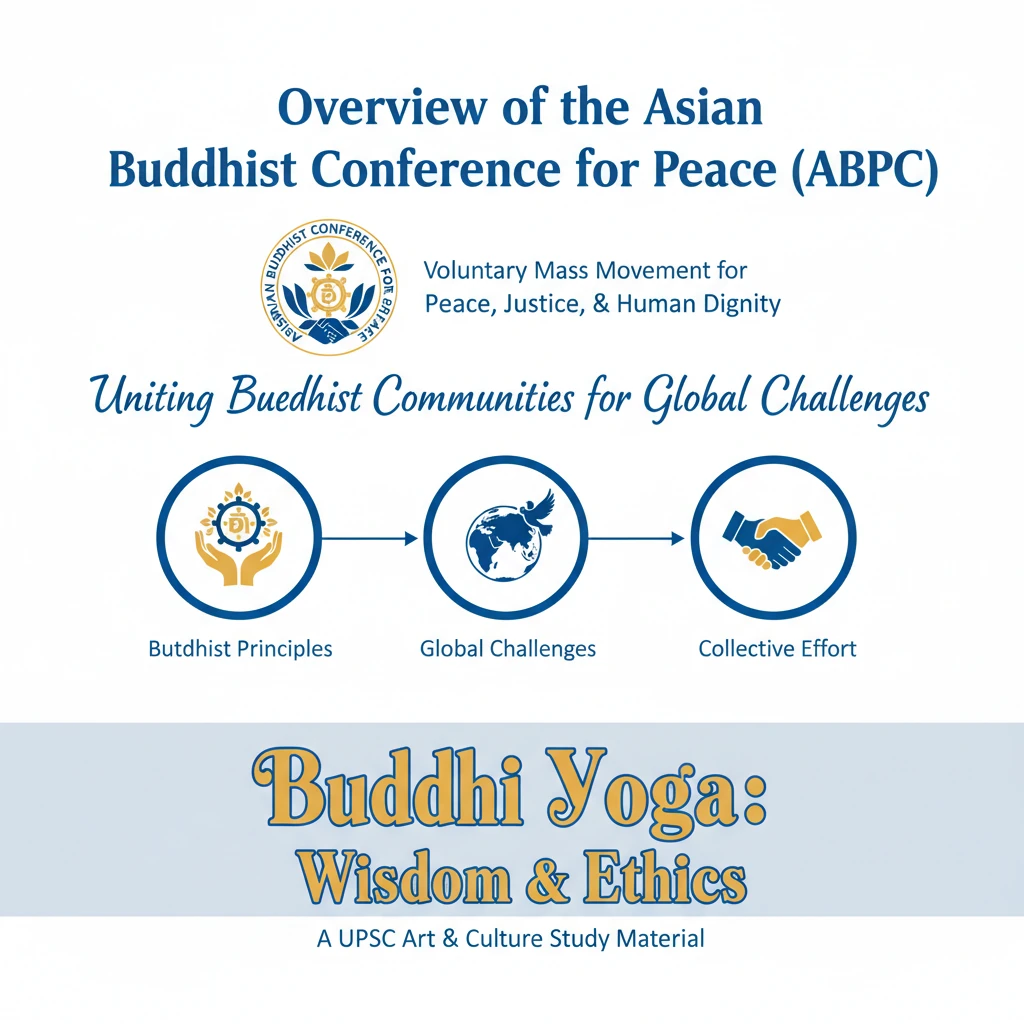
<h4>Overview of the Asian Buddhist Conference for Peace (ABCP)</h4><p>The <strong>Asian Buddhist Conference for Peace (ABCP)</strong> is a significant international organization. It functions as a <strong>voluntary mass movement</strong> comprising Buddhists across Asia, dedicated to promoting peace, justice, and human dignity.</p><p>Its primary goal is to unite Buddhist communities in a collective effort to address global challenges. The organization emphasizes the application of <strong>Buddhist principles</strong> to contemporary issues.</p><div class="info-box"><strong>Nature:</strong> Voluntary mass movement of Buddhists<br><strong>Geographical Scope:</strong> Primarily Asian countries<br><strong>Recent Event:</strong> 12th General Assembly convened in <strong>New Delhi</strong></div><h4>Formation and Core Objectives</h4><p>The <strong>ABCP</strong> was established with a vision to foster solidarity among Buddhists. It aims to contribute to <strong>world peace</strong> through dialogue and cooperation, drawing upon the inherent peaceful tenets of <strong>Buddhism</strong>.</p><div class="key-point-box"><strong>Key Objectives:</strong><ul><li>Promoting <strong>peace and disarmament</strong></li><li>Advocating for <strong>justice and human rights</strong></li><li>Fostering <strong>inter-religious dialogue</strong> and understanding</li><li>Contributing to <strong>social development</strong> and environmental protection</li></ul></div><h4>The 12th General Assembly in New Delhi</h4><p>The convening of the <strong>12th General Assembly</strong> in <strong>New Delhi</strong> underscores India's historical and cultural ties with Buddhism. Such assemblies serve as crucial platforms for deliberation and strategy formulation among member organizations.</p><p>This event brought together Buddhist leaders, scholars, and activists from various Asian countries. They discussed strategies for promoting peace and addressing regional and global issues through a Buddhist lens.</p><div class="exam-tip-box">Hosting international conferences like the <strong>ABCP General Assembly</strong> enhances India's <strong>soft power</strong> and cultural diplomacy. This is relevant for <strong>UPSC GS Paper 2 (International Relations)</strong> and <strong>GS Paper 1 (Art & Culture)</strong>.</div>
💡 Key Takeaways
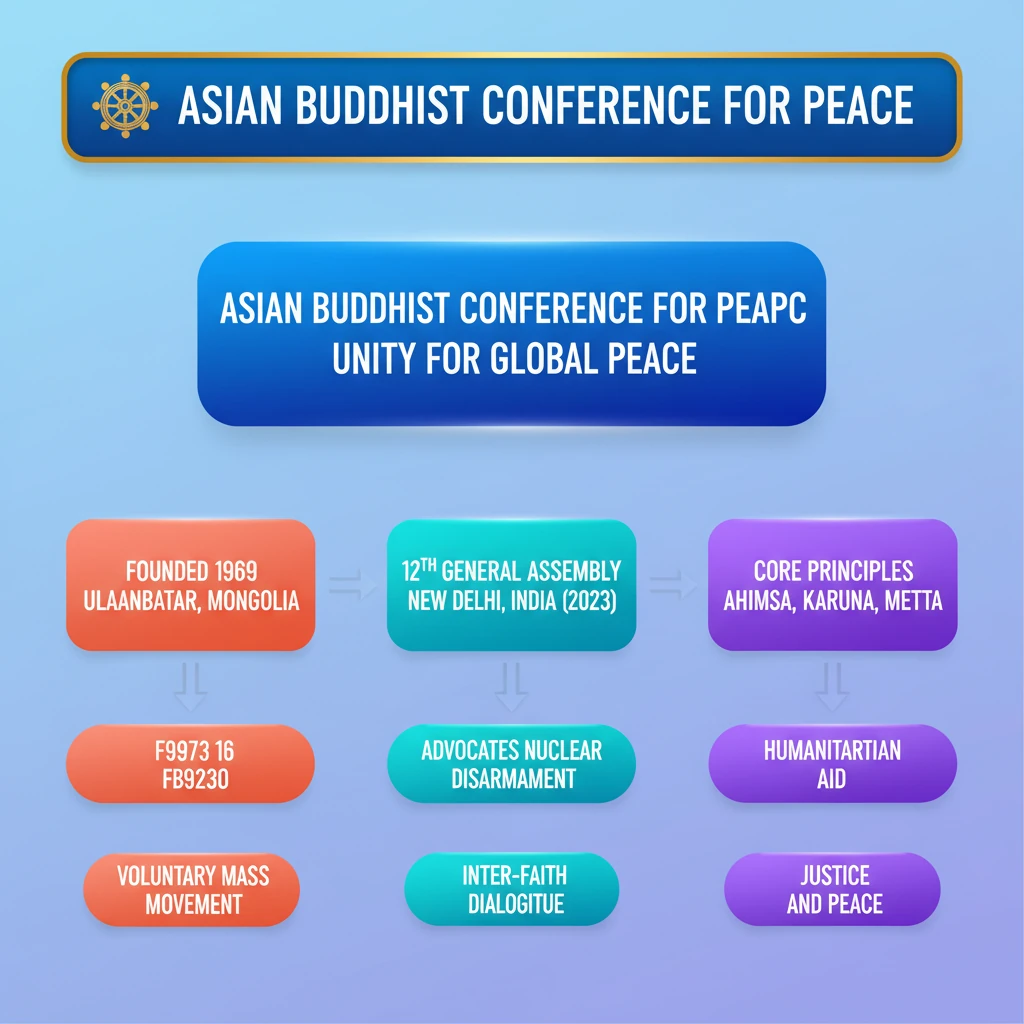
- •The ABCP is a voluntary mass movement of Buddhists in Asia dedicated to peace and justice.
- •It was founded in 1969 in Ulaanbaatar, Mongolia, to unite Buddhist communities for global peace.
- •The 12th General Assembly was recently held in New Delhi, highlighting India's strong ties with Buddhism.
- •ABCP advocates for nuclear disarmament, inter-faith dialogue, and provides humanitarian aid.
- •Its activities are rooted in core Buddhist principles such as Ahimsa, Karuna, and Metta.
- •The organization plays a significant role in cultural diplomacy and enhancing India's soft power.
- •It addresses contemporary global challenges including conflict resolution, human rights, and environmental protection.
🧠 Memory Techniques

95% Verified Content
📚 Reference Sources
•General knowledge about Asian Buddhist Conference for Peace (ABCP)
•Publicly available information on ABCP's history, objectives, and activities