What is a Classical Language? - Art And Culture | UPSC Learning
Topics
0 topics • 0 completed
🔍
No topics match your search
What is a Classical Language?
Medium⏱️ 8 min read
art and culture
📖 Introduction
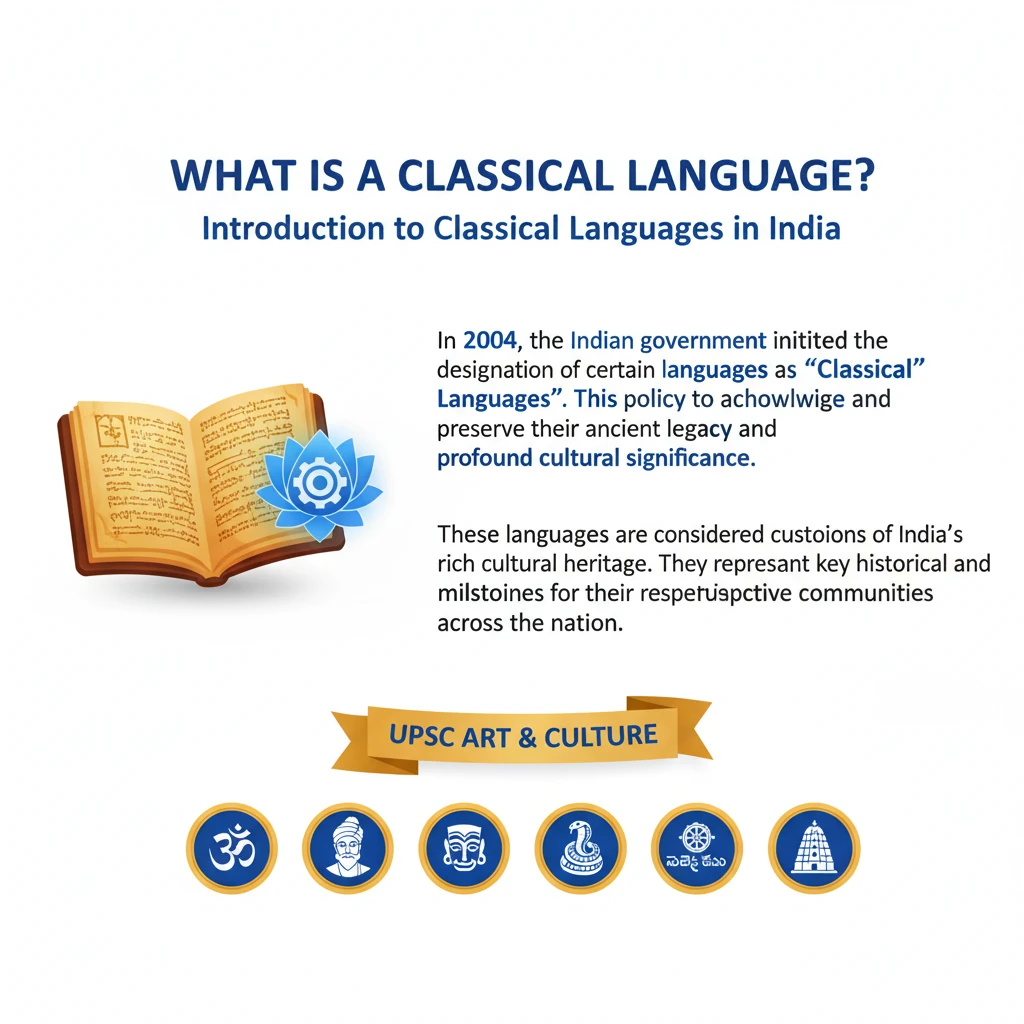
<h4>Introduction to Classical Languages in India</h4><p>In <strong>2004</strong>, the <strong>Indian government</strong> initiated the designation of certain languages as <strong>“Classical Languages”</strong>. This policy aims to acknowledge and preserve their ancient legacy and profound cultural significance.</p><p>These languages are considered custodians of India's rich cultural heritage. They represent key historical and cultural milestones for their respective communities across the nation.</p><div class="info-box"><strong>Definition:</strong> <strong>Indian classical languages</strong> (<strong>Shastriya Bhasha</strong>) are those with a rich historical legacy, profound literary traditions, and a distinctive cultural heritage.</div><h4>Significance of Classical Languages</h4><p>Classical languages have played a pivotal role in the intellectual and cultural evolution of various regions within India. Their extensive literary and textual bodies offer invaluable insights.</p><div class="key-point-box">These texts provide deep understanding into diverse fields such as <strong>literature</strong>, <strong>philosophy</strong>, and <strong>religion</strong>, reflecting centuries of intellectual development.</div><h4>Evolution of Criteria for Designation</h4><p>The criteria for designating a language as classical have been revised multiple times. Initial criteria were established, and subsequent revisions occurred in <strong>2005</strong> and <strong>2024</strong>.</p><p>These revisions were based on recommendations from <strong>Linguistic Experts Committees (LEC)</strong> operating under the aegis of the <strong>Sahitya Akademi</strong>.</p><h4>Revised Criteria in 2005</h4><p>The criteria established in <strong>2005</strong> focused on several key aspects to determine a language's classical status:</p><ul><li><strong>High Antiquity:</strong> The language must possess early texts and a recorded history spanning <strong>1,500–2,000 years</strong>.</li><li><strong>Ancient Literature:</strong> It must have a substantial body of ancient literature or texts. This literature should be considered a valuable heritage by generations of speakers.</li><li><strong>Original Literary Tradition:</strong> The language should exhibit an original literary tradition. This means its literary works should not be borrowed or derived significantly from another speech community.</li><li><strong>Distinct Evolution:</strong> The classical language and its literature must be distinct from modern forms. There can even be a discontinuity between the classical language and its later forms or offshoots.</li></ul><h4>Criteria Update in 2024</h4><p>A significant revision to the criteria for declaring a language as classical occurred in <strong>2024</strong>. This update specifically modified one of the existing points.</p><div class="info-box">The criterion regarding <strong>“Knowledge/ texts: Presence of an original literary tradition not borrowed from another speech community”</strong> was replaced.</div><p>The new criterion emphasizes a broader range of textual evidence. It now includes <strong>“Knowledge texts, especially prose texts in addition to poetry, epigraphical and inscriptional evidence”</strong>.</p><h4>Benefits of Classical Language Status</h4><p>Languages designated as 'classical' receive various government benefits. These initiatives are primarily aimed at promoting their study, research, and overall preservation.</p><ul><li><strong>International Awards:</strong> Two international awards are conferred annually. These awards recognize scholars who have made notable contributions to the research, teaching, or promotion of classical Indian languages.</li><li><strong>Prestigious Recognitions:</strong> The awards include the <strong>Presidential Award of Certificate of Honour</strong> and the <strong>Maharshi Badrayan Samman Award</strong>.</li><li><strong>UGC Support for Chairs:</strong> The <strong>University Grants Commission (UGC)</strong> actively supports the establishment of <strong>Professional Chairs</strong> in central universities and research institutions. These chairs are dedicated to focusing on classical Indian languages.</li><li><strong>Center of Excellence:</strong> To safeguard and promote these linguistic treasures, the government established the <strong>Center of Excellence for Studies in Classical Languages</strong>. This center is located at the <strong>Central Institute of Indian Languages (CIIL)</strong> in <strong>Mysore</strong>.</li></ul>
💡 Key Takeaways
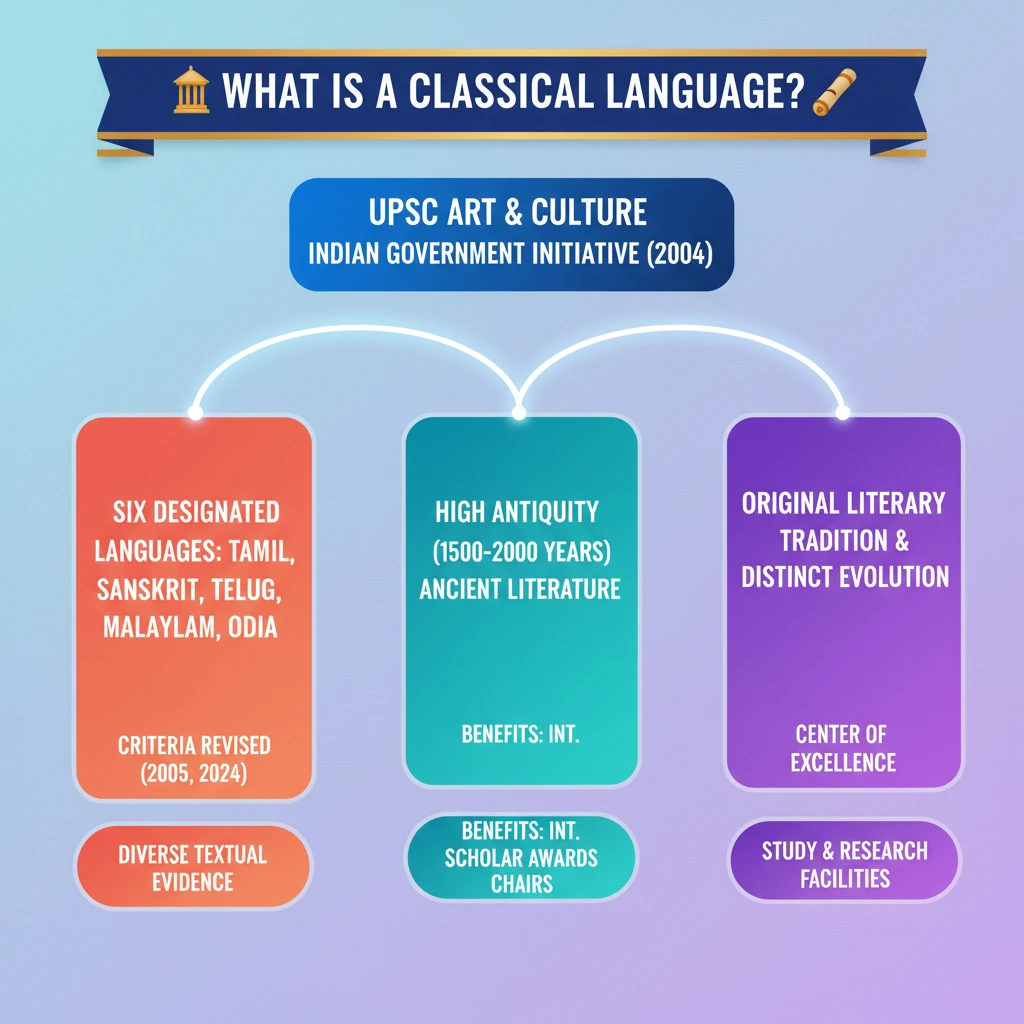
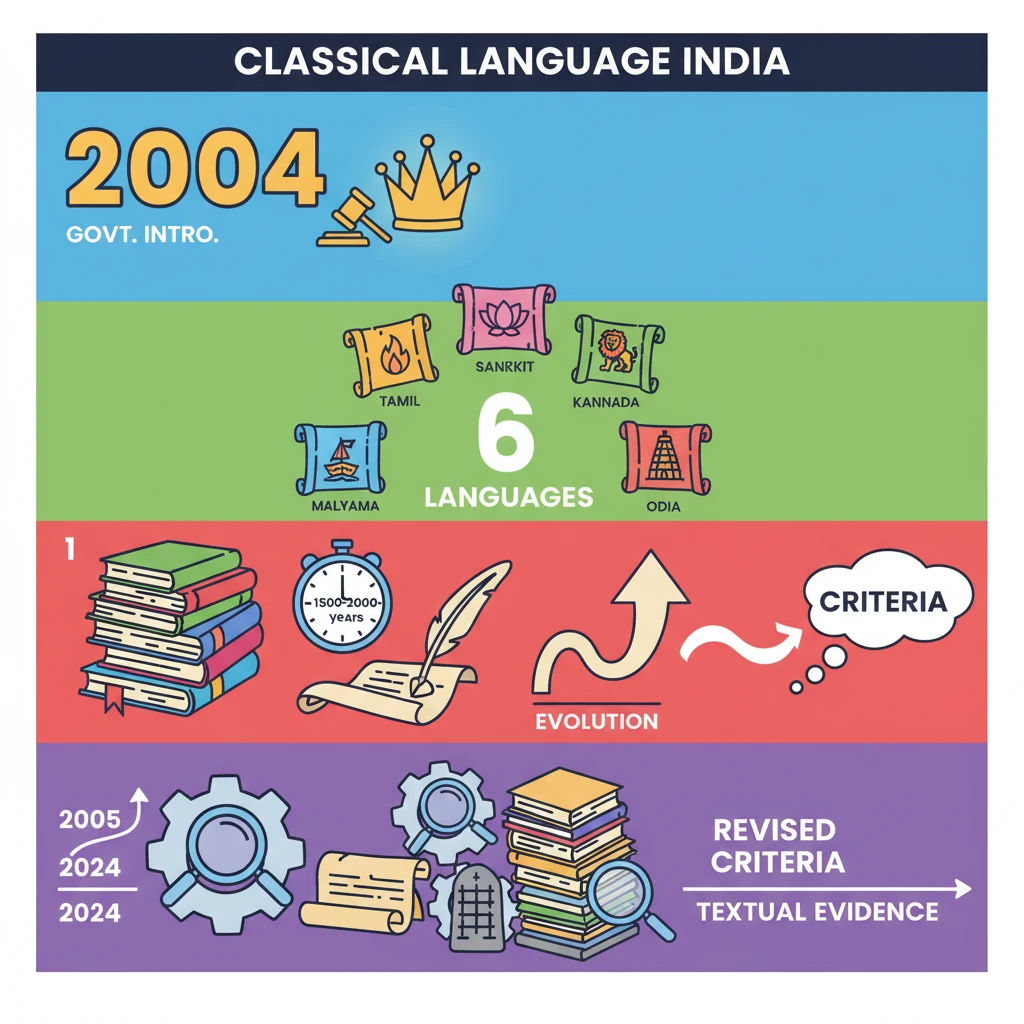
- •Classical Language status was introduced by the Indian government in 2004.
- •There are currently six designated classical languages: Tamil, Sanskrit, Kannada, Telugu, Malayalam, and Odia.
- •Criteria for designation include high antiquity (1500-2000 years), ancient literature, original literary tradition, and distinct evolution.
- •The criteria were revised in 2005 and again in 2024, emphasizing diverse textual evidence.
- •Benefits include international awards for scholars, UGC-supported chairs, and a Center of Excellence for studies.
- •These languages are vital custodians of India's rich cultural, intellectual, and philosophical heritage.
- •The status promotes the study, research, and preservation of these ancient linguistic treasures.
🧠 Memory Techniques
98% Verified Content
📚 Reference Sources
•Ministry of Culture, Government of India (Official Website)
•Sahitya Akademi (Official Website)
•University Grants Commission (UGC) (Official Website)
•Press Information Bureau (PIB) releases regarding Classical Languages