Types of Heritage Sites - Art And Culture | UPSC Learning
Topics
0 topics • 0 completed
🔍
No topics match your search
Types of Heritage Sites
Medium⏱️ 8 min read
art and culture
📖 Introduction
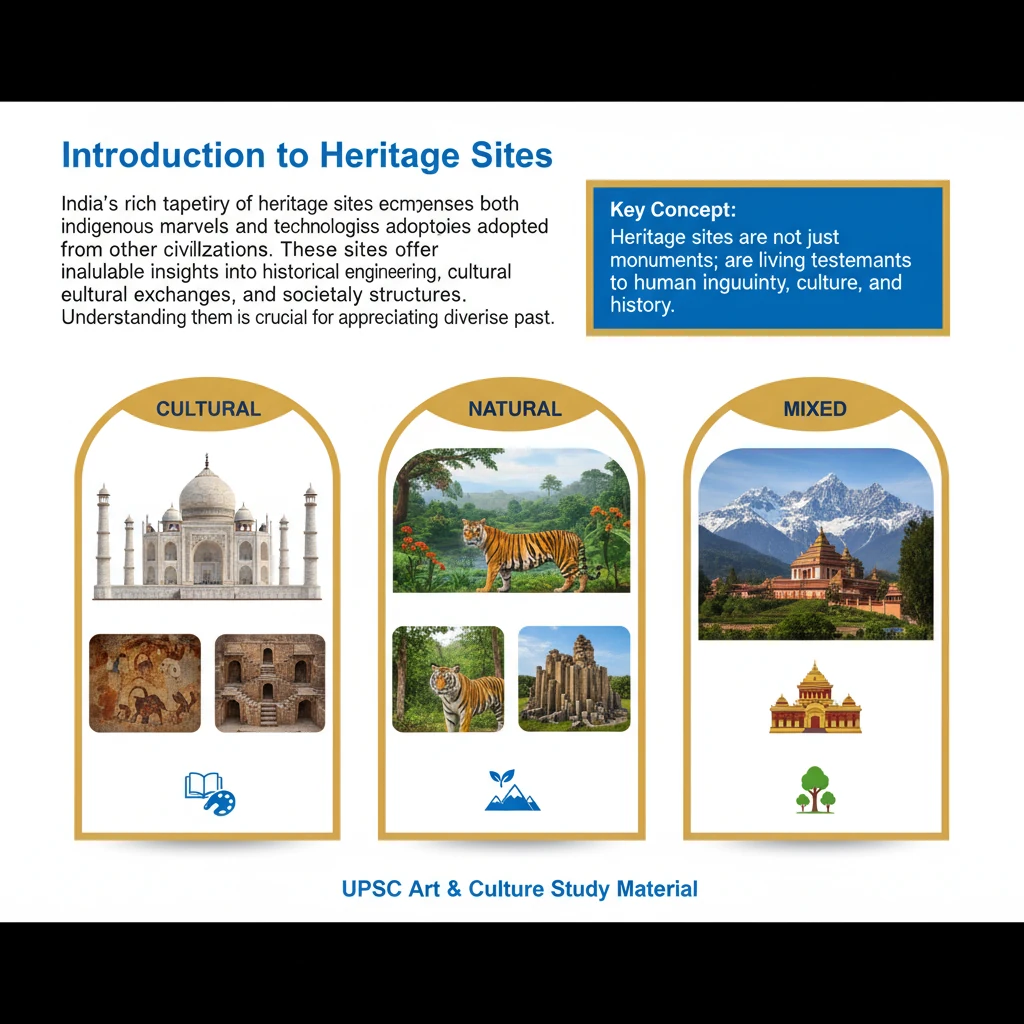
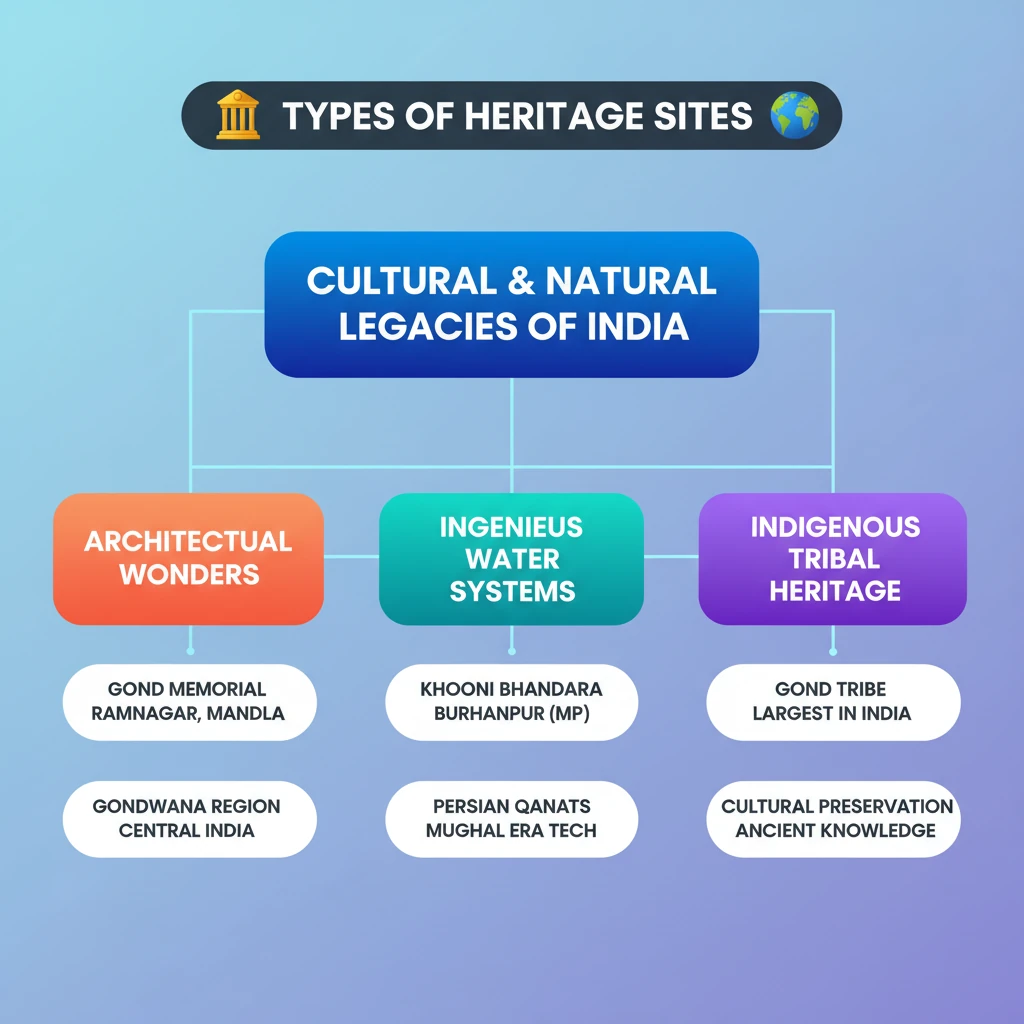
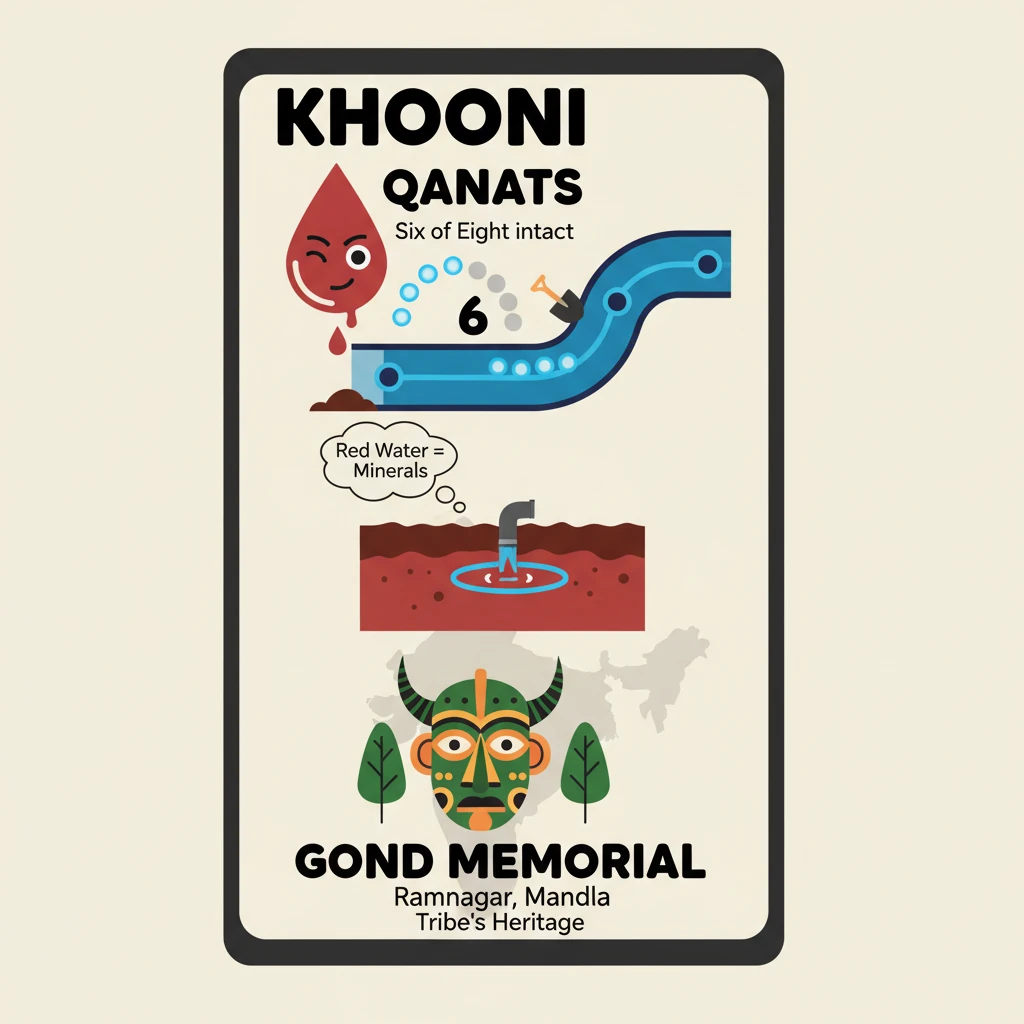
<h4>Introduction to Heritage Sites</h4><p>India's rich tapestry of heritage sites encompasses both indigenous marvels and technologies adopted from other civilizations. These sites offer invaluable insights into historical engineering, cultural exchanges, and societal structures. Understanding them is crucial for appreciating India's diverse past.</p><div class="key-point-box"><strong>Key Concept:</strong> Heritage sites are not just monuments; they are living testaments to human ingenuity, cultural evolution, and historical interactions, often showcasing both local traditions and imported influences.</div><h4>Khooni Bhandara: Persian Qanats in India</h4><p>The <strong>Khooni Bhandara</strong> in Burhanpur, Madhya Pradesh, represents an extraordinary example of imported hydrological engineering. These are a series of <strong>Persian Qanats</strong>, an ancient underground water management system, adapted and utilized during the <strong>Mughal era</strong> in India.</p><div class="info-box"><strong>Origin:</strong> Technologies like Qanats were imported from <strong>Iran</strong> and <strong>Iraq</strong>.<br><strong>Purpose:</strong> Served as essential <strong>public utilities</strong>, providing water to cities and settlements.</div><p>These subterranean conduits are known for their ingenious design, tapping into groundwater sources and transporting water over long distances through gravity, minimizing evaporation.</p><h4>Discovery and Condition of Khooni Bhandara</h4><p>In the early <strong>1900s</strong>, extensive archaeological efforts led to the excavation and tracing of <strong>eight sets</strong> of these underground conduits. Remarkably, <strong>six of these eight systems</strong> remain intact and functional to this day, showcasing the durability of their construction.</p><div class="info-box"><strong>Number of sets excavated:</strong> 8<br><strong>Number remaining intact:</strong> 6</div><p>The name <strong>'Khooni'</strong>, meaning 'bloody', is attributed to the hint of red colour present in the mineral-rich water flowing through these conduits. This unique characteristic gave the system its evocative name.</p><h4>Gond Memorial of Ramnagar, Mandla</h4><p>The <strong>Gond Memorial</strong> located in <strong>Ramnagar, Mandla</strong> district, is a significant cluster of monuments dedicated to the heritage of the <strong>Gond tribe</strong>, one of India's largest heterogeneous tribal communities. This region was historically known as <strong>Gondwana</strong>.</p><div class="info-box"><strong>Location:</strong> Ramnagar, Mandla district<br><strong>Historical Region:</strong> Gondwana (formerly Central Provinces)<br><strong>Tribe:</strong> Gond (largest heterogeneous tribe of India)</div><p>The historical <strong>Gondwana</strong> region encompassed parts of present-day <strong>Andhra Pradesh, Chhattisgarh</strong>, and <strong>Maharashtra</strong>. This vast territory was the traditional homeland of the Gond people, whose rich cultural legacy is preserved in these monuments.</p><h4>Key Monuments at Ramnagar</h4><p>The cluster of monuments at <strong>Ramnagar</strong> provides a glimpse into the architectural and cultural prowess of the Gond kingdom. These structures reflect the indigenous styles and influences prevalent in the region.</p><ul><li><strong>Moti Mahal:</strong> A prominent palace, likely serving as a royal residence.</li><li><strong>Raibagat ki Kothi:</strong> Another significant residential or administrative building.</li><li><strong>Suraj Mandir (Vishnu Mandir):</strong> A temple dedicated to the deity Vishnu, indicating religious practices.</li><li><strong>Begum Mahal:</strong> A palace or residence, possibly for royal women.</li><li><strong>Dalbadal Mahal:</strong> Another notable palace structure, contributing to the architectural complex.</li></ul><div class="exam-tip-box"><strong>UPSC Insight:</strong> Questions on tribal heritage and indigenous architectural forms are increasingly common in <strong>GS Paper I (Art & Culture)</strong>. Understanding specific sites like the Gond Memorial can provide valuable examples.</div>
💡 Key Takeaways
- •Khooni Bhandara represents Persian Qanats, an ancient underground water system from the Mughal era.
- •Six of the eight excavated Qanat systems in Burhanpur are still intact, showing remarkable engineering.
- •The name 'Khooni' refers to the reddish, mineral-rich water.
- •Gond Memorial in Ramnagar, Mandla, preserves the heritage of the Gond tribe, one of India's largest.
- •Gondwana was the historical region covering parts of Andhra Pradesh, Chhattisgarh, and Maharashtra.
- •The Gond Memorial includes significant structures like Moti Mahal and Suraj Mandir.
- •These sites exemplify both imported technological prowess and rich indigenous cultural heritage in India.
🧠 Memory Techniques
95% Verified Content
📚 Reference Sources
•NCERT Class XI - An Introduction to Indian Art
•UNESCO World Heritage Centre documentation (general principles of heritage classification)
•Archaeological Survey of India (ASI) reports on specific sites