Loss of Legal Protection - Art And Culture | UPSC Learning
Topics
0 topics • 0 completed
🔍
No topics match your search
Loss of Legal Protection
Medium⏱️ 6 min read
art and culture
📖 Introduction
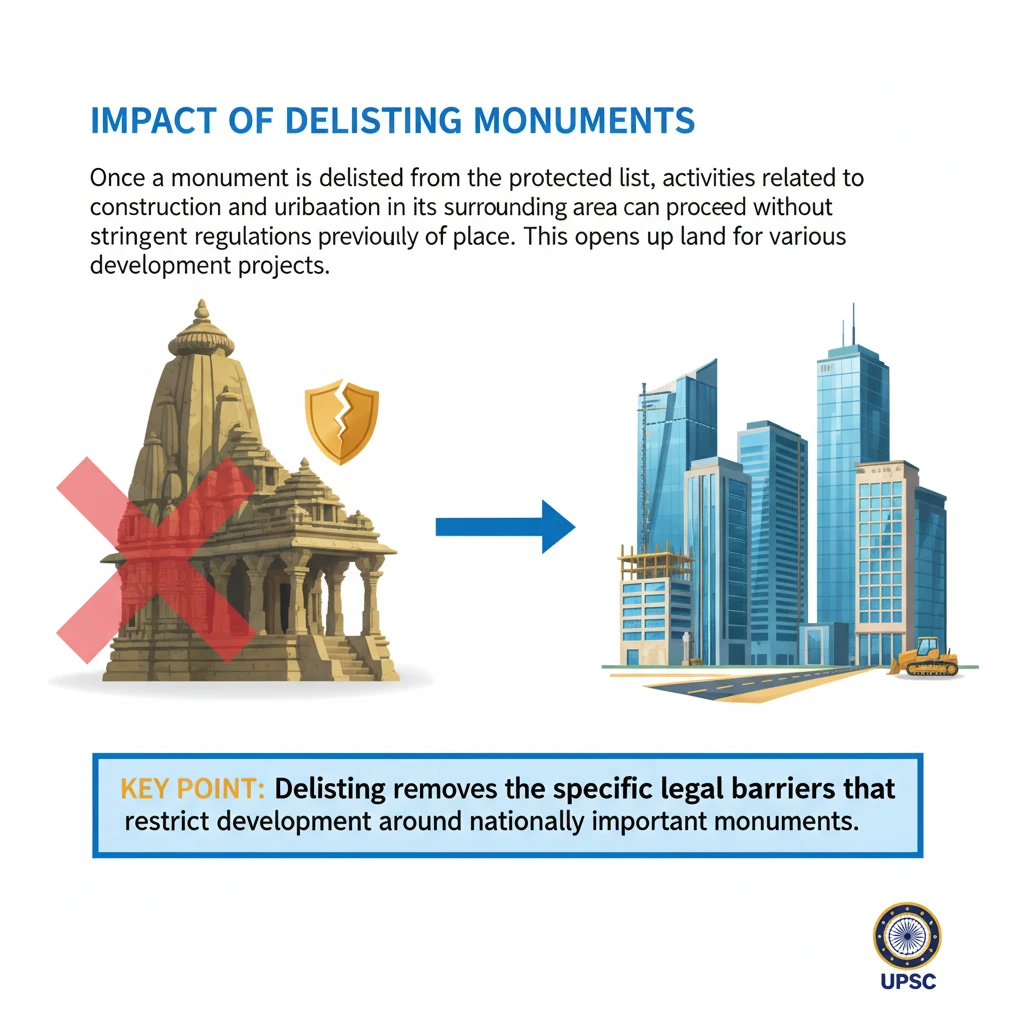
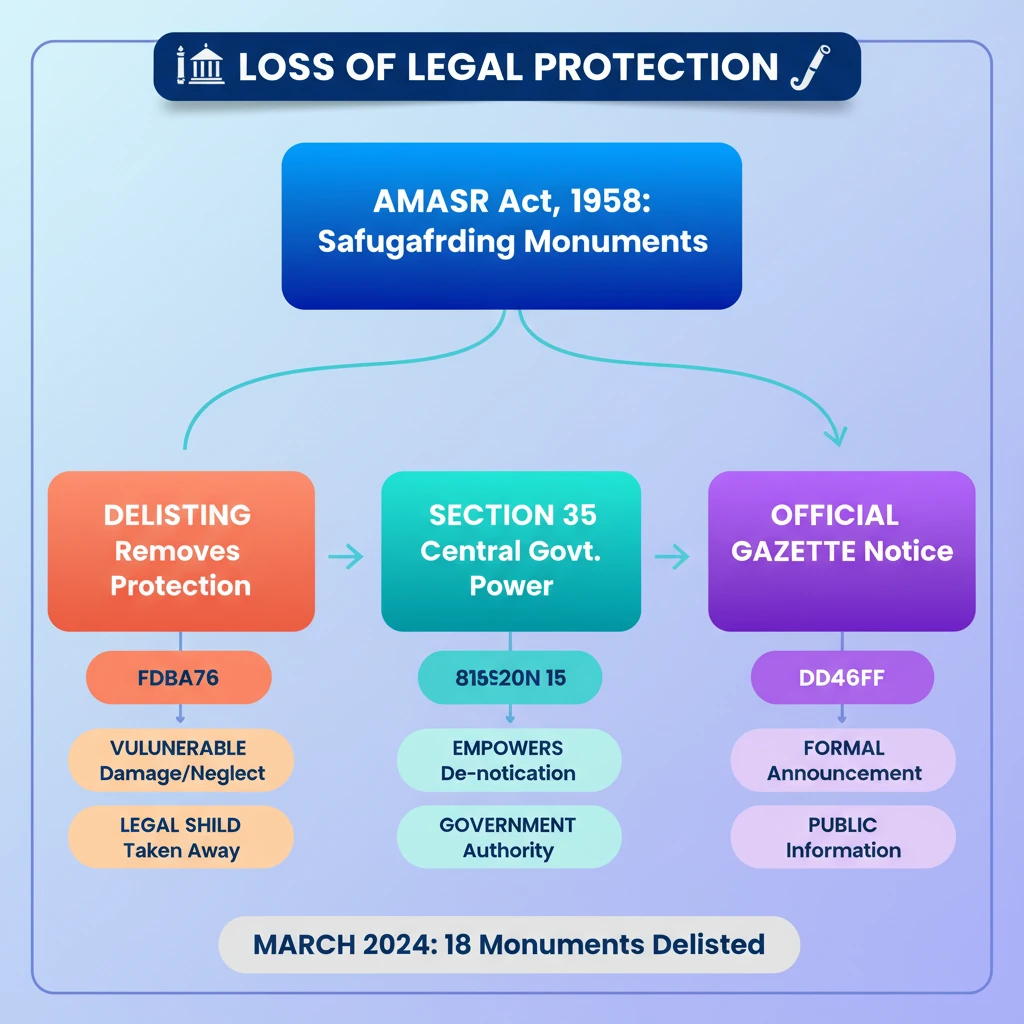
<h4>Impact of Delisting Monuments</h4><p>Once a monument is <strong>delisted</strong> from the protected list, activities related to <strong>construction</strong> and <strong>urbanisation</strong> in its surrounding area can proceed without the stringent regulations previously in place. This opens up land for various developmental projects.</p><div class="key-point-box"><strong>Key Point:</strong> Delisting removes the specific legal barriers that restrict development around nationally important heritage sites, potentially altering their environment.</div><h4>Loss of Legal Protection</h4><p>The <strong>Ancient Monuments and Archaeological Sites and Remains Act (AMASR Act), 1958</strong>, is the primary legislation that provides legal protection to monuments declared to be of <strong>national importance</strong>. This Act safeguards these sites from encroachment, damage, and unregulated construction.</p><p><strong>Delisting</strong> a monument signifies that it will no longer fall under the purview of the <strong>AMASR Act, 1958</strong>. Consequently, it loses this crucial legal protection, making it vulnerable to neglect, damage, or even demolition in the long term.</p><div class="exam-tip-box"><strong>UPSC Insight:</strong> Understanding the AMASR Act is crucial for questions on heritage protection (<strong>GS-I Art & Culture</strong>, <strong>GS-II Governance</strong>). The concept of 'delisting' highlights the dynamic nature of such protections.</div><h4>Procedure for Delisting</h4><p>The <strong>AMASR Act, 1958</strong>, itself outlines the procedure for delisting monuments. <strong>Section 35</strong> of the Act empowers the <strong>Central Government</strong> to declare that any ancient monument or archaeological site previously deemed of national importance has ceased to be so.</p><p>This declaration is made through a formal <strong>notification</strong> published in the <strong>Official Gazette</strong>. The gazette notification serves as the official legal instrument for removing a monument from the protected list.</p><h4>Recent Example of Delisting</h4><p>A significant instance of delisting occurred recently. A <strong>gazette notification</strong> was issued on <strong>March 8, 2024</strong>, announcing the delisting of <strong>18 monuments</strong> from national importance. This action sparked considerable discussion regarding heritage preservation.</p><div class="info-box"><strong>Date of Notification:</strong> March 8, 2024<br><strong>Number of Monuments Delisted:</strong> 18<br><strong>Public Feedback Window:</strong> Two months for objections or suggestions</div><p>Following the notification, a <strong>two-month window</strong> was provided for the public to submit any objections or suggestions regarding the proposed delisting. This period allows for public discourse and potential reconsideration.</p>
💡 Key Takeaways
- •The AMASR Act, 1958, provides legal protection to monuments of national importance.
- •Delisting removes this legal protection, making monuments vulnerable to damage and neglect.
- •Section 35 of the AMASR Act empowers the Central Government to delist monuments.
- •Delisting is formalized through a notification in the Official Gazette.
- •In March 2024, 18 monuments were delisted, followed by a public objection window.
- •Delisting facilitates construction and urbanization in the monument's vicinity.
- •This issue highlights the ongoing challenge of balancing development with heritage preservation.
🧠 Memory Techniques

98% Verified Content
📚 Reference Sources
•The Ancient Monuments and Archaeological Sites and Remains Act, 1958 (AMASR Act)
•Official Gazette notifications of the Ministry of Culture, Government of India