What are the Key Features of the Gateways of Sanchi Stupa? - Art And Culture | UPSC Learning
Topics
0 topics • 0 completed
🔍
No topics match your search

What are the Key Features of the Gateways of Sanchi Stupa?
Medium⏱️ 8 min read
art and culture
📖 Introduction
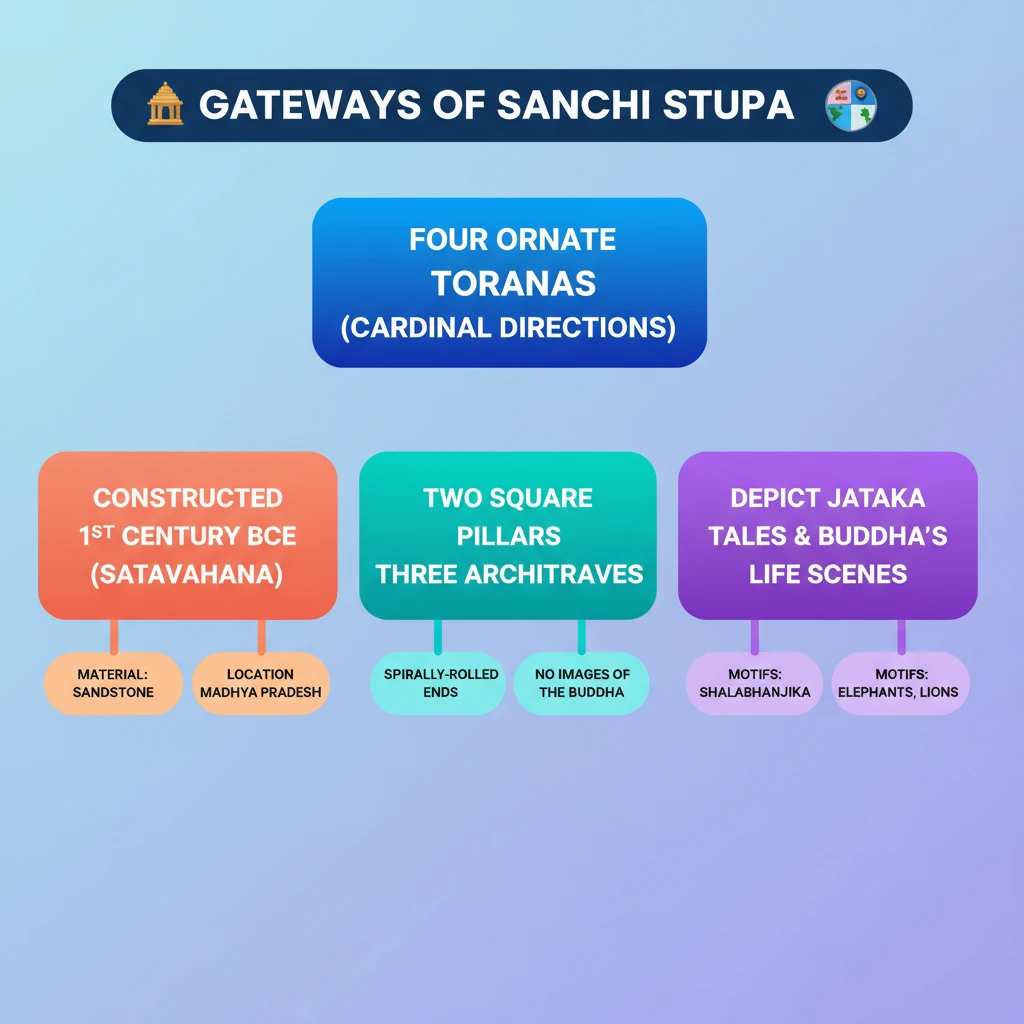
<h4>Introduction to Sanchi Gateways (Toranas)</h4><p>The <strong>Sanchi Stupa</strong> is renowned for its magnificent <strong>four gateways</strong>, known as <strong>toranas</strong>. These monumental structures are strategically oriented towards the <strong>four cardinal directions</strong>, marking the entrance to the sacred precinct.</p><div class="info-box"><strong>Construction Period:</strong> <strong>First century BCE</strong><br><strong>Patronage:</strong> <strong>Satavahana dynasty</strong> (built over several decades)</div><h4>Architectural Structure of the Gateways</h4><p>Each gateway is fundamentally composed of <strong>two robust square pillars</strong>. These pillars serve as the primary support for the elaborate superstructure above, showcasing advanced ancient Indian engineering.</p><p>The superstructure features <strong>three curved architraves</strong> (or beams). These architraves are distinctive for their <strong>spirally-rolled ends</strong>, adding to the aesthetic appeal and intricate design of the gateways.</p><h4>Rich Reliefs and Sculptural Decorations</h4><p>The <strong>pillars</strong> and <strong>architraves</strong> of the gateways are extensively adorned with intricate <strong>reliefs and sculptures</strong>. These carvings are central to understanding early Buddhist art and narrative traditions.</p><p>The decorations vividly depict various themes, offering a visual encyclopedia of Buddhist thought:</p><ul><li>Scenes from the <strong>Buddha’s life</strong>, illustrating key events and miracles.</li><li>Stories from the <strong>Jataka tales</strong>, which narrate the previous incarnations of the Buddha.</li><li>Other significant <strong>Buddhist iconography</strong>, symbolizing various aspects of the Dharma.</li></ul><p>Specific motifs found include the <strong>shalabhanjika</strong> (a fertility emblem), which is a <strong>yakshi</strong> grasping the branch of a tree, symbolizing auspiciousness. Other animal figures like <strong>elephants</strong>, <strong>winged lions</strong>, and <strong>peacocks</strong> are also prominently featured, often with symbolic meanings.</p><div class="key-point-box"><strong>Important Artistic Feature:</strong> The gates notably <strong>do not represent the Buddha in his human form</strong>. Instead, symbolic representations like the <strong>Bodhi tree</strong>, <strong>stupa</strong>, or <strong>footprints</strong> are used to denote his presence, characteristic of early Buddhist art.</div><h4>Philosophical Significance of the Architraves</h4><p>The <strong>three curved architraves</strong> are not merely decorative but carry profound <strong>philosophical significance</strong>, conveying key Buddhist doctrines and narratives through their specific depictions.</p><ul><li><strong>Upper Architrave:</strong> This section symbolically represents the <strong>seven Manushi Buddhas</strong>, referring to the previous incarnations of the Buddha, emphasizing the lineage of enlightenment.</li><li><strong>Middle Architrave:</strong> A pivotal narrative, the <strong>Great Departure</strong>, is depicted here. This scene illustrates <strong>Prince Siddhartha</strong> leaving <strong>Kapilavastu</strong> to embark on his ascetic journey in pursuit of enlightenment, a crucial step towards Buddhahood.</li></ul>
💡 Key Takeaways
- •Sanchi Stupa has four ornate gateways (toranas) oriented to cardinal directions.
- •These gateways were constructed in the first century BCE under the Satavahana dynasty.
- •They are made of two square pillars supporting three curved architraves with spirally-rolled ends.
- •The carvings depict scenes from Buddha's life, Jataka tales, and Buddhist iconography.
- •Key motifs include shalabhanjika, elephants, winged lions, and peacocks.
- •Buddha is represented symbolically (aniconic form), not in human form.
- •Architraves hold philosophical significance, depicting Manushi Buddhas and the Great Departure.
🧠 Memory Techniques
98% Verified Content
📚 Reference Sources
•NCERT Class 11 Fine Arts Textbook: An Introduction to Indian Art, Part I
•Archaeological Survey of India (ASI) official website
•UNESCO World Heritage Centre website (Sanchi)