What are the Key Facts About Vishnupad Temple and the Mahabodhi Temple? - Art And Culture | UPSC Learning
Topics
0 topics • 0 completed
🔍
No topics match your search
What are the Key Facts About Vishnupad Temple and the Mahabodhi Temple?
Easy⏱️ 7 min read
art and culture
📖 Introduction
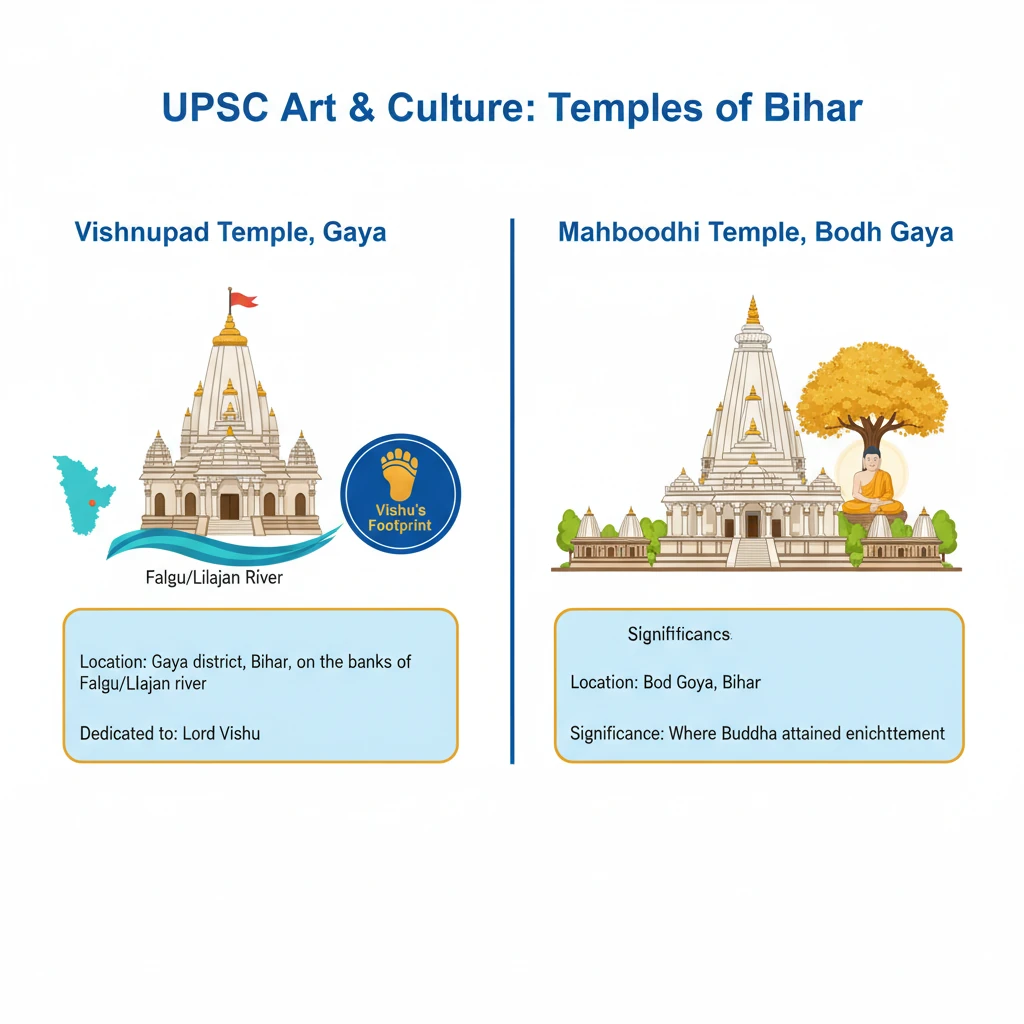
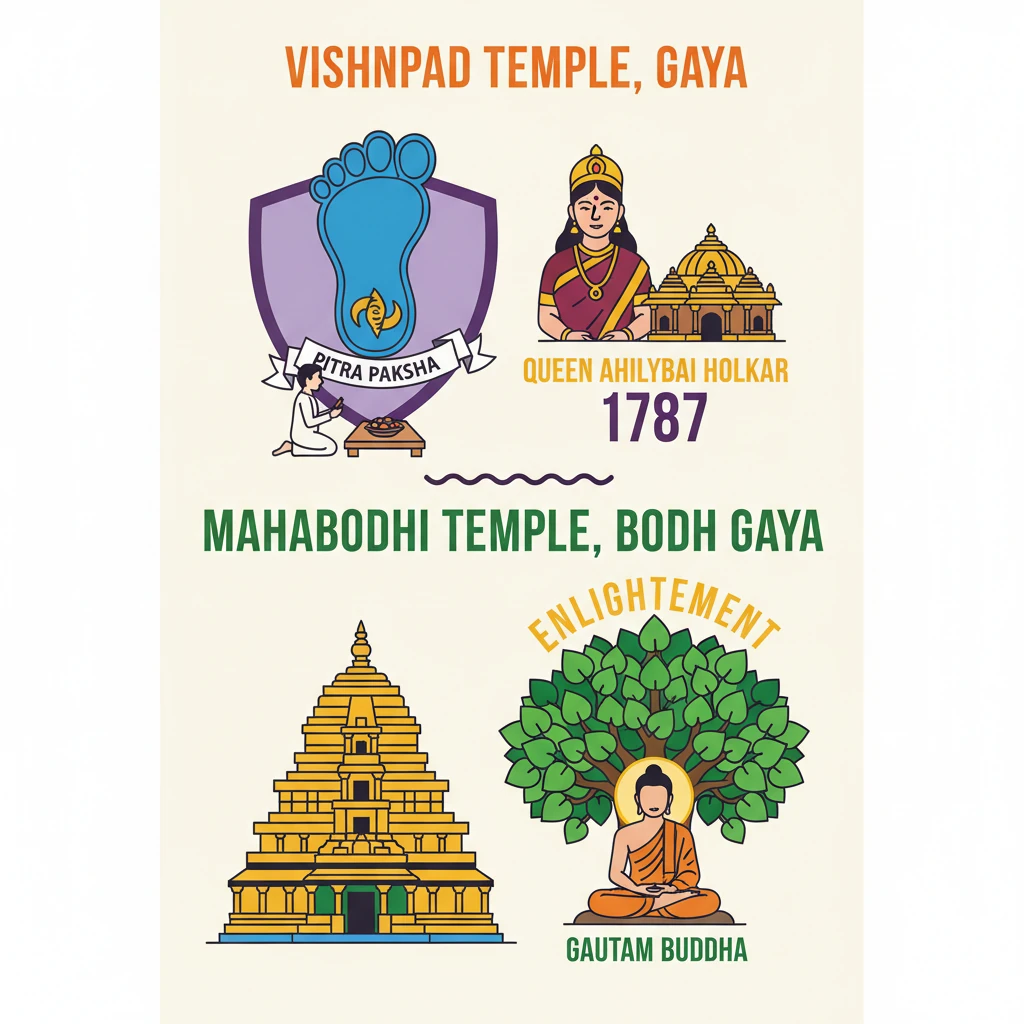
<h4>Vishnupad Temple, Gaya: Location and Dedication</h4><p>The <strong>Vishnupad Temple</strong> is prominently located on the banks of the <strong>Falgu/Lilajan river</strong> in the <strong>Gaya district</strong> of <strong>Bihar</strong>. This significant pilgrimage site is dedicated to <strong>Lord Vishnu</strong>, a principal deity in Hinduism.</p><div class="info-box"><strong>Location:</strong> Gaya district, Bihar, on the banks of Falgu/Lilajan river<br><strong>Dedicated to:</strong> Lord Vishnu</div><h4>The Legend of Gayasur and Vishnu's Footprint</h4><p>According to local mythology, a demon named <strong>Gayasur</strong> was granted the power to help others attain <strong>moksha</strong> (liberation from the cycle of rebirth) by the gods. However, he began to misuse this immense power.</p><p><strong>Lord Vishnu</strong> intervened to subdue Gayasur, leaving a divine <strong>footprint</strong> at the temple site. This footprint is believed to be a sacred mark commemorating this pivotal event.</p><div class="key-point-box"><strong>Legend:</strong> Lord Vishnu subdued demon <strong>Gayasur</strong>, leaving a sacred <strong>footprint</strong> at the temple site.</div><h4>Architectural Features of Vishnupad Temple</h4><p>The temple stands impressively at approximately <strong>100 feet tall</strong>. Its construction incorporates <strong>44 pillars</strong>, meticulously built from large blocks of <strong>gray granite</strong>, specifically <strong>Munger Black stone</strong>.</p><p>These granite blocks are joined using traditional <strong>iron clamps</strong>, showcasing ancient engineering techniques. The main shrine is <strong>octagonal</strong> in shape and is oriented towards the <strong>east</strong>.</p><div class="info-box"><strong>Height:</strong> ~100 feet<br><strong>Pillars:</strong> 44, made of <strong>Munger Black stone</strong> (gray granite)<br><strong>Structure:</strong> Octagonal shrine, east-facing</div><h4>Construction and Cultural Practices</h4><p>The current structure of the <strong>Vishnupad Temple</strong> was constructed in <strong>1787</strong> under the patronage and orders of <strong>Queen Ahilyabai Holkar</strong>, a renowned Maratha ruler.</p><p>The temple holds particular significance during <strong>Pitra Paksha</strong>, a period dedicated to honoring ancestors, attracting a large number of devotees for ancestral rites. The traditional priests of the temple, known as <strong>Brahma Kalpit Brahmins</strong> or <strong>Gayawal Brahmins</strong>, have served here since ancient times.</p><div class="exam-tip-box"><strong>UPSC Insight:</strong> Note the role of <strong>Queen Ahilyabai Holkar</strong> in temple construction, a common theme in Art & Culture for philanthropic rulers. The mention of <strong>Pitra Paksha</strong> connects to Hindu rituals and cultural practices.</div><h4>Mahabodhi Temple, Bodh Gaya: Site of Enlightenment</h4><p>The <strong>Mahabodhi Temple</strong> in <strong>Bodh Gaya</strong> is one of the most sacred sites in Buddhism. It is universally believed to be the exact location where <strong>Gautam Buddha</strong> attained <strong>enlightenment</strong>.</p><p>This profound spiritual awakening occurred while Buddha meditated under the sacred <strong>Mahabodhi Tree</strong>, a descendant of which still stands at the site today.</p><div class="key-point-box"><strong>Significance:</strong> Site where <strong>Gautam Buddha</strong> attained <strong>enlightenment</strong> under the <strong>Mahabodhi Tree</strong>.</div><h4>Construction History of Mahabodhi Temple</h4><p>The original structure of the <strong>Mahabodhi Temple</strong> was built by the great <strong>Emperor Asoka</strong> in the <strong>3rd century BCE</strong>. Asoka's patronage was crucial in establishing Buddhism as a major religion.</p><p>Over centuries, the temple complex has undergone several renovations and expansions, reflecting various architectural styles while preserving its core spiritual essence.</p><div class="info-box"><strong>Original Construction:</strong> By <strong>Emperor Asoka</strong> in the <strong>3rd century BCE</strong>.</div>
💡 Key Takeaways
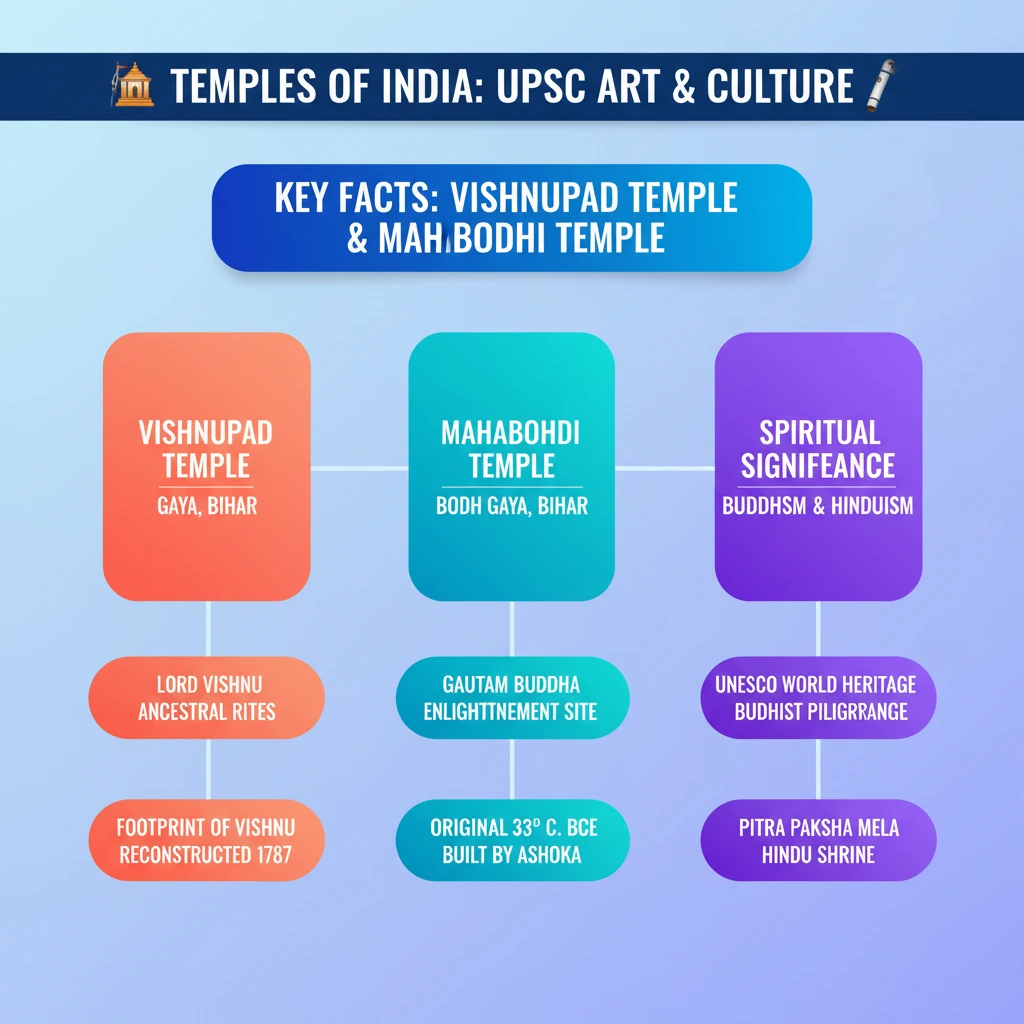
- •Vishnupad Temple in Gaya is dedicated to Lord Vishnu and is famous for ancestral rites during Pitra Paksha.
- •A legendary footprint of Lord Vishnu is believed to be present at the Vishnupad Temple.
- •Queen Ahilyabai Holkar reconstructed the current Vishnupad Temple in 1787.
- •Mahabodhi Temple in Bodh Gaya is the site where Gautam Buddha attained enlightenment.
- •Emperor Ashoka built the original Mahabodhi Temple in the 3rd century BCE.
- •Both temples are significant pilgrimage sites in Bihar, attracting devotees from India and worldwide.
- •The Mahabodhi Temple is a UNESCO World Heritage Site, emphasizing its global cultural importance.
🧠 Memory Techniques
95% Verified Content