What are Key Facts about Pali Language - Art And Culture | UPSC Learning
Topics
0 topics • 0 completed
🔍
No topics match your search
What are Key Facts about Pali Language
Easy⏱️ 6 min read
art and culture
📖 Introduction
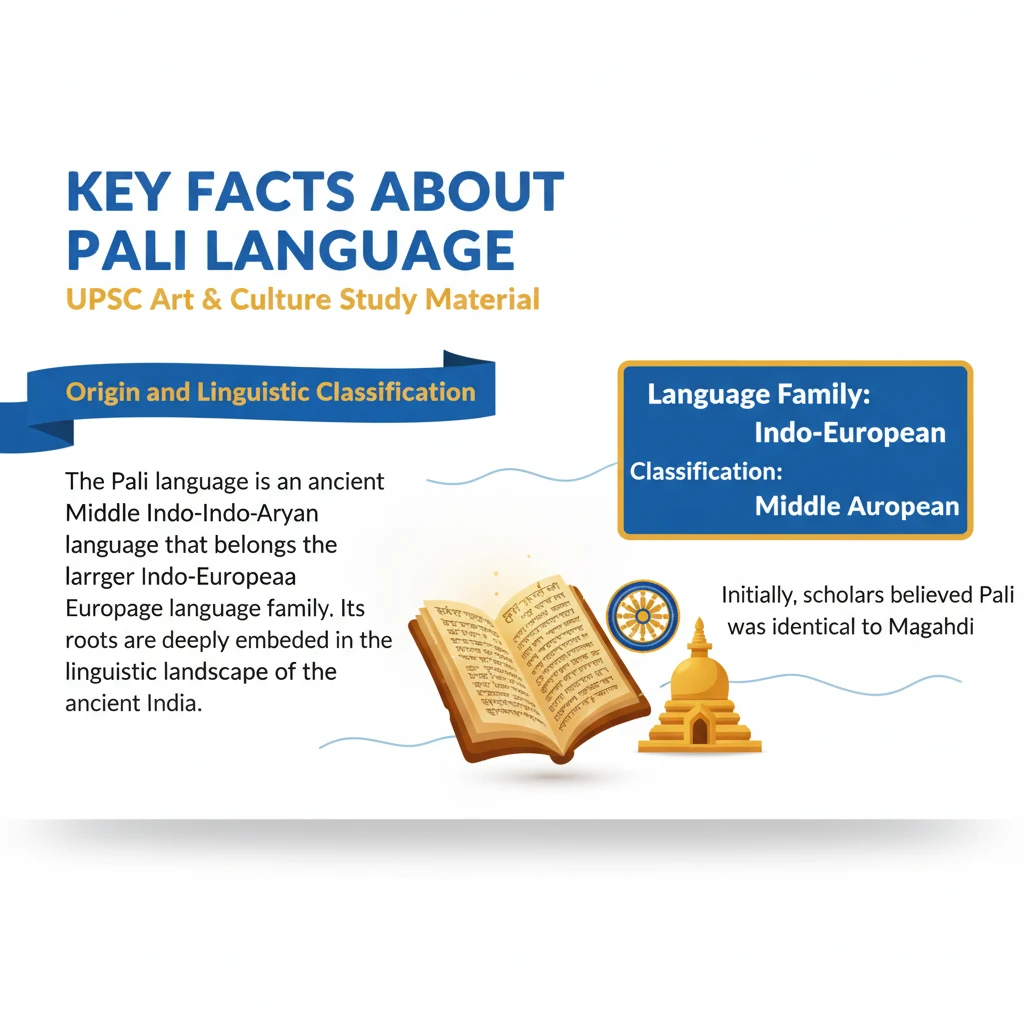
<h4>Linguistic Origin and Characteristics of Pali</h4><p>The <strong>Pali language</strong> belongs to the extensive <strong>Indo-European language family</strong>. Its roots are deeply embedded in the ancient linguistic landscape of India.</p><p>Initially, scholars believed that <strong>Pali</strong> was identical to <strong>Magadhi</strong>, the prominent language spoken in <strong>Magadha</strong> (modern-day Bihar). This perception was largely due to its strong association with early Buddhism, which flourished in the Magadhan region.</p><div class="info-box"><strong>Recent Linguistic Studies:</strong> Modern research indicates that <strong>Pali</strong> shows a stronger resemblance to the <strong>Prakrits</strong> of <strong>Western India</strong> rather than directly to <strong>Magadhi</strong>. This refines our understanding of its geographical and linguistic origins.</div><h4>Classical Status and Historical Significance</h4><p>The <strong>Union Cabinet</strong> has officially approved the recognition of <strong>Pali</strong> as a <strong>classical language</strong>. This prestigious status is shared with other significant Indian languages, including <strong>Prakrit</strong>, <strong>Marathi</strong>, <strong>Sanskrit</strong>, and <strong>Bengali</strong>.</p><p><strong>Pali</strong> holds a crucial connection with <strong>Emperor Ashoka</strong>. Many of <strong>Ashoka’s inscriptions</strong>, particularly those found in modern-day <strong>Uttar Pradesh</strong>, were written in <strong>Pali</strong>. This highlights its administrative and communicative importance during the Mauryan era.</p><div class="key-point-box"><strong>Connection with Buddhism:</strong> <strong>Pali</strong> is most famously known as the sacred language of the <strong>Theravada Buddhist canon</strong>. This includes the three principal collections of Buddhist scriptures, collectively known as the <strong>Tipitaka</strong>.</div><ul><li><strong>Vinaya Pitaka:</strong> Deals with monastic rules and discipline.</li><li><strong>Sutta Pitaka:</strong> Contains discourses and sermons of the Buddha.</li><li><strong>Abhidhamma Pitaka:</strong> Focuses on philosophical and psychological doctrines.</li></ul><h4>Scripts and Geographic Spread of Pali</h4><p>Originally, <strong>Pali</strong> was primarily written using the ancient Indian scripts of <strong>Brahmi</strong> and <strong>Kharoshti</strong>. These scripts were foundational to early Indian writing systems.</p><p>As <strong>Buddhism</strong> spread across Asia, the <strong>Pali language</strong> adapted to local writing systems. This facilitated the dissemination of Buddhist teachings to diverse cultural regions.</p><div class="info-box"><strong>Adaptation of Scripts:</strong><ul><li><strong>Sri Lanka:</strong> Written in <strong>Sinhalese</strong> script.</li><li><strong>Myanmar:</strong> Written in <strong>Burmese</strong> script.</li><li><strong>Thailand:</strong> Written in <strong>Thai</strong> script.</li><li><strong>Cambodia:</strong> Written in <strong>Khmer</strong> script.</li></ul>This widespread adoption underscores Pali's role as a lingua franca for Theravada Buddhism.</div>
💡 Key Takeaways
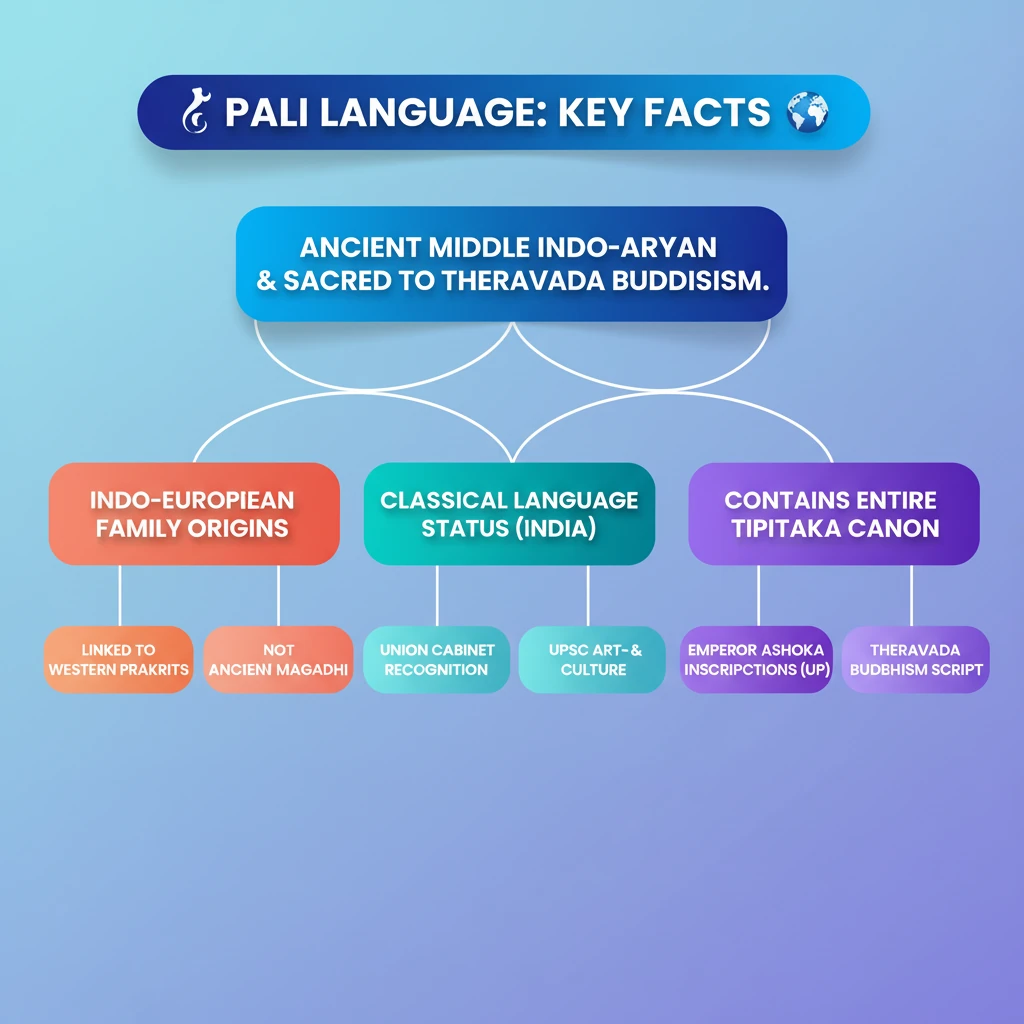
- •Pali is an Indo-European language, a Middle Indo-Aryan Prakrit.
- •It was initially confused with Magadhi but shows stronger ties to Western Indian Prakrits.
- •Pali is recognized as a classical language by the Union Cabinet.
- •Emperor Ashoka used Pali for some of his inscriptions, especially in Uttar Pradesh.
- •It is the sacred language of the Theravada Buddhist canon (Vinaya, Sutta, Abhidhamma Pitaka).
- •Originally written in Brahmi and Kharoshti, it adapted to local scripts like Sinhalese, Burmese, Thai, and Khmer.
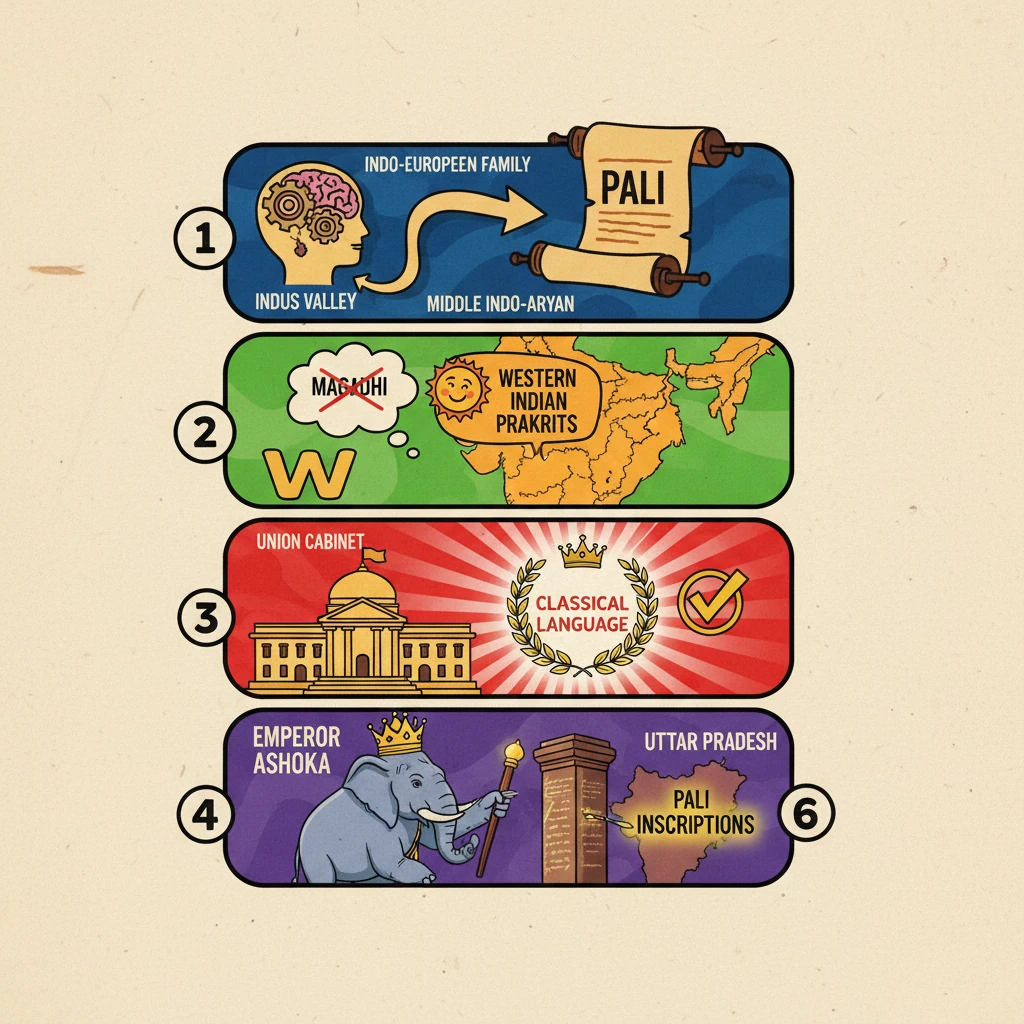
🧠 Memory Techniques
98% Verified Content
📚 Reference Sources
•NCERTs for Ancient Indian History and Art & Culture
•Standard academic texts on Indian languages and Buddhism