Group of Monuments at Hampi - Art And Culture | UPSC Learning
Topics
0 topics • 0 completed
🔍
No topics match your search
Group of Monuments at Hampi
Medium⏱️ 7 min read
art and culture
📖 Introduction
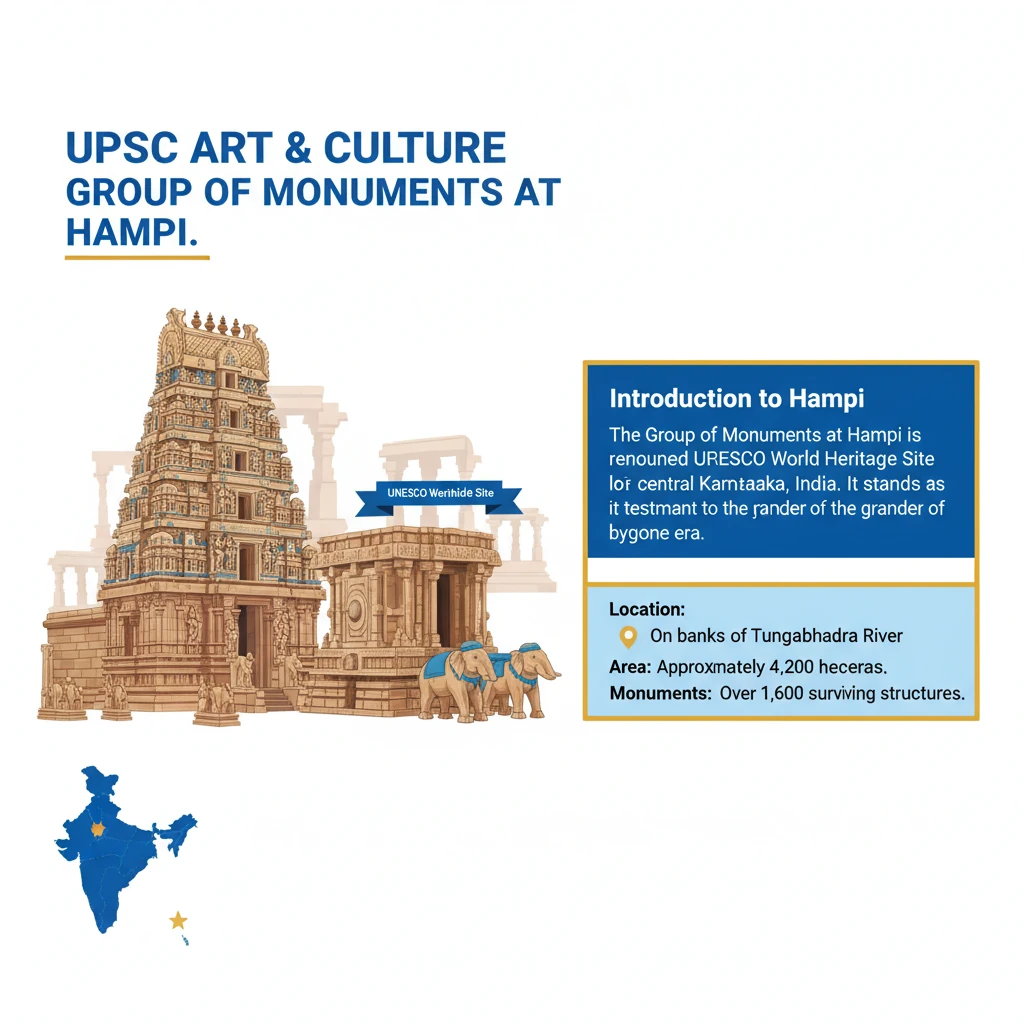
<h4>Introduction to Hampi</h4><p>The <strong>Group of Monuments at Hampi</strong> is a renowned <strong>UNESCO World Heritage Site</strong> located in <strong>central Karnataka</strong>, India. It stands as a testament to the grandeur of a bygone era.</p><div class="info-box"><strong>Location:</strong> On the banks of the <strong>Tungabhadra River</strong>📍<br><strong>Area:</strong> Approximately <strong>4,200 hectares</strong><br><strong>Monuments:</strong> Over <strong>1,600 surviving structures</strong>, including forts, temples, palaces, and other architectural marvels.</div><p>Hampi served as the magnificent capital of the powerful <strong>Vijayanagara Empire</strong>, holding immense historical and archaeological significance. Its ruins attract scholars, tourists, and pilgrims alike.</p><div class="key-point-box">The strategic location of Hampi, nestled amidst <strong>craggy hills</strong> and the <strong>Tungabhadra River</strong>, provided a natural defensive advantage, making it an ideal capital for the imperial city.</div><h4>Architectural Style: Vijayanagara Grandeur</h4><p>The monuments at Hampi represent the zenith of <strong>Vijayanagara architecture</strong>. This unique style is a remarkable synthesis, blending elements of the indigenous <strong>Dravidian style</strong> with distinct <strong>Indo-Islamic influences</strong>.</p><p>This fusion created a distinctive architectural language characterized by elaborate carvings, grand scale, and innovative structural designs.</p><div class="key-point-box">The blend of <strong>Dravidian</strong> and <strong>Indo-Islamic</strong> architectural elements is a defining characteristic of Hampi's structures, reflecting the cultural dynamism and cosmopolitan nature of the <strong>Vijayanagara Empire</strong>.</div><h4>Key Architectural Marvels</h4><p>Hampi is home to several iconic structures that showcase the empire's architectural prowess:</p><ul><li><strong>Vitthala Temple Complex:</strong> Renowned for its exquisitely carved musical pillars and the iconic <strong>Stone Chariot</strong>, a symbol of Karnataka tourism.</li><li><strong>Royal Enclosure:</strong> Features majestic structures such as the elegant <strong>Lotus Mahal</strong>, a queen's palace, and the grand <strong>Elephant Stables</strong>, which housed the royal elephants.</li><li><strong>Hazara Rama Temple:</strong> Distinguished by its intricate <strong>stone carvings</strong> and beautifully sculpted panels depicting scenes from the <strong>Ramayana</strong>, making it a visual narrative.</li><li><strong>Virupaksha Temple:</strong> One of the oldest and most sacred active temples in Hampi, dedicated to <strong>Lord Shiva</strong>, and a major pilgrimage center.</li></ul><h4>Other Significant Monuments</h4><p>Beyond the primary marvels, Hampi boasts numerous other notable structures that contribute to its rich tapestry:</p><ul><li><strong>Krishna Temple Complex</strong></li><li>Massive monolithic statues of <strong>Narasimha</strong> (Ugra Narasimha) and <strong>Ganesa</strong> (Sasivekalu Ganesa and Kadalekalu Ganesa)</li><li><strong>Hemakuta Group of Temples</strong>, featuring early Vijayanagara and pre-Vijayanagara structures.</li><li><strong>Achyutaraya Temple Complex</strong></li><li><strong>Pattabhirama Temple Complex</strong></li><li>And the aforementioned <strong>Lotus Mahal Complex</strong> (part of the Royal Enclosure)</li></ul><h4>Rediscovery and UNESCO Recognition</h4><p>The magnificent ruins of Hampi remained largely unknown to the wider world for centuries until their rediscovery by colonial administrators.</p><div class="info-box"><strong>Rediscovered by:</strong> <strong>Colonel Colin Mackenzie</strong>, a British engineer and antiquarian.<br><strong>Year of Rediscovery:</strong> <strong>1800</strong>, when he conducted the first survey of the site.</div><p>Recognizing its unparalleled cultural and historical significance, the international community bestowed a prestigious status upon Hampi, ensuring its preservation for future generations.</p><div class="highlight-box"><strong>UNESCO World Heritage Site:</strong> Hampi was inscribed by the <strong>United Nations Educational, Scientific and Cultural Organization (UNESCO)</strong> in <strong>1986</strong>. This designation acknowledges its outstanding universal value as a cultural landscape.</div>
💡 Key Takeaways
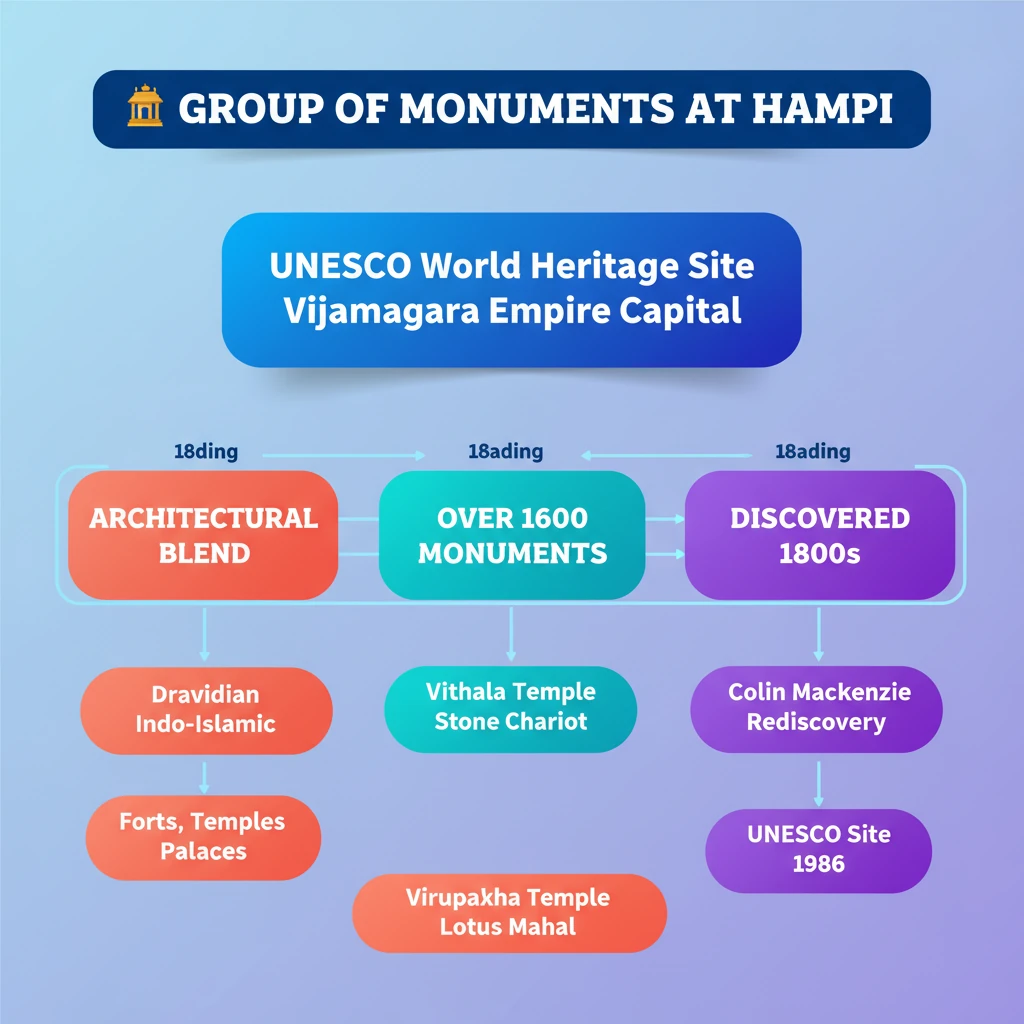
- •Hampi is a UNESCO World Heritage Site in central Karnataka, once the capital of the Vijayanagara Empire.
- •It features over 1,600 monuments, including forts, temples, and palaces, spread over 4,200 hectares.
- •Hampi's architecture is a unique blend of Dravidian and Indo-Islamic styles.
- •Key structures include the Vitthala Temple with its Stone Chariot, the Royal Enclosure with Lotus Mahal, and the Virupaksha Temple.
- •The site was rediscovered by Colonel Colin Mackenzie in 1800 and designated a UNESCO site in 1986.
- •Its strategic location on the Tungabhadra River provided natural defenses.
- •Hampi represents the pinnacle of Vijayanagara cultural and architectural achievements.
🧠 Memory Techniques

98% Verified Content
📚 Reference Sources
•UNESCO World Heritage Centre - Hampi
•Archaeological Survey of India (ASI) publications on Hampi
•NCERT textbooks for Ancient and Medieval Indian History