What are the Key Facts about the Hoysala Dynasty? - Art And Culture | UPSC Learning
Topics
0 topics • 0 completed
🔍
No topics match your search
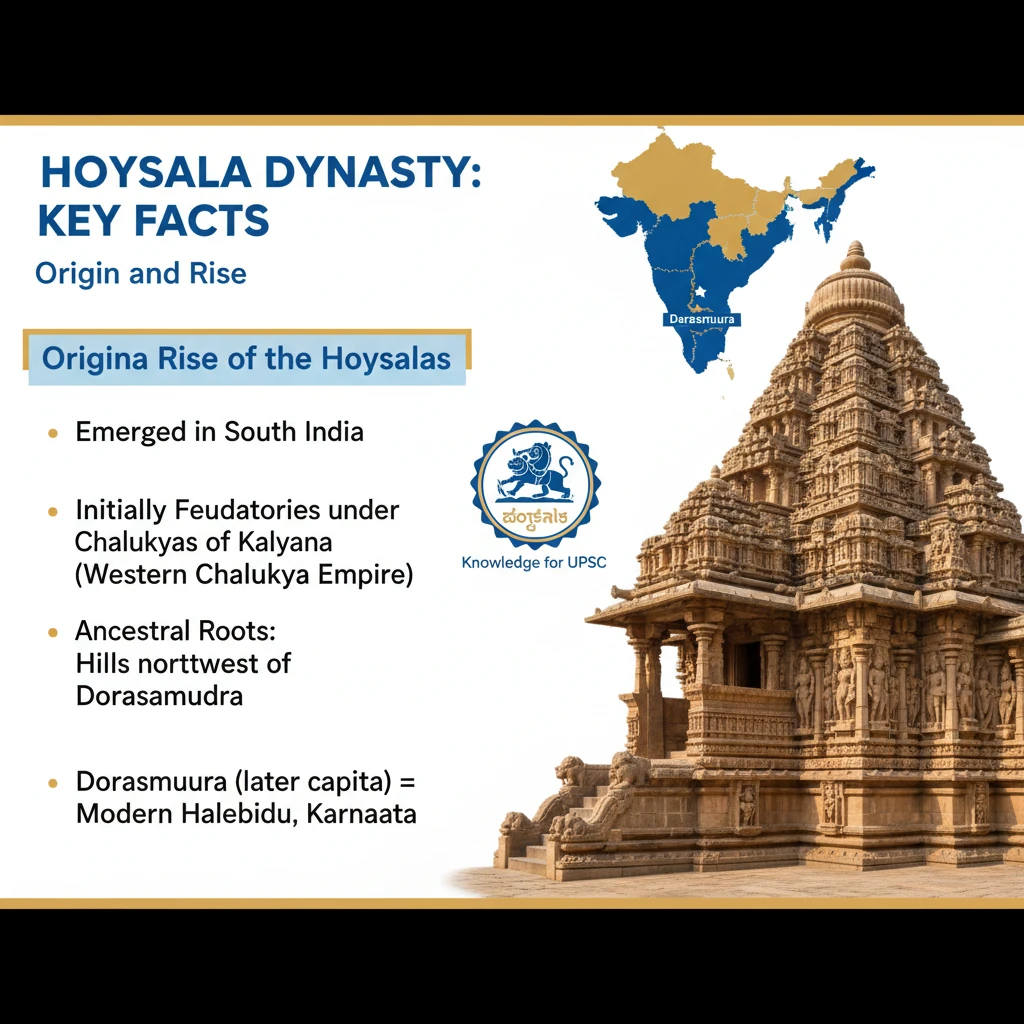
What are the Key Facts about the Hoysala Dynasty?
Medium⏱️ 8 min read
art and culture
📖 Introduction
<h4>Origin and Rise of the Hoysalas</h4><p>The <strong>Hoysalas</strong> emerged as significant rulers in South India, initially serving as <strong>feudatories</strong> under the powerful <strong>Chalukyas of Kalyana</strong>, also known as the <strong>Western Chalukya Empire</strong>.</p><p>Their ancestral roots trace back to the hills located northwest of <strong>Dorasamudra</strong>, which later became their capital. The city of <strong>Dorasamudra</strong> is presently identified as <strong>Halebid</strong>.</p><div class="info-box"><strong>Capital Established:</strong> <strong>Dorasamudra</strong> (modern <strong>Halebid</strong>) in <strong>1060 AD</strong></div><p>The Hoysala dynasty's influence spanned across regions of <strong>Karnataka</strong> and <strong>Tamil Nadu</strong>, particularly in the fertile <strong>Kaveri (Cauvery) river valley</strong>. Their reign extended from the <strong>11th to the 14th century</strong>.</p><h4>Notable Hoysala Rulers</h4><p>Several rulers left an indelible mark on the Hoysala dynasty, shaping its political and cultural landscape. Among the most prominent were <strong>Vishnuvardhana</strong>, <strong>Veera Ballala II</strong>, and <strong>Veera Ballala III</strong>.</p><div class="key-point-box"><strong>Greatest Hoysala King:</strong> <strong>Vishnuvardhana</strong> (also known as <strong>Bittideva</strong>) is widely regarded as the most influential ruler of the dynasty.</div><h4>Succession and Decline</h4><p>Following the decline of the Hoysala dynasty, their territories and legacy were eventually succeeded by the powerful <strong>Vijayanagar dynasty</strong>, marking a transition in South Indian political history.</p><h4>Religion and Cultural Patronage</h4><p>The Hoysala dynasty was notable for its broad religious tolerance and patronage. They actively supported various faiths, fostering a rich cultural environment.</p><ul><li><strong>Patronised Religions:</strong> <strong>Hinduism</strong>, <strong>Jainism</strong>, and <strong>Buddhism</strong>.</li></ul><p>A significant religious transformation occurred with <strong>King Vishnuvardhana</strong>. Initially, he adhered to <strong>Jainism</strong>, a faith prevalent in the region.</p><div class="info-box"><strong>Religious Conversion:</strong> <strong>King Vishnuvardhana</strong> converted to <strong>Vaishnavism</strong> under the profound influence of the revered <strong>Saint Ramanuja</strong>.</div><h4>Hoysala Temple Architecture</h4><p>The architectural prowess of the Hoysalas is best exemplified in their temples, constructed primarily during the <strong>12th and 13th centuries CE</strong>. These structures are celebrated for their distinctive style.</p><div class="key-point-box"><strong>Architectural Style:</strong> Hoysala temples showcase the unique artistic brilliance of the <strong>Vesara style</strong>, a hybrid architectural tradition.</div><p>Many Hoysala temples are not only architectural marvels but also hold international recognition for their cultural significance.</p><ul><li><strong>Chennakeshava Temple</strong> in <strong>Belur</strong></li><li><strong>Hoyaleshwara Temple</strong> in <strong>Halebid</strong></li><li><strong>Keshava Temple</strong> of <strong>Somnathpura</strong></li></ul><div class="info-box"><strong>UNESCO World Heritage Sites:</strong> The above-mentioned Hoysala temples are recognized as <strong>UNESCO World Heritage Sites</strong> and are protected by the <strong>Archaeological Survey of India (ASI)</strong>.</div>
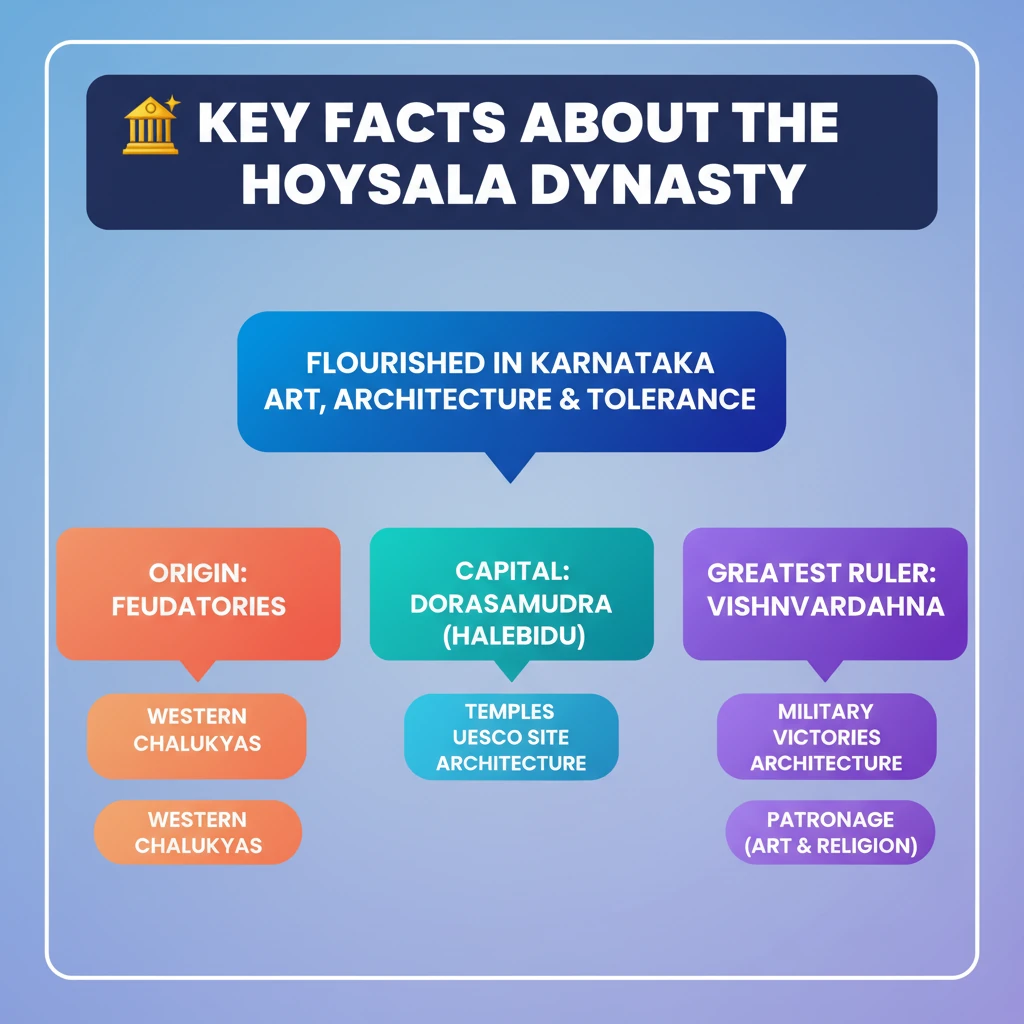
💡 Key Takeaways
- •The Hoysalas were initially feudatories of the Western Chalukyas before establishing their independent rule.
- •Their capital was Dorasamudra, known today as Halebid.
- •Vishnuvardhana was the greatest Hoysala king, known for his military victories and patronage of art.
- •The dynasty patronized Hinduism, Jainism, and Buddhism, showcasing religious tolerance.
- •Hoysala temples exemplify the unique Vesara style of architecture, known for intricate carvings.
- •Key temples like Chennakeshava (Belur), Hoyaleshwara (Halebid), and Keshava (Somnathpura) are UNESCO World Heritage Sites.
- •The Vijayanagar dynasty succeeded the Hoysalas in the Kaveri river valley region.
🧠 Memory Techniques

98% Verified Content
📚 Reference Sources
•UNESCO World Heritage Centre: Sacred Ensembles of the Hoysalas
•Archaeological Survey of India (ASI) records