Konark Wheels at Rashtrapati Bhavan - Art And Culture | UPSC Learning
Topics
0 topics • 0 completed
🔍
No topics match your search
Konark Wheels at Rashtrapati Bhavan
Medium⏱️ 7 min read
art and culture
📖 Introduction
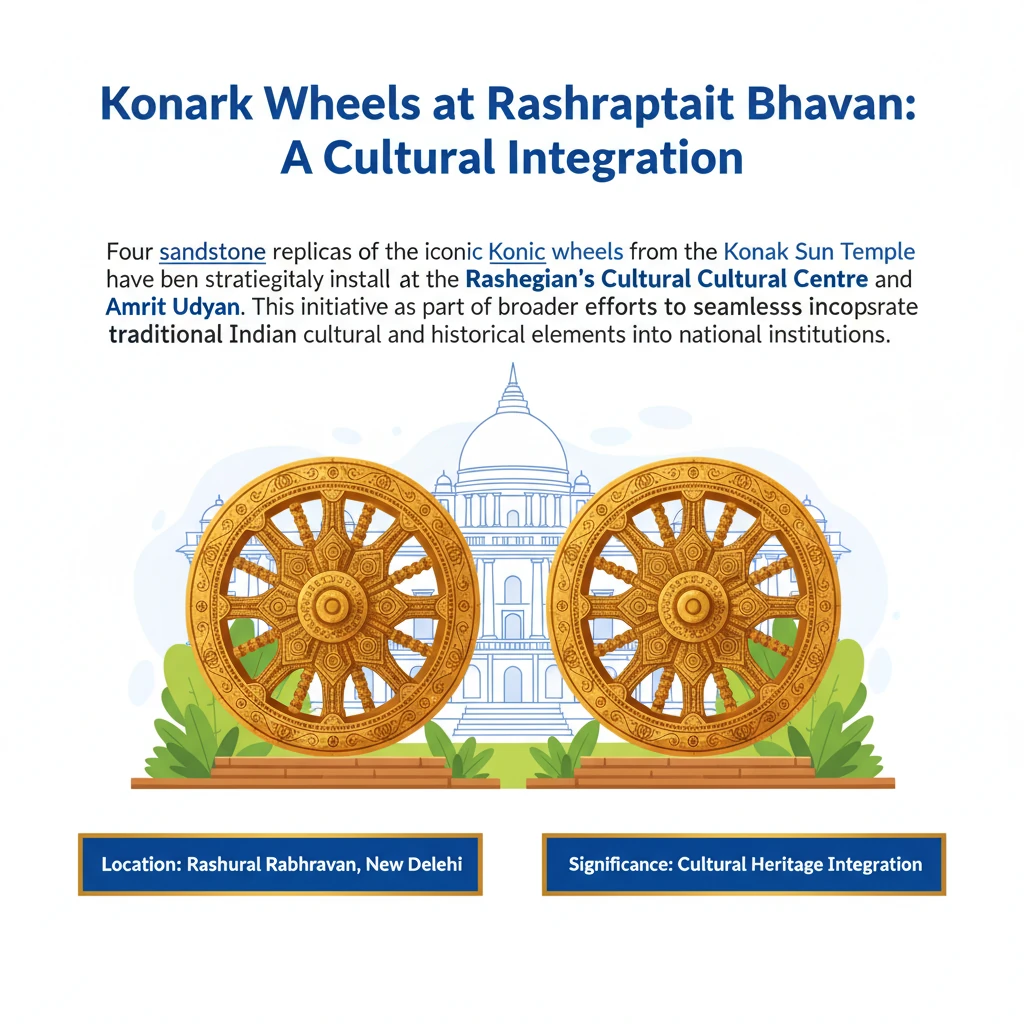
<h4>Konark Wheels at Rashtrapati Bhavan: A Cultural Integration</h4><p>Four sandstone replicas of the iconic <strong>Konark wheels</strong> from the <strong>Konark Sun Temple</strong> have been strategically installed at the <strong>Rashtrapati Bhavan's Cultural Centre</strong> and <strong>Amrit Udyan</strong>. This initiative is part of broader efforts to seamlessly incorporate traditional Indian cultural and historical elements into national institutions.</p><div class="info-box"><strong>Location of Replicas:</strong> Rashtrapati Bhavan's Cultural Centre and Amrit Udyan<br><strong>Origin:</strong> Konark Sun Temple, Odisha<br><strong>Purpose:</strong> Integration of traditional cultural and historical elements</div><h4>The Konark Sun Temple: An Overview</h4><p>The <strong>Konark Sun Temple</strong>, a magnificent 13th-century edifice near <strong>Puri</strong> in <strong>Odisha</strong>, was constructed by <strong>King Narasimhadeva I</strong> (1238–1264 AD). Its grand scale and intricate design stand as a powerful symbol of the architectural prowess and cultural values of the <strong>Eastern Ganga dynasty</strong>.</p><div class="key-point-box">The <strong>Konark Temple</strong> was declared a <strong>UNESCO World Heritage Site</strong> in <strong>1984</strong>, recognizing its outstanding universal value.</div><h4>Odisha School of Temple Architecture</h4><p>The <strong>Konark Temple</strong> is a prime example of the <strong>Odisha School of Temple Architecture</strong>, which is a sub-school of the broader <strong>Nagara School of Architecture</strong>. This style is predominantly found in <strong>East Indian Temples</strong>, particularly in the ancient <strong>Kalinga</strong> region (modern <strong>Puri District</strong>, including <strong>Bhubaneswar</strong>, <strong>Puri</strong>, and <strong>Konark</strong>).</p><p>The main architectural features of <strong>Odisha temples</strong> are categorized into three distinct orders:</p><ul><li><strong>Rekhapida:</strong> Refers to the curvilinear tower over the sanctum.</li><li><strong>Pidhadeul:</strong> Denotes the pyramidal roof over the assembly hall.</li><li><strong>Khakhra:</strong> A distinct type of roof structure, often seen in subsidiary shrines.</li></ul><h4>Key Architectural Characteristics of Odisha Temples</h4><p>In <strong>Odisha temple architecture</strong>, the <strong>shikhara</strong>, which is the tower over the sanctum, is locally known as <strong>deul</strong>. It typically rises almost vertically before curving sharply inwards near the top.</p><p>Preceding the <strong>deul</strong>, there is usually a <strong>mandapa</strong> (assembly hall) known as the <strong>jagamohana</strong>. Most <strong>Odisha temples</strong> are enclosed by prominent <strong>boundary walls</strong>.</p><div class="info-box"><strong>Deul:</strong> The <strong>shikhara</strong> (main tower) of an <strong>Odisha temple</strong>.<br><strong>Jagamohana:</strong> The <strong>mandapa</strong> (audience hall) preceding the <strong>deul</strong>.</div><p>The ground plan of the main temple is almost always <strong>square</strong>. However, in the upper reaches of its superstructure, it transitions to a <strong>circular form</strong> at the crowning element, known as the <strong>mastaka</strong>.</p><p>While the exteriors of these temples are lavishly carved with intricate details, their interiors are generally quite bare, creating a stark contrast.</p><h4>Konark Sun Temple: Key Features and Significance</h4><p>The <strong>Konark Sun Temple</strong>, built by <strong>King Narasimhadeva I</strong>, is renowned for its unique design as a colossal chariot. The <strong>vimana</strong> (principal sanctuary) was originally surmounted by a high tower, a <strong>shikhara</strong> (also known as <strong>Rekha deul</strong>), which collapsed and was largely restored in the 19th century.</p><p>To the east, the <strong>jagamohana</strong> (audience hall) dominates the ruins with its impressive pyramidal mass. Further east, the <strong>natmandir</strong> (dance hall), now unroofed, stands on a high platform, indicating its original grandeur.</p><h4>Architectural Significance: The Chariot Design and Wheels</h4><p>The temple is conceived as a colossal <strong>chariot</strong> for the Sun God, pulled by seven horses (though only one remains intact). It features <strong>12 pairs of intricately carved wheels</strong>, making a total of 24 wheels, each approximately <strong>9 feet 9 inches</strong> in diameter.</p><div class="info-box"><strong>Wheel Dimensions:</strong> 9 feet 9 inches in diameter<br><strong>Spokes:</strong> Each wheel has 8 thick and 8 thin spokes<br><strong>Function:</strong> Serve as precise <strong>ancient sundials</strong></div><p>The intricate carvings on the wheels include circular medallions, animals, and foliage on the rims. The medallions themselves depict various luxury scenes, adding to the temple's artistic richness.</p><h4>Symbolic Interpretations of the Konark Wheels</h4><p>The <strong>12 pairs of wheels</strong> are widely interpreted to signify the <strong>12 months of the year</strong>. The <strong>24 wheels</strong> collectively represent the <strong>24 hours in a day</strong>, highlighting the temple's connection to time and celestial movements.</p><div class="key-point-box">Another significant interpretation links the wheel to the <strong>“Wheel of Life”</strong> – symbolizing the continuous cycle of creation, preservation, and realization in cosmic existence.</div><h4>Cultural and Religious Heritage</h4><p>The <strong>Konark Wheel</strong> bears a strong resemblance to the <strong>Buddhist Dharmachakra</strong>, symbolizing the cosmic cycle of <strong>Dharma</strong> (righteousness) and <strong>Karma</strong> (action). This connection underscores the broader philosophical themes prevalent in ancient Indian thought.</p><p>Furthermore, some interpretations suggest that the <strong>12 wheels</strong> represent the <strong>zodiac signs</strong>, linking the temple's design to astrological and cosmic principles, reflecting a holistic worldview.</p>
💡 Key Takeaways
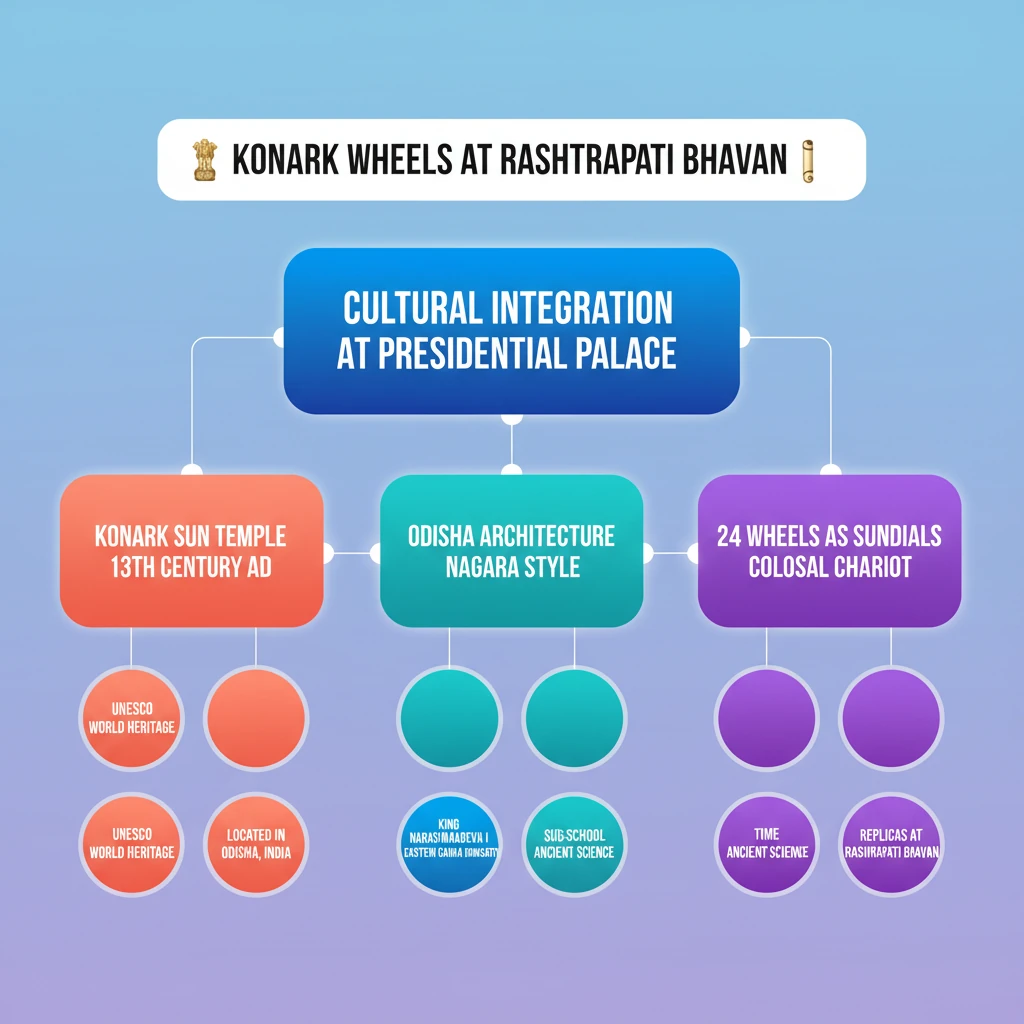
- •Konark Wheel replicas are installed at Rashtrapati Bhavan to integrate cultural elements.
- •The Konark Sun Temple is a 13th-century UNESCO World Heritage Site in Odisha.
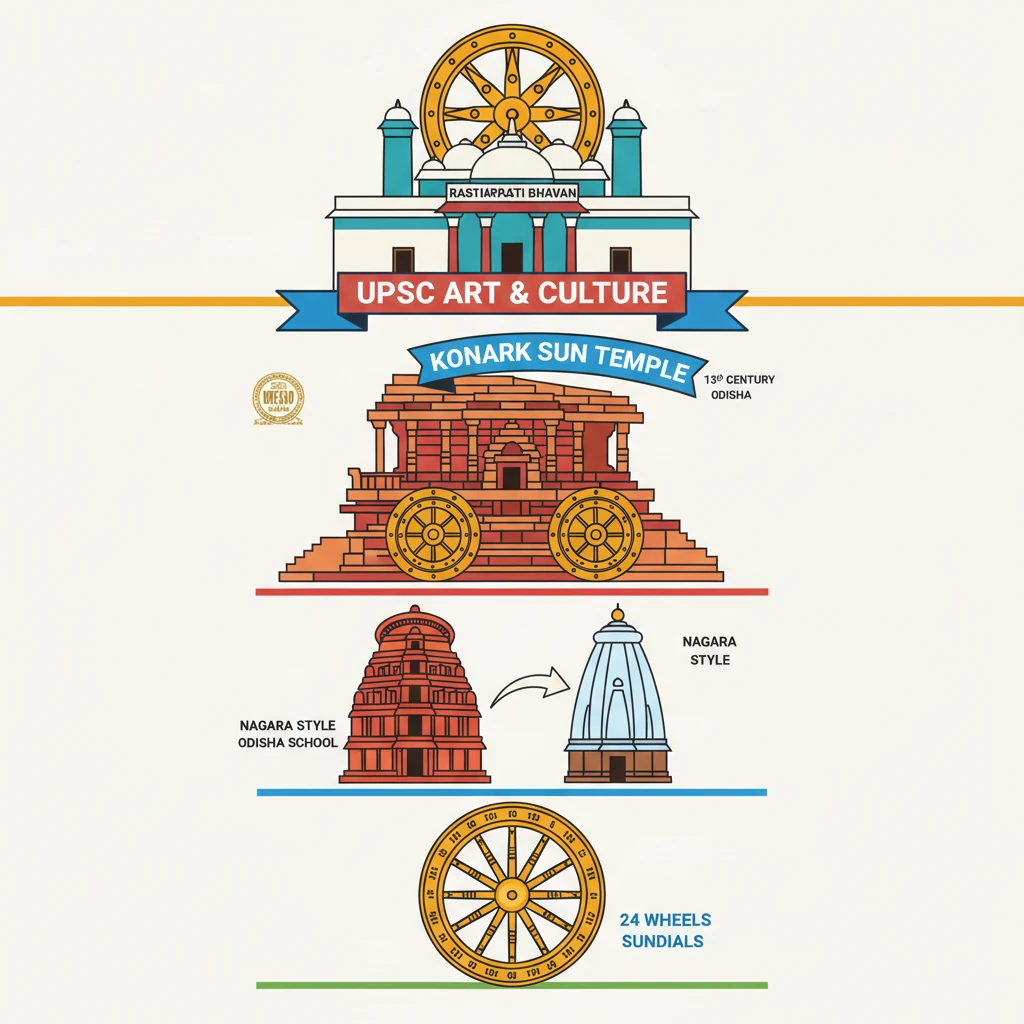
- •It exemplifies the Odisha School of Temple Architecture, a sub-school of the Nagara style.
- •The temple is designed as a colossal chariot with 24 wheels, which function as sundials.
- •King Narasimhadeva I of the Eastern Ganga dynasty built the Konark Sun Temple.
- •Odisha temples feature distinct 'deul' (shikhara) and 'jagamohana' (mandapa) with lavish exteriors.
- •The wheels symbolize months, hours, the 'Wheel of Life', and connect to the Buddhist Dharmachakra.
🧠 Memory Techniques
98% Verified Content
📚 Reference Sources
•UNESCO World Heritage Centre - Konark Sun Temple
•NCERT Fine Arts Class 11 - An Introduction to Indian Art
•Indian Culture Portal (Ministry of Culture, Government of India)