Cultural Exchange and Growth of Kashmir’s Craft Industry - Art And Culture | UPSC Learning
Topics
0 topics • 0 completed
🔍
No topics match your search
Cultural Exchange and Growth of Kashmir’s Craft Industry
Medium⏱️ 7 min read
art and culture
📖 Introduction
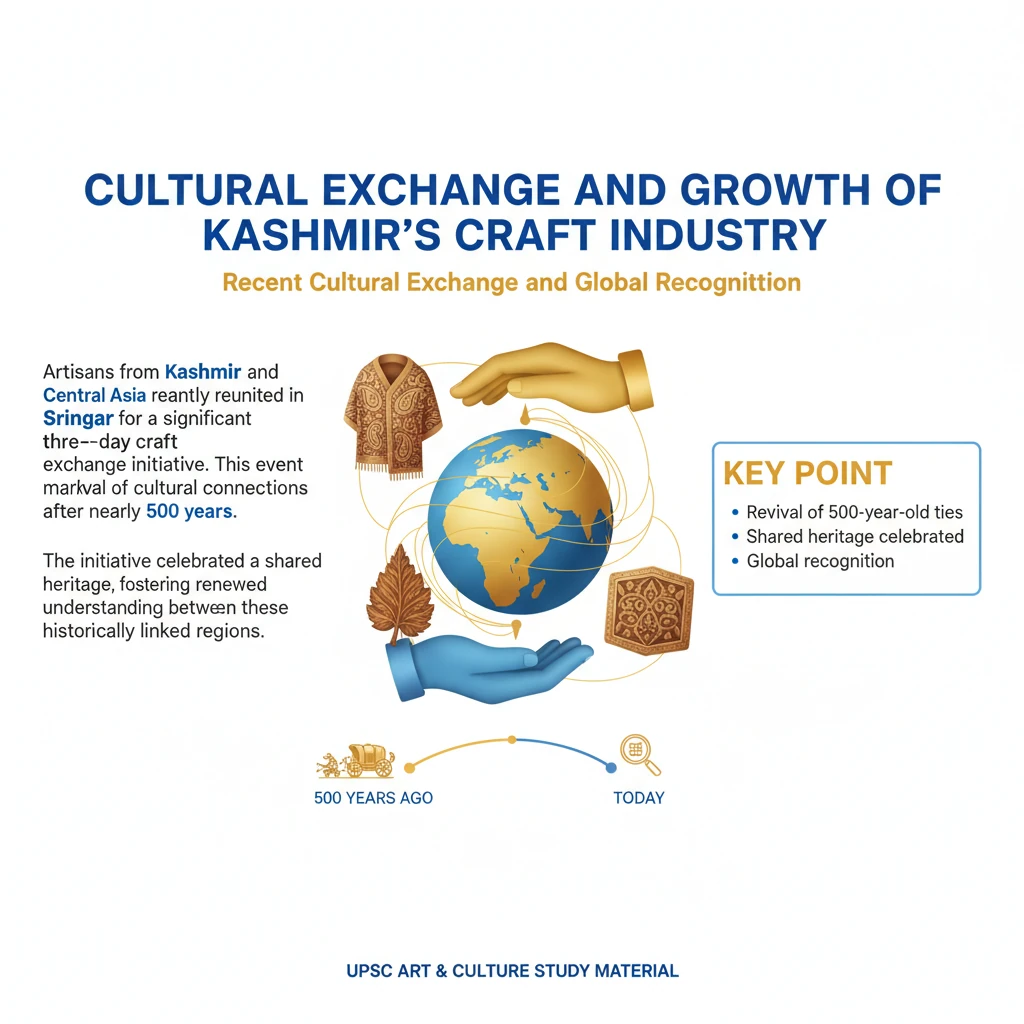
<h4>Recent Cultural Exchange and Global Recognition</h4><p>Artisans from <strong>Kashmir</strong> and <strong>Central Asia</strong> recently reunited in <strong>Srinagar</strong> for a significant three-day craft exchange initiative. This event marked a revival of cultural connections after nearly <strong>500 years</strong>.</p><p>The initiative celebrated a shared heritage, fostering renewed understanding and collaboration between these historically linked regions.</p><div class="key-point-box">The event also celebrated <strong>Srinagar's</strong> recognition as a <strong>“World Craft City”</strong> by the <strong>World Crafts Council (WCC)</strong>. This designation highlights the city's rich artisanal legacy and ongoing contributions to global craft heritage.</div><h4>Historical Central Asian Influence on Srinagar's Crafts</h4><p>The development of <strong>Srinagar's</strong> distinctive crafts has deep roots in historical interactions with <strong>Central Asia</strong>.</p><p>A pivotal figure in this cultural exchange was <strong>Zain-ul-Abidin</strong>, the <strong>9th Sultan of Kashmir</strong>, who reigned in the <strong>15th century</strong>.</p><div class="info-box"><strong>Sultan Zain-ul-Abidin's Contribution:</strong><ul><li>Introduced <strong>Central Asian craft techniques</strong> to <strong>Kashmir</strong>.</li><li>Brought skilled artisans from regions like <strong>Samarkand</strong>, <strong>Bukhara</strong>, and <strong>Persia</strong>.</li></ul></div><p>These initial connections flourished during his reign, significantly shaping the local craft industry.</p><p>However, post <strong>Zain-ul-Abidin's</strong> era, these cultural and craft connections gradually weakened. They eventually came to an end by <strong>1947</strong>, largely due to geopolitical shifts.</p><div class="key-point-box"><strong>Srinagar's Strategic Location:</strong><p>Located on the historic <strong>Silk Route</strong>, <strong>Srinagar</strong> naturally became a melting pot for cultural, economic, and artistic exchanges. This geographical advantage facilitated cross-cultural interactions vital for craft development.</p></div><h4>Specific Craftsmanship Techniques: Wood Carving</h4><p>Among the many crafts influenced, <strong>wood carving</strong> stands out as a prominent example of <strong>Kashmiri</strong> artistry.</p><p><strong>Kashmiri artisans</strong> are renowned for their intricate woodwork, a skill greatly enhanced by the adoption of techniques introduced from <strong>Central Asia</strong>.</p><div class="info-box"><strong>Characteristics of Kashmiri Wood Carving:</strong><ul><li>Known for intricate, detailed patterns.</li><li>Often features floral motifs, calligraphy, and geometric designs.</li><li>Utilizes local woods like <strong>walnut</strong>, which is ideal for fine carving.</li></ul></div>
💡 Key Takeaways
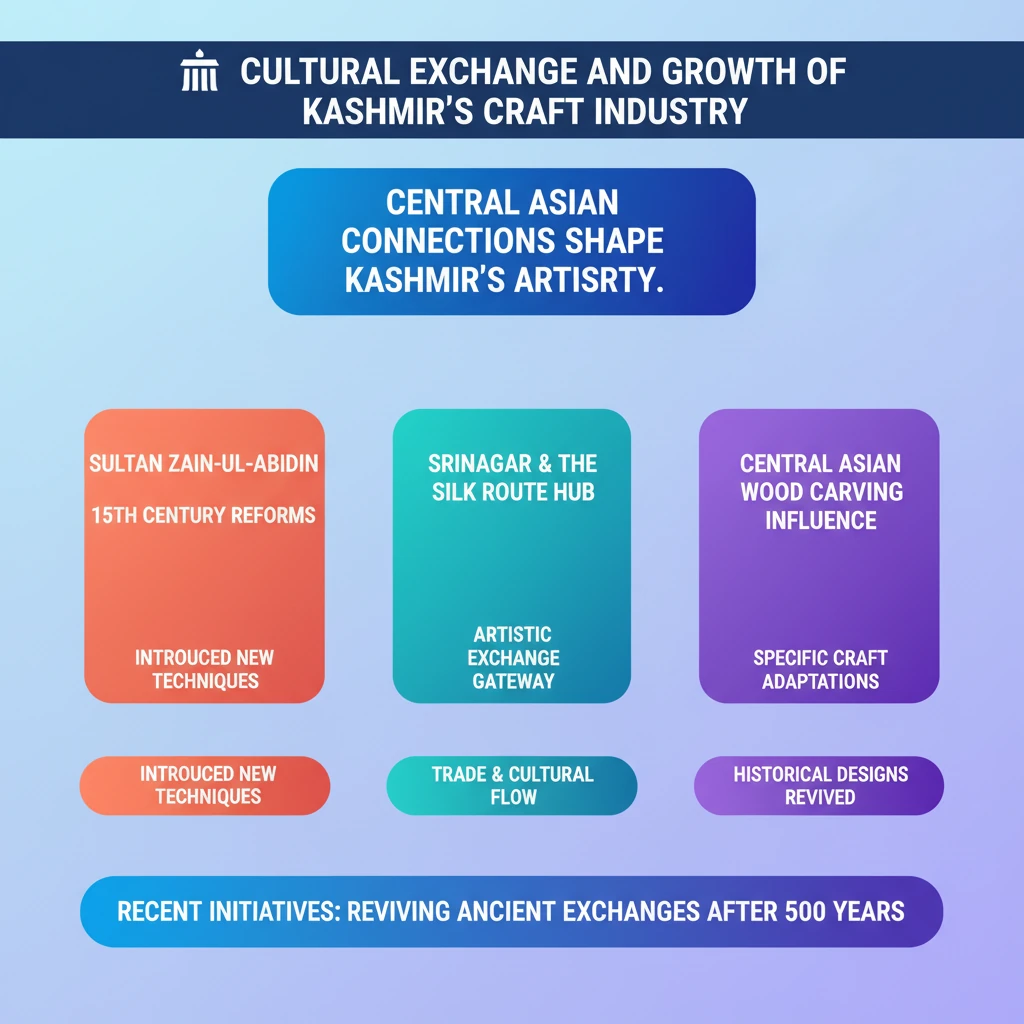
- •Kashmir's craft industry has a deep historical connection with Central Asia.
- •Sultan Zain-ul-Abidin in the 15th century played a crucial role in introducing Central Asian craft techniques.
- •Srinagar's location on the Silk Route facilitated extensive cultural and artistic exchanges.
- •Specific crafts like wood carving show clear Central Asian influence.
- •Recent initiatives are reviving these ancient cultural exchanges after 500 years.
- •Srinagar's recognition as a "World Craft City" signifies global acknowledgment of its craft heritage.
- •These crafts are vital for preserving cultural identity and supporting local economies.
🧠 Memory Techniques
95% Verified Content