What are the Constitutional Provisions Related to Languages in India - Art And Culture | UPSC Learning
Topics
0 topics • 0 completed
🔍
No topics match your search
What are the Constitutional Provisions Related to Languages in India
Medium⏱️ 8 min read
art and culture
📖 Introduction
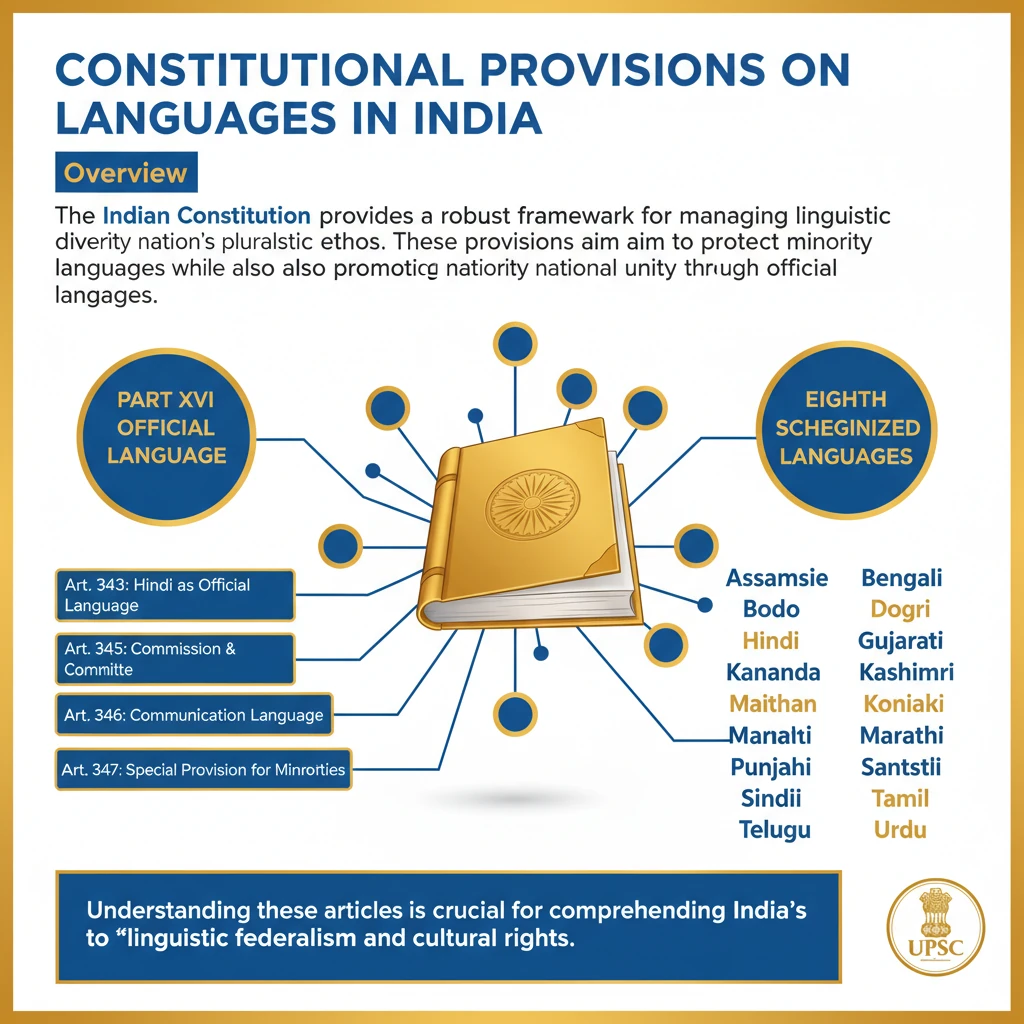
<h4>Overview of Constitutional Provisions on Languages</h4><p>The <strong>Indian Constitution</strong> provides a robust framework for managing linguistic diversity, reflecting the nation's pluralistic ethos. These provisions aim to protect minority languages while also promoting national unity through official languages.</p><div class="key-point-box">Understanding these articles is crucial for comprehending India's approach to <strong>linguistic federalism</strong> and <strong>cultural rights</strong>.</div><h4>Article 29: Protection of Minorities' Interests</h4><p><strong>Article 29</strong> of the Indian Constitution is a fundamental right that safeguards the interests of minorities. It ensures that all citizens have the right to preserve their distinct <strong>language</strong>, <strong>script</strong>, or <strong>culture</strong>.</p><div class="info-box"><strong>Key Aspect:</strong> This article applies to any section of citizens residing in India having a distinct language, script, or culture. It is not limited to religious minorities.</div><h4>Eighth Schedule: Recognized Official Languages</h4><p><strong>Part XVII</strong> of the Indian Constitution specifically deals with the <strong>official languages</strong> of the Union and states. The <strong>Eighth Schedule</strong> is integral to this part, listing the languages recognized by the Constitution.</p><div class="info-box"><strong>Number of Languages:</strong> The Eighth Schedule currently recognizes <strong>22 official languages</strong>. These include Assamese, Bengali, Bodo, Dogri, Gujarati, Hindi, Kannada, Kashmiri, Konkani, Maithili, Malayalam, Manipuri, Marathi, Nepali, Odia, Punjabi, Sanskrit, Santhali, Sindhi, Tamil, Telugu, and Urdu.</div><div class="exam-tip-box">Remember the original number of languages (14) and the amendments that added others (Sindhi, Konkani, Manipuri, Nepali, Bodo, Dogri, Maithili, Santhali) for Prelims.</div><h4>Classical Language Status</h4><p>Beyond the Eighth Schedule, the government also confers <strong>'classical language'</strong> status to certain languages. This status comes with specific benefits for promotion and preservation.</p><div class="info-box"><strong>Current Count:</strong> <strong>Six languages</strong> in India currently have “classical” status. These are <strong>Tamil</strong> (2004), <strong>Sanskrit</strong> (2005), <strong>Kannada</strong> (2008), <strong>Telugu</strong> (2008), <strong>Malayalam</strong> (2013), and <strong>Odia</strong> (2014).</div><h4>Article 350A: Primary Education in Mother Tongue</h4><p><strong>Article 350A</strong> mandates that every state and every local authority within the state must endeavor to provide adequate facilities for instruction in the <strong>mother tongue</strong> at the <strong>primary stage of education</strong>.</p><p>This provision is crucial for ensuring that children receive foundational education in a language they understand best, promoting better learning outcomes and cultural continuity.</p><h4>Article 350B: Special Officer for Linguistic Minorities</h4><p><strong>Article 350B</strong> provides for the appointment of a <strong>“Special Officer” for linguistic minorities</strong>. This officer's role is to investigate all matters relating to the safeguards provided for linguistic minorities under the Constitution.</p><p>The Special Officer reports directly to the <strong>President of India</strong>, and these reports are then laid before each House of Parliament.</p><h4>Article 351: Development of Hindi Language</h4><p><strong>Article 351</strong> empowers the <strong>Union government</strong> to issue a directive for the <strong>development of the Hindi language</strong>. The objective is to promote the spread of Hindi and enrich its vocabulary by drawing upon other Indian languages, particularly Sanskrit.</p><div class="key-point-box">This article highlights the constitutional aspiration for <strong>Hindi</strong> to serve as a medium of expression for all the elements of the composite culture of India.</div>
💡 Key Takeaways
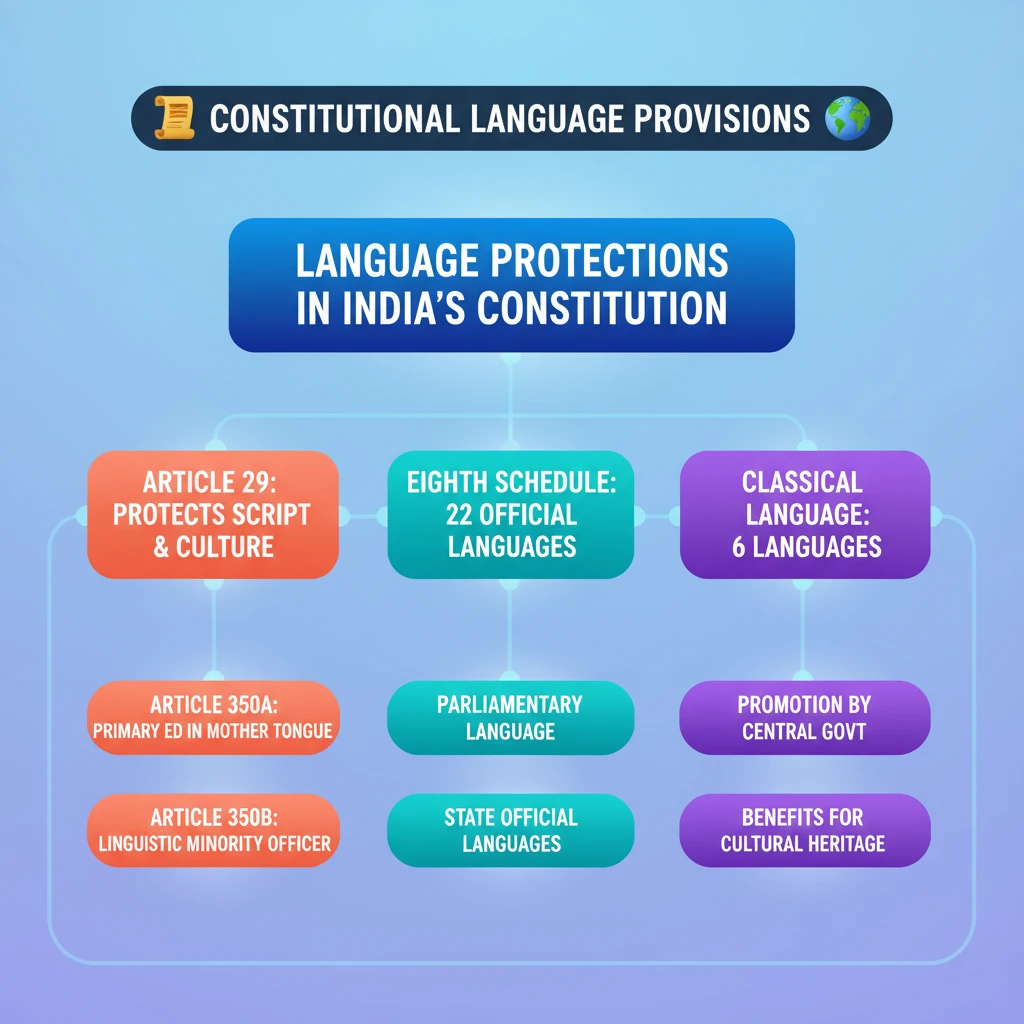
- •Article 29 protects the language, script, or culture of any section of citizens.
- •The Eighth Schedule lists 22 officially recognized languages of India.
- •Six languages currently hold 'classical language' status, receiving special promotion.
- •Article 350A mandates primary education in the mother tongue for all states.
- •Article 350B provides for a Special Officer to safeguard linguistic minorities.
- •Article 351 empowers the Union to promote the development of the Hindi language.
- •India's language policy balances national unity with the protection of linguistic diversity.
🧠 Memory Techniques

98% Verified Content
📚 Reference Sources
•The Constitution of India (as amended)
•National Education Policy (NEP) 2020 document
•Press Information Bureau (PIB) releases on classical languages