51,200 Year Old Cave Painting Discovered - Art And Culture | UPSC Learning
Topics
0 topics • 0 completed
🔍
No topics match your search
51,200 Year Old Cave Painting Discovered
Medium⏱️ 7 min read
art and culture
📖 Introduction
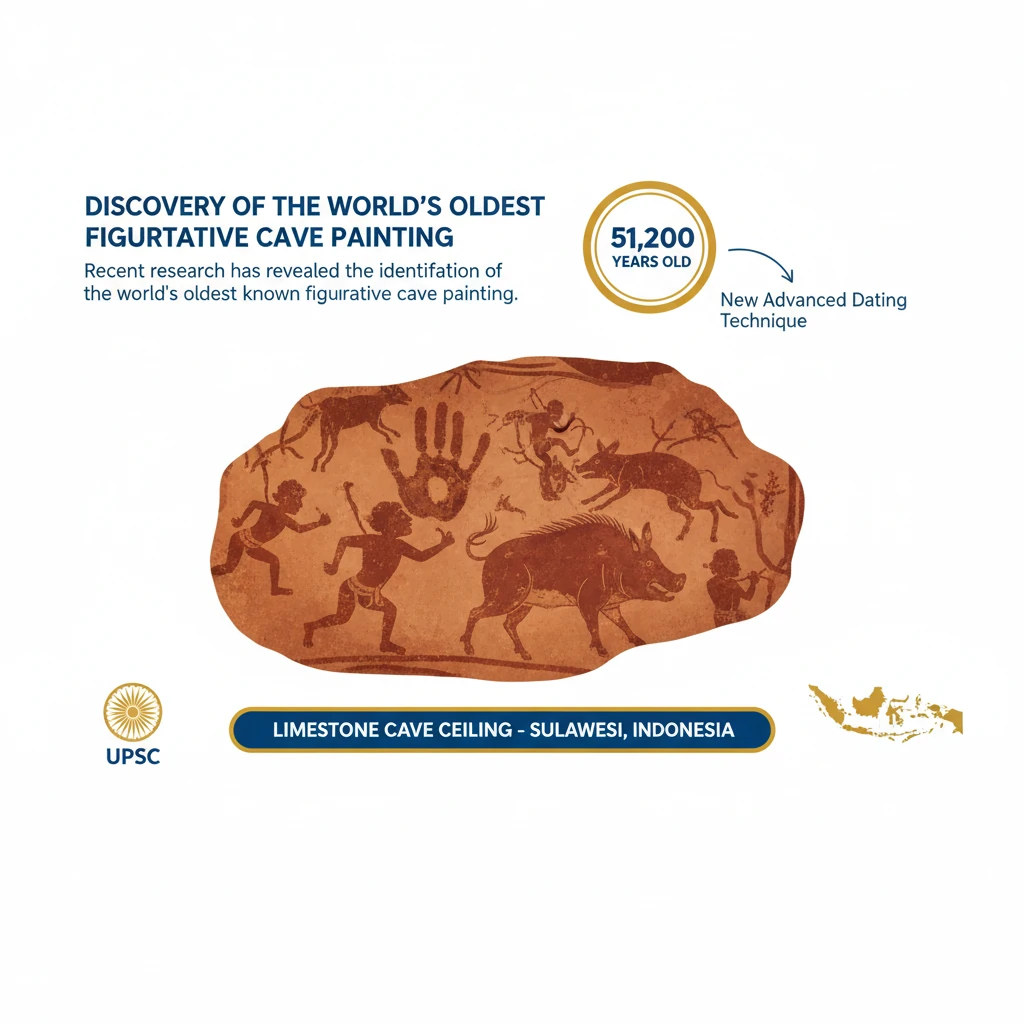
<h4>Discovery of the World's Oldest Figurative Cave Painting</h4><p>Recent research has revealed the identification of the <strong>world's oldest known figurative cave painting</strong>. This remarkable artwork is approximately <strong>51,200 years old</strong>, a discovery made possible through a new, advanced dating technique.</p><p>The painting is strategically located on the ceiling of a <strong>limestone cave</strong>, specifically found on the island of <strong>Sulawesi, Indonesia</strong>.</p><div class="info-box"><strong>Location:</strong> 📍 <strong>Sulawesi, Indonesia</strong><br><strong>Age:</strong> 📅 Approximately <strong>51,200 years old</strong><br><strong>Type:</strong> <strong>Figurative cave painting</strong></div><h4>Artistic Representation and Details</h4><p>The ancient artwork depicts a compelling scene, primarily featuring a <strong>pig standing still</strong> with its mouth partly open. This central figure is surrounded by several others.</p><p>Accompanying the pig are <strong>three human-like figures</strong>, each shown in distinct poses and actions:</p><ul><li>The <strong>largest figure</strong> is depicted with outstretched arms, gripping a <strong>rod</strong>.</li><li>A <strong>second figure</strong> is positioned directly in front of the pig, holding a <strong>stick</strong>.</li><li>The <strong>third figure</strong> is shown upside-down, with legs pointing upwards and one hand reaching towards the pig’s head.</li></ul><div class="key-point-box">This detailed depiction offers invaluable insights into the narrative abilities and artistic sophistication of early human societies.</div><h4>Understanding Uranium Series (U-series) Dating Technique</h4><p>The precise age of the rock art was determined using <strong>Uranium Series (U-series) analysis</strong>. This advanced dating technique is particularly effective for materials found in limestone caves.</p><p>The method involves analyzing <strong>calcite deposits</strong> that form on the surface of the cave paintings. Researchers use <strong>laser beams</strong> to meticulously compare the ratio of specific isotopes of <strong>uranium</strong> to <strong>thorium</strong> within these deposits.</p><p>This comparison allows for an accurate calculation of the time elapsed since the calcite layer formed, thereby dating the artwork either above or below it.</p><div class="info-box"><strong>Isotope Definition:</strong> An <strong>isotope</strong> is a variant of an atom within the same element. It shares the same atomic number and chemical properties but differs in atomic mass and physical characteristics.</div><h4>Previous Applications and Impact of U-series Dating</h4><p>The <strong>U-series dating method</strong> has also been successfully applied to other significant archaeological sites. Notably, it was used to date another cave painting at <strong>Leang Tedongnge, Sipong 4</strong>.</p><p>This painting was initially estimated to be around <strong>43,900 years old</strong>. However, the application of <strong>U-series analysis</strong> revealed that the <strong>Leang Tedongnge</strong> painting is at least <strong>4,000 years older</strong> than previously believed.</p><div class="exam-tip-box">⚡ For UPSC, understanding such scientific dating techniques like <strong>U-series analysis</strong> is crucial. It directly impacts our understanding of historical timelines and archaeological findings, relevant for <strong>GS Paper 1 (Art & Culture, History)</strong> and <strong>GS Paper 3 (Science & Technology)</strong>.</div>

💡 Key Takeaways
- •The world's oldest known figurative cave painting is approximately 51,200 years old.
- •It was discovered on the ceiling of a limestone cave in Sulawesi, Indonesia.
- •The painting depicts a pig surrounded by three human-like figures.
- •The age was determined using Uranium Series (U-series) analysis of calcite deposits.
- •This discovery significantly pushes back the timeline for complex figurative art.
- •It offers crucial insights into early human artistic expression and cognitive abilities.
- •The U-series method also re-dated the Leang Tedongnge painting, making it 4,000 years older than previously thought.
🧠 Memory Techniques

95% Verified Content
📚 Reference Sources
•General archaeological and scientific literature on cave paintings and U-series dating