Historical Evolution - Art And Culture | UPSC Learning
Topics
0 topics • 0 completed
🔍
No topics match your search
Historical Evolution
Medium⏱️ 8 min read
art and culture
📖 Introduction
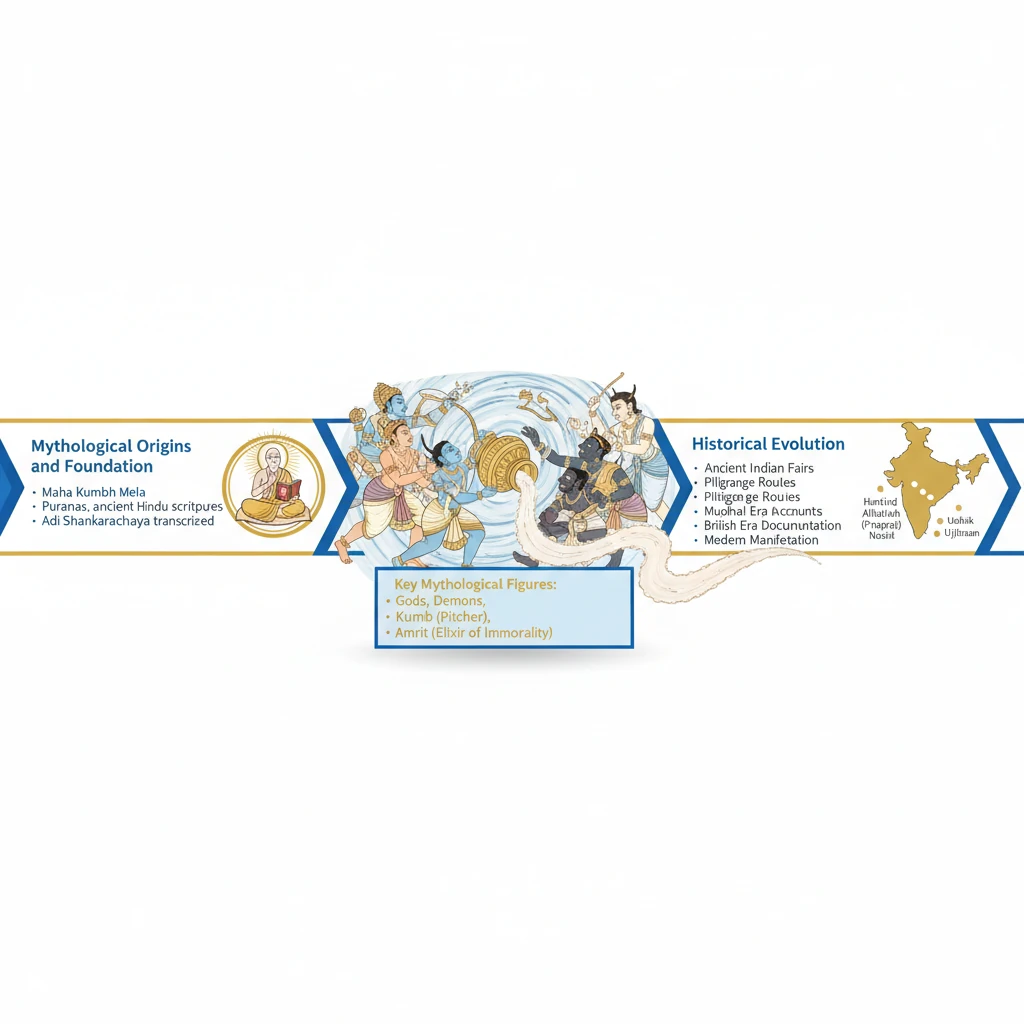
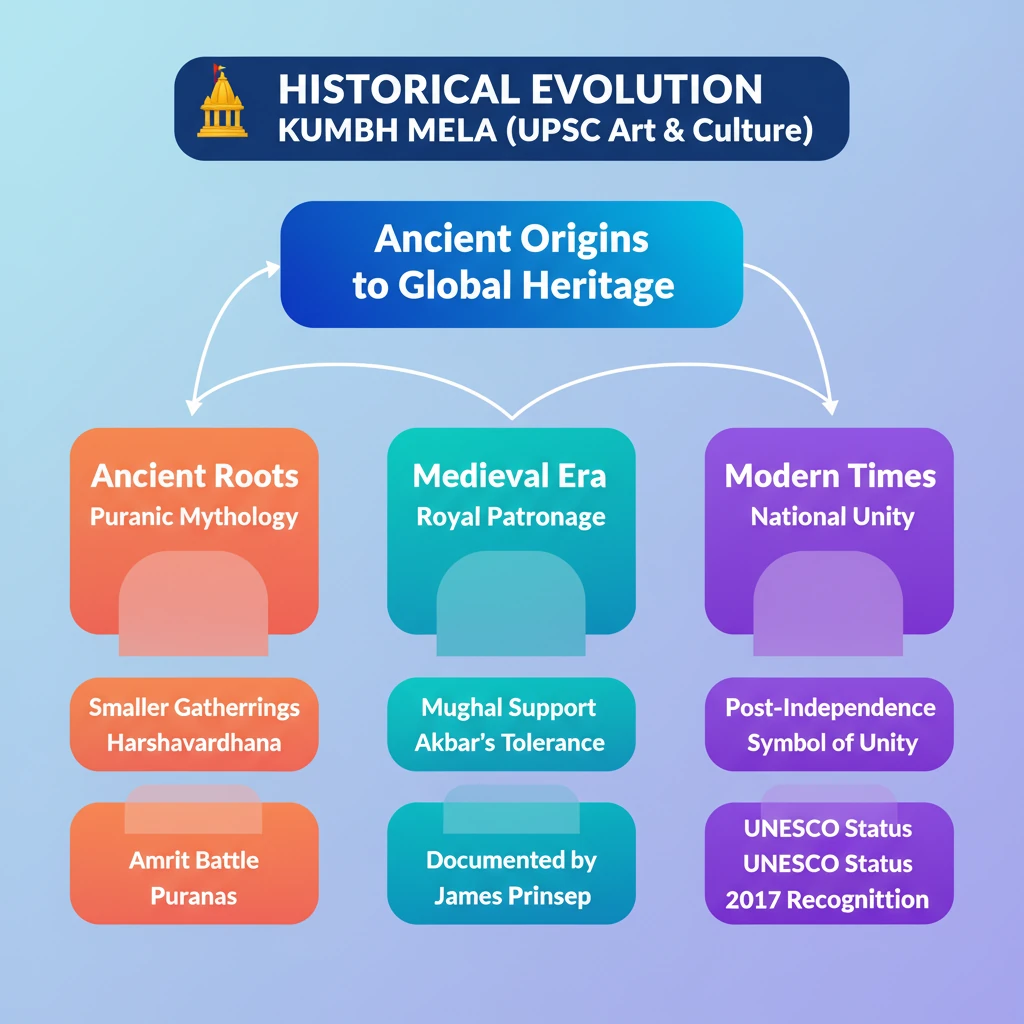
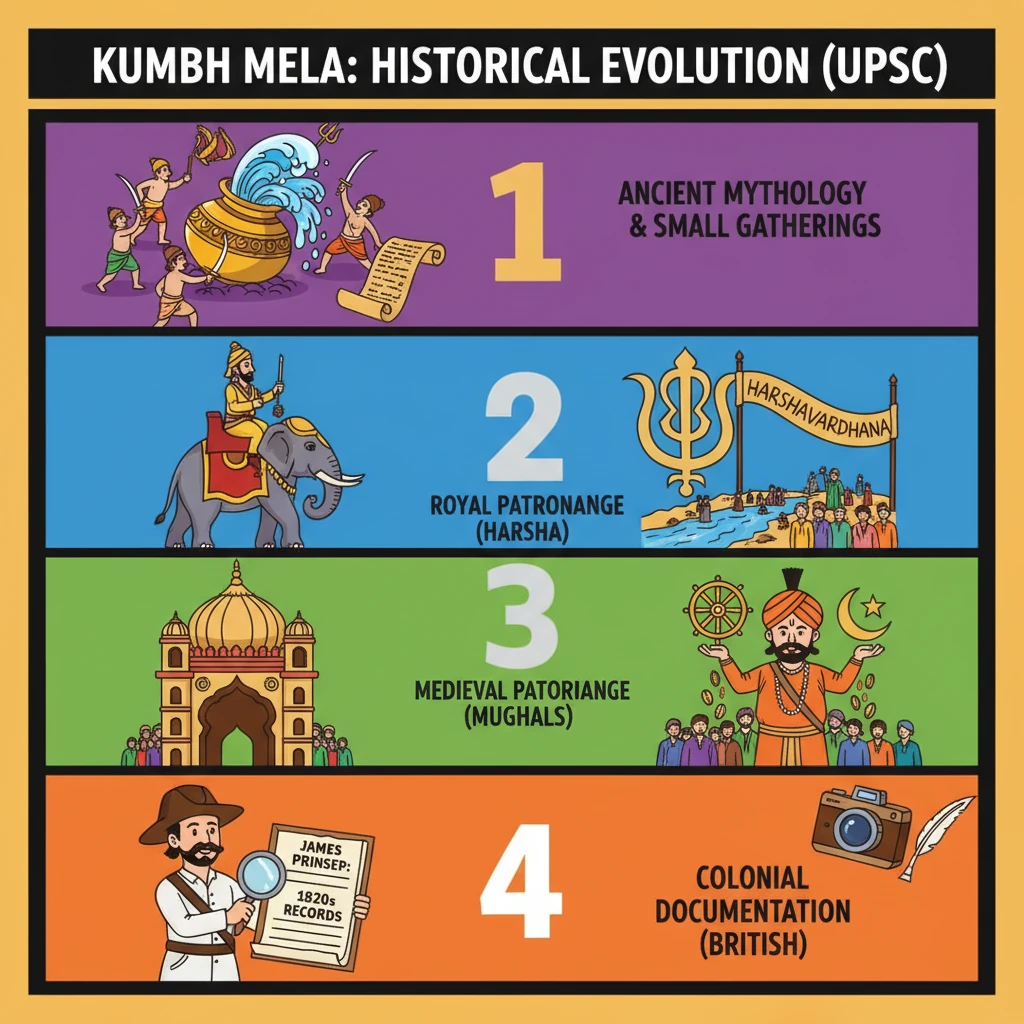
<h4>Mythological Origins and Foundation</h4><p>The <strong>Maha Kumbh Mela</strong> finds its origins in the <strong>Puranas</strong>, ancient Hindu scriptures. Its narrative was significantly transcribed and popularized by <strong>Adi Shankaracharya</strong>.</p><p>The myth describes a fierce battle between <strong>gods and demons</strong> over a sacred pitcher (<strong>Kumbh</strong>) containing <strong>Amrit</strong>, the elixir of immortality.</p><div class="info-box"><strong>Key Mythological Event:</strong> Lord Vishnu, in the guise of <strong>Mohini</strong>, successfully secured the <strong>Amrit</strong> from the demons, leading to its dispersal at four holy sites.</div><h4>Ancient Development and Early Gatherings</h4><p>Historically, the <strong>Kumbh Mela</strong> began as smaller congregations during the <strong>Maurya and Gupta periods</strong>, spanning from the <strong>4th century BCE to the 6th century CE</strong>.</p><p>These early gatherings involved pilgrims from across the <strong>Indian subcontinent</strong>, signifying their nascent importance.</p><div class="key-point-box">The significance of the Mela grew substantially with the rise of <strong>Hinduism</strong>, particularly under influential rulers like the <strong>Guptas</strong>, who elevated its status.</div><p>A pivotal figure in its organization was <strong>King Harshavardhana</strong> of the <strong>Pushyabhuti dynasty</strong>, who initiated the formal organization of the <strong>Kumbh fair at Prayagraj</strong>.</p><h4>Medieval Patronage and Royal Support</h4><p>During the medieval era, the <strong>Kumbh Mela</strong> received significant patronage from various powerful royal dynasties. This support helped sustain and expand the festival.</p><ul><li><strong>Chola Empire</strong></li><li><strong>Vijayanagar Empire</strong></li><li><strong>Delhi Sultanate</strong></li><li><strong>Mughal Empire</strong></li></ul><p>Notably, <strong>Mughal Emperor Akbar</strong>, known for his policy of religious tolerance, granted the <strong>Naga Sadhus</strong> the distinct honour of leading the royal entry to the Mela in <strong>1565</strong>.</p><h4>Colonial Observation and Documentation</h4><p>During the <strong>Colonial Period</strong>, British administrators were profoundly fascinated by the immense scale and diverse nature of the <strong>Kumbh Mela</strong>.</p><p>They undertook extensive observation and documentation of the festival, providing valuable external perspectives.</p><div class="info-box"><strong>Key Chronicler:</strong> In the <strong>19th century</strong>, <strong>James Prinsep</strong> meticulously chronicled the <strong>Kumbh Mela's ritualistic practices</strong> and its complex <strong>socio-religious dynamics</strong>.</div><h4>Post-Independence Significance and Global Recognition</h4><p>In the <strong>Post-Independence</strong> era, the <strong>Kumbh Mela</strong> has come to symbolize <strong>national unity</strong> and stands as a powerful testament to <strong>India’s rich cultural heritage</strong>.</p><div class="exam-tip-box">The Mela's ability to draw millions from diverse backgrounds highlights its role in fostering <strong>social cohesion</strong> and showcasing <strong>India's pluralistic traditions</strong> for <strong>UPSC GS Paper 1 (Indian Heritage and Culture)</strong>.</div><p>Its global significance was formally recognized by <strong>UNESCO in 2017</strong>, when it was inscribed on the list of <strong>Intangible Cultural Heritage of Humanity</strong>, acknowledging its enduring ancient traditions.</p>
💡 Key Takeaways
- •Kumbh Mela's origins are rooted in ancient Puranic mythology involving the battle for Amrit.
- •It evolved from smaller gatherings in ancient times, gaining prominence under rulers like Harshavardhana.
- •Medieval dynasties, including the Mughals, provided significant patronage, with Akbar demonstrating religious tolerance.
- •British administrators like James Prinsep extensively documented the Mela in the colonial era, providing historical records.
- •Post-independence, it symbolizes national unity and received UNESCO Intangible Cultural Heritage status in 2017.
- •The Mela is a unique blend of spiritual faith, social gathering, and cultural preservation, attracting millions.
- •Its timing is determined by specific astrological alignments at four sacred river confluence sites in India.
🧠 Memory Techniques
98% Verified Content
📚 Reference Sources
•UNESCO official website (Intangible Cultural Heritage)
•NCERT textbooks (Ancient and Medieval Indian History)
•General knowledge resources on Indian culture and history