What are the Key Facts About Amravati and Andhra Buddhism? - Art And Culture | UPSC Learning
Topics
0 topics • 0 completed
🔍
No topics match your search

What are the Key Facts About Amravati and Andhra Buddhism?
Medium⏱️ 8 min read
art and culture
📖 Introduction
<h4>Discovery and Naming of Amravati</h4><p>In the <strong>late 1700s</strong>, <strong>Raja Vessareddy Nayudu</strong> unknowingly discovered ancient <strong>limestone ruins</strong> in <strong>Andhra's Dhanyakataka village</strong>. These ruins were subsequently used by him and local inhabitants for construction purposes.</p><div class="info-box"><strong>Initial Discovery:</strong> Late 1700s by Raja Vessareddy Nayudu<br><strong>Original Name:</strong> Dhanyakataka village<br><strong>New Name:</strong> Amravati (due to use of ruins for construction)</div><p>The systematic destruction of these ancient structures continued until <strong>1816</strong>. It was then that <strong>Colin Mackenzie's intensive survey</strong> led to the rediscovery of the magnificent <strong>Amravati Stupa</strong>, despite causing some further damage during the process.</p><h4>Buddhism's Arrival and Spread in Andhra</h4><p><strong>Buddhism</strong>, which originated in the <strong>fifth century BCE</strong> in the ancient kingdom of <strong>Magadh</strong> (present-day Bihar), made its way to <strong>Andhra Pradesh</strong> primarily through established <strong>trade routes</strong>.</p><div class="info-box"><strong>Founder of Buddhism:</strong> Siddhartha Gautama (the Buddha)<br><strong>Origin:</strong> Magadh (5th century BCE)<br><strong>Spread to Andhra:</strong> Mainly via trade routes</div><p>The first significant evidence of Buddhism in Andhra Pradesh dates back to the <strong>3rd century BCE</strong>. <strong>Emperor Ashoka</strong> played a crucial role by setting up an inscription in the region, providing a major impetus to the religion's expansion.</p><p>Monks from Andhra were notable attendees at the <strong>first Buddhist council</strong>, which took place in <strong>483 BCE</strong> at <strong>Rajgir, Bihar</strong>. This indicates an early and strong presence of Buddhism in the region.</p><p>Buddhism flourished in Andhra Pradesh for nearly <strong>six centuries</strong>, until the <strong>3rd century CE</strong>. Even after this period, isolated sites such as <strong>Amaravati, Nagarjunakonda, Jaggayyapeta, Salihundam, and Sankaram</strong> continued to practice the religion until the <strong>14th century CE</strong>.</p><p>Historians observe that Buddhism's presence in Andhra coincided with the region's <strong>first urbanization process</strong>. This growth was significantly aided by <strong>oceanic trade</strong>, which facilitated the religion's widespread dissemination.</p><h4>Distinctive Nature of Andhra Buddhism</h4><div class="key-point-box">Andhra Buddhism exhibited unique characteristics compared to its Northern counterpart, particularly in patronage, political influence, and integration of local customs.</div><ul><li><strong>Merchant Patronage:</strong> In Andhra, the spread of Buddhism was largely driven by <strong>merchants, craftsmen, and wandering monks</strong>. This contrasts sharply with the prominent <strong>royal patronage</strong> (e.g., <strong>King Bimbisara</strong> or <strong>Ajatashatru</strong>) observed in North India.</li><li><strong>Influence on Political Rulers:</strong> The economic success of traders and their association with Buddhism influenced Andhra's political rulers. These rulers subsequently issued inscriptions supporting the <strong>Buddhist Sangha</strong>, suggesting a more <strong>bottom-up spread</strong> of Buddhism in the region.</li><li><strong>Integration of Local Practices:</strong> Buddhism in Andhra uniquely integrated various local religious practices into its doctrines. This included elements like <strong>megalithic burials</strong>, <strong>Goddess worship</strong>, and <strong>Naga (snake) worship</strong>, reflecting a significant adaptation to regional traditions.</li></ul><h4>Significance of Amravati in Buddhism</h4><p><strong>Amravati</strong> holds immense importance as the recognized <strong>birthplace of Mahayana Buddhism</strong>. This is one of the two major branches of Buddhism, emphasizing the path of the <strong>Bodhisattva</strong>.</p><div class="key-point-box"><strong>Amravati:</strong> Birthplace of Mahayana Buddhism</div><p>The renowned Buddhist philosopher, <strong>Acharya Nagarjuna</strong>, resided in Amravati. He developed the profound <strong>Madhyamika philosophy</strong>, which centers on the concepts of <strong>emptiness (Shunyata)</strong> and the <strong>middle way</strong>.</p><div class="info-box"><strong>Key Philosopher:</strong> Acharya Nagarjuna<br><strong>Developed:</strong> Madhyamika philosophy<br><strong>Core Concepts:</strong> Emptiness, Middle Way</div><p>From Amravati, <strong>Mahayana Buddhism</strong> successfully spread across a vast geographical area, including <strong>South Asia, China, Japan, Korea, and Southeast Asia</strong>.</p><h4>Factors Leading to the Decline of Buddhism in Andhra Pradesh</h4><h5>Rise of Shaivism</h5><p>A primary factor contributing to the decline of Buddhism in Andhra Pradesh was the ascendance of <strong>Shaivism</strong>. By the <strong>seventh century CE</strong>, Chinese travelers noted the decline of Buddhist stupas and the thriving presence of <strong>Shiva temples</strong>.</p><p>These Shiva temples received substantial patronage from <strong>aristocrats and royals</strong>. The growing influence of Shaivism offered a more structured and socially integrated religious framework, which appealed significantly to the local populace and rulers, thereby drawing support away from Buddhist institutions.</p><h5>Decline of Urbanisation</h5><p>During the <strong>third century BCE</strong>, the region experienced considerable <strong>urbanization and trade</strong>. This period of growth had strongly supported the spread of Buddhism, largely due to its emphasis on a <strong>casteless society</strong>, which resonated with urban merchant communities.</p><div class="exam-tip-box">When analyzing the decline of religions, always consider both internal (doctrinal shifts, monastic practices) and external factors (patronage, socio-economic changes, rise of rival faiths).</div>
💡 Key Takeaways
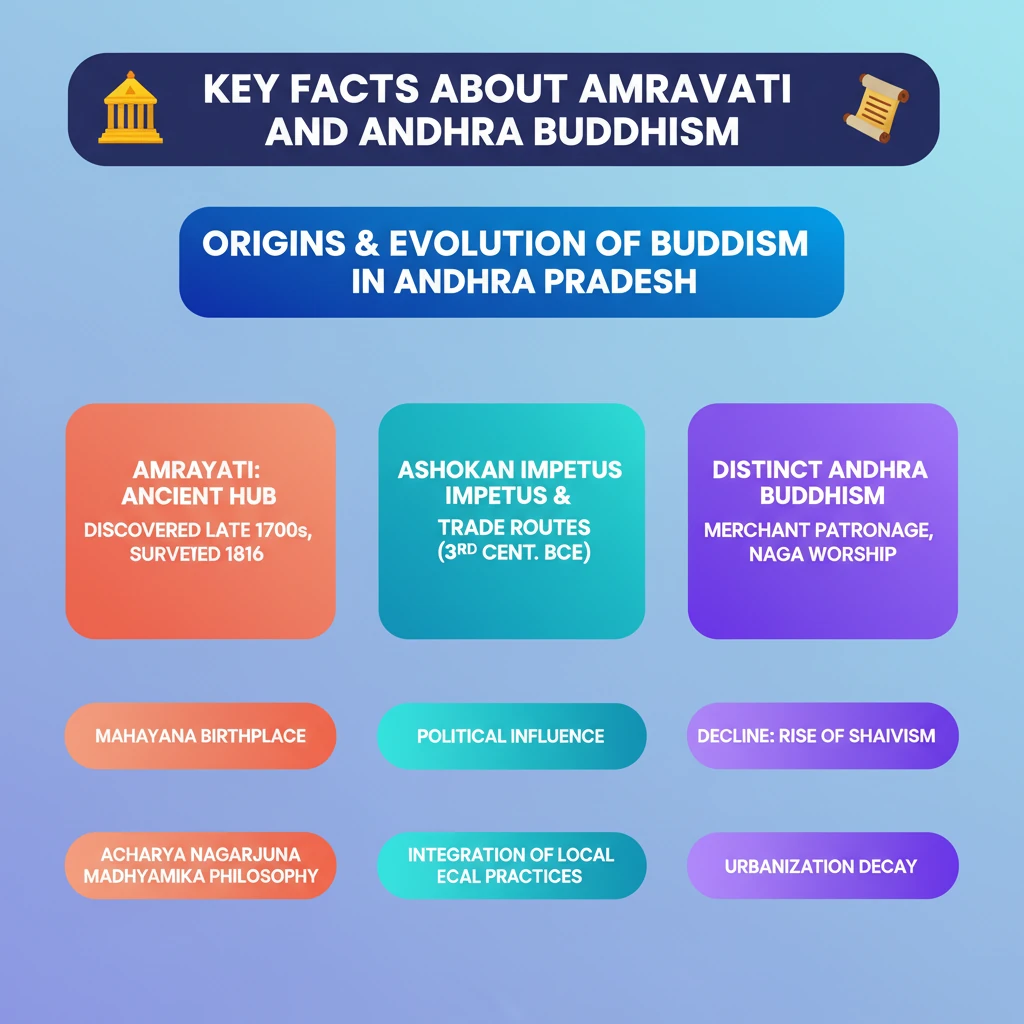
- •Amravati was an ancient Buddhist site in Andhra Pradesh, initially discovered in the late 1700s and systematically surveyed in 1816.
- •Buddhism spread to Andhra Pradesh via trade routes and received a major impetus from Emperor Ashoka in the 3rd century BCE.
- •Andhra Buddhism was distinct due to merchant patronage, influence on political rulers, and integration of local practices like Naga worship.
- •Amravati is considered the birthplace of Mahayana Buddhism and was home to Acharya Nagarjuna, who developed the Madhyamika philosophy.
- •Factors contributing to Buddhism's decline in Andhra included the rise of Shaivism and the decline of urbanization.
- •The new capital of Andhra Pradesh, Amaravati, is named after this historic Buddhist site, symbolizing cultural continuity.
🧠 Memory Techniques

98% Verified Content