Contract Farming in India’s Agriculture - Agriculture Allied Sector | UPSC Learning
Topics
0 topics • 0 completed
🔍
No topics match your search
Contract Farming in India’s Agriculture
Medium⏱️ 10 min read
agriculture allied sector
📖 Introduction
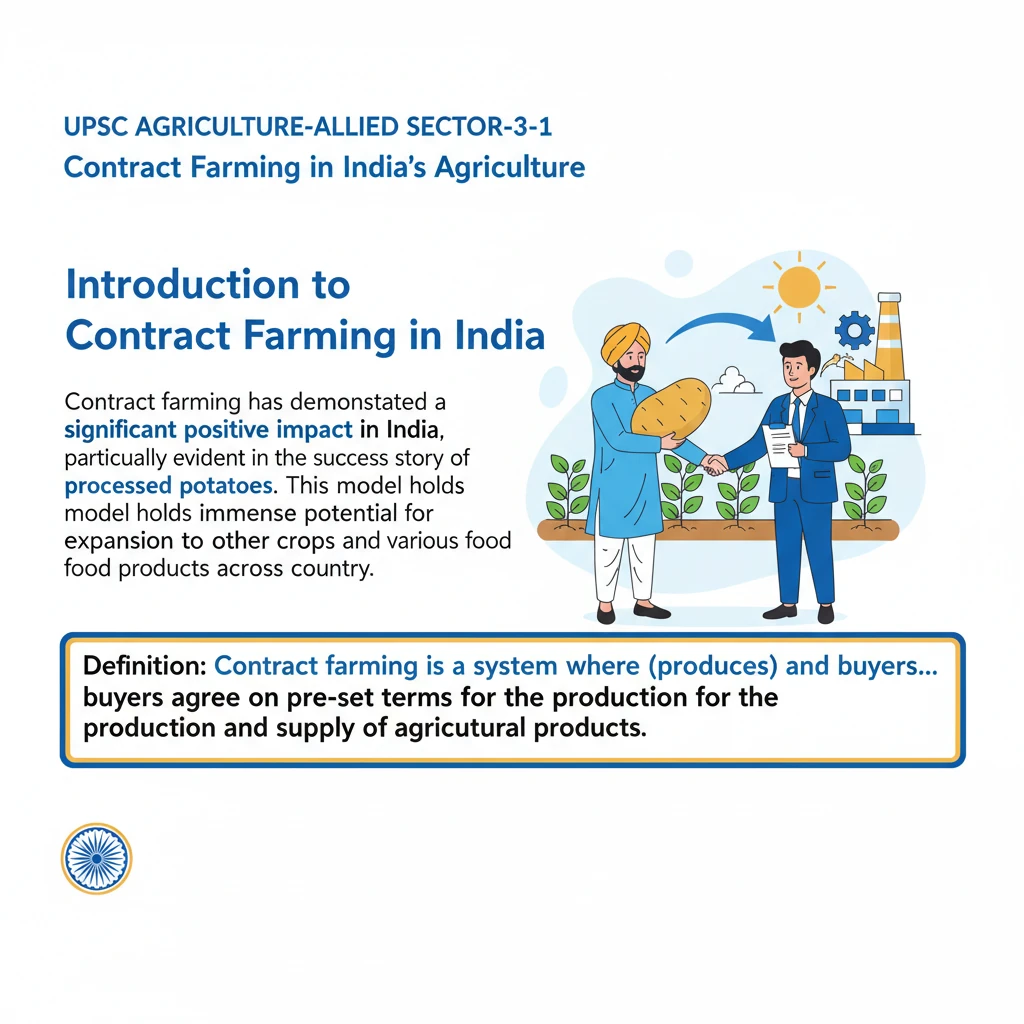
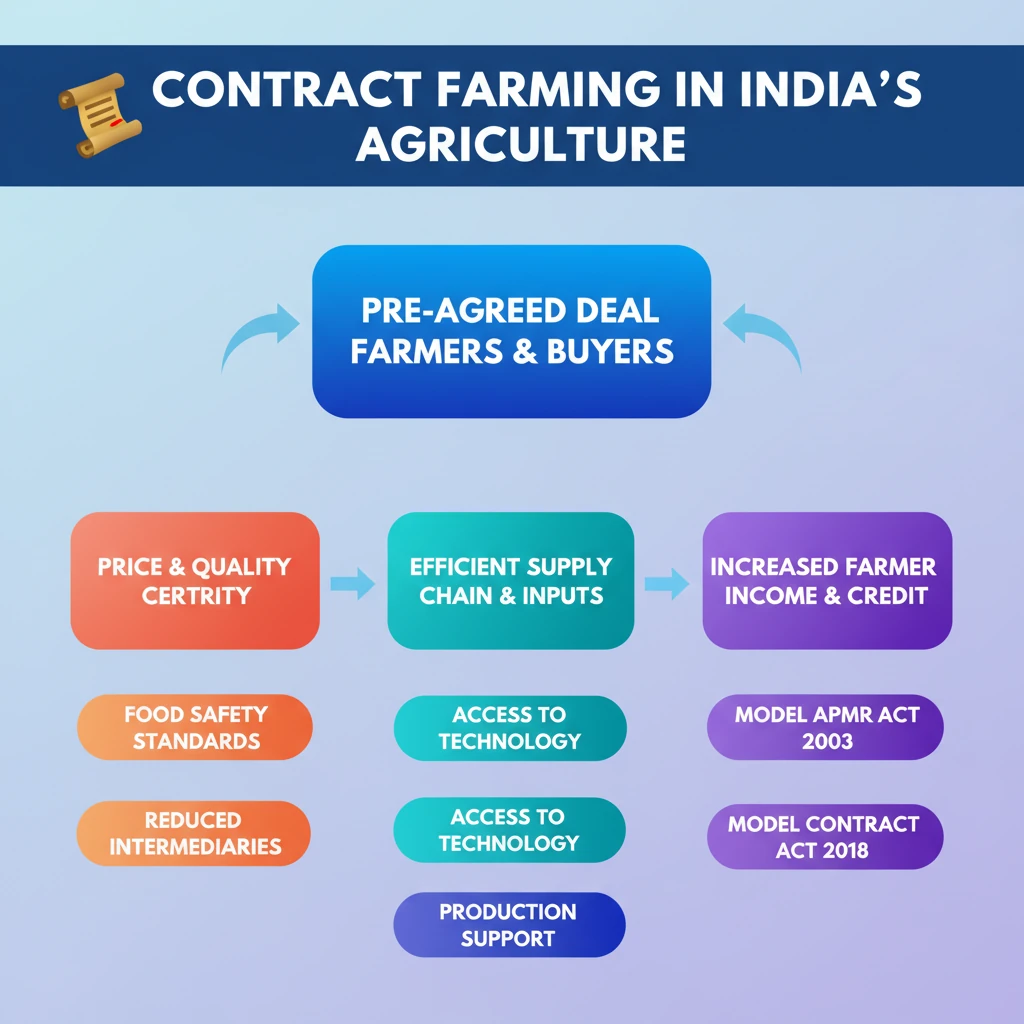
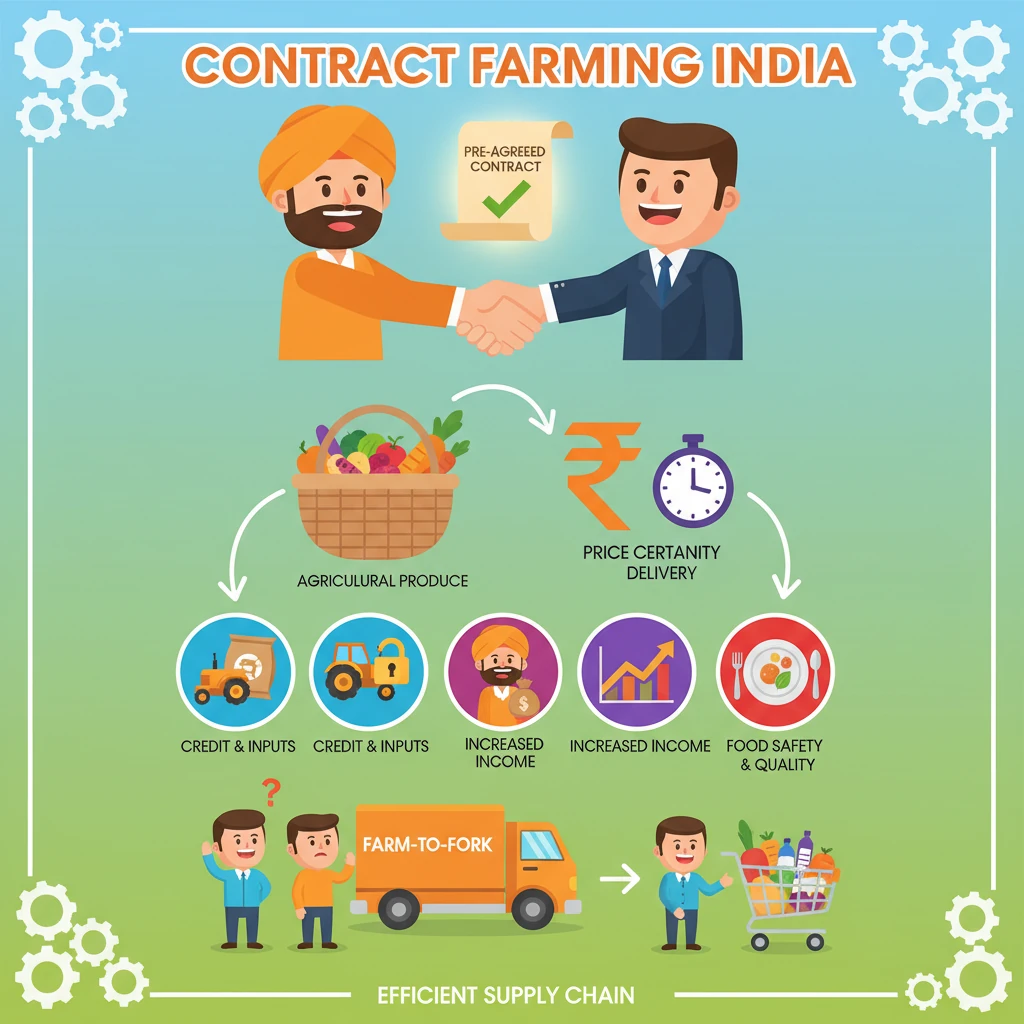
<h4>Introduction to Contract Farming in India</h4><p><strong>Contract farming</strong> has demonstrated a significant positive impact in India, particularly evident in the success story of <strong>processed potatoes</strong>. This model holds immense potential for expansion to other crops and various food products across the country.</p><div class="info-box"><strong>Definition:</strong> <strong>Contract farming</strong> is a system where <strong>farmers (producers)</strong> and <strong>buyers</strong> enter into a formal agreement regarding the production and marketing of specific farm products.</div><p>The core of this agreement specifies crucial terms such as the <strong>price</strong>, <strong>quantity</strong>, <strong>quality standards</strong>, and <strong>delivery date</strong> for the farmer’s produce. These terms are established <strong>before the production process begins</strong>, providing certainty to both parties.</p><h4>Advantages of Contract Farming</h4><p>Contract farming offers a multitude of benefits, streamlining agricultural processes and improving outcomes for both farmers and consumers.</p><ul><li><strong>Efficient Supply Chain Management:</strong> It significantly reduces the <strong>wastage of perishables</strong> by creating a direct link between production and processing/market. This ensures <strong>fair pricing</strong> for both producers and consumers by minimizing intermediaries.</li><li><strong>Access to Credit and Inputs:</strong> Farmers benefit from crucial support provided by contracting firms. This includes access to <strong>credit</strong>, essential <strong>inputs</strong> (like seeds, fertilizers), and valuable <strong>extension services</strong>. This support often leads to improved quality and higher production yields.</li><li><strong>Enhanced Operational Efficiency for Firms:</strong> For contracting firms, this model helps in reducing operational costs, boosting overall efficiency, and reliably meeting the demand for <strong>high-value, non-traditional crops</strong>.</li><li><strong>Increased Income for Farmers:</strong> Farmers engaged in contract farming often report <strong>higher incomes</strong> compared to non-contract farmers. This is due to improved yields, guaranteed prices, and the adoption of more efficient farming practices.</li></ul><div class="info-box">An <strong>RBI paper</strong> highlighted that farmers typically receive only <strong>31%–43%</strong> of the consumer price for fruits and vegetables. This share has the potential to significantly <strong>increase under contract farming</strong> by cutting out middlemen.</div><ul><li><strong>Meeting Food Safety Standards:</strong> Contracting firms frequently provide training to farmers on critical <strong>food safety practices</strong>. This includes guidance on using <strong>organic fertilizers</strong> and effective <strong>pesticide control</strong>, helping farmers meet stringent <strong>international standards</strong> like the <strong>Maximum Residue Level (MRL)</strong>.</li><li><strong>Better Price for Consumers:</strong> By effectively cutting out multiple intermediaries in the supply chain, contract farming can offer <strong>better prices for consumers</strong>. This ensures competitive rates for products without the added markups from middlemen.</li></ul><h4>Policy Framework for Contract Farming in India</h4><p>India has evolved its policy framework to support and regulate contract farming, aiming to protect farmer interests and promote organized agricultural production.</p><div class="key-point-box"><strong>Model APMR (Agricultural Produce Marketing Regulation) Act, 2003:</strong> This landmark act introduced specific provisions for contract farming.</div><ul><li>It mandated <strong>compulsory registration for contracting firms</strong>.</li><li>It established mechanisms for <strong>dispute resolution</strong>.</li><li>It provided for <strong>market fee exemptions</strong> for contracted produce.</li><li>Crucially, it <strong>protected farmers’ land ownership</strong>, ensuring that land cannot be transferred or alienated under contract.</li></ul><div class="key-point-box"><strong>Model Agriculture Produce and Livestock Contract Farming Act, 2018:</strong> This more recent act further refined and strengthened the framework.</div><ul><li>It proposed the establishment of <strong>state-level authorities</strong> for the effective implementation and monitoring of contract farming.</li><li>It emphasized the <strong>promotion of Farmer Producer Organizations (FPOs)</strong> to empower farmers collectively.</li><li>It included provisions for <strong>insurance for contracted produce</strong>, mitigating risks for farmers.</li></ul>
💡 Key Takeaways
- •Contract farming involves a pre-agreed arrangement between farmers and buyers for agricultural produce.
- •It ensures price certainty, quality standards, and delivery schedules before production begins.
- •Key advantages include efficient supply chains, access to credit and inputs for farmers, and increased farmer income.
- •It helps meet food safety standards and can lead to better prices for consumers by reducing intermediaries.
- •India has a policy framework, including the Model APMR Act, 2003, and the Model Contract Farming Act, 2018, to regulate and promote it.
- •The 2018 Act emphasizes FPOs, state-level authorities, and insurance for contracted produce.
- •Successful in processed potatoes, contract farming holds significant potential for other crops and allied sectors.
🧠 Memory Techniques
95% Verified Content
📚 Reference Sources
•Model Agriculture Produce and Livestock Contract Farming Act, 2018
•Model APMR (Agricultural Produce Marketing Regulation) Act, 2003
•Reserve Bank of India (RBI) papers on agricultural marketing